
Your print says “zinc plate.” Your plater has two process lines. The choice between alkaline and acid zinc plating affects deposit distribution, hydrogen embrittlement risk, appearance, adhesion performance, and critically whether your part will hold up in the application it was designed for. Here’s how to tell the difference and specify correctly.
Zinc electroplating is not a single process it’s a family of processes. Under the broad label of “zinc plate,” manufacturers operate two fundamentally different bath chemistries: alkaline zinc and acid zinc. Both deposit metallic zinc onto steel substrates to provide corrosion protection. Both can be passivated with trivalent chromate to meet RoHS and OEM specifications. But they behave differently in the tank, on the part, and in service and the choice between them matters more than most engineers and buyers realize.
At Plateco, we operate both alkaline and acid zinc plating lines and have been matching the right process to the right part since 1974. The goal of this guide is to give engineers, quality managers, and procurement professionals a clear, practical understanding of how these two chemistries differ, where each excels, and how to make the right call for your specific application.
How Each Process Works
To understand the performance differences between alkaline and acid zinc, it helps to understand the chemistry that drives each process. The zinc deposition mechanism is the same at a high level zinc ions in the bath are reduced at the steel cathode surface by electric current, building up a metallic zinc deposit but the bath chemistry surrounding that reaction differs significantly, and those differences cascade into real-world performance distinctions.
Alkaline Zinc: Controlled Deposition Chemistry
Alkaline zinc plating baths operate at a high pH typically pH 12 to 14 using sodium hydroxide (caustic soda) as the primary bath carrier. The most common commercial alkaline zinc systems today are non-cyanide alkaline zinc (also called zincate or non-CN alkaline), which use organic brighteners and grain refiners in place of the cyanide complexing agents that dominated older alkaline bath formulations.
In an alkaline bath, zinc ions are present as zincate complexes zinc bound to hydroxide in the alkaline solution. This complexed state moderates the zinc deposition reaction, producing a slower, more controlled deposit that is inherently more uniform across complex part geometries. The bath is chemically forgiving: it self-regulates to some extent, producing consistent deposits even with variations in current density across the part surface.
The cathodic efficiency of alkaline zinc is lower than acid zinc typically 65–80% meaning a larger fraction of the electrical energy drives hydrogen evolution rather than zinc deposition. This lower efficiency is part of what drives the slower, more controlled deposition behavior. It also means longer plating times for equivalent deposit thickness.
Acid Zinc: High-Efficiency, High-Brightness Chemistry
Acid zinc plating baths most commonly zinc chloride (chloride bath) systems operate at acidic pH, typically pH 4.5 to 5.5. Zinc ions are present as simple chloride or sulfate complexes that dissociate more readily than the alkaline zincate form, enabling faster, more efficient zinc deposition.
Acid zinc baths have significantly higher cathodic efficiency than alkaline systems typically 93–98% meaning nearly all of the electrical energy goes to zinc deposition rather than hydrogen evolution. This translates to faster plating speeds, brighter deposits with less additive input, and better deposit coverage in the high-current-density areas of the part (corners, edges, and raised features).
The trade-off is deposit distribution. In the high-efficiency acid bath, zinc deposits preferentially at high-current-density zones the areas of the part with geometric line-of-sight to the anodes. Recessed areas, blind holes, interior threads, and complex cavities receive less zinc deposit. This non-uniform distribution is the defining limitation of acid zinc for geometrically complex parts.
- pH 12–14, sodium hydroxide carrier
- Zincate complexes controlled deposition
- 65–80% cathodic efficiency
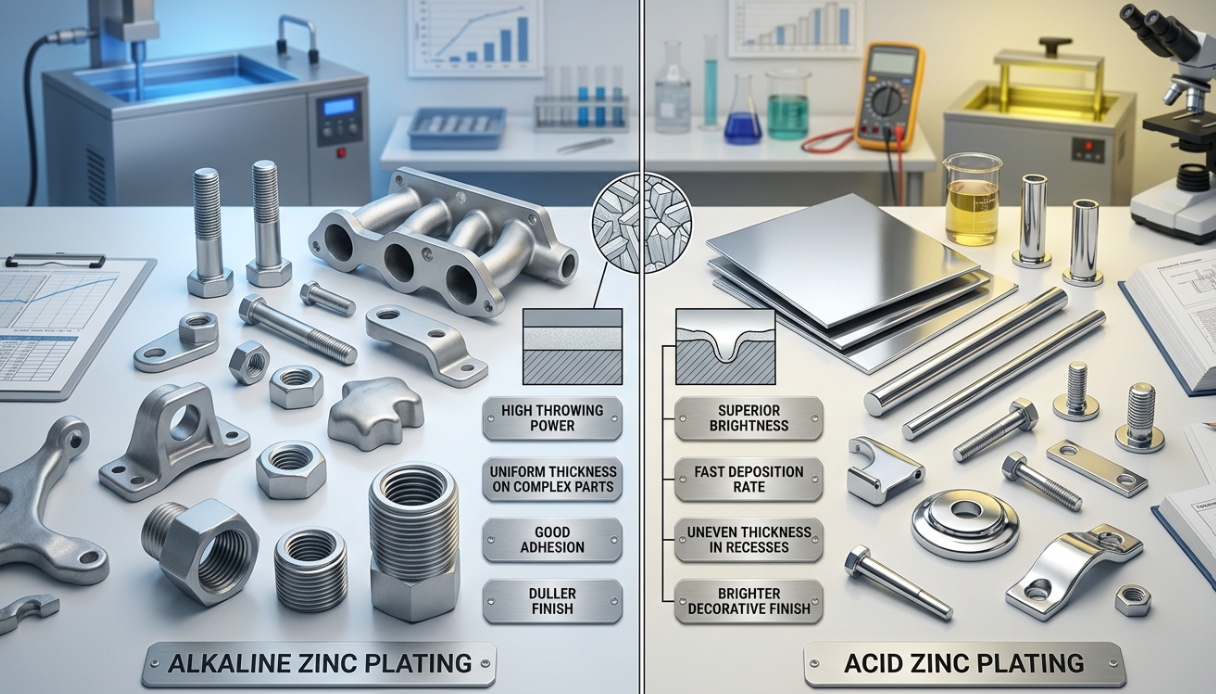
- Superior throwing power into recesses
- Lower hydrogen generation at cathode
- Longer plating times for given thickness
- Fine-grained, matte-to-semi-bright deposit
- pH 4.5–5.5, chloride carrier
- Simple zinc complexes fast deposition
- 93–98% cathodic efficiency
- Higher current-density bias uneven recesses
- More hydrogen generation at cathode
- Faster plating cycles for equivalent thickness
- Brilliant, highly reflective bright deposit
Throwing Power: The Most Important Performance Difference
If you take away only one concept from this guide, make it this: throwing power. Throwing power is a bath’s ability to deposit zinc uniformly across complex, non-uniform geometries including into recesses, blind holes, threads, cavities, and areas shielded from direct anode-to-cathode current paths.
Alkaline zinc baths have dramatically better throwing power than acid zinc baths. This is the single most significant performance difference between the two chemistries and the primary reason to choose alkaline zinc for complex parts.
Why Throwing Power Matters in Practice
Consider a hex head bolt. The flat surfaces shank, under-head bearing face, and hex flats are all in direct line of sight to the anodes in the plating rack or barrel. These areas receive strong current density and will build up zinc deposit readily in both alkaline and acid baths.
Now consider the thread roots. The valleys between thread crests are partially shielded from the anode. Current density in the thread roots is lower than on the exposed shank. And consider a blind threaded hole on a bracket the bottom of the hole receives almost no direct current.
In an acid zinc bath, these low-current-density areas receive proportionally much less zinc. The deposit ratio between the highest-current-density area and the thread root can be 5:1 or higher. The thread root may have only 3–4µm of zinc while the exposed shank has 15–20µm. The part may appear to meet specification on the measurable surfaces and still have essentially unprotected steel in the threaded areas most likely to experience corrosion and stress concentration.
In an alkaline zinc bath, the self-regulating character of the bath chemistry moderates current distribution, pushing more zinc into the lower-current-density areas. A well-controlled alkaline bath can achieve deposit ratios of 1.5:1 or better between high- and low-current-density zones meaning the thread roots get substantially more zinc relative to the exposed shank. This is the 3–4× throwing power advantage referenced in our header statistics.
Alkaline Advantage: Complex GeometryFor threaded fasteners, parts with deep recesses, blind holes, complex stampings, assemblies plated in-process, and any geometry where uniform zinc coverage across all surfaces is required, alkaline zinc is the technically correct choice. The throwing power advantage is not incremental it is the difference between adequate protection on all surfaces and inadequate protection in recesses.
Acid Advantage: Simple GeometryFor flat stampings, wire forms, simple brackets, sheet metal parts, and components without significant recesses or blind holes, acid zinc’s geometry limitation becomes irrelevant, and its advantages higher deposit efficiency, brighter finish, faster cycle time can be fully leveraged without compromise.
Hydrogen Embrittlement Risk: A Critical Distinction
As detailed in our hydrogen embrittlement guide, the zinc electroplating process introduces atomic hydrogen into high-strength steel substrates, potentially causing delayed brittle fracture under sustained load. The choice of bath chemistry has a direct, quantifiable effect on how much hydrogen is introduced during deposition.
Alkaline zinc baths because of their lower cathodic efficiency (65–80%) do generate more hydrogen at the bath level compared to the fraction of current going to zinc deposition. However, the nature of hydrogen evolution in alkaline baths differs from acid baths in ways that actually result in less hydrogen being absorbed into the steel substrate. In alkaline systems, hydrogen typically evolves as molecular hydrogen (H₂) that bubbles off the surface, rather than atomic hydrogen that diffuses into the steel lattice at the elevated rates seen in acid systems.
Acid zinc baths despite their higher cathode efficiency and less hydrogen evolution per unit of current operate in an acidic environment that actively promotes atomic hydrogen absorption into the steel during deposition. The acidic pH creates conditions where nascent atomic hydrogen at the steel surface is more readily absorbed into the lattice before it can combine into molecular hydrogen and escape.
The practical result: alkaline zinc plating introduces significantly less hydrogen into high-strength steel substrates than acid zinc plating. For parts above HRC 36 (approximately 150 ksi tensile strength), this difference is engineering-significant and directly affects the hydrogen embrittlement relief requirements and the residual risk after bake relief.
Hydrogen Embrittlement Risk Comparison by Bath Chemistry
| Factor | Alkaline Zinc | Acid Zinc (Chloride) |
|---|---|---|
| Bath pH | 12–14 (alkaline) | 4.5–5.5 (acidic) |
| H absorption into steel | Lower | Higher |
| Bake relief requirement (HRC 36–40) | Recommended | Required |
| Preferred for HRC 40+ parts | Yes — lower baseline risk | Acceptable with strict bake control |
| Acid pickling pre-treatment impact | Same for both acid pre-treatment H absorption must be controlled independently | |
Deposit Appearance and Surface Quality
The aesthetic difference between alkaline and acid zinc is immediately visible: acid zinc produces a dramatically brighter, more reflective deposit that closely resembles chrome plating in its as-plated condition. Alkaline zinc produces a more matte to semi-bright finish that, while clean and uniform, lacks the mirror-like brilliance of acid zinc.
Acid Zinc: The Bright Finish Standard
Acid zinc (chloride) deposits are fine-grained and highly leveling the bath chemistry actively fills microscopic surface irregularities, producing a smooth, mirror-bright appearance that has made acid zinc the dominant choice for consumer hardware, automotive visible components, and any application where the zinc finish is the visible surface of the final product. The brightness of acid zinc is largely intrinsic to the bath chemistry, requiring less additive input to achieve than equivalent brightness in alkaline systems.
After passivation, acid zinc parts have a particularly crisp appearance: clear passivate produces a clean blue-silver finish, and yellow passivate creates a vivid iridescent gold. This visual quality is difficult to replicate with alkaline zinc at the same deposit thickness.
Alkaline Zinc: Functional Finish with Consistent Coverage
Alkaline zinc deposits have a tighter, more columnar grain structure than acid zinc. The deposit is less intrinsically bright but very uniform in morphology. Passivated alkaline zinc has a clean, functional appearance that meets most industrial and OEM specifications. The matte character of alkaline zinc, once passivated and topcoat-sealed, is largely indistinguishable from acid zinc in production applications where the part is not a visible consumer surface.
For applications where appearance is strictly secondary to performance structural fasteners, hidden hardware, industrial components the appearance difference between alkaline and acid zinc after passivation is commercially irrelevant. For applications where the bright metallic appearance of the zinc is part of the product’s visual identity (retail hardware, consumer products, visible automotive trim fasteners), acid zinc is the correct choice.
Barrel vs. Rack: How Loading Method Interacts with Bath Chemistry
Zinc plating is performed in two primary loading configurations: barrel plating (parts tumbling in a rotating perforated drum immersed in the bath) and rack plating (individual parts fixtured on frames and immersed with controlled part-to-anode geometry). Both alkaline and acid zinc can be run in barrel or rack configuration, but the interactions between loading method and bath chemistry create important considerations.
Barrel Plating and Alkaline Zinc
Barrel plating is used for high volumes of small parts fasteners, clips, stampings, small brackets where individual racking would be prohibitively slow and expensive. In barrel plating, parts constantly tumble and re-orient relative to the anodes, averaging out current density somewhat. However, because the barrel itself shields the parts from the plating field, current density within a barrel is inherently uneven, and throwing power is critical to achieving adequate zinc distribution across all part surfaces.
Alkaline zinc’s superior throwing power is especially valuable in barrel applications. The self-regulating bath chemistry compensates for the complex, constantly changing part orientations in the tumbling barrel, producing more uniform coverage on complex geometry than acid zinc would in the same configuration. For threaded fasteners in barrel plating which describes the majority of commercial fastener zinc plating alkaline zinc is technically preferred.
Rack Plating and Acid Zinc
Rack plating provides controlled, consistent part-to-anode geometry for each part. For flat stampings, sheet metal parts, large brackets, and simple-geometry components, the uniform anode arrangement in rack plating minimizes the throwing power disadvantage of acid zinc. When the part geometry is simple and all significant surfaces have approximately equal anode exposure, acid zinc can deliver excellent results with its higher brightness and efficiency advantages fully expressed.
Practical GuidanceThe combination that appears most often in demanding commercial zinc plating: alkaline zinc barrel plating for threaded fasteners and complex small parts; acid zinc rack plating for flat and simply-shaped stampings and sheet metal components. When in doubt about which process your plater should use, share the part geometry and application with them a qualified plater will recognize the correct process from the part description.
Paint and Coating Adhesion Over Zinc
Many zinc-plated parts don’t remain bare zinc: they go on to receive paint, powder coat, e-coat, adhesive bonding, or other subsequent processing. The choice of zinc bath chemistry affects the adhesion of these subsequent coatings.
Alkaline zinc deposits tend to have slightly better adhesion to subsequent organic coatings. The grain structure of alkaline zinc provides a more receptive surface for primer and powder coat adhesion compared to the smoother, more closed-grain surface of highly brightened acid zinc. For parts that will be painted or powder-coated, alkaline zinc with clear passivate is often the preferred pre-treatment, particularly when long-term coating adhesion is critical (automotive underbody parts, agricultural structural components).
Acid zinc’s highly leveled, bright surface can reduce mechanical adhesion for some coating systems the very smoothness that makes acid zinc look better can work against paint adhesion. However, modern automotive primer and powder coat formulations have been specifically developed to bond over both alkaline and acid zinc with trivalent passivate, and adhesion differences are often manageable with correct surface preparation and primer selection. Confirm compatibility with your coating supplier before specifying for adhesion-critical applications.
Full Comparison: Alkaline vs. Acid Zinc Plating
Alkaline vs. Acid Zinc Comprehensive Process and Performance Comparison
| Property | Alkaline Zinc | Acid Zinc | Winner |
|---|---|---|---|
| Bath pH | 12–14 | 4.5–5.5 | Context |
| Cathodic Efficiency | 65–80% | 93–98% | Acid |
| Throwing Power | Excellent | Fair–Poor (recesses) | Alkaline |
| Deposit Brightness | Matte to semi-bright | Highly bright | Acid |
| Hydrogen Embrittlement Risk | Lower | Higher | Alkaline |
| Complex Part Geometry | Excellent | Poor–Fair | Alkaline |
| Plating Speed | Slower | Faster | Acid |
| Barrel Plating Performance | Excellent | Good (simple geometry) | Alkaline |
| Paint / Powder Coat Adhesion | Very good | Good | Alkaline |
| Corrosion Resistance (passivated) | Equivalent | Equivalent | Equal |
| RoHS / REACH Compliance | Yes (trivalent passivate) | Yes (trivalent passivate) | Equal |
| High-Strength Steel Suitability | Preferred | Acceptable with bake relief | Alkaline |
| Relative Cost | Slightly higher | Slightly lower | Acid |
Which Process Is Right for Your Parts?
The decision between alkaline and acid zinc is ultimately an engineering question that depends on part geometry, substrate hardness, appearance requirements, subsequent processing, and volume economics. Here is a systematic decision guide based on the most common application scenarios.
Process Selection Guide Application vs. Recommended Chemistry
| Application Scenario |
Alkaline |
Acid |
| Threaded fasteners (bolts, nuts, studs) of any grade |
✅ |
⚠ |
|
High-strength fasteners (Grade 8 / 10.9 / 12.9, HRC 36+) |
✅ |
❌ |
| Flat stampings and sheet metal brackets (simple geometry) |
✅ |
✅ |
| Consumer hardware where bright appearance is required |
⚠ |
✅ |
| Parts with blind holes, deep recesses, or complex cavities |
✅ |
❌ |
|
Parts to be painted or powder coated |
✅ |
⚠ |
| Barrel plating of mixed small parts (clips, pins, washers) |
✅ |
⚠ |
|
High-volume rack plating of uniform flat parts |
✅ |
✅ |
| Springs, lock washers, and high-carbon spring steel |
✅ |
❌ |
| Wire forms and wire goods |
✅ |
✅ |
The Corrosion Resistance Equivalence Point
One important clarification that surprises many specifiers: when properly plated and passivated, alkaline zinc and acid zinc provide equivalent corrosion protection. The zinc deposit quality, corrosion resistance per unit thickness, and passivate compatibility are not meaningfully different between the two chemistries for most applications. The differences are in deposit distribution (coverage across the whole part) and hydrogen introduction not in the intrinsic corrosion resistance of the zinc deposit itself.
This means that a measurement of zinc thickness on the accessible surface of an acid-zinc-plated threaded fastener may show full specification compliance and that part may still have inadequate zinc coverage in the thread roots where corrosion will actually initiate in service. The surface measurement doesn’t tell the whole story for complex geometry. This is why throwing power matters, and why alkaline zinc is specified for complex parts even when corrosion resistance equivalence might suggest either process would work.
“We treat zinc plating as an extremely complex process demanding state-of-the-art technology, painstaking planning, obsessive quality control, and a tremendous amount of talent. Because our customers don’t come to us for excuses they come to us for perfection. And we’ll do whatever it takes to give them nothing less.” Jim Schweich, Chief Executive Perfectionist, Plateco, Inc.
Writing a Complete Specification: What to Tell Your Plater
The most effective zinc plating specifications tell the plater what performance is required, provide the information needed to select the correct process, and leave the process selection to the qualified plater. Micromanaging bath chemistry in a drawing callout is often counterproductive your plater knows their own lines better than a drawing note can convey. But giving your plater the right information about your part enables them to make the correct process call.
The information your plater needs to select between alkaline and acid zinc:
- Part geometry description or print: Is there threaded engagement? Blind holes? Significant recesses? Or is it primarily flat and open?
- Steel grade and hardness or tensile strength class: Is the part low-carbon mild steel, or is it heat-treated to HRC 36+? This drives both bath selection and bake relief requirements.
- Subsequent processing: Will the part be painted, powder-coated, or adhesively bonded? If so, which primer or adhesive system?
- Appearance requirements: Is the zinc finish the visible surface of the final product? Is maximum brightness required?
- Applicable specification: ASTM B633 service condition and passivate type; OEM or customer-specific specification if applicable.
Complete Specification Example Industrial FastenerZinc electroplate per ASTM B633, SC3 (12µm minimum significant surfaces), trivalent yellow passivate (Type II). Part: SAE Grade 8 hex bolt, SAE 1035 steel quenched and tempered, hardness HRC 33–39. Alkaline zinc bath chemistry preferred for uniform thread-root coverage. Hydrogen embrittlement relief bake required: 375°F ± 25°F, 8 hours minimum, within 4 hours of plating. Trivalent chromate only, RoHS compliant per Directive 2011/65/EU. Full process documentation with shipment.
Complete Specification Example Sheet Metal BracketZinc electroplate per ASTM B633, SC2 (8µm minimum significant surfaces), trivalent clear passivate (Type III). Part: 16-gauge CR steel stamping, no recesses, will receive powder coat. Acid zinc acceptable — simple geometry, no complex recesses. No bake relief required (substrate below HRC 36). Trivalent chromate only, RoHS compliant. Parts must be free of white rust at time of painting.
Frequently Asked Questions
No. ASTM B633 specifies service conditions (minimum deposit thickness), passivate types, and performance requirements it does not prescribe alkaline vs. acid bath chemistry. The selection of bath chemistry is a process decision made by the plater based on part geometry, substrate, and customer requirements. Some OEM-specific specifications (John Deere JDM, certain automotive Tier 1 standards) do specify bath chemistry or require alkaline zinc for specific part categories always check the applicable specification document.
Not Sure Which Process Your Part Needs?
Send us your print or describe your part and application our team will evaluate the geometry, substrate, and spec requirements and confirm the correct process before your first run. Alkaline or acid, barrel or rack, we run both lines and get it right.