

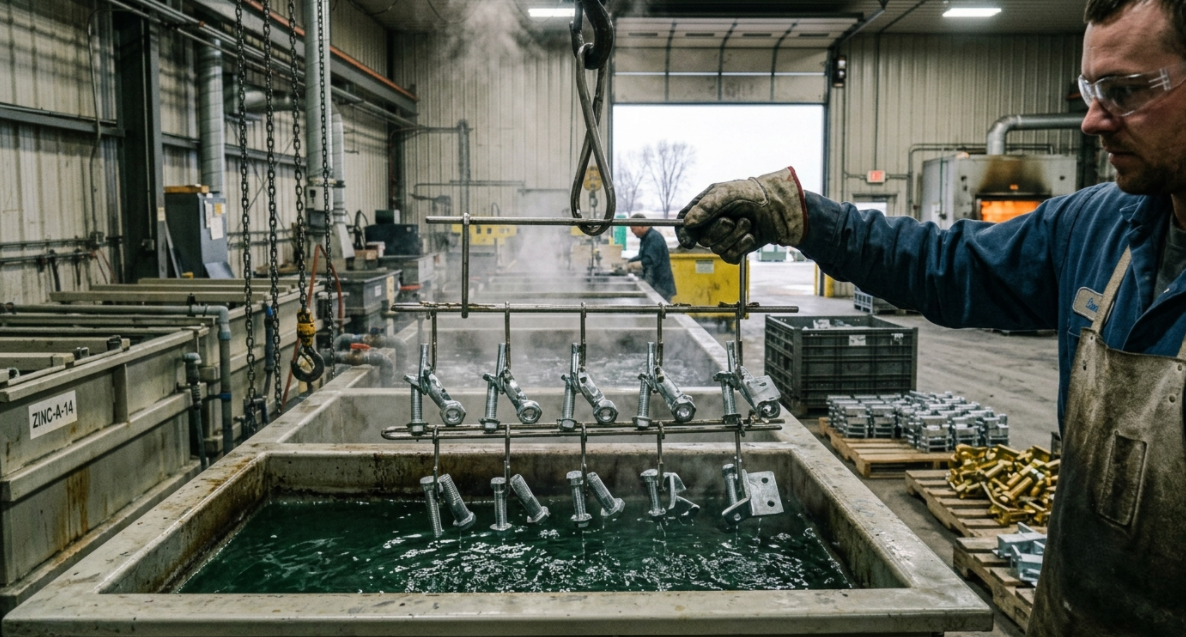
A structural engineer writes “hot-dip galvanized or equivalent” on a connection detail and moves on to the next sheet. Six weeks later a fabricator is trying to figure out whether zinc electroplating actually qualifies as “equivalent,” whether the building inspector will accept it and whether the anchor bolts embedded in concrete need a different spec than the exposed tie plates fifteen feet away. Construction hardware carries some of the least forgiving corrosion requirements in metal finishing, because the failure mode isn’t a warranty claim, it’s a structural liability. This guide breaks down exactly what Wisconsin construction projects require from zinc plated hardware, how it differs from galvanizing and how to specify it so it passes inspection the first time.
Construction hardware occupies a strange middle ground in the corrosion protection world. It isn’t a decorative fastener that fails cosmetically, and it isn’t a sealed component sitting inside a climate-controlled enclosure. It’s structural or semi-structural steel anchor bolts, tie plates, joist hangers, embedment plates, framing connectors and structural fasteners that are expected to hold a building together for decades often while sitting exposed to Wisconsin’s freeze-thaw cycles, road salt spray and direct weather.
At Plateco, we’ve been zinc plating hardware for Wisconsin fabricators, steel erectors and hardware manufacturers since 1974. We regularly see the same pattern on incoming purchase orders and drawings a corrosion protection callout that’s vague enough to leave the actual coating decision in the hands of whoever processes the order last. For most products, that ambiguity causes an inconvenience. For construction hardware, it can mean a coating that doesn’t meet building code, doesn’t satisfy the engineer of record or doesn’t hold up long enough to protect the connection it was installed to protect.
This guide is built specifically for that gap. It covers which zinc coating options actually apply to construction hardware how Wisconsin’s climate and code environment shape the right choice how zinc plating compares to hot-dip galvanizing for structural applications and exactly how to write a specification that a fabricator an inspector and a plater can all read the same way.
SC3–SC4
Typical ASTM B633 service condition range for outdoor construction hardware
1974
Year Plateco began zinc plating for Wisconsin fabricators and steel erectors
50+
Approximate freeze-thaw cycles a Wisconsin structure experiences per year
Why Construction Hardware Has Different Stakes Than Most Plated Parts
Most zinc plated components fail gracefully. A rusted machine screw gets replaced during routine maintenance. A corroded bracket on a piece of equipment gets flagged during an inspection and swapped out before it causes a bigger problem. Construction hardware doesn’t get that same margin for error.
Anchor bolts embedded in concrete, tie plates connecting structural members and joist hangers carrying load are often installed once and expected to perform for the life of the structure, frequently 30, 50 or more years, without routine inspection or replacement. Many of these components become inaccessible once construction is complete, buried in concrete, hidden behind finished walls or positioned in locations where inspection requires significant disassembly. A coating failure on an accessible bracket is an annoyance. A coating failure on an embedded anchor bolt is a structural integrity question that can require invasive investigation to even diagnose.
This is why building codes, structural engineers and hardware manufacturers treat corrosion protection specifications for construction hardware with a level of rigor that other industries don’t always apply. It’s also why the margin for a vague or under-specified purchase order is so much smaller here than it is for a general industrial fastener.
The Most Common Mistake on Construction Hardware Orders
Specifying “zinc plate” or “galvanized” without indicating the governing standard, service condition or whether the component is intended for exposed, embedded or interior use. This leaves the actual corrosion protection level up to whoever fills the order and creates real risk that a building inspector or engineer of record rejects the finished hardware or worse, that it’s installed and fails prematurely in the field.
Zinc Electroplating vs. Hot-Dip Galvanizing Which Applies to Your Hardware
The single most common point of confusion on construction hardware specifications is the difference between zinc electroplating and hot-dip galvanizing. Both put zinc on steel. They are not interchangeable processes they don’t produce the same coating thickness and building codes and structural specifications frequently call for one specifically rather than the other. Getting this distinction right at the specification stage prevents a rejected shipment later.
Zinc Electroplating
Zinc electroplating deposits a thin uniform layer of zinc onto steel using an electric current in a plating bath. Coating thicknesses typically range from 5 to 25 micrometers under ASTM B633 which governs electrodeposited zinc coatings. Electroplating produces a smooth dimensionally precise finish which makes it the right choice for hardware with threaded features tight tolerances or components that need to maintain a specific fit after coating like structural bolts machine screws used in connector assemblies or hardware that mates with other precision components.
Hot-Dip Galvanizing
Hot-dip galvanizing immerses steel in a bath of molten zinc producing a significantly thicker coating, typically in the range of 45 to 100+ micrometers under ASTM A123 or A153 depending on the component. This thickness advantage makes hot-dip galvanizing the standard choice for heavy structural steel, large embedment plates and components with a very long expected service life where dimensional precision is less critical than raw coating mass. Many structural building codes and engineering specifications default to hot-dip galvanizing for primary structural steel specifically because of this thickness advantage.
Why the Distinction Matters on a Drawing
If an engineer’s detail calls for ASTM A153 hot-dip galvanizing on a heavy anchor bolt and it’s plated instead under ASTM B633 the coating thickness will be a fraction of what the spec requires and an inspector checking the hardware against the call-out has grounds to reject it, regardless of how well the plating was executed. The reverse problem happens too hot-dip galvanizing applied to a precision-threaded fastener can build up enough coating to bind the thread or push the part out of its dimensional tolerance which is exactly why smaller, threaded or dimensionally sensitive hardware is far more commonly zinc plated than hot-dip galvanized.
✓ Quick Reference: Which Process Applies
Zinc electroplating (ASTM B633) is typically specified for structural bolts and nuts, threaded rod, smaller anchor bolts, connector plates with punched or drilled tolerances and any hardware where thread fit or dimensional precision matters. Hot-dip galvanizing (ASTM A123/A153) is typically specified for heavy structural steel members, large embedment plates, guardrail and fencing hardware and components where maximum coating mass and long-term unmaintained exposure outweigh dimensional precision.
ASTM B633 Service Conditions for Construction Hardware
For construction hardware that is zinc electroplated rather than hot-dip galvanized ASTM B633 governs the required thickness organized into four service condition (SC) categories based on the severity of the exposure environment. Nearly all exterior construction hardware falls into SC3 or SC4 interior protected hardware can often be specified at SC1 or SC2.
ASTM B633 Thickness Requirements for Construction Applications
| Service Condition | Min. Thickness (µm) | Exposure Environment | Typical Construction Hardware Application |
|---|---|---|---|
| SC 1 — Mild | 5 µm | Dry indoor no condensation | Interior framing hardware protected mechanical room brackets |
| SC 2 — Moderate | 8 µm | Indoor with occasional condensation | Covered but unheated storage structures interior utility hardware |
| SC 3 — Severe | 12 µm | Outdoor exposure, weather, temperature cycling | General exterior tie plates exposed connectors fencing hardware |
| SC 4 — Very Severe | 25 µm | Harsh outdoor exposure road salt permanent weather exposure | Anchor bolts near roadways bridge-adjacent hardware coastal or heavy-salt-exposure structures |
📋 A Note on “Significant Surfaces”
ASTM B633 thickness requirements apply to a part’s significant surfaces the areas critical to function or protection and reachable by a test probe or XRF gauge. On construction hardware with complex geometry such as punched connector plates or multi-hole brackets confirm with your plater which surfaces the specified thickness applies to and whether any recessed or interior features require a separate discussion.
How Wisconsin’s Climate Shapes the Right Specification
Wisconsin construction hardware faces a corrosion environment that’s more demanding than a generic “outdoor exposure” categorization suggests and the specification should reflect that rather than defaulting to a minimum standard.
Freeze-Thaw Cycling
Wisconsin structures typically experience dozens of freeze-thaw cycles each winter. Each cycle drives moisture into microscopic surface imperfections and joints and the repeated expansion and contraction accelerates the breakdown of any coating that isn’t fully continuous or that has any porosity. Hardware exposed to this cycling for years without interruption needs a coating thickness with real margin above the code minimum not the bare minimum for the exposure category.
Road Salt Exposure
Deicing salt used on Wisconsin roads, sidewalks and parking structures is one of the fastest accelerants of zinc consumption in any coating system. Hardware near roadways, parking structures, loading docks or any area subject to salt application, including salt spray carried by wind or vehicle traffic, should be treated as SC4 regardless of how the exposure might otherwise be categorized. This is a common point where under-specification happens a bracket that seems only “moderately” exposed can face heavy salt loading simply because of its proximity to a plowed or salted surface.
Seasonal Humidity and Condensation
Wisconsin’s humid summers and cold, damp shoulder seasons create extended condensation exposure for semi-protected hardware, such as components under an overhang or within a ventilated but unheated structure. This exposure is often underestimated because the hardware isn’t in direct rain or snow contact but sustained condensation cycling can be nearly as corrosive as direct weather exposure over time.
Embedded vs. Exposed Hardware
Hardware embedded in concrete such as anchor bolts cast into a footing exists in a different chemical environment than hardware left exposed to open air. Concrete’s alkaline environment is somewhat protective of zinc under normal conditions but the transition zone where an anchor bolt exits the concrete and becomes exposed to open air is a known point of accelerated corrosion since it experiences both moisture wicking from the concrete and direct weather exposure. This transition zone deserves the higher end of the applicable service condition range even if the rest of the embedded portion could technically tolerate less.
A Wisconsin-Specific Risk Point
The concrete-to-air transition zone on embedded anchor bolts is one of the most common places we see premature corrosion on construction hardware in Wisconsin. If your project has embedded anchors with an exposed portion above grade, specify the full exposed-environment service condition for the entire bolt not just a reduced thickness based on the embedded majority of its length.
Zinc Plating Requirements by Construction Hardware Type
Different categories of construction hardware carry different practical requirements shaped by both their function and their typical exposure. Here’s how that breaks down for common Wisconsin project components.
Anchor Bolts
Typical spec: SC3 to SC4 (12–25µm) for electroplated ASTM A153 for hot-dip galvanized heavy anchors
Anchor bolts connecting structural steel to concrete foundations face the transition-zone risk described above, plus direct exposure at grade level where moisture, salt and debris collect. Smaller, precision-threaded anchor bolts are typically zinc electroplated to preserve thread fit larger structural anchors are frequently hot-dip galvanized per ASTM A153 for maximum coating mass.
Tie Plates and Structural Connectors
Typical spec: SC3 (12µm), SC4 (25µm) for exposed exterior locations
Tie plates, joist hangers and framing connectors used in exterior or semi-exterior applications need reliable protection against direct weather exposure. Interior connectors in fully enclosed conditioned structures can often be specified at SC2 but any connector with exterior exposure including those under a roof overhang but open to weather should be treated as SC3 at minimum.
Fencing and Guardrail Hardware
Typical spec: SC4 (25µm) electroplated or hot-dip galvanized for larger components
Fencing and guardrail hardware sits in some of the harshest exposure on a typical Wisconsin project particularly along roadways where salt spray is constant during winter months. This category is one of the clearest cases for maximum practical coating thickness often paired with a trivalent yellow passivate for additional protection.
Framing Hardware and Fasteners
Typical spec: SC2 to SC3 (8–12µm) depending on final building envelope location
Framing screws, structural fasteners and connector bolts used within a completed building envelope generally face a more moderate exposure once construction is finished but during the construction phase itself before the envelope is sealed they may be exposed to weather for weeks or months. Specifying at least SC3 accounts for this construction-phase exposure window even if the long-term service environment is more protected.
Embedment Plates
Typical spec: Hot-dip galvanizing per ASTM A123 or SC4 zinc electroplate for smaller plates
Larger embedment plates cast into concrete for later structural connections are frequently hot-dip galvanized due to their size and the long often permanent service life expected of them. Smaller embedment hardware may be zinc electroplated at SC4 if dimensional tolerances for a later connection require it.
A Note on Building Code and Engineer of Record Requirements
Wisconsin follows the Wisconsin Uniform Dwelling Code for residential construction and the Wisconsin Commercial Building Code which incorporates International Building Code provisions for commercial and larger projects. These codes frequently reference ASTM standards directly for structural hardware corrosion protection and an engineer of record’s stamped drawings will typically specify the governing standard explicitly. When a drawing calls out a specific ASTM standard and service condition that specification supersedes any general “zinc plate” assumption a fabricator might otherwise apply and deviating from it even with a coating that seems equivalent, risks inspection rejection and change-order delays.
If your project’s specification is ambiguous or references an outdated standard the fastest path forward is confirming the requirement directly with the engineer of record before hardware is fabricated and coated, rather than making an assumption that has to be corrected after the fact.
Passivate and Topcoat Considerations for Exterior Construction Hardware
For zinc electroplated construction hardware, the passivate or chromate conversion coating applied over the zinc plays a significant role in extending service life, particularly for the SC3 and SC4 applications common in Wisconsin exterior construction.
Trivalent yellow passivate is the standard choice for most exterior construction hardware. It’s RoHS compliant, provides meaningfully better corrosion resistance than a clear passivate and is widely accepted across construction hardware specifications. For hardware facing the most severe exposure such as fencing and guardrail components near roadways a trivalent yellow passivate combined with a topcoat sealer provides a substantial extension of service life before white or red corrosion products appear which is often the deciding factor between a coating system that lasts a decade and one that shows visible corrosion within a single harsh winter.
Black passivate systems are sometimes specified for construction hardware where a darker finish is architecturally preferred such as visible exterior connectors on a project with a specific aesthetic requirement though these typically provide somewhat less corrosion resistance than a comparable yellow system at the same zinc thickness.
How to Write a Construction Hardware Zinc Plating Specification That Holds Up
A specification that clearly communicates the requirement protects the fabricator the plater and the project timeline. Based on the patterns above a complete specification for construction hardware should include the governing standard the service condition or coating class the passivate type where applicable and any project-specific notes about exposure or dimensional requirements.
📋 Specification Example — Exterior Tie Plate
Zinc electroplate per ASTM B633, SC4, Type II (trivalent yellow passivate). Minimum thickness 25µm on significant surfaces. Coating applies to full exposed exterior surface including bolt-hole edges. Trivalent chromate per RoHS Directive 2011/65/EU.
📋 Specification Example — Embedded Anchor Bolt with Exposed Portion
Hot-dip galvanize per ASTM A153, Class C. Full-length galvanizing required including embedded portion no field-applied coating substitution accepted for the exposed transition zone. Verify thread fit after galvanizing per specified nut class.
The two elements most often missing from construction hardware specifications are an explicit service condition or ASTM class and a clear statement of which process electroplating or hot-dip galvanizing is required rather than leaving that choice to the fabricator or plater. Given how different the two processes and their resulting coating thicknesses are this is not a detail to leave implicit.
Why Wisconsin Fabricators Choose a Local Plating Partner for Construction Work
Construction project timelines run on tight sequencing and hardware delays cascade quickly into schedule slippage on a job site. Sourcing zinc plating from a Wisconsin-based partner rather than an out-of-state or overseas supplier gives fabricators meaningfully shorter transit times, faster turnaround on rush orders when a project schedule shifts, and the ability to have a direct conversation with a plater’s quality team if a shipment needs clarification before it leaves the facility.
A local partner also brings direct familiarity with Wisconsin’s climate demands and the specification patterns common to the state’s structural engineering community, agricultural construction and municipal infrastructure work. That familiarity shows up in practical ways knowing that a bracket near a parking structure needs SC4 even if the drawing doesn’t specify it explicitly or flagging a transition-zone risk on an anchor bolt detail before it becomes a field problem.
“We treat zinc plating as an extremely complex process demanding state-of-the-art technology painstaking planning obsessive quality control and a tremendous amount of talent. Because our customers don’t come to us for excuses they come to us for perfection. And we’ll do whatever it takes to give them nothing less.”
— Jim Schweich, Chief Executive Perfectionist, Plateco, Inc.
Frequently Asked Questions
Can zinc electroplating be used instead of hot-dip galvanizing on structural steel if the drawing calls for galvanizing?
Generally, no, not without written approval from the engineer of record. Hot-dip galvanizing per ASTM A123 or A153 produces a significantly thicker coating than zinc electroplating under ASTM B633 and structural specifications that call for galvanizing typically do so because the coating mass not just corrosion resistance in general is required for the expected service life of the component. Substituting a thinner electroplated coating without explicit approval risks inspection rejection and creates real liability exposure if the substitution isn’t documented.
Does zinc plated hardware meet Wisconsin building code requirements for exterior structural connections?
It depends entirely on which standard and service condition the code or the engineer of record’s stamped drawings actually require for that specific component. Wisconsin’s commercial and residential codes reference ASTM standards for corrosion protection and zinc electroplating per ASTM B633 at an appropriate service condition satisfies many exterior hardware requirements particularly for smaller threaded or dimensionally sensitive components. Larger structural steel and long-service embedment components more often require hot-dip galvanizing specifically. Confirming the governing standard on your project’s drawings is the only reliable way to know which applies.
What service condition should I specify for hardware I’m not sure will be indoors or outdoors long-term?
When there’s genuine uncertainty about long-term exposure specify for the more demanding environment rather than assuming the more protected one. The cost difference between SC2 and SC3 or SC3 and SC4 is a modest percentage of total hardware cost, while the cost of a premature corrosion failure on structural or safety-related hardware including inspection, remediation and potential liability is dramatically higher.
How does salt spray testing relate to construction hardware specifications?
Salt spray testing typically run per ASTM B117 measures how long a coating system resists corrosion under accelerated laboratory conditions and is often referenced as a supplementary requirement alongside an ASTM B633 service condition particularly for hardware in high-salt-exposure locations like roadway-adjacent fencing or parking structure connectors. If your project specification includes a minimum salt spray hour requirement confirm with your plater that the specified zinc thickness and passivate system are actually capable of meeting it since the two requirements need to be consistent with each other.
Who is responsible for confirming the correct coating specification when a drawing is ambiguous, the fabricator or the plater?
Practically, this responsibility is shared but the fabricator holds the contractual relationship with the project and should confirm ambiguous requirements with the engineer of record before hardware fabrication begins. A quality plating partner will flag ambiguous or incomplete specifications rather than defaulting to a minimum standard, but the final confirmation of project-specific code and engineering requirements needs to trace back to the party responsible for the design.
Does Plateco handle both zinc electroplating and coordination for hot-dip galvanizing needs on the same project?
Plateco specializes in zinc electroplating including barrel and rack processes for construction hardware requiring ASTM B633 compliance, precision thread fit or dimensional control after coating. For projects with mixed requirements some components electroplated and others requiring hot-dip galvanizing we can advise on which process fits which component based on your drawings and help you route each correctly even when that means directing a specific component elsewhere for the right process.
Ready to Get Your Hardware Specification Right?
Tell Us About Your Project
Plateco has been zinc plating construction hardware for Wisconsin fabricators, steel erectors, and manufacturers since 1974, with the process controls and documentation to back an engineer of record’s specification and satisfy building inspection requirements. Send us your drawings and we’ll confirm exactly what your hardware needs before it goes on the line.