

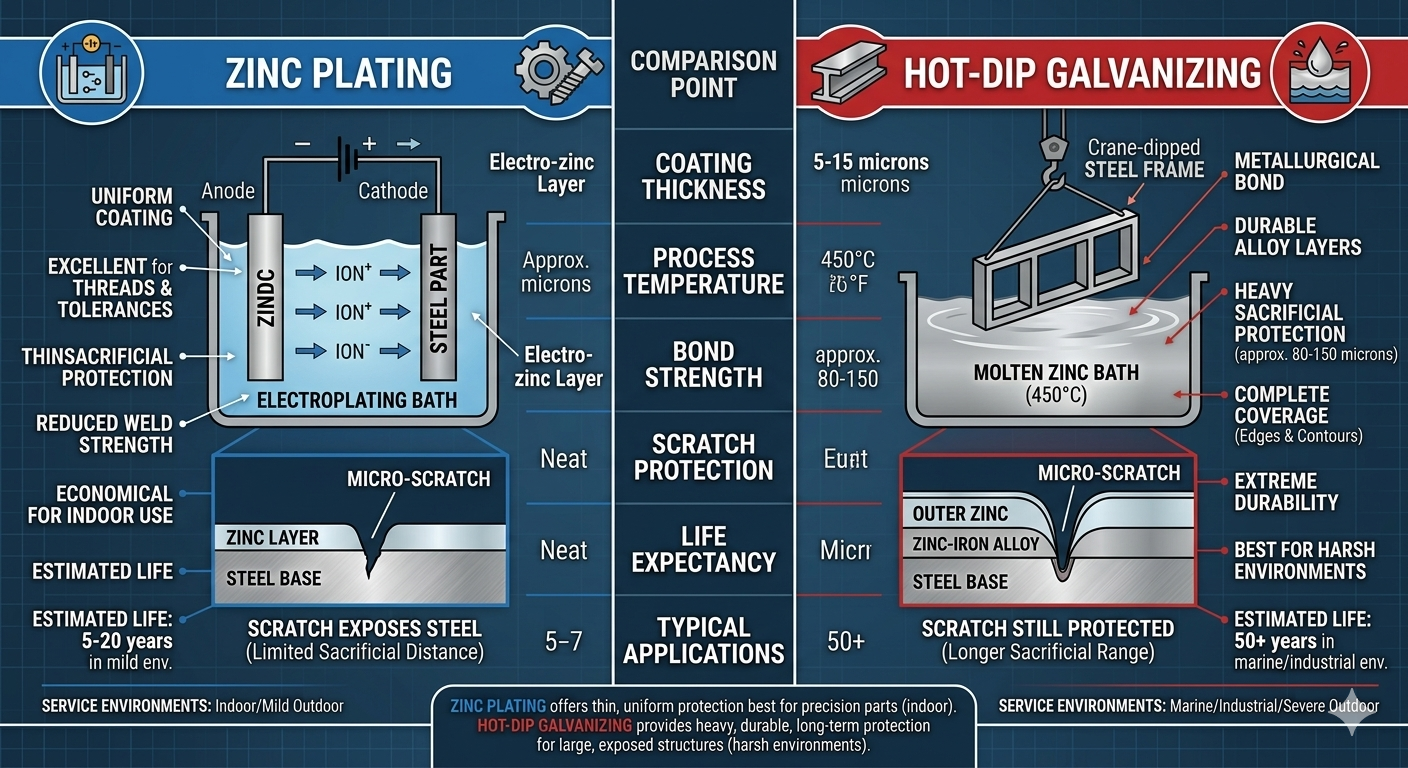
Both processes deposit zinc on steel. Both deliver sacrificial corrosion protection. But they serve fundamentally different applications — and choosing the wrong one for your parts means either over-engineering your cost structure or under-delivering on service life. This guide gives you the full technical and commercial comparison you need to specify correctly.
Process A
Same protective metal, radically different processes, deposit thicknesses, and application profiles. The right choice depends entirely on your part geometry, strength requirements, and operating environment.
The short answer: Hot-dip galvanizing deposits far more zinc and lasts longer in the most aggressive outdoor environments — but it is unsuitable for precision parts, threaded fasteners, thin-gauge components, and high-strength steels. Zinc electroplating delivers superior dimensional control, hydrogen embrittlement management, and passivate performance for the vast majority of manufactured components. The question is never which process is “better” in the abstract — it is which process is correct for your specific application.
If you are a procurement engineer, quality manager, or materials engineer evaluating coating options for steel components, the zinc plating versus hot-dip galvanizing question appears straightforward on its surface and turns complicated the moment you engage with the details. Both processes use zinc. Both rely on zinc’s electrochemical nobility below steel to deliver sacrificial cathodic protection. Both are mature, well-understood industrial processes with decades of field performance data behind them.
But they are not interchangeable. The two processes differ in deposit thickness by an order of magnitude, in process temperature by hundreds of degrees, in dimensional impact by a factor that determines whether threaded parts remain functional, and in their interaction with substrate material hardness in ways that have caused structural failures when the distinction was ignored. Understanding those differences — in technical depth, not just surface-level summary — is what makes a correct specification decision possible.
This guide is a resource: it assumes you already know you need zinc-based corrosion protection, and you are evaluating which process fits your specific parts, environment, and cost model. It will walk through every major comparison dimension, score each process honestly, and give you a decision framework you can apply directly to your specification work.
How Each Process Works: The Foundational Difference
Before comparing outcomes, understanding the process mechanics is essential — because the differences in corrosion performance, dimensional impact, and application suitability all trace directly back to how each process deposits zinc.
Zinc Electroplating: Controlled Electrochemical Deposition
Zinc electroplating — whether barrel or rack — is an electrochemical process. Parts are immersed in an aqueous zinc electrolyte bath. Direct electrical current drives zinc ions from the bath onto the steel surface, building up a deposit atom by atom. The process occurs at near-ambient temperature — typically 70–85°F for alkaline non-cyanide systems. Deposit thickness is controlled by current density, bath chemistry, and immersion time, and can be held to tight tolerances: ±0.0001 inch is achievable in a well-controlled rack plating operation. After plating, a passivation conversion coating — trivalent chromate — is applied to dramatically enhance the zinc deposit’s corrosion resistance.
The governing standard is ASTM B633 for electrodeposited zinc. Deposit thicknesses range from 5 µm (SC 1 mild service) to 25 µm (SC 4 very severe service). With modern trivalent yellow passivate and sealer, electroplated zinc at SC 4 achieves 500 or more hours of neutral salt spray resistance.
Hot-Dip Galvanizing: Thermal Immersion Bonding
Hot-dip galvanizing (HDG) is a thermal metallurgical process. Steel parts are immersed in a bath of molten zinc at approximately 840°F (450°C). At that temperature, zinc reacts metallurgically with the steel surface, forming a series of intermetallic zinc-iron alloy layers beneath an outer layer of pure zinc. The resulting deposit is bonded to the steel at the atomic level — not merely adherent to it. Deposit thickness for HDG ranges from approximately 45 µm (1.8 mil) on thin sheet to 150 µm or more on heavy structural sections, governed by ASTM A123 (structural steel) and ASTM A153 (hardware and fasteners).
The process operates at fixed temperature — there is no equivalent of current density control. Part geometry influences thickness distribution, and recesses, threads, and blind holes can develop uneven or clogged zinc deposits. No passivate is applied; the zinc-iron alloy layers themselves provide the initial barrier protection before the outer zinc develops its natural zinc carbonate patina in service.
Key Process InsightThe 840°F process temperature of hot-dip galvanizing is not an incidental detail — it is the source of the process’s most important limitations. That temperature can relieve residual stresses in steel, alter heat-treated microstructures in high-strength steels, and cause dimensional distortion in thin-gauge or precision components. These are not edge-case concerns. They are the primary reasons why HDG and zinc electroplating serve different application spaces, despite both depositing zinc.
The Full Comparison: Eight Critical Dimensions
The following eight-round comparison evaluates zinc electroplating and hot-dip galvanizing across every dimension that matters to a specification decision. Each round includes technical depth, real-world implications, and a winner designation — with honest acknowledgment where either process leads in that dimension.
Round 01 Corrosion Protection Performance & Service Life Edge: HDG (Thick Parts)
Raw corrosion protection performance is a function of how much zinc is available to sacrifice in protecting the steel — and hot-dip galvanizing wins on sheer zinc mass in most structural applications. A standard HDG deposit on a structural section delivers 85 µm or more of zinc. A standard zinc electroplate at SC 4 delivers 25 µm. More zinc means longer sacrificial life before the steel is exposed.
The practical translation: HDG on a structural steel beam in a highway bridge environment can deliver 50–75 years of maintenance-free service. Zinc electroplate on the same steel in the same environment would require either a much thicker deposit specification or periodic recoating. For outdoor structural applications — guardrails, utility poles, transmission towers, marine dock hardware — HDG’s mass advantage is real and consequential.
However, the comparison inverts when passivate chemistry enters the equation. Modern zinc electroplate with trivalent yellow passivate and organic sealer achieves 500+ hours of neutral salt spray resistance — often matching or exceeding standard HDG performance in accelerated corrosion testing, despite the 10:1 thickness difference. The passivate is doing substantial protective work on top of the zinc’s sacrificial mechanism. For manufactured parts in controlled industrial environments, the effective corrosion performance gap is much narrower than the raw thickness numbers suggest.
Zinc Electroplating
- 5–25 µm deposit thickness
- 500+ hrs salt spray (SC 4 + passivate)
- Strong in indoor/sheltered industrial use
- Passivate adds significant performance
Hot-Dip Galvanizing
- 45–200+ µm deposit thickness
- 50–75 year life on structural steel
- Dominant for outdoor structural use
- No passivate — zinc patina develops naturally
Round 02 Dimensional Precision & Tolerance Control Clear Winner: Zinc Electroplating
This is where zinc electroplating’s dominance over HDG is absolute and unambiguous. Zinc electroplating adds 5–25 µm to part dimensions — a controlled, predictable, and often tolerance-specified amount. Precision rack plating can hold deposit thickness to ±0.0001 inch. For threaded fasteners, precision instrument components, mating surfaces, press-fit interfaces, and any part where post-coat dimensional compliance matters, electroplating is the only viable zinc process.
Hot-dip galvanizing adds 45–200+ µm in uncontrolled distribution — more on edges and outside corners, less in recesses and threads. On a standard M10 bolt, a 100 µm HDG deposit adds more than 0.008 inches to the shank diameter per side. A bolt that was M10 before galvanizing will not fit an M10 nut after galvanizing — the nut must be overtapped to accommodate the deposit, which reduces thread engagement and alters the torque-tension relationship. This is not a solvable problem in HDG; it is an inherent consequence of the deposit thickness and distribution. ASTM A153 acknowledges this by providing that HDG nuts be tapped oversize after coating.
For any manufactured component with dimensional tolerances that matter to assembly fit, function, or safety — which describes the majority of industrial components — hot-dip galvanizing is not a viable option regardless of its corrosion performance advantages.
Round 03 Hydrogen Embrittlement Risk for High-Strength Steels Advantage: HDG (Structural) / Mech. Galv. (Fasteners)
Hydrogen embrittlement is one of the most consequential differences between these processes for high-strength steel applications. Zinc electroplating is an electrochemical process that generates hydrogen at the cathode surface as a byproduct. A fraction of that hydrogen diffuses into the steel substrate. In low-strength steels this is benign — the hydrogen diffuses back out over time. In high-strength steels with core hardness above Rockwell C34, absorbed hydrogen can cause delayed fracture under sustained tensile stress. Parts may appear sound at delivery and fail catastrophically weeks after installation.
Hot-dip galvanizing does not introduce hydrogen into the steel substrate — it is a thermal process, not an electrochemical one. This is a genuine advantage for high-strength steel structural components. However, the 840°F process temperature introduces its own risk: it can alter the tempered microstructure of heat-treated high-strength steels, effectively reducing their strength and ductility. ASTM A153 specifically restricts HDG of fasteners with tensile strength above 150 ksi (approximately Grade 8 / ASTM A354 BD) precisely because the process temperature can compromise material properties.
For the highest-strength fastener applications — Grade 8+, B7 studs, structural bolts above 150 ksi — neither standard electroplating nor hot-dip galvanizing is the correct specification. Zinc mechanical galvanizing per ASTM B695 is: a room-temperature process that introduces no hydrogen and causes no thermal microstructure alteration, making it the engineering-correct choice for precision high-strength fasteners requiring zinc coating.
Round 04 Part Size, Geometry & Process Compatibility Depends on Application
Hot-dip galvanizing scales efficiently to very large structural components — I-beams, wide-flange sections, fabricated trusses, pipe, structural tubing — that would be impractical to electroplate. The molten zinc bath can accommodate virtually any part that can be physically immersed, and the metallurgical bonding ensures coverage in crevices and on complex geometries without the current distribution challenges of electroplating. For large structural steel fabrications, HDG has no real competitor.
Zinc electroplating, conversely, handles small to medium components with complexity and precision that HDG cannot match. Barrel plating processes thousands of small parts per hour — fasteners, stampings, clips, pins — with uniform deposit at a cost per part that makes it the only economically viable process for high-volume small hardware. Rack plating addresses larger precision components with controlled thickness distribution and no part-on-part contact. Neither barrel nor rack electroplating is practical for structural beams or large fabrications.
Thin-gauge components — sheet metal stampings, clips, springs — cannot be hot-dip galvanized without risk of thermal distortion or zinc run-off that leaves inadequate coverage. Electroplating handles thin gauge without difficulty.
Round 05 Cost & Lead Time Advantage: Zinc Electroplating (Manufactured Parts)
For high-volume manufactured hardware — fasteners, stampings, machined components — zinc barrel electroplating is the lowest-cost zinc coating process available. Barrel plating processes thousands of parts per hour in continuous operation with low labor content per part. At scale, per-part zinc plating cost for standard hardware is measured in fractions of a cent. That cost efficiency is a core reason zinc electroplating dominates the hardware and manufactured parts supply chain.
Hot-dip galvanizing has a different cost structure that works in its favor for large structural components. The process is highly efficient for large weldments and structural sections — a structural beam costs roughly the same to galvanize regardless of its surface area distribution — but the per-part economics for small components are unfavorable. Setup, jigging, and handling costs dominate for small parts. For fabricated structural steel, HDG’s cost structure is highly competitive and often less expensive than painting systems that require ongoing maintenance.
Lead time also favors electroplating for manufactured components. A well-run electroplating operation turns most hardware lots in 24–72 hours. Hot-dip galvanizing facilities, particularly for custom fabrications, may require 5–15 business days depending on shop load and part size. For just-in-time manufacturing supply chains, this difference is material.
Round 06 Appearance, Finish Quality & Aesthetic Control Clear Winner: Zinc Electroplating
Zinc electroplating produces a smooth, uniform, controllable surface finish. Passivate chemistry determines the final appearance — clear/silver, yellow/iridescent, or matte black — and that appearance is consistent part to part and lot to lot. For consumer-visible components, branded hardware, instrument assemblies, or any application where aesthetic consistency is part of the specification, electroplating delivers what is required.
Hot-dip galvanizing produces a characteristically rough, spangled, variable surface. The zinc-iron alloy layers create a texture that varies with steel chemistry, section thickness, and cooling rate. Drips, runs, and uneven surface texture are normal process characteristics, not defects. For structural steel this is irrelevant — nobody cares what a guardrail looks like at the microstructure level. For manufactured components in visible assemblies, these characteristics are specification non-starters.
Round 07 Regulatory Compliance & Environmental Profile Both Fully Compliant
Both zinc electroplating (with trivalent passivate) and hot-dip galvanizing are fully compliant with RoHS, REACH, and ELV regulations. Zinc is a non-toxic, environmentally benign metal — it is an essential micronutrient in biological systems, not a hazardous substance. The industry’s transition from hexavalent to trivalent chromate passivation systems has resolved the one area where zinc electroplating had a historical regulatory exposure.
Hot-dip galvanizing generates zinc oxide fume during the process — a regulated industrial air emission managed through ventilation and capture systems at compliant facilities. Zinc electroplating generates no significant airborne emissions. Both processes generate zinc-bearing waste streams that require proper treatment before disposal. Neither process has material regulatory disadvantages in current industrial practice.
Round 08 Post-Coat Processing & Paint Compatibility Context-Dependent
Both zinc electroplate and hot-dip galvanized steel can serve as primers for subsequent paint systems. Hot-dip galvanized surfaces require weathering or chemical treatment before painting to achieve adequate paint adhesion — the initial spangle surface is too smooth and chemically reactive to accept paint directly. Electroplated zinc, particularly with a conversion coating, provides a better immediate paint adhesion substrate but may require specific primer systems for maximum performance in duplex coating (zinc plus paint) applications.
For duplex systems — zinc plus organic topcoat, which can achieve corrosion protection lifetimes that dwarf either coating alone — the choice between electroplated zinc primer and HDG depends primarily on part geometry, size, and the structural versus manufactured application context that governs the overall specification. Both can form effective duplex systems when specified correctly.
Head-to-Head Scorecard
Process AZinc Electroplating5/8Dimensions Won or TiedWins: Dimensional precision, appearance, cost/lead time, high-strength compatibility (w/ mech. galv.), regulatory profile
Process BHot-Dip Galvanizing2/8Dimensions Won or TiedWins: Structural service life (thick deposits), large fabrication suitability
The scorecard reflects the manufactured components context — fasteners, hardware, precision parts, assemblies — which represents the majority of industrial zinc coating specifications. For large structural steel fabrications — bridges, transmission towers, highway guardrails, utility structures — the scoring reverses significantly in favor of hot-dip galvanizing. The processes are not in competition for structural applications; zinc electroplating is simply not a viable process for that application class.
Complete Specification Reference: Side-by-Side
| Attribute | Zinc Electroplating | Hot-Dip Galvanizing |
|---|---|---|
| Governing Standard | ASTM B633 (electrodeposit); ASTM B695 (mechanical) | ASTM A123 (structural); ASTM A153 (hardware) |
| Deposit Thickness Range | 5–25 µm (0.0002″–0.001″) standard; up to 50+ µm mechanical | 45–200+ µm (0.002″–0.008″+) depending on steel section |
| Process Temperature | Ambient (~75°F) — no thermal stress on part | 840°F (450°C) — risk of distortion & microstructure alteration |
| Dimensional Impact | Minimal, controlled, tolerance-specifiable | Significant — may block threads, exceed fit tolerances |
| Hydrogen Embrittlement | Present in electroplating; managed with baking per ASTM B633; eliminated in mechanical galvanizing | Not generated (thermal process) — but thermal risk to high-strength steels above 150 ksi |
| Salt Spray Performance | 500+ hrs to white rust with trivalent yellow passivate + sealer (SC 4) | 600–1000+ hrs to red rust on thick structural deposits; no passivate |
| Structural Service Life | 5–20+ years depending on service class and environment | 50–75 years on structural sections in most atmospheric environments |
| Surface Finish | Smooth, uniform, aesthetically consistent; clear/yellow/black passivate options | Rough, spangled, variable — normal for structural use; not cosmetic |
| Suitability: Small Fasteners & Hardware | Ideal — barrel plating is designed for this | Poor — thread fill, clogging, and cost structure unfavorable |
| Suitability: Large Structural Fabrications | Not practical — part size and economics | Ideal — purpose-designed for structural steel |
| Suitability: High-Strength Steel (>RC34) | Mechanical galvanizing (zero H₂ risk); electroplating with baking for RC34–RC40 | Restricted above 150 ksi per ASTM A153 — thermal microstructure risk |
| Cost per Part (High-Volume Hardware) | Very low — barrel plating optimized for high-volume small parts | Higher — handling and process economics favor structural, not hardware |
| Lead Time (Manufactured Parts) | 24–72 hours typical for most hardware lots | 5–15 business days typical for structural fabrications |
| RoHS / REACH Compliance | Full compliance with trivalent passivate | Full compliance — no restricted substances |
| Paint / Topcoat Adhesion | Good adhesion with conversion coating | Requires weathering or chemical treatment before painting |
The Decision Framework: Which Process for Your Application
The comparison data above distills into a straightforward decision framework. Most engineering specification decisions are not close calls once the relevant factors are assembled — the process that is correct for your application is usually obvious when you apply the right criteria.
Specify Zinc Electroplating When:
- Parts have threads, tight tolerances, or dimensional interfaces that must function post-coating
- Components are high-volume hardware — fasteners, clips, stampings, machined parts
- Aesthetic consistency is required — clear, yellow, or black passivate finish
- Lead time is critical — 24–72 hour turnaround required
- Parts are too small or too complex for HDG bath immersion
- High-strength steel parts (RC34–RC40) require zinc coating with managed embrittlement protocol
- Parts are thin-gauge and would distort at 840°F HDG process temperature
- RoHS / REACH compliance documentation is required
- Operating environment is industrial indoor, sheltered outdoor, or moderate atmospheric
- Parts are large structural steel fabrications — beams, trusses, columns, pipe
- Maximum service life in severe outdoor atmospheric environments is the primary requirement
- Dimensional tolerances are not critical — structural connections, not precision fits
- Surface appearance is secondary — structural, not cosmetic, application
- Steel is low-to-medium strength — below 150 ksi tensile — no temperature sensitivity
- Long maintenance intervals are the primary value driver — 50+ year service life target
- Highway, utility, marine, or coastal structural exposure is the operating environment
✓ When to Specify Zinc Mechanical Galvanizing InsteadZinc mechanical galvanizing per ASTM B695 occupies a third niche that neither standard electroplating nor hot-dip galvanizing serves well: high-strength fasteners (Grade 8+, B7 studs, ASTM A354 BD) requiring zinc coating. Mechanical galvanizing deposits zinc at room temperature through mechanical impaction — generating no hydrogen (no embrittlement risk) and applying no heat (no thermal microstructure alteration). It achieves deposit thicknesses of 12–50 µm with the controlled thread compatibility of electroplating. For high-strength fasteners in oil and gas, construction, and heavy equipment applications, mechanical galvanizing is the engineering-correct process that neither alternative provides.
What a Qualified Zinc Electroplating Supplier Brings to This Decision
If your application analysis leads you to zinc electroplating — as it does for the majority of manufactured component specifications — the next decision is supplier qualification. The gap between a precision zinc plating operation and a commodity shop is not primarily about equipment. It is about process discipline, documentation infrastructure, and the quality management systems that produce consistent, on-specification deposits lot after lot.
We treat zinc plating as an extremely complex process demanding state-of-the-art technology, painstaking planning, obsessive quality control, and a tremendous amount of talent. Because our customers don’t come to us for excuses — they come to us for perfection. And we’ll do whatever it takes to give them nothing less.
— Jim Schweich, Chief Executive Perfectionist, Plateco, Inc.
Plateco’s 0.1% customer return rate for Q1 2026 — against an industry backdrop where commodity plating operations frequently run 1–3% defect return rates — reflects two fully automated production lines, continuous bath chemistry monitoring, 100% lot-level thickness verification, and an ISO 9001:2015 quality management system audited by an external registrar. The 7th consecutive Top Shops recognition from Products Finishing magazine reflects the same operational discipline.
When evaluating zinc electroplating suppliers for manufactured component work, the questions that separate qualified from unqualified operations are: Can you provide a specific, tracked defect return rate — not an assurance, a number? Are you ISO 9001:2015 certified with a current certificate? Can you describe your bath chemistry monitoring protocol, measurement frequency, and control limits? Do you have OEM approvals from major manufacturers who have independently audited your process? Can you provide lot-level thickness measurement data with every shipment?
- ISO 9001:2015 certification with named external registrar
- Documented customer return rate below 0.5% — tracked and trended by lot
- Formal bath chemistry monitoring with defined control limits and replenishment protocols
- 100% lot-level zinc thickness verification — XRF or calibrated magnetic gauge
- Hydrogen embrittlement baking capability with calibrated ovens and traceable lot records
- Trivalent passivate systems with sealer for SC 4 applications — salt spray data available
- OEM specification approvals — Caterpillar, John Deere, Parker Hannifin, Case/CNH, or equivalent
- Certificate of conformance and material compliance (RoHS/REACH) documentation per lot
The Bottom Line: Complementary Processes, Not Competitors
The zinc plating versus hot-dip galvanizing question is not ultimately a question of which process is superior — it is a question of application fit. Hot-dip galvanizing is a category-defining solution for outdoor structural steel. Its service life advantage in that application class is real, substantial, and unlikely to be challenged by any electroplating system. For structural bridges, transmission towers, highway hardware, and marine dock structures, it is the correct specification.
Zinc electroplating — barrel, rack, or mechanical galvanizing for high-strength applications — is the correct specification for virtually everything else: the fasteners, hardware, precision components, assemblies, and manufactured parts that constitute the overwhelming majority of industrial zinc coating volume. Its advantages in dimensional control, process flexibility, hydrogen embrittlement management, aesthetic quality, lead time, and per-part cost for manufactured components are not marginal — they are decisive.
The specification mistake to avoid is not choosing one over the other when both could theoretically work. It is applying HDG to precision parts where its dimensional impact destroys fit and function, or specifying undersized electroplate service classes for genuine outdoor structural exposure because the per-part cost difference felt meaningful. Correct process selection, correctly specified to the appropriate service class, from a supplier with the process discipline to execute it consistently — that is the formula for corrosion protection that works.
Need Zinc Electroplating That Outperforms the Competition?
Plateco’s 0.1% return rate, ISO 9001:2015 certification, and full-service barrel, rack, and mechanical galvanizing capability mean your parts arrive on spec — every time. Talk to our engineering team about the right process for your application.