
Oil and gas components operate in some of the most chemically aggressive, mechanically demanding environments on earth offshore platforms, sour gas wells, high-pressure subsea systems. This guide explains exactly which specifications govern zinc plating in those environments, what each demands, and how to ensure your supplier can actually meet them.
The oil and gas industry does not extend the benefit of the doubt to materials specifications. When a wellhead fastener fails at 10,000 PSI, when a subsea valve housing corrodes through, when a hydrogen sulfide-exposed component embrittles and fractures under load the consequences are measured in production shutdowns, environmental incidents, and lives at risk. The specification discipline that governs materials in this industry reflects that reality.
Zinc plating has a legitimate and well-established role in oil and gas applications but that role is carefully bounded. Zinc electrodeposits are effective sacrificial corrosion protection in the right environments, for the right component types, applied under the right specifications, by suppliers with the process capability to meet those specifications consistently. Where those conditions are met, zinc plating delivers reliable service life. Where they are not, it fails and in oil and gas, failure is unacceptably costly.
This guide is written for procurement engineers, materials engineers, and quality managers who specify or approve zinc-plated components for upstream, midstream, and downstream oil and gas applications. It covers the relevant specification landscape — ASTM standards, NACE/AMPP guidance, API requirements, and OEM specifications — and explains what each demands in practical terms.
Understanding the Oil & Gas Corrosion Environment
Before reviewing specifications, it is essential to understand the corrosion environments that oil and gas components actually encounter — because the specification requirements flow directly from those environments. Oil and gas corrosion conditions are not uniform. They range from mild atmospheric exposure in sheltered onshore facilities to extraordinarily aggressive sour gas and offshore saltwater environments where unprotected steel would corrode through in weeks.
The industry conventionally segments operating environments into three broad categories, each with distinct corrosion aggressors and corresponding protection requirements.
Atmospheric & Onshore
Zone 1 — ModerateSheltered and open-air onshore facilities. Corrosion aggressors include humidity, rainfall, industrial atmosphere, and spilled process fluids. Salt exposure present near coastal facilities. General hardware, structural fasteners, instrument enclosures, piping supports.
Splash Zone & Offshore
Zone 2 — SevereOffshore platform structural hardware and topside equipment. Continuous saltwater spray, condensation, and marine atmosphere. Chloride concentration is the dominant corrosion driver. Demanding salt spray performance required — SC 4 minimum for most applications.
Sour Service (H₂S)
Zone 3 — CriticalWellbore, downhole, and processing environments containing hydrogen sulfide. H₂S introduces sulfide stress cracking (SSC) risk in high-strength steels — a form of hydrogen embrittlement with no warning prior to fracture. NACE MR0175/ISO 15156 governs all metallic materials here.
Zinc plating is appropriate — and commonly specified — for Zone 1 and Zone 2 applications. In Zone 3 sour service, the material and process requirements shift fundamentally, and the considerations for any surface finish, including zinc plating, are governed by NACE MR0175 and the underlying requirements for the substrate steel itself.
Critical DistinctionZinc plating protects steel from corrosion. It does not protect steel from sulfide stress cracking. In sour service environments, the primary materials concern is the mechanical integrity of the steel substrate under H₂S exposure — and that concern is governed by NACE MR0175/ISO 15156, not by the surface finish specification. Zinc plating can coexist with sour service specification compliance, but it is not a substitute for it.
The Specification Landscape: Which Standards Govern Zinc Plating in Oil & Gas
Zinc-plated components in oil and gas applications are typically governed by a layered specification structure. At the base is the electroplating process standard — ASTM B633. Above that sit industry-specific standards addressing particular hazard modes: NACE MR0175 for sour service, API standards for equipment classes, and company-specific specifications maintained by operators and OEMs. Understanding where each standard applies — and how they interact — is the core of correct specification practice in this industry.
ASTM B633 — The Electroplating Process Foundation
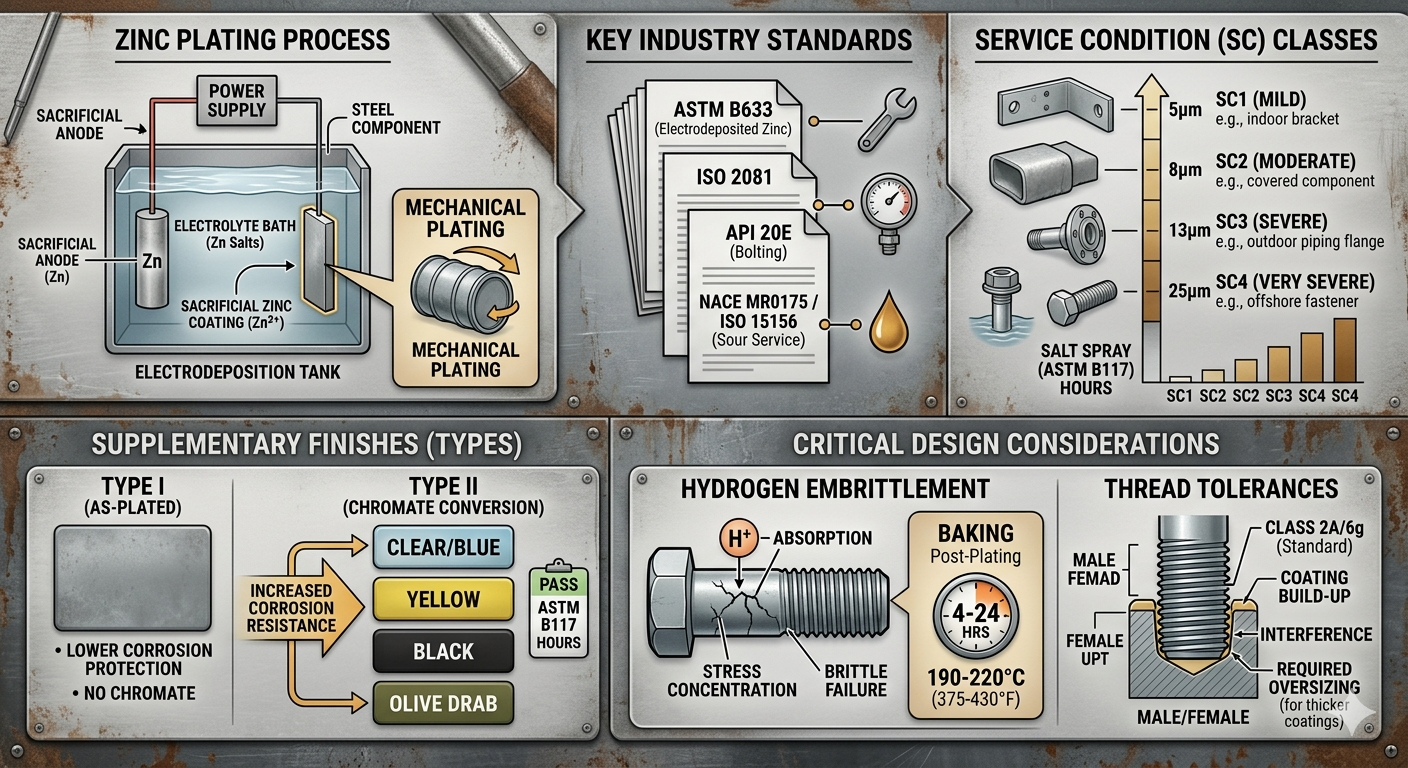
ASTM B633, Standard Specification for Electrodeposited Coatings of Zinc on Iron and Steel, is the governing process standard for zinc electroplating regardless of industry. It establishes the service condition classifications that define minimum zinc deposit thickness, the passivation requirements for each service tier, and the testing methods — most notably neutral salt spray per ASTM B117 — used to verify corrosion performance.
For oil and gas applications, ASTM B633 service condition selection is the first and most consequential specification decision. The relevant classifications for the industry are:
| Service Class | Min. Zinc Thickness | Oil & Gas Application Fit | Salt Spray Target |
|---|---|---|---|
| SC 1 — Mild | 5 µm (0.0002″) | Interior instrument hardware, protected indoor components only | ~24 hrs white rust |
| SC 2 — Moderate | 8 µm (0.0003″) | Sheltered onshore structural hardware, non-weather-exposed components | ~72 hrs white rust |
| SC 3 — Severe | 12 µm (0.0005″) | Outdoor onshore, exposed atmospheric hardware, general field fasteners | ~120 hrs white rust |
| SC 4 — Very Severe | 25 µm (0.001″) | Offshore platforms, coastal facilities, chemical process environments, splash zone hardware | 500+ hrs with trivalent passivate & sealer |
For the majority of oil and gas applications with any meaningful weather or chemical exposure, SC 4 is the correct specification floor. The incremental cost of SC 4 versus SC 3 plating is modest — a fraction of a cent per fastener at volume. The cost differential between adequate and inadequate corrosion protection in an offshore or process environment is not modest.
NACE MR0175 / ISO 15156 — Sour Service Material Requirements
NACE MR0175, now maintained under the joint NACE/ISO designation ISO 15156, is the definitive standard governing metallic materials in equipment for oil and gas production containing hydrogen sulfide. Its relevance to zinc plating is specific and important: the standard governs the mechanical and metallurgical properties of steel substrates exposed to H₂S environments, with particular focus on hardness limits designed to prevent sulfide stress cracking.
For zinc-plated components destined for sour service, the critical compliance question is not whether the zinc deposit meets a corrosion specification — it is whether the steel substrate complies with MR0175 hardness and heat treatment requirements. Specifically, MR0175 restricts the use of carbon steels above Rockwell C22 in sour service without specific qualification. This has direct implications for the electroplating process: high-strength steel components that would require hardness-based hydrogen embrittlement baking per ASTM B633 are precisely the components whose hardness levels MR0175 restricts in sour service.
Engineering NoteThe intersection of ASTM B633 hydrogen embrittlement baking requirements and NACE MR0175 hardness restrictions requires careful materials engineering review for high-strength fasteners in sour service. Components that comply with MR0175 by operating at lower hardness levels (≤ RC22) typically fall below the threshold (RC34) that triggers mandatory embrittlement baking under B633 — but this must be verified, not assumed, for each component design. Engaging your plating supplier’s engineering team at the specification stage, before production, prevents costly compliance problems downstream.
NACE SP0176 — Cathodic Protection Compatibility
NACE SP0176, the standard practice for corrosion control of steel fixed offshore platforms, addresses cathodic protection system design and compatibility. In offshore environments where zinc-plated structural hardware is used in conjunction with impressed-current or sacrificial anode cathodic protection systems, the zinc coating interacts with the cathodic protection circuit. Zinc is itself a sacrificial anode material — the interaction between the zinc deposit and the larger cathodic protection system must be understood in the context of overall corrosion protection design for the structure.
For most fastener and hardware applications on cathodically protected offshore structures, zinc plating provides a compatible and beneficial additional layer of protection. The key engineering consideration is ensuring that the zinc deposit specification is consistent with the overall cathodic protection design intent.
API Standards — Equipment-Class Requirements
The American Petroleum Institute maintains a family of equipment standards that contain surface finish and coating requirements for specific component classes. The most directly relevant to zinc-plated components are:
| API Standard | Scope | Zinc Plating Relevance |
|---|---|---|
| API 20E | Alloy and Carbon Steel Bolting for Use in the Petroleum & Natural Gas Industries | Covers surface treatment requirements for bolting, including zinc plating and hydrogen embrittlement relief requirements for high-strength grades. Explicitly references ASTM B633 and ASTM F2329 for mechanically deposited zinc. |
| API 6A | Wellhead and Christmas Tree Equipment | Governs material and coating requirements for wellhead hardware. External fasteners and hardware on API 6A equipment are typically specified to SC 4 or equivalent. Sour service variants require MR0175 compliance for substrate materials. |
| API 5CT | Casing and Tubing | Governs thread protection and coupling coatings. Zinc plating on thread protectors and couplings must meet corrosion performance requirements consistent with transportation and storage exposure. |
| API 17D | Subsea Wellhead and Christmas Tree Equipment | For subsea applications. Surface treatment specifications for non-pressure-containing hardware. Zinc plating permitted for structural hardware in appropriate depth/exposure classifications. Compatibility with subsea cathodic protection systems required. |
High-Strength Fasteners: The Critical Specification Intersection
More than any other component type, high-strength fasteners represent the point where zinc plating specification complexity in oil and gas reaches its highest density. Wellhead bolting, pressure vessel stud bolts, flange fasteners, and structural connection hardware in oil and gas applications frequently operate at tensile strength levels where hydrogen embrittlement is a genuine failure risk — and where the intersection of ASTM B633, ASTM F2329, ASTM F519, and NACE MR0175 all apply simultaneously.
In oil and gas bolting applications, a hydrogen embrittlement failure is not a quality problem — it is a safety event. The specification regime for high-strength fasteners in this industry exists precisely because the failure mode is silent, delayed, and potentially catastrophic. Getting the surface treatment specification right is not optional.
— Plateco Engineering Reference Archive
ASTM F2329 — Zinc Coating by Hot-Dip and Mechanical for Fasteners
ASTM F2329 governs zinc coatings on threaded fasteners, including both hot-dip galvanized and mechanically deposited zinc. It explicitly addresses hydrogen embrittlement by specifying that for fasteners with core hardness above Rockwell C35, or with tensile strength above 1040 MPa, mechanical deposition (per ASTM B695) is the required process — because electrodeposition at those strength levels carries unacceptable embrittlement risk that post-plate baking cannot fully eliminate.
For lower-strength fasteners where electrodeposition is acceptable, F2329 specifies post-plate embrittlement relief baking consistent with ASTM B633 requirements — and mandates notch tensile or sustained load testing per ASTM F519 to verify that the baking cycle has adequately reduced absorbed hydrogen before the fasteners are released for use.
Process Selection for Oil & Gas Fastener Applications
The three zinc processes available from a full-service zinc plating operation each have distinct roles in oil and gas fastener applications, defined primarily by part strength level and geometry.
| Zinc Process | Strength Range | Embrittlement Risk | O&G Application |
|---|---|---|---|
| Zinc Barrel Electroplating | Below RC34 (≤1040 MPa) | Manageable with baking Baking Required |
General hardware, non-structural fasteners, instrument components, surface equipment hardware |
| Zinc Rack Electroplating | Below RC34 (≤1040 MPa) | Manageable with baking Baking Required |
Large components, complex geometry parts, precision tolerance components, manifold hardware |
| Zinc Mechanical Galvanizing | All strength levels including Grade 8+ and B7 studs | Zero — no hydrogen generated Preferred for High-Strength |
B7/B7M stud bolts, Grade 8+ structural fasteners, ASTM F2329 high-strength applications, sour service substrate candidates |
Industry Best PracticeFor ASTM A193 B7 stud bolts — the workhorse of oil and gas pressure-boundary bolting — zinc mechanical galvanizing is the specification of choice when zinc surface treatment is required. The process deposits zinc to ASTM B695 Class 12 (12 µm minimum) or Class 25 (25 µm minimum) with zero hydrogen embrittlement risk, meeting the tensile strength-based restrictions of ASTM F2329 and complying with the coating performance requirements of API 20E for external service.
Passivation Requirements for Oil & Gas Environments
Bare zinc electrodeposit — without passivation — provides drastically reduced corrosion performance relative to passivated zinc. In the wet, saline, and chemically aggressive environments of oil and gas operations, an unpassivated zinc deposit can begin developing white corrosion products within hours and lose meaningful sacrificial zinc reserve within weeks. Passivation chemistry selection is as important as deposit thickness for oil and gas applications.
The modern standard for high-performance zinc passivation is trivalent chromate conversion coating, applied immediately after electrodeposition and — for demanding service conditions — overcoated with an organic sealer. The transition to trivalent systems from hexavalent chromate was driven by RoHS and REACH regulatory requirements, and initially raised concerns about whether trivalent passivates could match hexavalent performance. Those concerns have been resolved by process development: modern trivalent yellow passivate systems with optimized sealers routinely achieve 500 or more hours of neutral salt spray resistance on properly deposited zinc.
Trivalent Clear Passivate
Moderate EnvironmentsThin conversion layer, silver appearance. Suitable for SC 1–SC 2 service conditions. Not recommended for direct offshore or splash zone exposure without additional protection. Primarily for interior and sheltered hardware.
Trivalent Yellow Passivate + Sealer
Severe & Offshore EnvironmentsThick conversion layer with organic sealer topcoat. Standard specification for SC 4 oil and gas hardware. Achieves 500+ hour salt spray performance. Required for offshore platforms, coastal facilities, and weather-exposed structural hardware.
Black Trivalent Passivate
Instrument & Valve HardwareBlack conversion coating for instrument components, valve hardware, and OEM-specified assemblies requiring black finish. Performance varies significantly by formulation — always confirm salt spray hours to white rust with supplier test data before specifying for severe environments.
Specification Precision RequiredA purchase order that specifies “zinc plated per ASTM B633 SC 4” leaves passivate type undefined. In the oil and gas supply chain, that ambiguity creates risk: a supplier who applies clear trivalent passivate where yellow trivalent with sealer was needed delivers a part that looks compliant but has dramatically inferior corrosion performance. Passivate type must be explicitly called out in the specification — “zinc per ASTM B633 SC 4, trivalent yellow chromate passivate with topcoat sealer, 500 hours minimum salt spray per ASTM B117 to white rust.
What Qualifies a Zinc Plating Supplier for Oil & Gas Work
The oil and gas industry imposes rigorous qualification requirements on its supply chain — and for good reason. A zinc plating operation that performs adequately for general industrial hardware may lack the process controls, quality system infrastructure, and documentation capability required for oil and gas component supply. The gap between a qualified and an unqualified supplier is not primarily about equipment — it is about process discipline, documentation, and the quality management systems that ensure consistency lot after lot.
- 0.1%Plateco Customer Return Rate — Q1 2026
- 500+Hours Salt Spray — SC 4 with Trivalent Passivate & Sealer
- 50+Years of Precision Zinc Plating Experience
ISO 9001:2015 Certification — The Quality System Baseline
ISO 9001:2015 certification establishes that a facility has implemented a documented quality management system with defined process controls, calibrated measurement systems, corrective action processes, and regular internal and external audits. For oil and gas supply chain participation, ISO 9001 certification is not optional — it is the minimum quality system expectation. A plating supplier who cannot provide a current ISO 9001 certificate with a named registrar is not a qualified supplier for oil and gas component processing.
OEM Specification Approvals — The Process Qualification Evidence
OEM approvals — from major equipment manufacturers like Caterpillar, John Deere, Parker Hannifin, or Case/CNH — represent a significantly higher qualification bar than self-declared ASTM compliance. An OEM-approved plater has undergone external process audit, demonstrated statistical control of deposit thickness, and proven passivation performance against documented OEM test criteria. The breadth of OEM approvals a plating operation holds is a credible proxy for its overall process maturity and discipline.
- Confirm ISO 9001:2015 CertificationRequest a current certificate with registrar name. Verify the certificate covers the specific processes being ordered — electroplating, mechanical galvanizing, hydrogen embrittlement baking as applicable. Confirm the certificate is not expired.
- Request Documented Defect Return RateA qualified supplier tracks returns by lot and can provide a specific percentage, not a general assurance. Industry best-in-class operations run below 0.5%. Rates above 1% indicate inadequate process control for oil and gas supply chain use.
- Verify Bath Chemistry Control DocumentationRequest a description of bath monitoring frequency, control limits, replenishment protocols, and dump-and-replace criteria. The answer reveals process discipline. “We check it regularly” is not an acceptable answer for oil and gas supply.
- Confirm Thickness Measurement Capability and FrequencyAsk what thickness measurement method is used (XRF fluorescence or calibrated magnetic gauge), how frequently it is applied, at what locations on the part, and how results are recorded and trended. Every lot should have documented thickness data.
- Verify Hydrogen Embrittlement Baking Protocol for High-Strength PartsConfirm that high-strength component identification occurs at order entry, that baking is performed within 4 hours of plating, that oven temperature is calibrated and verified, and that bake cycle records are traceable to production lots. For ASTM F519 testing requirements, confirm testing capability or qualified sub-supplier.
- Require Full Compliance Documentation PackageFor oil and gas supply chain use, every lot shipment should include a certificate of conformance referencing the applicable specification and service class, material safety compliance declarations (RoHS, REACH), and thickness measurement data for the lot. A supplier who cannot provide this documentation package creates traceability risk for your quality system.
The Complete Oil & Gas Zinc Plating Specification Checklist
A complete zinc plating specification for an oil and gas component should address each of the following elements. Gaps in any element create ambiguity that can translate into non-compliant parts, or — worse — parts that appear compliant but fail in service.
| Specification Element | What to Specify | Priority |
|---|---|---|
| Base Plating Standard | ASTM B633 (electroplate) or ASTM B695 / ASTM F2329 (mechanical) | Required |
| Service Class | SC 1 / SC 2 / SC 3 / SC 4 — based on actual operating environment | Required |
| Minimum Zinc Thickness | Explicit minimum in µm or inches — do not rely solely on service class | Required |
| Passivate Type | Trivalent yellow with sealer (SC 4), trivalent clear (SC 1–2), black trivalent (cosmetic) | Required |
| Salt Spray Performance | Minimum hours to white rust per ASTM B117 — explicitly stated | Required |
| Hydrogen Embrittlement Protocol | Baking per ASTM B633 / F519 for parts ≥ RC34; mechanical galvanizing for parts ≥ RC35 per F2329 | Required for High-Strength |
| Sour Service Compliance | NACE MR0175 / ISO 15156 compliance statement for substrate material if sour service application | Required for H₂S Environments |
| Lot Documentation | Certificate of conformance, thickness data, embrittlement bake records as applicable | Recommended |
| RoHS / REACH Compliance | Declaration of trivalent (not hexavalent) passivate chemistry | Recommended |
| Dimensional Control | Maximum deposit thickness tolerance where thread fit or dimensional interface is critical | As Required |
Where Zinc Plating Fits — and Where It Doesn’t — in Oil & Gas
Zinc plating is not appropriate for every oil and gas component. Understanding the application boundaries prevents both under-protection (using zinc plating where a more aggressive corrosion control system is needed) and over-specification (requiring exotic coatings where zinc plating would perform perfectly well). The following framework defines the appropriate application envelope.
Well-Suited Applications for Zinc Plating
- Surface equipment fasteners and structural hardware in onshore and offshore atmospheric environments
- Instrument enclosures, cable trays, and electrical hardware in sheltered and exposed onshore locations
- General-purpose hardware on topside offshore platform structures — with SC 4 specification and trivalent yellow passivate
- Piping support hardware, clamps, and brackets in non-immersion, non-sour atmospheric service
- Low- to medium-strength bolting on non-pressure-boundary connections in atmospheric service
- Thread protectors and temporary corrosion protection for casing, tubing, and pipe connections during transport and storage
- Valve body and actuator hardware in non-wetted, atmospheric service positions
Applications Requiring Additional or Alternative Corrosion Protection
Zinc plating alone is insufficient — or inappropriate — in the following conditions: submerged or splash zone service where continuous cathodic protection system integration or more robust barrier coatings are required; process-wetted surfaces in contact with hydrocarbons, process water, or chemicals where the zinc deposit may be chemically incompatible with the process fluid; and high-temperature applications above approximately 120°C where zinc-iron interdiffusion and passivate degradation reduce the deposit’s corrosion performance below acceptable levels.
Specification GuidanceFor offshore structural hardware that will be integrated into a cathodic protection system, consult your corrosion engineer before specifying zinc plating in isolation. The interaction between the zinc deposit’s sacrificial protection mechanism and the cathodic protection circuit can influence the overall corrosion protection design. In most cases, zinc plating remains appropriate and beneficial — but the specification should acknowledge the cathodic protection context.
Specification Discipline Is Corrosion Protection
In oil and gas applications, the quality of a zinc plating specification is itself a form of corrosion protection. A complete, precise specification — correct service class, explicitly defined passivate type and performance requirement, hydrogen embrittlement protocol for high-strength parts, and sour service substrate compliance where applicable — is what translates a corrosion protection intention into actual field performance. An incomplete specification is an invitation to failure at the weakest link in the documentation chain.
The supplier side of this equation matters equally. A specification written to the highest standard is only as good as the supplier’s ability to execute against it — consistently, lot after lot, with the process documentation to prove it. In the oil and gas supply chain, “we’ve never had a problem” is not a quality assurance. Documented process controls, calibrated measurement systems, traceable lot records, and ISO 9001:2015 certification are.
Zinc plating has a well-established, cost-effective role in oil and gas corrosion protection. Executed correctly — with the right specification, the right process, and the right supplier — it delivers service life that matches the demand of the environment. The specifications exist to ensure that “correctly” is not a matter of interpretation.
We treat zinc plating as an extremely complex process demanding state-of-the-art technology, painstaking planning, obsessive quality control, and a tremendous amount of talent. Because our customers don’t come to us for excuses — they come to us for perfection. And we’ll do whatever it takes to give them nothing less.
— Jim Schweich, Chief Executive Perfectionist, Plateco, Inc.