

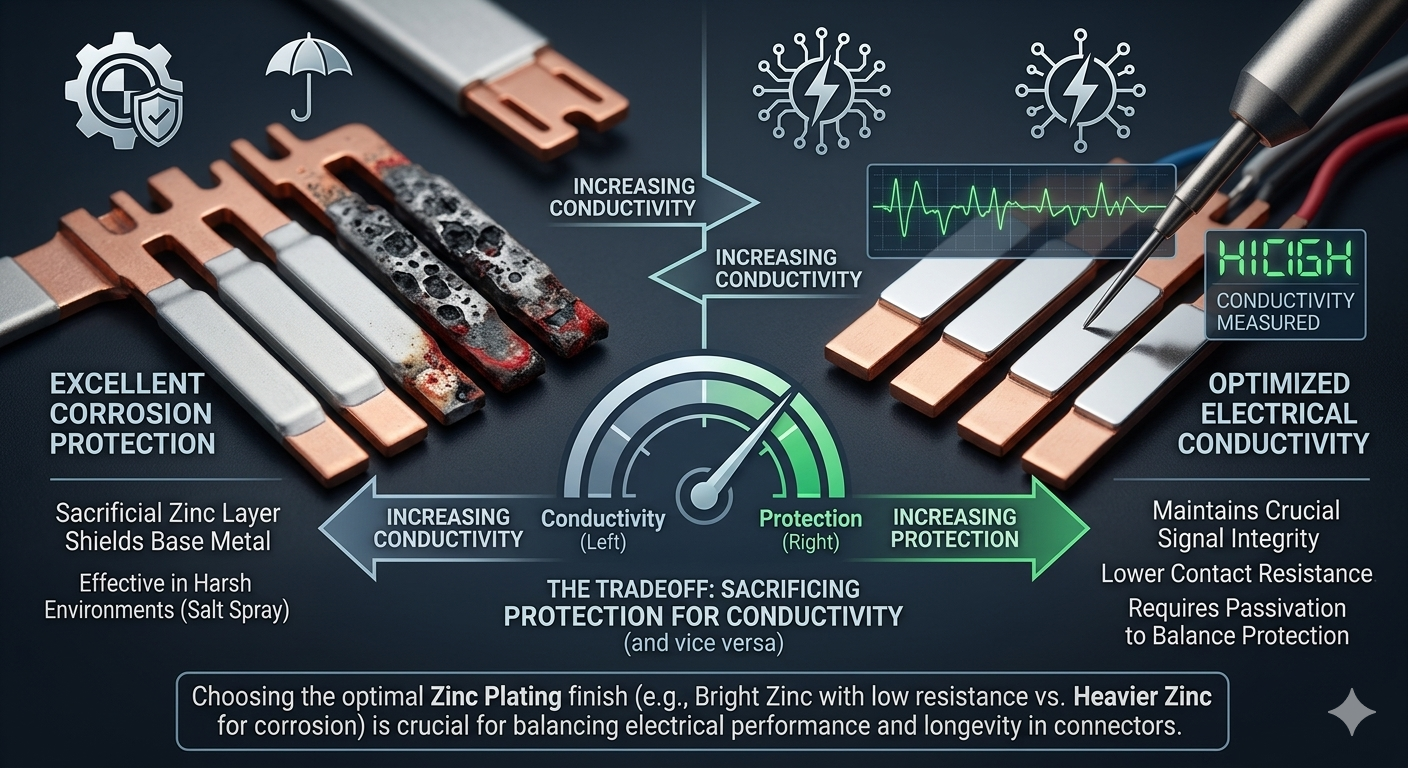
Zinc plating is one of the most effective corrosion barriers available for steel components — but steel isn’t the only material in an electrical assembly, and corrosion isn’t the only failure mode engineers have to design around. When zinc plating is applied to electrical components and connectors, conductivity enters the equation. This guide explains the real tradeoffs, when zinc plating is the right call, and how to specify it correctly for electrical hardware.
Electrical engineers and procurement teams specifying hardware for electrical panels, enclosures, control cabinets, wire harness brackets, grounding assemblies, and industrial connectors face a question that doesn’t come up in purely structural applications: if we zinc-plate this part, what happens to electrical performance?
The question is legitimate. Zinc is not copper. It does not have the conductivity of silver or gold — the metals that typically appear in high-precision connector contacts. But framing zinc plating primarily as a conductivity question misses the more important engineering reality:most electrical hardware is structural steel first, and most structural steel fails electrically not because of its coating, but because corrosion eventually destroys the contact interface entirely.
Understanding when zinc plating helps, when it creates tradeoffs, and how to specify it correctly for electrical applications is what this guide covers — start to finish.
Zinc and Electrical Conductivity: The Real Numbers
Before evaluating zinc plating in electrical applications, it helps to anchor the discussion in actual material data. Electrical conductivity is measured relative to copper, which is assigned 100% on the International Annealed Copper Standard (IACS). Here is where common engineering metals sit:
Conductivity shown as percentage of International Annealed Copper Standard (IACS). Zinc plating deposits are typically 5–25 µm thick — a fraction of a millimeter — over the base substrate.
Zinc at ~28% IACS is notably more conductive than the carbon steel it typically covers (~15–17% IACS). This is the first critical insight: a zinc-plated steel part is not less conductive than uncoated steel at the contact interface — it is more conductive at the surface. The zinc deposit creates a surface layer that conducts better than the steel underneath it, which is why zinc-plated grounding hardware can outperform bare steel hardware in terms of initial contact resistance.
The important caveat is what happens over time. Unlike noble metals such as gold or platinum, zinc oxidizes. The zinc oxide layer that forms on the surface — the same “white corrosion” that sacrificially protects the base steel — is a poor conductor. This is the genuine tradeoff in zinc-plated electrical hardware: the initial conductivity advantage can degrade as the oxide layer develops on the contact surface.
Where Zinc Plating Works Well in Electrical Applications
The answer to “does zinc plating work for electrical components?” is not a single yes or no — it depends entirely on the component’s function within the electrical system. There is a meaningful distinction between parts that carry and switch current at precision contact interfaces, and parts whose electrical function is incidental to their structural role.
Grounding Hardware and Bonding Brackets
Ground straps, chassis bonding brackets, equipment grounding conductors, and panel ground bars are among the most common electrical applications for zinc-plated steel. These parts require a reliable low-resistance path to ground — but that path is maintained through mechanical clamping force, not through a sliding or separable contact interface. The zinc deposit provides excellent corrosion protection, the contact is made at a threaded joint with high clamping force that breaks through any surface oxide, and the electrical path is stable over time.
Electrical Enclosure Hardware
Steel enclosures for control panels, junction boxes, switchgear cabinets, and industrial electrical equipment are routinely zinc-plated — including fasteners, mounting brackets, hinge hardware, door panels, and internal mounting rails. The zinc plating protects the enclosure structure from corrosion in industrial environments, which protects the components inside. The electrical function of enclosure hardware is secondary; structural integrity and corrosion resistance are the primary requirements.
Wire Harness and Cable Management Hardware
Conduit clamps, cable tray hardware, wire loom brackets, and harness routing clips are structural components that keep wiring in position. Many are steel and benefit from zinc plating for corrosion protection in automotive, industrial, and outdoor environments. The electrical function is grounding continuity through the conduit and cable tray system — again, maintained through clamping force rather than precision contact interfaces.
Panel Fasteners, Studs, and Standoffs
Threaded fasteners used to mount electrical components to enclosure panels, PCB mounting standoffs in industrial (not consumer) electronics, and terminal block mounting hardware are typical zinc-plating candidates. The fasteners provide mechanical assembly; electrical conductivity is a secondary attribute rather than a designed-for specification requirement.
Bus Bar Mounting Hardware
The bolts, nuts, and clamps that mechanically fasten copper bus bars to insulators or panel structures are often zinc-plated steel. Again, the hardware itself is structural; the current-carrying path is through the copper bus, not through the steel fastener. Zinc plating provides corrosion protection in environments where humidity and industrial atmosphere would otherwise attack bare steel over time.
The Conductivity–Protection Tradeoff: Honest Engineering Analysis
Zinc plating is not a neutral choice in electrical applications. It brings genuine advantages and genuine limitations that need to be understood before specifying it — particularly for applications where electrical performance is tightly defined.
Advantages for Electrical Hardware
- Better surface conductivity than bare steel at fresh contact interface
- Sacrificial corrosion protection extends service life in harsh environments
- Prevents insulating iron oxide (rust) from forming on contact surfaces
- Uniform, consistent surface compared to rough or pitted bare steel
- Cost-effective — no precious metal coating required for structural/grounding hardware
- RoHS-compliant trivalent passivates available for regulated applications
- Proven performance in outdoor, industrial, and automotive electrical systems
Limitations to Understand
- Zinc oxide layer (white corrosion) is resistive — degrades contact interface over time
- Not suitable for precision separable connector contacts (use gold, tin, or silver)
- Chromate passivate layer adds additional resistance at the surface
- Not recommended for high-frequency signal contacts where surface resistance matters at µΩ levels
- Galvanic incompatibility with aluminum structures — requires engineered interface
- Thicker deposits can affect dimensional tolerances in precision assemblies
Engineering Caution
Never specify zinc plating for precision separable connector contacts — socket and pin interfaces in multi-pin connectors, card edge contacts, or RF connector bodies where the contact interface requires stable, low-resistance, repeated mating cycles. For these applications, gold, silver, or tin plating over copper or brass is the correct specification. Zinc plating is for steel structural hardware, not precision contact surfaces.
Understanding Zinc Oxide at Electrical Contacts
The zinc oxide question deserves more technical depth, because it is frequently misunderstood — leading engineers to either over-restrict zinc plating (applying it where it would work fine) or under-restrict it (applying it where contact resistance matters and will eventually cause failures).
Zinc oxide (ZnO) forms naturally on zinc surfaces exposed to oxygen and moisture. This is the same electrochemical process that gives zinc its sacrificial protection value — the zinc is reacting before the steel beneath it does. The oxide layer is thin, adherent, and on a macroscopic level appears as a dull or chalky white surface deposit (“white rust”) after extended exposure.
At an electrical contact interface, the oxide layer behaves as a thin resistive film. Its impact on electrical resistance depends critically on two factors:
-
Contact force. At high mechanical contact forces — such as a bolted grounding lug or a compressed cable clamp — the oxide film is physically disrupted and the underlying zinc metal provides metal-to-metal contact. This is why bolted zinc-plated grounding hardware performs reliably over time: the clamping force maintains the metal interface regardless of surface oxidation.
-
Contact type. In separable, low-force, or wiping-contact interfaces — the kind found in multi-pin connectors, socket contacts, and card-edge interfaces — clamping force is not sufficient to reliably disrupt the oxide. Here, contact resistance becomes variable and can increase significantly over time, especially in humid or contaminated environments.
The engineering conclusion is straightforward: zinc plating is appropriate for bolted, clamped, and screwed electrical connections. It is not appropriate for separable connector contacts or low-force sliding interfaces. This is not a limitation unique to zinc — it is the same constraint that drives the use of gold and silver plating on precision connector contacts across the entire electronics industry.
Passivate Selection and Its Effect on Electrical Performance
The chromate conversion coating (passivate) applied over the zinc deposit after plating has its own effect on electrical properties — and it is a variable that electrical engineers specifying zinc-plated hardware often overlook.
Trivalent Clear Passivate
Clear trivalent chromate produces the thinnest conversion coating of the standard passivate options. It adds the least additional surface resistance of any passivate and provides a bright, slightly blue appearance. For electrical hardware where contact resistance matters (grounding assemblies, bonding brackets), clear passivate is generally the better choice over yellow because of its thinner interface layer. It is fully RoHS and REACH compliant.
Trivalent Yellow Passivate
Yellow passivate forms a thicker chromate conversion layer than clear, providing significantly greater corrosion resistance. For outdoor electrical enclosures, industrial panel hardware, and structural electrical components in demanding environments — where corrosion resistance is the priority and contact resistance is not actively measured — yellow passivate is appropriate and common. It is the standard choice when the OEM specification calls for maximum corrosion resistance without specifying contact performance.
Trivalent Black Passivate
Used when the electrical hardware specification calls for a black finish — common in visible panel-mount hardware, interior equipment, and certain cable management systems where aesthetics are specified alongside performance. Corrosion resistance is comparable to yellow. Black passivate has no meaningful advantage or disadvantage relative to yellow or clear in terms of electrical contact resistance.
5–25 µm Typical zinc deposit thickness range for electrical hardware
28% IACS Zinc electrical conductivity vs. copper baseline
500h+Hours to red rust possible with trivalent yellow + sealer topcoat
Electrical Applications by Use Case
To make the specification decision concrete, here is a breakdown of common electrical component categories and how zinc plating fits into each.
Conditional
Bus Bar Fasteners
Bolts and nuts mounting copper or aluminum bus. Zinc plates the steel fastener, not the bus. Appropriate if galvanic interface between zinc and bus material is engineered.
Recommended
Cable Tray & Conduit
Tray sections, couplings, clamps, conduit hangers. Structural hardware exposed to atmosphere; grounding continuity maintained through clamping. Barrel plate economically.
Not Recommended
Connector Contacts
Pin and socket contacts in separable connectors. Gold, silver, or tin over copper is required. Zinc oxide will degrade contact resistance on repeated mating cycles.
Conditional
Switch & Relay Hardware
Mounting hardware, housings, and structural brackets: zinc appropriate. Actuator contacts and internal switching contacts: specify nickel, silver, or gold plating.
Galvanic Compatibility: Zinc and Aluminum Structures
Electrical enclosures, industrial equipment frames, and outdoor structures frequently use aluminum for its combination of light weight, corrosion resistance, and thermal conductivity. When zinc-plated steel hardware is fastened directly to aluminum structures, a galvanic corrosion risk is introduced — and this is a genuine engineering concern that is separate from the conductivity question.
In the galvanic series, aluminum is electrochemically more active (less noble) than zinc. When zinc and aluminum are in direct contact in the presence of an electrolyte — moisture, condensation, or cleaning fluid — the aluminum acts as the anode and corrodes preferentially. This is the opposite of the zinc-steel relationship: zinc protects steel, but aluminum is sacrificed when coupled with zinc.
Design Guidance
When zinc-plated steel fasteners are used with aluminum enclosures or structures in environments where moisture is possible, use an insulating washer or conductive grease at the interface to prevent direct metal-to-metal galvanic contact. This is standard practice in outdoor electrical installation and is specified in NEC and IEC grounding standards for mixed-metal assemblies. The grounding continuity is maintained through the electrical bonding path, not through the fastener-to-structure galvanic couple.
Barrel vs. Rack Plating for Electrical Components
Choosing between barrel and rack plating for electrical hardware follows the same logic as any other application — part size, geometry, volume, and dimensional tolerance — but there are a few additional considerations specific to electrical assemblies.
| Factor | Barrel Plating | Rack Plating |
|---|---|---|
| Best for | Small fasteners, clips, small brackets, conduit hardware | Large enclosure panels, bus bar mounting plates, large brackets |
| Coating uniformity | ✔ Excellent on threads and internal features via tumbling | ✔ Excellent for large flat surfaces and critical features |
| Dimensional tolerance | Wider — appropriate for standard fasteners and clips | ✔ Tighter — required for precision-fit hardware |
| Volume economics | ✔ Lowest cost per piece for high-volume small parts | ✗ Higher cost — individual handling required |
| Thread coverage | ✔ Superior — tumbling provides multi-angle exposure | ~ Adequate with proper racking orientation |
| Delicate parts | ✗ Contact between parts may mark surfaces | ✔ No part-on-part contact; ideal for delicate surfaces |
| Throughput for production runs | ✔ Up to 800 lbs per barrel load | Limited by rack size and load configuration |
For the vast majority of electrical enclosure fasteners, cable management hardware, and grounding clips, barrel plating is the correct and most economical process. Rack plating is appropriate for large panel components, precision-fit standoffs, or any part where contact marks from tumbling would be unacceptable.
The Zinc Plating Process for Electrical Hardware: Step by Step
Consistent corrosion and electrical performance on zinc-plated electrical hardware starts with a disciplined, fully documented plating process. Every step in the sequence directly affects the quality of the final coating — and any deviation from the process has the potential to produce inconsistent results that reach the field in electrical assemblies where failures matter.
Incoming Part Inspection & Work Order Assignment
Parts are received and inspected against the job traveler. The work order specifies every process parameter — cleaning sequence, zinc deposit thickness target, passivate type (clear, yellow, or black), dimensional tolerance constraints, and inspection criteria. For electrical hardware, the work order may also specify passivate type based on the customer’s conductivity requirements. No process decisions are made on the floor without documented authorization.
Surface Preparation: Alkaline Cleaning & Acid Pickling
Oils, drawing compounds, heat treat scale, and surface oxides must be completely removed before zinc will bond to steel. Inadequate cleaning is the single most common root cause of adhesion failures and inconsistent coating thickness — both of which directly affect electrical contact performance. At Plateco, over half of all processing tanks are dedicated to cleaning, reflecting how foundational this step is to quality output.
Zinc Electrodeposition
Parts enter the electrolyte bath where current drives zinc ion deposition onto the steel surface. For barrel plating, continuous tumbling ensures even exposure of all surfaces — including threaded features critical to electrical grounding connections. Bath chemistry, temperature, current density, and contamination levels are monitored by automated control systems throughout the run. Consistent deposit thickness is the output of consistent process control; it cannot be achieved through inspection alone.
Chromate Passivation
The zinc-plated parts receive the specified chromate conversion coating. For electrical hardware where contact resistance matters, trivalent clear passivate is typically specified. For enclosure structure and non-contact hardware where maximum corrosion protection is the priority, trivalent yellow is standard. All passivates used at Plateco are RoHS and REACH compliant — hexavalent chromium is not used.
Quality Inspection, Salt Spray Testing & Certification
Finished parts are inspected for coating thickness, surface appearance, and adherence to the applicable specification. Salt spray sample testing verifies corrosion performance. A Certificate of Conformance is generated for each batch, documenting the specification plated to, the revision level, passivate type, and inspection results. Full batch traceability is maintained for quality audits — essential for electrical OEM supplier documentation requirements.
Specification Requirements for Zinc-Plated Electrical Hardware
Electrical component suppliers working in industrial, commercial, and automotive electrical applications will encounter a range of specifications that govern zinc plating on electrical hardware. Compliance is not optional — and keeping current with specification revisions is the responsibility of the plating partner, not just the purchasing team.
ASTM B633 — The Baseline Standard
ASTM B633, Standard Specification for Electrodeposited Coatings of Zinc on Iron and Steel, is the foundational reference for zinc plating in virtually every industrial and commercial application. It defines four service condition classes based on exposure environment, minimum zinc thickness requirements for each class, and the passivate types that correspond to each service condition. For electrical hardware in indoor environments, SC 2 (5 µm minimum) is often sufficient. For outdoor enclosures, industrial environments with humidity or chemical exposure, SC 3 (8 µm minimum) or SC 4 (13 µm minimum) is appropriate.
UL and NEMA Enclosure Standards
UL 508A (industrial control panel standard) and NEMA enclosure type ratings define environmental performance requirements for electrical enclosures — NEMA 4 for indoor/outdoor watertight, NEMA 12 for industrial environments, and so on. These standards don’t prescribe a specific plating specification, but the corrosion resistance required to meet NEMA ratings in steel enclosures is typically achieved through zinc electroplating to ASTM B633 SC 3 or higher, combined with yellow passivate and a sealer topcoat where required.
IEC 61439 and 61812
For electrical switchgear and control panel assemblies destined for European and international markets, IEC 61439 sets the performance framework for low-voltage switchgear assemblies. Zinc plating on steel enclosure components contributes to the corrosion resistance class requirements within these standards. Trivalent chromate systems meet RoHS compliance requirements that are mandatory for electrical equipment sold in EU markets.
Automotive Electrical OEM Specifications
Electrical harness brackets, grounding clips, and enclosure hardware entering automotive platforms are subject to the same Ford, GM, Stellantis, and Toyota zinc plating specifications that apply to structural fasteners — WSS-M21P17, GMW3044, and similar. These specs define zinc thickness, passivate type, and salt spray performance requirements that apply regardless of whether the part’s primary function is structural or electrical.
Plateco plates to: ASTM B633, John Deere JDM specifications, CAT (Caterpillar), Parker Hannifin, Case (CNH), and numerous customer-specific OEM standards across industrial and automotive electrical applications — with full documentation and batch traceability for every production run.
Choosing the Right Zinc Plating Partner for Electrical Applications
For electrical component suppliers, the quality requirements on zinc plating go beyond the coating itself. Documentation, traceability, specification currency, and delivery reliability are all part of what makes a plating partner viable for supply into electrical OEM programs.
Here is what to evaluate in a prospective plating partner for electrical hardware:
-
ISO 9001:2015 certification. A documented quality management system is the baseline for any supplier operating in regulated electrical markets. It provides the framework for specification compliance, nonconformance management, corrective action, and continuous improvement. Plateco holds ISO 9001:2015 certification and applies it to every production run.
-
Current specification maintenance. OEM and industry specifications for zinc plating are living documents with revision levels that change. A plating partner who plates to an obsolete revision of an applicable standard is producing parts that will fail a quality audit — even if the coating itself is technically sound. Ask how your partner tracks and incorporates specification changes.
-
Automated production lines. Process consistency in zinc plating — the kind required for electrical hardware that must perform reliably in industrial and outdoor environments — requires automated chemistry monitoring, temperature control, and current regulation. Manual operations introduce variability that shows up as inconsistent coating thickness, adhesion failures, and out-of-spec salt spray performance.
-
In-house salt spray testing. A plating partner that can verify corrosion performance in-house — rather than relying on outside laboratories — can respond to process drift before out-of-spec parts reach your dock. Salt spray capability integrated into the quality management system provides real-time process feedback.
-
RoHS and REACH compliance documentation. Electrical and electronic equipment sold in major global markets requires RoHS-compliant surface treatments. Trivalent chromate systems are compliant; hexavalent chromate is not. Your plating partner must be able to provide compliance documentation for every batch — not just a blanket statement.
-
Delivery reliability. Electrical panel assembly, switchgear manufacturing, and automotive harness production operate on tightly managed schedules. A plating partner with a documented on-time delivery rate — and a commitment to back it up — is not a nice-to-have. It is a supply chain requirement. Plateco delivers on spec, on time — or it’s on us. 95% on-time delivery rate, backed by a direct financial commitment.
“We treat zinc plating as an extremely complex process demanding state-of-the-art technology, painstaking planning, obsessive quality control, and a tremendous amount of talent. Because our customers don’t come to us for excuses — they come to us for perfection. And we’ll do whatever it takes to give them nothing less.”— Jim Schweich, Chief Executive Perfectionist, Plateco, Inc.
The Engineering Decision in Plain Language
The “conductivity vs. protection” framing of the zinc plating question is not wrong — it captures a real tradeoff. But for the vast majority of electrical hardware that engineers actually specify zinc plating for, it is the wrong question. The relevant question is: what failure mode am I protecting against, and how does zinc plating perform against that failure mode in this specific application?
For grounding hardware, enclosure structure, conduit systems, cable management, and bolted electrical connections in industrial and outdoor environments, the failure mode is corrosion — and zinc plating solves it reliably, economically, and with full compliance to industry and OEM specifications. The conductivity tradeoff is not a practical concern because clamping force maintains the contact interface.
For precision separable contacts, signal-level connector interfaces, and any application where contact resistance is measured at the µΩ level and must remain stable through repeated cycling, zinc plating is the wrong coating. Gold, silver, or tin over copper is the right answer — and a knowledgeable plating partner will tell you exactly that, rather than taking the job and delivering a part that will eventually fail in service.
Plateco has been the precision zinc plating specialist since 1974. ISO 9001:2015 certified. Fully automated production lines. Current OEM specification compliance. In-house salt spray testing. And a commitment that is simple and direct: on spec, on time — or it’s on us. For electrical and industrial suppliers who cannot afford the alternative, that is the only acceptable standard.
On Spec. On Time.
Or It’s On Us.
Supplying into electrical OEM programs? Get a quote from the zinc plating specialist industrial suppliers trust.