

In the competitive landscape of industrial manufacturing, the “finish” on a part is rarely just an afterthought. Whether a component is destined for the undercarriage of a heavy-duty tractor or the internal bracketry of a precision electronic assembly, the plating method used to apply zinc or other protective coatings determines the part’s longevity, cost-effectiveness, and structural integrity.
At Plateco, we specialize in high-performance zinc finishes. A question we encounter daily from engineers and procurement officers is: “Should we rack plate or barrel plate these parts?”
The answer is rarely a simple “this or that.” It requires an analysis of part geometry, metal substrate, production volume, and the specific tolerances required for the final assembly. This 2,000-word guide serves as a technical deep-dive into these two essential handling methods, providing you with the knowledge to optimize your supply chain and finishing quality.
1. Understanding the Mechanics: How Parts Move
Before we compare the advantages, we must define exactly what happens inside the plating facility. Both rack and barrel plating are forms of electroplating, meaning they use an electrical current and a chemical electrolyte to deposit metal. The difference lies entirely in the material handling.
The Barrel Plating Process
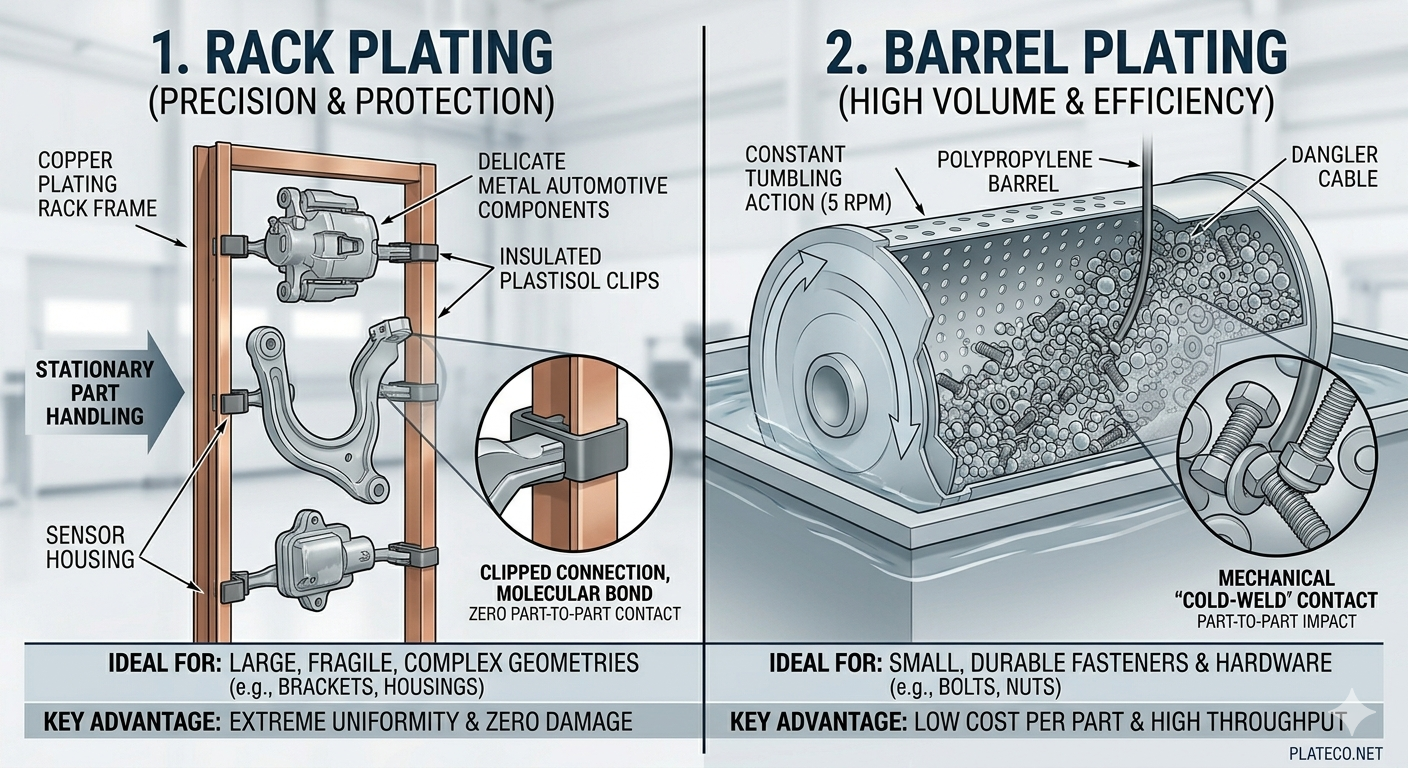
Barrel plating is a “bulk” process. Imagine a large, perforated cylinder made of high-density polypropylene. This cylinder—the barrel—is filled with a batch of parts. Inside the barrel are “danglers,” which are heavy-duty, flexible cables with conductive metal ends.
As the barrel is submerged in the zinc solution, it rotates slowly (typically 5 to 10 RPM). The parts tumble over each other in a continuous “cascade.” This motion serves two purposes:
- It ensures the parts are constantly making and breaking contact with the danglers and each other, distributing the electrical current.
- It ensures the plating solution (the electrolyte) is constantly being refreshed around every surface of the part.
The Rack Plating Process
Rack plating is a “stationary” process. Parts are individually hung on a custom-designed metal frame, or “rack.” These racks are usually made of copper or brass for high conductivity and are coated in a thick layer of plastisol (an acid-resistant rubber) to ensure only the contact points stay exposed.
The parts are held in place by clips, hooks, or wires that are manually tightened to ensure a solid electrical connection. Once loaded, the entire rack is moved through the cleaning, plating, and passivation tanks as a single unit. The parts never touch one another, and they remain in a fixed orientation throughout the entire cycle.
2. The Case for Barrel Plating: Efficiency at Scale
For the vast majority of fasteners and small hardware, barrel plating is the industry standard. It offers several distinct advantages that are hard to beat in a high-volume manufacturing environment.
A. Unmatched Cost Efficiency
The most obvious benefit of barrel plating is the lower “per-piece” cost. Because hundreds of pounds of parts can be loaded into a barrel using a simple scale or hopper, the amount of human labor per part is incredibly low. There is no need for a technician to handle each individual screw or washer.
B. High Production Throughput
Barrel lines are designed for speed. At Plateco, our automated barrel lines can process thousands of parts per hour. This makes barrel plating the only viable option for the “fastener world”—where orders are often measured in millions of units.
C. Superior Coating Uniformity for Simple Shapes
Counterintuitively, barrel plating can sometimes offer better uniformity than rack plating for simple shapes. Because the parts are constantly tumbling, “shadowing” (where one part blocks another from the current) is virtually non-existent. Every part receives an equal “average” exposure to the anodes, resulting in a very consistent batch.
3. The Case for Rack Plating: Precision and Protection
If barrel plating is the “brute force” of the industry, rack plating is the “surgical strike.” It is reserved for parts that require a level of care that a tumbling barrel simply cannot provide.
A. Protection of Delicate Geometries
Many modern industrial parts are “fragile” in a mechanical sense. Think of a long, thin rod, a delicate stamped leaf spring, or a part with a thin-walled tube. If you put 200 lbs of these parts in a barrel and rotate it, the weight of the parts pressing on each other will cause bending, tangling, and permanent distortion.
Rack plating keeps these parts stationary. There is zero risk of mechanical damage, ensuring that your parts arrive at the assembly line as straight and true as when they left the CNC machine.
B. Prevention of “Nesting” and “Blind Spots”
Some parts are prone to “nesting”—the tendency of flat or cup-shaped parts to stick together due to surface tension. In a barrel, if two flat washers stick together, the surfaces facing each other will receive zero zinc.
In rack plating, we can design the rack to hold parts apart. Furthermore, for parts with deep, “blind” holes or complex internal cavities, we can orient the part on the rack so that the air bubbles escape and the plating solution can flow freely into the hole.
C. Aesthetic Excellence
Barrel plating inevitably causes “nicks and dings” on the surface of the parts as they collide. For a structural bolt, this doesn’t matter. But for a visible decorative piece or a part with a “show-quality” finish, these micro-abrasions are unacceptable. Rack plating produces a flawless, mirror-like finish because the parts never touch anything but the conductive clip.
4. Technical Analysis: Current Density and Thickness Control
The decision between rack and barrel often comes down to the laws of physics—specifically Current Density.
Current Density in the Barrel
In a barrel, the current must travel from the dangler, through a “mass” of parts, to the parts at the outer edge of the tumble. This leads to a varying current density. The parts at the “top” of the tumble get more zinc than those in the “middle.” While the rotation helps average this out, there is always a wider statistical “bell curve” of thickness in barrel plating compared to rack.
Current Density on the Rack
In rack plating, we have precise control over where the electricity goes. We can use:
- Shields: To block current from “high-density” areas (like sharp corners) to prevent over-plating.
- Auxiliary Anodes: To “throw” current into deep recesses that would otherwise be under-plated.
This level of control allows us to meet extremely tight tolerances (e.g., +/- 0.0001”) that are simply impossible in a barrel.
5. Industry-Specific Use Cases
To help you visualize where your parts fit, let’s look at how different industries utilize these processes at Plateco.
Automotive Industry
- Barrel: Brake caliper clips, engine mount bolts, wheel nuts, and small stampings. These parts need high corrosion resistance (zinc-nickel or heavy zinc) and are produced in the millions.
- Rack: Long brake lines, large suspension arms, exterior trim pieces, and complex steering rack housings.
Agricultural and Construction Equipment
- Barrel: Heavy-duty washers, standard grade 8 bolts, and pivot pins.
- Rack: Large hydraulic cylinders, control levers, and structural brackets that are over 12 inches long.
Solar and Renewable Energy
- Barrel: The massive volume of mounting hardware and nuts used in solar racking systems.
- Rack: Large, flat collector plates or structural rails that would be too heavy or unwieldy for a barrel.
6. The “Hidden” Costs: Labor vs. Lead Time
When comparing quotes, it is important to look beyond the “price per thousand.”
Rack Plating is labor-intensive. It requires “Rackers”—skilled workers who manually attach and detach parts. This makes the labor cost roughly 5x to 10x higher than barrel plating. However, because the process is more controlled, the “scrap rate” for complex parts is much lower.
Barrel Plating is energy and chemistry intensive. While labor is low, the barrels themselves consume more electricity to rotate, and the chemistry must be managed more aggressively to handle the “bulk” load.
At Plateco, we optimize both. Our automated lines reduce the labor footprint even on rack projects, allowing us to offer competitive pricing that smaller shops can’t match.
7. Quality Standards: ASTM and Beyond
Regardless of the method, the final finish must meet a specification.
- ASTM B633: The standard for electrodeposited zinc. Both rack and barrel plating can meet this standard.
- Part Testing: We subject both rack and barrel parts to the same rigorous Salt Spray Testing (ASTM B117) to ensure they meet the 96, 240, or 1000-hour requirements specified by our customers.
8. Summary Comparison Table
| Feature | Barrel Plating | Rack Plating |
| Primary Goal | High volume / Low cost | High precision / Part protection |
| Typical Part Size | Under 6 inches | Up to 10+ feet (depending on tank) |
| Labor Cost | Low (Automated loading) | High (Manual racking) |
| Coating Thickness | Moderate control | Exceptional control |
| Surface Finish | Industrial (Minor nicks) | Aesthetic (Flawless) |
| Thread Protection | Standard threads are fine | Precision/Fine threads preferred |
| Risk of Tangling | High for springs/wires | Zero |
9. Decision Matrix: Which One Should You Choose?
Ask yourself these four questions:
- Is the part smaller than a deck of cards? If yes, and it’s not fragile, go Barrel.
- Does the part have a “Class 3” thread or a critical sealing surface? If yes, go Rack.
- Are you ordering fewer than 500 pieces? The setup time for a barrel might not be efficient; Rack might be better for small batches of larger parts.
- Is the part “Springy” or likely to tangles? (e.g., a long coil spring). If yes, avoid the barrel at all costs. Rack is your only choice.
10. Partnering with Plateco
At Plateco, we are more than just a “plating shop.” We are your technical partners in metal finishing. Located in the heart of the Midwest, we have spent decades perfecting the balance between high-volume efficiency and precision quality.
Our facility features:
- Custom Rack Design: If your part is unique, we can build a custom rack to ensure perfect plating and zero damage.
- Advanced Barrel Technology: Our barrels use state-of-the-art “dangler” systems and perforated designs to ensure the fastest plating speeds and the most uniform coatings in the industry.
- Full Lab Support: We monitor our chemistry hourly to ensure that whether your part is in a rack or a barrel, the zinc it receives is of the highest purity.
Choosing the right process is about more than just a price point—it’s about ensuring your product survives in the hands of the end-user. Whether you need the rugged throughput of a barrel or the white-glove precision of a rack, Plateco is here to deliver.
Contact Plateco today to discuss your blueprints or request a sample plate. Let’s finish your project the right way.