

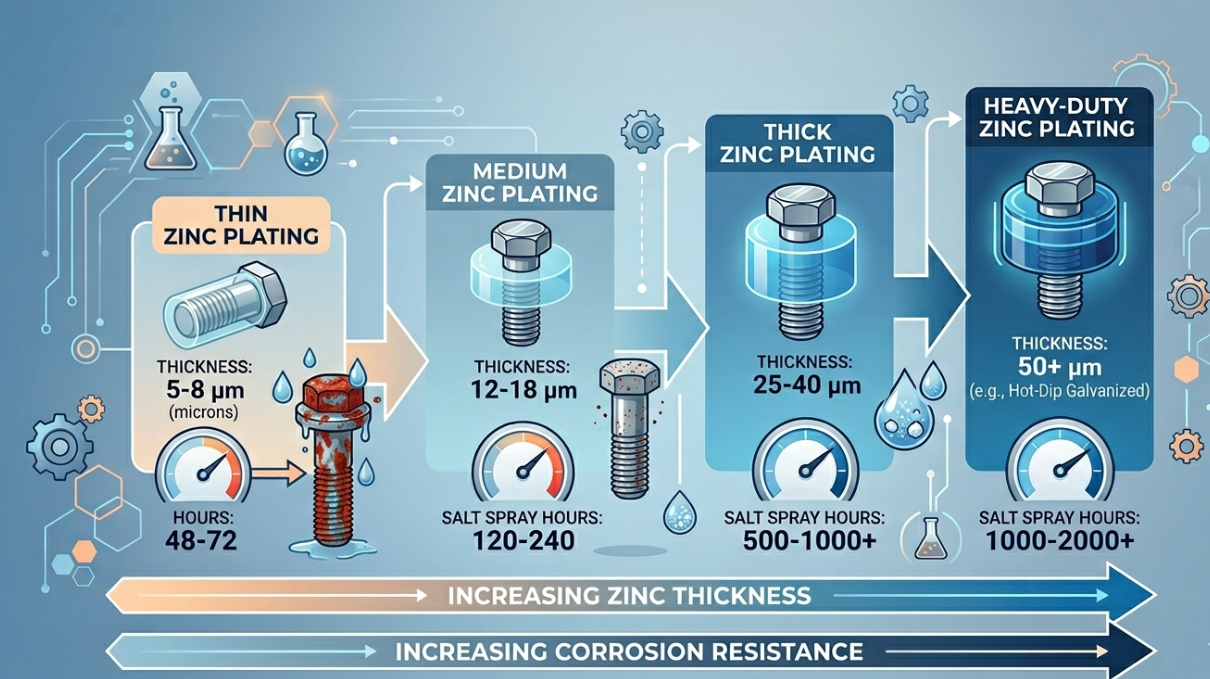
A rigorous, data-driven reference for engineers and quality managers who need to understand the relationship between zinc coating thickness, passivate chemistry, sealer selection, and the salt spray performance their parts will actually deliver mapped against ASTM B633, ASTM B695, and real OEM specification requirements.
Not all zinc plating is equal. A specification that reads “zinc plate per ASTM B633” without a service class tells a plater nothing about performance requirements and it tells an engineer nothing about what they will actually receive. Understanding the direct, quantifiable relationship between zinc coating thickness, passivate chemistry, and salt spray hours is the foundation of writing specifications that produce parts which survive their operating environment for the expected service life.
This guide is for engineers performing technical evaluations and writing or reviewing zinc plating specifications. It covers what salt spray testing actually measures, why thickness and passivate chemistry are the two primary variables controlling corrosion performance, how the ASTM B633 and ASTM B695 service class systems translate into real performance outcomes, and how to build a complete coating specification that maps to a defined salt spray hour target whether that target is 96 hours or 1,000 hours.
What Salt Spray Testing Actually Measures
Salt spray testing standardized in ASTM B117 and its international equivalent ISO 9227 is an accelerated corrosion test that exposes zinc-plated parts to a continuous mist of 5% sodium chloride solution at 35°C (95°F). It is not a real-world corrosion simulation. It is a comparative performance test that reveals the corrosion resistance of a coating system relative to known benchmarks and specification requirements.
The test reports two critical milestones, and understanding what each one means mechanically is essential to interpreting results correctly:
White Corrosion (White Rust) — The First Stage
White corrosion is zinc oxide forming on the zinc coating surface. It is the zinc doing exactly what it is designed to do sacrificing itself to protect the underlying steel. White rust appears as a chalky, gray-white powdery deposit on the surface of the part. Its appearance does not mean the part has failed; it means the sacrificial consumption of the zinc coating has begun. In most engineering applications, white corrosion is a performance milestone, not a rejection criterion unless the specification explicitly limits it, or unless cosmetic integrity is a functional requirement.
Red Corrosion (Red Rust) — The Critical Failure Point
Red corrosion is iron oxide forming on the steel substrate. Its appearance indicates that the zinc coating in that area has been fully depleted and the base metal is now directly exposed to the corrosive environment. This is the primary failure criterion for zinc plating specifications. The vast majority of engineering specifications ASTM B633 service classes, OEM specifications, application-specific standards express their corrosion performance requirements in terms of hours to first red rust.
Lab Setup Note — Why Source MattersASTM B117 calibration is not automatic. A salt spray chamber that is not maintained and verified daily can deliver inconsistent test conditions meaning data from an uncertified or poorly maintained chamber is unreliable for specification compliance purposes. Plateco’s salt spray chamber is set up per ASTM B117/ISO 9227 and checked daily by certified lab personnel. When we report salt spray hours, the data is backed by a verified, calibrated test environment. When evaluating salt spray data from a plating vendor, always ask how and how often their chamber is verified.
Understanding the Corrosion Mechanism: Why Zinc Works
Zinc protects steel through two simultaneous mechanisms, and both are operating during a salt spray test. The first is barrier protection: the zinc coating physically separates the steel surface from the electrolyte. As long as the coating is intact, the salt solution cannot contact the steel directly. The second and more important for real-world applications is sacrificial cathodic protection.
Zinc is electrochemically less noble than iron. On the galvanic series, zinc sits well below iron, meaning that when both metals are in contact in the presence of an electrolyte, zinc will corrode preferentially to protect the iron. Even at a scratch, chip, or coating gap where the steel is exposed, the surrounding zinc continues to corrode sacrificially, slowing or preventing red rust initiation in that exposed area. This is why a zinc-plated part with a surface scratch will still resist red rust for a meaningful period the zinc migrates electrochemically to protect the exposed steel. Bare steel with no coating would begin rusting immediately at any exposed point.
The salt spray hour number on your test report is not a fixed property of zinc plating. It is an engineered outcome, determined by three variables you control: the zinc thickness you specify, the passivate chemistry you select, and whether a sealer is added. Change any one of these, and the hours change with it.
Zinc Thickness and Salt Spray Hours: The Core Relationship
The relationship between zinc coating thickness and hours-to-red-rust is the most fundamental performance parameter in zinc plating specification. More zinc mass means more sacrificial material for the corrosive environment to consume before reaching the steel. In practical terms: at equivalent passivate chemistry, doubling the zinc thickness significantly increases the time to red rust though the relationship is not perfectly linear because passivate effectiveness, coating density, and substrate condition also contribute.
ASTM B633 formalizes this relationship through four Service Condition (SC) classes, each with a minimum zinc thickness and a corresponding corrosion performance expectation. Understanding what these classes mean in practice and where they are routinely misapplied is essential to writing specifications that produce parts capable of surviving their actual service environment.
| Service Class | Min. Zinc Thickness | Thickness in Mils | Hours to Red Rust (Clear Passivate) | Hours to Red Rust (Yellow + Sealer) | Tier |
|---|---|---|---|---|---|
| ASTM B633 SC1 Mild | 5 µm | 0.0002″ | Indoor Protected | ||
| ASTM B633 SC2 Moderate | 8 µm | 0.0003″ | Moderate Outdoor | ||
| ASTM B633 SC3 Severe | 12 µm | 0.0005″ | Severe Outdoor | ||
| ASTM B633 SC4 Very Severe | 25 µm | 0.001″ | Very Severe / Road | ||
| ASTM B695 Class 25 | 25 µm | 0.001″ | Structural / Construction | ||
| ASTM B695 Class 50 | 50 µm | 0.002″ | Anchor / Buried | ||
| ASTM B695 Class 75 | 75 µm | 0.003″ | Extreme / Marine |
Important Reading Note: The hour ranges above represent typical performance of properly executed coating systems at each thickness class. Actual salt spray hours depend heavily on passivate selection, sealer presence, surface preparation quality, bath chemistry control, and part geometry. The ranges reflect real-world performance across well-run plating operations not theoretical maximums from controlled laboratory conditions. Under-controlled bath chemistry or poor surface prep can reduce performance by 30–50% at any thickness class.
The Passivate Layer: The Multiplier on Zinc Thickness Performance
If zinc thickness is the foundation of corrosion resistance, the passivate (chromate conversion coating) is the multiplier. A correctly specified and applied passivate can extend the hours-to-red-rust of a 12 µm zinc coating by 50–150% compared to the same coating with no passivate or with a lower-performance passivate system. This is not a marginal difference it is the difference between meeting a 120-hour specification and meeting a 240-hour specification, without changing the zinc thickness at all.
Understanding what each passivate type delivers and what it does not is the second pillar of writing a specification that produces the right outcome.
Hexavalent Chromium — The Legacy ChemistryHistorically, hexavalent chromium (Cr6+) passivates offered the highest corrosion resistance of any passivate chemistry, with hours-to-red-rust often 30–50% higher than equivalent trivalent formulations. However, hexavalent chromium is now prohibited under RoHS (in electronics and automotive applications) and restricted under REACH. All major automotive OEMs including the GMW3044 and Ford WSS-M21P17 specification systems prohibit Cr6+ passivates. Plateco does not offer hexavalent passivates in any standard process. All Plateco passivate offerings are trivalent REACH compliant, RoHS compliant, and engineered to meet or closely approach the performance of legacy hexavalent systems at the service classes they are designed for.
The Sealer: The Final Barrier Layer
For applications requiring salt spray performance above approximately 300 hours, a wax or polymer sealer applied over the passivate is the mechanism that bridges the gap. Sealers add a final barrier layer over the passivate that slows electrolyte penetration and extends the effective performance of the coating system. The performance contribution of a sealer is significant on a 25 µm SC4 zinc coating with yellow passivate, a sealer can push red rust performance from 400 hours to 500+ hours, the threshold required by demanding OEM specifications including JS-500.
Sealers also introduce a secondary effect that engineers must account for in fastener applications: they add surface lubricity. A lubricated fastener surface changes the torque-tension relationship during assembly. Torque specifications written for dry zinc-plated fasteners may need adjustment when a sealer-bearing topcoat is present. This is not a reason to avoid sealers it is a reason to account for them in the fastener’s torque specification and to ensure the plater documents sealer presence on the production record.
Reading a Zinc Plating Specification: What Every Element Means
A fully qualified zinc plating specification contains multiple elements, each controlling a different aspect of the coating system. Many engineers see specifications like “Fe/Zn 12 Type II SC3” on a drawing and treat them as a single unit without understanding what each element independently controls. Breaking them apart gives you the ability to evaluate whether a specification is correct for the application and to identify which element to change when a specification isn’t delivering the required performance.
Fe
Iron / Steel
substrate
Zn
Electrodeposited
zinc
12
12 µm (0.0005″)
on sig. surfaces
Type II
Yellow chromate
(trivalent)
SC3
Severe outdoor
environment
ASTM B633 Finish Types Reference
| Type | Passivate Description | Visual Appearance | Min. Hrs to White Rust (ASTM B633) | REACH / RoHS |
|---|---|---|---|---|
| Type I | As-plated, no supplementary treatment | Dull silver-gray zinc | Not specified (bare zinc) | ✓ |
| Type II | Colored chromate (yellow/gold) | Yellow-gold iridescent | 96 hrs minimum | Trivalent ✓ |
| Type III | Colored chromate (olive drab) | Olive-brown | 96 hrs minimum | Trivalent ✓ |
| Type IV | Colored chromate (black) | Black to dark gray | 96 hrs minimum | Trivalent ✓ |
| Type V | Clear chromate | Clear to blue-iridescent | 72 hrs minimum | Trivalent ✓ |
| Type VI | Phosphate conversion coating | Gray, matte | Not specified | ✓ |
ASTM B633 Service Classes: Matching the Environment to the Specification
The most consequential specification decision an engineer makes for zinc-plated parts is the service class. It determines the minimum zinc thickness which determines the corrosion life and it is the element most frequently misassigned in the field. Specifying SC1 for a part that will live in an SC3 environment does not save money; it schedules a warranty claim. Understanding the environments each service class was designed for is the baseline for making correct assignments.
The Most Common Specification Error in Zinc Plating: Specifying SC2 (8 µm) for components that operate in SC3 environments. This error is widespread in procurement-driven specification decisions where the lower zinc thickness looks like a cost savings. In practice, the cost difference between SC2 and SC3 plating on a standard fastener is typically fractions of a cent per part. The cost of a field failure traceable to inadequate corrosion protection is orders of magnitude larger — warranty claims, product recalls, and in structural applications, liability exposure. Use the correct service class for the actual operating environment, every time.
OEM Specification Requirements: What Major Customers Actually Demand
ASTM B633 is the baseline. OEM-specific specifications layer additional requirements on top of that baseline specific passivate chemistry, sealer requirements, testing protocols, and in some cases, specific salt spray hour minimums that go beyond what the base ASTM service class would imply. Engineers working in automotive, agricultural, or heavy equipment supply chains need to understand the OEM specification, not just the underlying ASTM standard.
| OEM Specification | Min. Zinc Thickness | Passivate Requirement | Min. Salt Spray to Red Rust | Key Constraint |
|---|---|---|---|---|
| ASTM B633 SC3 | 12 µm | Any Type (II recommended for outdoor) | 120+ hrs (Type II) | Baseline standard; passivate selection drives outcome |
| ASTM B633 SC4 | 25 µm | Type II + sealer for outdoor | 240–500 hrs | Sealer required for SC4 full-performance applications |
| GMW3044 (GM Automotive) | Per zone table | Trivalent Cr3+ ONLY — Cr6+ prohibited | 200–500 hrs by zone | GADSL compliance; hexavalent chromium absolutely prohibited |
| Ford WSS-M21P17 | Per part table | Trivalent; heat-stable for under-hood | 200–480 hrs by zone | Thermal stability of passivate critical for under-hood zones above 150°F |
| JDM F15 (John Deere) | 12–25 µm by class | Yellow trivalent | 200–480 hrs by class | Specific test panels required; OEM audit rights |
| JDM F22 / F23 (Deere) | Per component table | Yellow or black trivalent | 240–500 hrs | Mechanical galvanizing preferred for high-strength hardware |
| CAT 1E0397 (Caterpillar) | 12–25 µm | Yellow trivalent + sealer | 240–500 hrs | Structural outdoor exposure; sealer mandatory for outdoor-exposed hardware |
| JS-500 (Heavy Equipment) | 25 µm minimum | Yellow trivalent + sealer required | 500 hrs minimum | 500-hour floor no exceptions; SC4 zinc + yellow + sealer is the standard system |
| Toro M-300 / M-310 | Per part drawing | Yellow trivalent | 200–300 hrs | Outdoor grounds equipment; turf and moisture exposure profile |
| ASTM B695 Class 25 (Mech. Galv.) | 25 µm | Clear or yellow trivalent | 240–400 hrs | Non-electrolytic; no hydrogen embrittlement risk; structural hardware preferred |
| ASTM B695 Class 50 (Mech. Galv.) | 50 µm | Clear or yellow trivalent | 500–800 hrs | Anchor bolts, buried hardware; heaviest standard mechanically deposited coating |
Building a Coating System to Hit a Specific Salt Spray Target
With the thickness and passivate data in hand, the specification-writing task becomes systematic: identify the salt spray hour target your application requires, then select the zinc thickness and passivate combination that reliably meets it. The following table maps target hours to the coating system required to achieve them.
| Target: Hrs to Red Rust | Required Zinc Thickness | Passivate | Sealer | ASTM B633 Spec Call-Out | Typical Application |
|---|---|---|---|---|---|
| 48–96 hrs | 5 µm (SC1) | Clear trivalent | No | Fe/Zn 5 Type V SC1 | Indoor protected fasteners |
| 96–120 hrs | 8 µm (SC2) | Clear or yellow trivalent | No | Fe/Zn 8 Type V or II SC2 | General indoor hardware |
| 120–200 hrs | 12 µm (SC3) | Yellow trivalent | No | Fe/Zn 12 Type II SC3 | Automotive underhood, agricultural clips |
| 200–300 hrs | 12–25 µm (SC3–SC4) | Yellow trivalent | Recommended | Fe/Zn 12 Type II SC3 + sealer | JDM F15, outdoor construction hardware |
| 300–500 hrs | 25 µm (SC4) | Yellow trivalent | Required | Fe/Zn 25 Type II SC4 + sealer | CAT 1E0397, automotive chassis, JS-500 |
| 500–800 hrs | 50 µm (B695 Cl.50 — Mech. Galv.) | Yellow trivalent | Optional | ASTM B695 Class 50 + Type II passivate | Anchor bolts, structural fasteners, buried hardware |
| 800–1,200+ hrs | 75 µm (B695 Cl.75 — Mech. Galv.) | Yellow trivalent | Recommended | ASTM B695 Class 75 + Type II passivate | Marine, extreme exposure, coastal infrastructure |
The Variables That Reduce Actual Salt Spray Performance Below Specification
Correctly specifying zinc thickness and passivate type is necessary but not sufficient for achieving the target salt spray hours. Several process variables that the specifying engineer does not directly control but can evaluate in a plating partner routinely determine whether a correctly specified part actually performs at its specified level or falls significantly short.
Surface Preparation Quality
Zinc adhesion depends entirely on clean steel. Contamination that survives into the plating bath oils, cutting fluids, heat treat scale, weld flux creates adhesion failures that manifest as blistering, peeling, and bare spots in salt spray testing. A plating operation with inadequate cleaning stages will fail to meet salt spray specifications even at correct thickness, because the coating detaches or develops voids before the zinc is consumed. Plateco’s seven-stage integrated cleaning process eliminates this variable for the widest range of incoming contamination profiles.
Bath Chemistry Control
Zinc bath chemistry pH, zinc metal concentration, brightener levels, contamination affects the quality and density of the zinc deposit continuously throughout a production run. A bath that drifts out of specification partway through a run produces parts in the latter portion of the run that are at risk of under-performing on salt spray even at the correct specified thickness. Hourly automated bath monitoring and dosing, as Plateco operates, prevents this drift. Manual titration at shift intervals leaves hours of bath drift unaddressed between measurements.
Passivate Application Timing
Passivate must be applied within a controlled time window after plating typically within 30 minutes before the fresh zinc surface begins to oxidize. Passivate applied over oxidized zinc bonds poorly and delivers significantly reduced corrosion performance. This process timing requirement is often underspecified in supplier quality agreements, but it is one of the most common root causes of salt spray failures in parts that are correctly specified on the drawing.
Coating Thickness Distribution
ASTM B633 specifies minimum thickness on “significant surfaces.” Parts with complex geometry deep recesses, blind holes, threaded roots naturally receive less zinc than flat, exposed surfaces due to current distribution in the plating bath. A part that measures 12 µm on a flat significant surface may have 6–8 µm in a thread valley, where corrosion can initiate first. This is not a specification violation it is the expected physics of electroplating but it means that thread and recess performance may be below the specification value, and engineers should consider whether their application’s most corrosion-critical surfaces are the flat significant surfaces or the recesses.
Hydrogen Embrittlement and Baking Effects
For high-strength steel parts requiring hydrogen embrittlement relief baking (ASTM F1941), the bake cycle must be completed before passivate application. If a plater bakes parts after passivation as some operations do for scheduling convenience the heat degrades the passivate coating, significantly reducing its corrosion performance. Parts that are correctly baked before passivation, as required by ASTM F1941, will consistently outperform in salt spray testing compared to incorrectly sequenced bake-then-passivate operations.
Plateco’s Salt Spray Testing and Quality Commitment
The relationship between specification and performance is only as reliable as the plating operation executing it. Plateco, Inc. has specialized exclusively in zinc plating since 1974 barrel electroplating, rack electroplating, and mechanical galvanizing with an engineering-first approach to specification compliance that positions us as a technical partner, not a commodity job shop.
In-house ASTM B117 salt spray testing. Plateco’s salt spray chamber is verified daily by certified lab personnel and operates per ASTM B117/ISO 9227. Monthly testing across our most-run processes provides ongoing visibility into bath performance before a customer sees a failure. This proactive testing is the mechanism behind our 0.13% documented reject rate problems are identified at source, not at your incoming inspection.
ISO 9001:2015 certified quality management system. Documented processes for bath chemistry management, calibrated coating thickness measurement equipment (magnetic and XRF gauges), trained personnel with defined competency requirements, and a corrective action system that root-causes and resolves non-conformances systematically. For programs requiring PPAP or OEM audit support, this infrastructure is in place and maintained not assembled on request.
Broad OEM specification compliance. Plateco plates to ASTM B633, ASTM B695, GMW3044, Ford WSS-M21P17, JDM F15/F22/F23, CAT 1E0397, Parker Hannifin, Toro M-300/M-310, JLG, and JS-500 among others. When your drawing references an OEM specification, we know what it requires beyond the base ASTM standard, and our production control systems are calibrated to meet those requirements consistently.
- All Plateco passivates are trivalent REACH and RoHS compliant across every standard process offering
- Hourly automated bath chemistry monitoring and dosing on all production lines
- Seven-stage integrated cleaning eliminates pre-cleaning requirement for most incoming contamination profiles
- 90+ foot conveyor bake oven for hydrogen embrittlement relief ensuring complete temperature compliance for all parts in load
- In-house salt spray chamber verified daily, monthly production process testing, results available on request
- Up to 800 lbs/barrel for barrel plating; custom rack design for rack plating; ASTM B695 Class 5–75 for mechanical galvanizing
Need a Coating System Mapped to Your Exact Salt Spray Requirement?
Send Plateco your drawing, OEM specification, and target salt spray hours. Our engineering team will confirm the correct zinc thickness, passivate, and sealer combination and provide documented salt spray data to back the recommendation.