

By the time a buyer starts searching for mechanical galvanizing services, the exploratory work is usually finished. The part has been designed, the corrosion problem is understood, and someone has already learned that standard zinc electroplating won’t carry the load, or that hot-dip galvanizing will distort the part or clog the threads. What remains is a practical, high-stakes question which vendor can run this coating on tens of thousands, or millions, of parts and deliver the same result on the last lot as on the first?
This guide is written for that moment. It’s for engineers, quality managers, purchasing leads and operations managers who are comparing suppliers for production-volume heavy-duty coating work. We’ll cover what mechanical galvanizing actually delivers, how it compares with the alternatives on the factors that drive a sourcing decision, which specifications matter, what “at scale” should mean in practice, and the specific questions worth putting to any vendor, including us, before you release a purchase order.
Thick, Uniform Zinc
Mechanical galvanizing builds a heavier, more evenly distributed zinc layer than typical electroplating, including in threads, recesses and blind holes
No Electrolytic Hydrogen
Because the process uses tumbling rather than electrical current, it avoids the main source of hydrogen embrittlement risk on high-strength fasteners
Repeatability Is the Real Product
At volume, process control, inspection discipline and lot documentation matter as much as the coating chemistry itself
Why Buyers Move to Mechanical Galvanizing at Production Volume
Few buyers choose mechanical galvanizing as a first instinct. They arrive at it because something else stopped working. The most common triggers we see are field corrosion failures on parts that were electroplated to a thin class, hydrogen embrittlement concerns on high-strength hardware, thread fit problems after hot-dip processing, and rising replacement or warranty costs in salt-heavy or wet service environments.
In the Upper Midwest, those environments are the norm rather than the exception. Winter road salt, freeze-thaw cycling, agricultural exposure, washdown and buried or ground contact all accelerate zinc consumption. A coating that looks adequate on a print can run out of sacrificial zinc well before the design life of the assembly it protects. When that happens, the cost isn’t the price of plating. It’s the cost of the failure, the recall or the field replacement.
Mechanical galvanizing exists to close that gap. It sits between standard zinc electroplating and hot-dip galvanizing, delivering heavier protection than the former without the heat and dimensional penalties of the latter. For buyers running recurring production volume, that middle position is often exactly what the application calls for, as long as the vendor behind it can execute consistently.
Have Questions About Your Parts?- (608) 524-8241
What Mechanical Galvanizing Is, and How It Works in Production
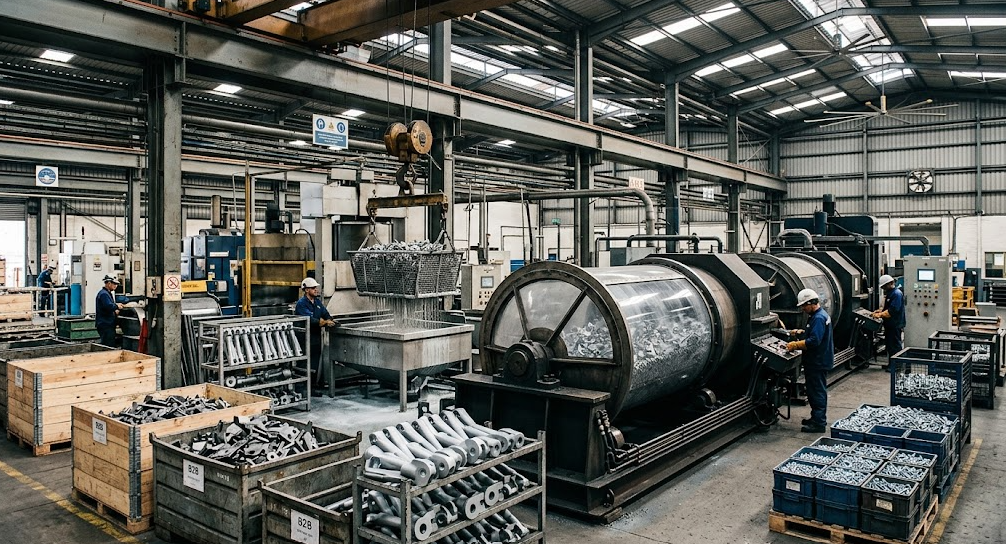
Mechanical galvanizing is a cold-application process. Rather than using an electrical current, as electroplating does, it bonds zinc powder to the steel surface through a combination of tumbling, impact and controlled conditions. The zinc is mechanically embedded and built up in layers, producing a dense, adherent coating. A full description of our capability is available on our mechanical galvanizing here is how it works from a production perspective.
1. Surface Preparation
Parts are cleaned to remove oils, scale, rust and other contaminants. Everything downstream depends on this step. Zinc particles bond to clean steel, and any residual soil becomes a potential adhesion failure. At volume, preparation has to be controlled by procedure and verified, not left to operator judgment.
2. Loading and Tumbling
Prepared parts go into a rotating drum with zinc powder. As the drum turns, parts tumble and collide, embedding zinc into the surface. This motion carries zinc into threads, blind holes, recesses and complex shapes, which is why mechanical galvanizing is valued where line-of-sight or current-distribution limits make other methods uneven. Load size, part mix, drum speed and cycle time all affect the result, and they’re the main levers a disciplined operation controls.
3. Particle Bonding
Controlled process conditions help the zinc particles adhere uniformly and securely. This does not melt the steel or the zinc. The result is a dense layer that is typically thicker and more protective than electroplated coatings.
4. Finishing and Protection
After coating, parts can be sealed or passivated to enhance corrosion resistance and achieve a specific appearance. Finish selection should be driven by the exposure environment and any program requirement for chromate chemistry, so confirm it explicitly on your RFQ.
Mechanical Galvanizing vs. Zinc Electroplating vs. Hot-Dip: A Buyer’s Comparison
Sourcing teams typically compare three zinc-based options. The right answer depends on part size, geometry, steel strength, service environment and volume. The table below summarizes how they differ on the factors that most often decide the question.
| Factor | Mechanical Galvanizing | Zinc Electroplating | Hot-Dip Galvanizing |
|---|---|---|---|
| Coating thickness | High, selectable by class | Moderate | Very high |
| Corrosion protection | Excellent | Good | Excellent |
| Thread and recess coverage | Very good, uniform | Good | Can build up and require thread clearing |
| Hydrogen embrittlement risk | No electrolytic hydrogen | Possible bake relief often required | Low, though pickling still matters |
| Heat distortion risk | None from the coating process | None | Present due to molten-zinc temperatures |
| Typical parts | Large and heavy-duty fasteners, structural hardware, anchor bolts, connectors | Small to medium parts | Large structural fabrications |
Mechanical galvanizing fills the gap between traditional electroplating and hot-dip galvanizing, offering heavier protection without the heat distortion associated with hot-dip processes. If your part is a threaded fastener that has to keep its fit, resist road salt and survive a service life measured in years, this is frequently the process that satisfies all three requirements at once.
It’s equally important to say when it is not the answer. For small, high-volume parts with modest corrosion requirements, zinc barrel electroplating is usually the more economical choice. For flat or geometrically simple parts that need a decorative or tightly controlled thin finish, zinc rack electroplating may fit better. A trustworthy vendor will tell you so and, ideally, can offer all three, which is one reason we do.
Specifications to Confirm Before You Source
A purchase order for mechanical galvanizing is only as good as the specification behind it. Several standards commonly appear, and they are not interchangeable.
ASTM B695: Mechanically Deposited Zinc Coatings
ASTM B695 is the governing specification for mechanically deposited zinc coatings on iron and steel. It defines coating classes by minimum thickness, so the class on your print determines how much zinc the vendor must deliver, and by extension how long the part will resist corrosion in service. Read the class callout carefully a lighter class may be adequate for indoor or mild conditions, while buried, marine, deicing-salt or washdown exposure generally calls for a heavier one.
ASTM B633 and Other Zinc Callouts
Prints sometimes reference ASTM B633, the electrodeposited zinc standard, on parts that were later moved to a mechanical process, or vice versa. If your drawing calls out one process but your engineering intent is heavier protection, resolve that mismatch before quoting. An engineering change request is far cheaper than a coating that meets the letter of the wrong specification.
Hot-Dip Standards as a Reference Point
Some buyers use hot-dip galvanizing requirements, such as ASTM A153 for hardware, as a benchmark for how much protection they need. Mechanical galvanizing is not a drop-in substitute for a hot-dip callout. If your specification names hot-dip, confirm with your engineer or customer whether a mechanically deposited coating of equivalent thickness is acceptable before you switch processes.
Corrosion Testing and Customer Requirements
Neutral salt spray testing under ASTM B117 is a common way to compare coating performance, and many customers specify hours-to-white-corrosion or hours-to-red-rust targets for the coating plus passivate system. Note that salt spray is a comparative lab test, not a guarantee of field life. Ask what your vendor can test, what they test routinely and how results are recorded.
Finally, check any customer-specific or OEM requirements layered on top of the ASTM standard: appearance, chromate type, torque-tension or lubricity requirements, and sorting or packaging instructions. You can review the standards Plateco works to on our Certifications & Specifications page.
Hydrogen Embrittlement: Why Process Choice Matters for High-Strength Parts
Hydrogen embrittlement is a delayed, brittle failure mechanism that can affect high-strength steel. In electroplating, hydrogen can be introduced into the steel during the process, which is why baking after plating is commonly required for susceptible parts, with tight time windows between plating and bake. Our guide to hydrogen embrittlement covers the mechanism in detail.
Mechanical galvanizing doesn’t use electrical current, so it avoids the electrolytic hydrogen generation associated with electroplating. For buyers of high-strength fasteners and structural hardware, that is often the single most important reason to specify it. Two caveats are worth stating plainly. First, surface preparation steps can still influence hydrogen exposure on very high-strength steel, so share the hardness or strength grade of your parts with any vendor. Second, your specification and your customer remain the final authority if a print requires a particular embrittlement-relief procedure or testing, that requirement stands regardless of process.
Where Mechanical Galvanizing Delivers the Most Value
The process earns its place in applications where corrosion is severe, parts are structurally important and failure is expensive. Typical environments include heavy moisture exposure, road salt and deicing chemicals, buried or ground contact, industrial washdown and agricultural wear conditions.
Typical parts include large fasteners, anchor bolts, structural hardware, heavy-duty connectors, and components for mining, construction and agricultural equipment. For these applications, the coating can be the difference between frequent replacement and dependable long-term performance.
The common thread is that these parts are usually produced in recurring quantities, installed in places that are expensive to service and specified by engineers who have a real reason for a heavier coating. That makes the combination of performance and repeatability the central purchasing criterion.
What “At Scale” Should Actually Mean When You Evaluate a Vendor
Almost every plating shop will claim to handle production volume. The claim only means something if it can be tied to specific operational capabilities. When you assess a mechanical galvanizing supplier for scale, look for these:
Batch Repeatability
Mechanical galvanizing is a batch process, so consistency between batches is everything. That depends on controlled parameters: surface preparation protocols, drum rotation speed and duration, controlled process conditions, and thickness verification at defined checkpoints. At Plateco, these are the quality process controls that keep coating performance consistent, measurable and aligned with engineering priorities.
Range of Part Sizes and Mixes
A facility set up for scale should handle a wide range of part sizes without forcing you to consolidate or redesign. At our Reedsburg, Wisconsin facility, we operate mechanical galvanizing systems tailored for precision, heavy coating performance and batch repeatability, supporting both prototype quantities and high-volume production.
Capacity and Scheduling Discipline
Ask about current capacity, typical lead times and how the shop handles surges and standing releases. A vendor that is already running near its limit cannot reliably absorb your blanket order. Ask for a realistic answer rather than an optimistic one.
Complementary Capabilities
Production programs change. A part moves to a lighter class, a new SKU appears, a design shifts from a large fastener to a smaller one. A supplier offering barrel, rack and mechanical processes under one quality system lets you adjust the process without re-qualifying an entirely new vendor.
Mechanical galvanizing isn’t about applying the heaviest coating possible. It’s about delivering the coating your specification calls for, on every part and every lot, with the proof to back it up. When we quote this work, we want to understand the environment, the class, the steel grade and the volume first, so the process we recommend matches the problem you actually have.
The Plateco Team
Total Cost of Ownership: Looking Beyond Price Per Pound
Mechanical galvanizing generally costs more per part than thin-class electroplating, and buyers should expect that. The more useful comparison, though, is total cost of ownership across the life of the assembly. Consider the following.
Service life. A thicker, well-bonded zinc layer lasts longer in aggressive environments, which reduces replacement cycles, maintenance labor and downtime.
Failure and warranty exposure. A single field failure on structural or safety-relevant hardware can exceed the plating cost of an entire year’s production. Avoiding that risk is where heavier protection pays for itself.
Secondary operations. Hot-dip parts often need thread chasing or re-tapping. Electroplated high-strength parts may need baking and testing. Mechanical galvanizing can reduce or remove these steps, which have real labor, scheduling and scrap costs.
Rework and rejects. Uniform coverage on threads and recesses reduces rejected lots and fit-up problems at assembly. Over a large program, a lower reject rate is a meaningful cost advantage.
Logistics and communication. A vendor who answers the phone, quotes promptly and ships on schedule saves your team hours every week. That doesn’t show up in a price-per-piece comparison, but it shows up in your results.
The fair way to evaluate is to ask each vendor for a quote that states the specification and class, the finish, packaging and lead time, then compare the full cost of getting acceptable parts to your line.
Quality Systems and Documentation: What a Production Buyer Should Expect
For a recurring production program, documentation is not paperwork for its own sake. It’s how you prove compliance to your own customers and how you diagnose problems quickly when they occur.
A quality management system. Plateco maintains ISO 9001 certification you can review our certificate through the PRI badge on our site, and read more in our guide on ISO 9001 and the zinc plating supply chain. If your program needs additional accreditations, ask us to confirm our current status directly instead of relying on a general claim.
Lot-level records. You should be able to tie a shipment to the process records that produced it, including coating class, process parameters and inspection results.
Thickness verification. Ask how thickness is measured, how often and on how many pieces per lot. For a heavy-coating process, this is the most direct evidence that the specified class was delivered.
Nonconformance handling. Ask how deviations are recorded, investigated and corrected. A mature quality system doesn’t pretend problems never occur it shows what happens when they do.
Certificates of conformance. Confirm what your certificate will state and whether it references the specification, class and finish on your print.
Moving Work to a New Vendor: What the Transition Should Look Like
Changing suppliers on a running part is a real concern for most buyers. A well-managed transition reduces the risk considerably. A sensible sequence looks like this:
1. Share the full package. Send prints, specifications, annual volume, release pattern and any customer requirements. The more complete the information, the more accurate the quote.
2. Confirm the specification. Resolve any mismatch between the process called out and the process intended, before sample parts are run.
3. Run samples. Process a representative lot and evaluate thickness, appearance, thread fit and adhesion against your acceptance criteria.
4. Agree on documentation and packaging. Align on certificates, labeling, packaging and shipping before production starts.
5. Ramp in stages. Begin with a portion of volume, confirm results, and scale up. If you’re leaving a current vendor, ask us about Plateco Transfer so the handoff doesn’t put your line at risk.
Questions to Ask Any Mechanical Galvanizing Vendor Before You Commit
Use these questions in your next supplier evaluation. A capable vendor will answer them specifically and without defensiveness.
Which specification and class will you coat to, and how do you verify thickness on each lot? Look for a clear reference to the specification on your print and a defined measurement routine.
What parameters do you control, and how do you keep batches consistent? Surface preparation, drum speed, cycle time and process conditions should all have a documented answer.
How do you handle high-strength steel? Ask what the vendor needs to know about hardness or strength grade and how their process addresses embrittlement concerns.
What is your real capacity and lead time for my volume? Expect numbers and an honest discussion of constraints.
What does your documentation package include? Ask to see a sample certificate and the lot-level records that sit behind it.
What happens when a lot fails inspection? The answer reveals more about a supplier’s quality maturity than any assurance of quality.
Can you also run barrel or rack electroplating if my needs change? It’s a practical question about future flexibility.
Frequently Asked Questions
Is mechanical galvanizing suitable for large parts?
Yes. It’s well suited to medium and large components that need a thick protective coating and durable corrosion resistance, such as large fasteners, anchor bolts and structural hardware. Confirm size and weight limits with your vendor for your specific parts.
How does mechanical galvanizing compare with hot-dip galvanizing?
Mechanical galvanizing provides a thicker coating than typical electroplating, with consistent coverage and without the distortion risk associated with the high temperatures of hot-dip processing. Hot-dip may still be the better fit for very large fabrications or where a specification requires it.
Can mechanical galvanizing withstand road salt exposure?
The dense zinc layer offers strong protection in corrosive environments, including freeze-thaw cycles and deicing chemicals. For severe exposure, specify an appropriate coating class and passivate system and validate it against your own performance requirements.
Is there a risk of the coating flaking?
With proper surface preparation and process control, the coating delivers strong adhesion and reduces the risk of separation under normal use. This is why preparation and in-process controls deserve as much scrutiny as the coating itself.
Does mechanical galvanizing eliminate hydrogen embrittlement concerns?
It avoids the electrolytic hydrogen introduced by electroplating, which is the principal concern for high-strength parts. Still share the strength grade of your parts and follow any embrittlement requirements stated in your specification or by your customer.
When should I choose barrel or rack electroplating instead?
For small parts, thinner coating requirements and tighter cost targets, electroplating is often the better fit. We can walk through the trade-offs for your specific part and recommend the process that meets your requirements without over-specifying.
Ready to Discuss Your Production Requirements?
Plateco has been zinc plating for Wisconsin manufacturers, fabricators and OEMs since 1974. Send us your prints, specifications, volumes and corrosion challenges, and we’ll recommend the right mechanical galvanizing solution, or tell you honestly if another process fits better.