

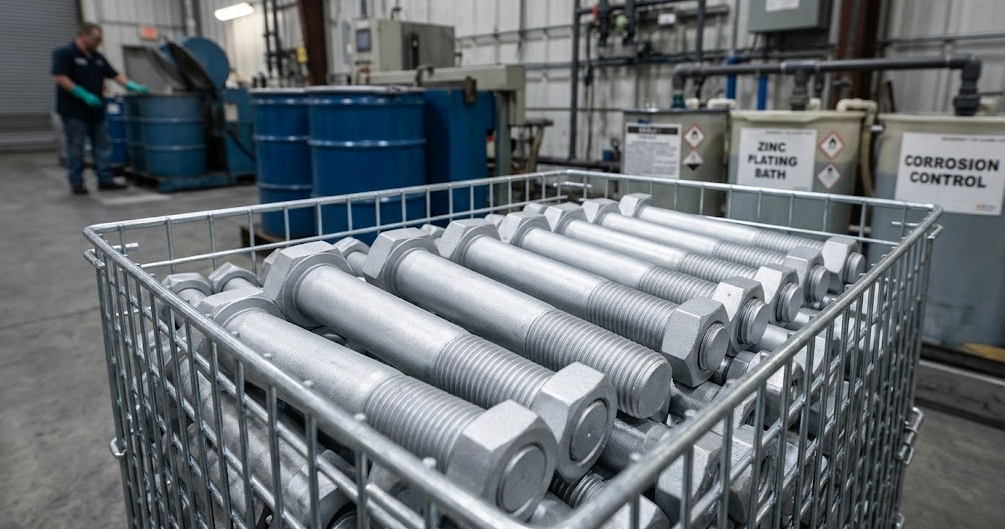
A distributor receives a pallet of steel hex bolts from a new supplier. The finish looks bright, the box says “zinc plated,” and the order goes straight onto the shelf. Eight months later a contractor calls the bolts are showing red rust on a deck rail, and the thread won’t take a nut on half the lot. Nothing about “zinc plated” told anyone how thick the coating was, what passivate sat on top of it, or whether the parts were ever checked against a standard. This guide explains how zinc barrel coating really protects steel hardware, what to ask for on a purchase order, and how industrial supply buyers can avoid the problems that lead to returns, rework and warranty claims.
Walk through any industrial supply warehouse and you’ll see the same thing on nearly every aisle small steel parts. Hex bolts, carriage bolts, machine screws, nuts, washers, clips, pins, rivets, stampings and brackets. They are cheap per piece, they move in enormous quantities, and they are almost always made from carbon steel, which means they start rusting the moment moisture reaches them. Corrosion protection is not an optional extra on this hardware. It is what makes the part sellable.
Zinc barrel electroplating is the workhorse process behind that protection. It is how most small, high-volume steel hardware gets its corrosion-resistant finish, and it is the process that lets a supplier deliver thousands or millions of pieces with a consistent coating at a price that still makes sense on a shelf or a bill of materials.
At Plateco, zinc plating is not a side service. It is the only thing we do. From our facility in Reedsburg, Wisconsin, we run automated zinc barrel electroplating lines for manufacturers, fastener suppliers and industrial distributors who need dependable corrosion protection on small steel components. This article draws on that experience. It covers how the process works, what the coating does, how thickness and passivate choices change performance, which hardware belongs in a barrel and which doesn’t, and how to write a specification that a buyer, a plater and an inspector will all read the same way.
Why Steel Hardware Needs Corrosion Protection Before It Ever Reaches a Shelf
Bare carbon steel is a strong, inexpensive and easily machined material, and it has one serious weakness. Iron reacts with oxygen and water to form iron oxide, which we know as rust. Rust is not a cosmetic issue on hardware. It swells, which seizes threads. It flakes, which changes dimensions and reduces the clamp load a fastener can hold. And it spreads, staining whatever the part touches.
For an industrial supplier, the consequences are practical and expensive. Rusted stock is unsellable stock. A lot that corrodes in a humid warehouse becomes write-off inventory. A lot that corrodes after it is installed becomes a return, a replacement shipment and sometimes a lost customer. The finish on a small steel part is therefore a commercial decision as much as a technical one.
Wisconsin and the surrounding Midwest make the problem worse. Winter road salt, humid summers, wide temperature swings, agricultural environments and heavy industrial use all accelerate corrosion. Hardware that ends up on a truck chassis, a grain handling system, a fence line or a building connection will be tested by these conditions within the first season. Hardware that ships from a Wisconsin warehouse to customers across the Great Lakes region needs a finish built for that reality, not the mildest possible reading of “outdoor.”
How zinc protects steel
Zinc protects steel in two ways. First, it acts as a barrier a continuous zinc layer keeps oxygen and moisture away from the steel underneath. Second, and more importantly, zinc is sacrificial. Zinc is more electrochemically active than iron, so when the coating is scratched or cut, the exposed steel stays protected while the nearby zinc corrodes first. That is why a nick on the head of a plated bolt does not turn into a rust bloom the way a nick in paint can.
Zinc corrodes slowly, and the products it forms (often seen as white, powdery “white rust”) are far less destructive than red iron rust. A chromate conversion coating applied over the zinc slows that process further, and that combination of zinc plus passivate is the foundation of most corrosion-resistant steel hardware sold today.
What Is Zinc Barrel Electroplating?
Zinc barrel electroplating is an electrochemical process that deposits a thin, uniform zinc coating onto small steel parts in bulk. Instead of mounting each part on a fixture, hundreds or thousands of pieces are loaded into a perforated, rotating barrel. The barrel is lowered into a zinc electrolyte solution and turned slowly while direct current flows through the system. Zinc ions in the solution are drawn to the negatively charged steel surfaces and deposit there as metallic zinc.
The tumbling is the key feature. As the barrel rotates, parts constantly shift position, so every surface gets exposure to the solution and to the current. That motion helps zinc reach threads, recesses, blind holes and undercuts that would be difficult to coat evenly any other way. It is also what makes the process so efficient one barrel load processes an enormous number of parts at the same time.
Barrel plating is designed for:
- High-volume production runs
- Small to medium-sized components such as fasteners, stampings and clips
- Applications where cost per piece matters
- Parts where protection matters more than cosmetic perfection
It is the opposite of a one-off process. Barrel plating rewards volume, consistency and repeat orders, which is exactly how industrial supply works.
The Barrel Plating Process, Step by Step
A quality finish is not made in the plating tank alone. Most coating failures are decided before or after zinc goes on the part. Here is what a well-controlled barrel line does, and why each step matters to a buyer.
1. Bulk loading
Parts are loaded into the barrel by weight and volume. Loading is more important than it sounds. An overloaded barrel limits part movement and gives uneven coverage. An underloaded one can damage delicate parts. Our automated barrel lines process loads of up to 800 pounds per barrel, and we adjust rotation speed for fragile or very small components.
2. Cleaning and surface preparation
Before any zinc is deposited, parts go through degreasing to remove oils and cutting fluids, acid pickling to remove oxides and scale, and rinsing to prevent contamination between stages. Zinc will not adhere to a dirty or oxidized surface. Poor preparation is the leading cause of blistering, peeling and patchy coverage, and no amount of plating time fixes it afterward.
3. Zinc deposition
In the electrolyte bath, current passes through the solution and the tumbling parts, and a controlled zinc layer builds on every exposed surface. Thickness depends on current density, time in the bath, bath chemistry and temperature. This is where automation earns its keep automated chemistry monitoring keeps the deposit consistent from the first barrel of the day to the last.
4. Chromate conversion and post-plating treatment
After plating, parts receive a chromate conversion coating, also called a passivate. This thin film dramatically increases corrosion resistance and sets the finish color. Common options include clear (blue), yellow, black and olive drab, along with custom finishes. A sealer or topcoat can be added for more demanding environments.
5. Drying, inspection and packaging
Parts are dried, inspected, and packed. Thickness checks, visual inspection and documentation happen here, and this is where a plater either proves the lot meets the specification or catches the problem before it ships.
Barrel Plating vs. Rack Plating vs. Mechanical Galvanizing
Barrel plating is one of three zinc processes Plateco offers, and choosing correctly saves money and avoids rejected lots.
| Process | Best for | Strengths | Limits |
|---|---|---|---|
| Zinc barrel electroplating | Small parts in high volume bolts, screws, nuts, washers, clips, stampings | Low cost per piece, uniform coverage on threads and recesses, high throughput | Not suited to large, long or delicate parts or highly cosmetic surfaces |
| Zinc rack electroplating | Larger, heavier or cosmetically critical parts | Individual part handling, better appearance control, no tumbling damage | Slower and more labor per piece |
| Zinc mechanical galvanizing | High-strength fasteners and springs where hydrogen is a concern | Cold process with no hydrogen introduced, heavier coating possible | Less suited to very fine threads and tight tolerances |
For most standard fasteners and small hardware, barrel plating delivers the best combination of performance and efficiency. Rack plating may be preferred for large or highly cosmetic parts, and mechanical galvanizing is worth considering for hardened fasteners. Our team can recommend the right process for each part number, and we will tell you when a component belongs on a different line.
Which Steel Hardware Belongs in a Barrel?
Industrial supply catalogs are full of parts that suit barrel plating well. Typical examples include:
Hex bolts, carriage bolts, machine screws, self-tapping and sheet metal screws. Tumbling lets solution reach thread roots consistently.
Flat washers, lock washers and nuts of all sizes. Very high-volume items where per-piece cost drives the sourcing decision.
Cotter pins, spring clips, retaining hardware and small stamped brackets used across automotive and industrial assemblies.
Small anchors, tie hardware and connector bolts used in construction and agricultural applications.
Plateco’s barrel lines serve automotive suppliers, agricultural equipment makers, industrial machinery producers and construction hardware companies, all of which share one need reliable corrosion protection on parts that are made by the thousand.
Barrel plating is not right for everything large, heavy or cosmetically critical parts can scratch or dent while tumbling and are better served by racks.
Coating Thickness: The Number That Decides Service Life
Of all the variables in zinc plating, thickness has the most direct effect on how long hardware survives. Thicker zinc means more sacrificial material, and therefore more time before the steel underneath is exposed. ASTM B633 organizes thickness requirements into four service conditions (SC) based on how harsh the environment is.
| Service Condition | Min. Thickness | Environment | Typical Hardware |
|---|---|---|---|
| SC 1 – Mild | 5 µm | Dry indoor, no condensation | Interior fasteners, enclosed assemblies |
| SC 2 – Moderate | 8 µm | Indoor with occasional condensation | Covered or unheated storage, utility hardware |
| SC 3 – Severe | 12 µm | Outdoor exposure, weather, temperature cycling | General exterior fasteners and connectors |
| SC 4 – Very Severe | 25 µm | Harsh outdoor exposure, road salt, constant weather | Roadside, agricultural and heavy-exposure hardware |
A practical caution about barrel plating thickness
Barrel-plated parts do not all receive exactly the same coating. Because parts tumble through different positions inside the barrel, there is natural variation from piece to piece, and a single average number hides it. That is why serious thickness specifications reference a minimum on significant surfaces, and why measurement is done on a sampling plan rather than a single part. Heavier service conditions also take longer in the bath, which affects cost and turnaround.
Passivates and Topcoats: Color Is a Corrosion Decision
The chromate conversion coating over the zinc is a major part of the system’s corrosion performance. For buyers, it is also the most visible feature of the finish. Color is not just cosmetic different passivates carry different protection levels.
- Clear (blue): A bright, lightly protective finish suited to mild, mostly indoor environments.
- Yellow: The standard choice when more corrosion resistance is needed. It offers noticeably better protection than clear and is widely accepted in construction, automotive and general industrial specifications.
- Black: Chosen where a dark appearance is required. It is often paired with a sealer, since the black film by itself typically gives less protection than a comparable yellow system.
- Olive drab: A heavier, more corrosion-resistant film used where color or higher protection is required, such as some military-style and heavy-duty applications.
For hardware facing the harshest conditions, such as winter road salt or agricultural exposure, a sealer or topcoat over the passivate extends the time before white or red corrosion appears. Performance is engineered by adjusting three things together zinc thickness, chromate system and post-treatment sealer. Changing one without the others rarely gets the result you expect.
Salt Spray Testing: What the Hours Mean (and Don’t)
Many hardware specifications include a salt spray requirement, typically tested per ASTM B117. In this test, plated parts are exposed to a continuous salt fog in a chamber, and the result is reported as the number of hours before white corrosion (zinc) or red rust (steel) appears. A related requirement may specify hours to first red rust.
Salt spray is a useful comparison tool, and it is routinely used to qualify a plating system. It is not a direct prediction of years in service. Real environments involve wet and dry cycles, temperature changes, abrasion and chemicals that the chamber does not reproduce. Treat the number as a quality benchmark and make sure it is consistent with the other parts of your specification. A requirement for long hours on a thin clear-passivated coating, for instance, simply won’t be met, and the mismatch is better caught at quoting than at final inspection. Our guide to salt spray testing covers this in more detail.
Threads, Fit and Dimensional Control
Zinc plating adds material to a part, and on threaded hardware that matters. A typical deposit is thin enough to be compatible with standard fits, but a thick coating on a tight-tolerance thread can prevent a nut from running freely. Because barrel plating puts zinc inside threads as well as outside them, thread allowances need to be part of the conversation.
The tumbling action helps with coverage, but it also means thread engagement, thread class and the intended mating part should be known when the order is quoted. Industry standards for plated fasteners address thread allowance, and many fastener suppliers handle this by producing threads slightly undersized or oversized for later plating. If you are sourcing from a manufacturer who has already accounted for plating allowance, tell your plater so the coating thickness doesn’t push parts out of tolerance. If you are plating parts that were not designed for coating, ask for a trial lot first.
Hydrogen Embrittlement: The Risk Buyers Shouldn’t Ignore
Any electroplating process can introduce hydrogen into steel, particularly during acid pickling and plating. In low-strength steel this is harmless. In hardened, high-strength steel, trapped hydrogen can cause delayed brittle failure a fastener that passes inspection and then snaps under load days after installation.
The industry standard response is a post-plating baking cycle, which drives hydrogen out of the steel. Baking is commonly specified for hardened fasteners (high-strength bolts and through-hardened or case-hardened parts) and is addressed in standards such as ASTM B850. Timing matters because baking needs to happen soon after plating, before the zinc and passivate seal the hydrogen in.
How to Write a Zinc Barrel Plating Specification That Holds Up
A specification that leaves room for interpretation will be interpreted by whoever handles the order last. A good one answers the following questions plainly:
- Which standard governs (for example, ASTM B633), and which service condition or thickness?
- Which passivate type and color, and is RoHS-compliant trivalent chromate required?
- Is a sealer or topcoat required?
- Is there a salt spray requirement, and if so, which hours to which type of corrosion?
- Does the part need baking for hydrogen relief, and what is the hardness or grade?
- Are there thread, fit or dimensional requirements after plating?
- What documentation is required certificates of conformance, thickness reports or lot traceability?
Zinc electroplate per ASTM B633, SC3, Type II (yellow trivalent chromate), minimum 12 µm on significant surfaces. RoHS compliant. Barrel plate acceptable. Thread fit to be verified after plating. Certificate of conformance required with each lot.
Zinc electroplate per ASTM B633, SC3, Type II. Parts are hardened bake for hydrogen embrittlement relief per ASTM B850 within the required window after plating. Thickness report and lot traceability required.
The two elements missing most often are an explicit service condition and a clear statement of the passivate. Those two choices alone account for most of the difference in service life between one lot of “zinc plated” hardware and another.
Quality Control, Documentation and Traceability
For a distributor or OEM, the plater’s quality system is part of the product. When a customer audits your supply chain or questions a lot, you need records. A zinc specialist should be able to supply:
- Thickness measurements, taken by an appropriate gauge or XRF method
- Certificates of conformance tied to your purchase order and part number
- Lot and batch traceability
- Process records, including bath chemistry control
- Third-party quality certifications
Plateco holds ISO 9001 certification, and we provide documentation and traceability to support quality audits and compliance reviews. We can also plate to ASTM B633, customer-specific OEM standards and other industry corrosion performance requirements. You can review our certifications and specifications for details.
What Industrial Supply Buyers Gain from a Zinc-Only Specialist
General metal finishers run many chemistries under one roof, from zinc to nickel to anodize and beyond. Plateco focuses on zinc, and that focus shows up in practical ways. A single-process shop spends all its engineering attention on one set of baths, one family of passivates and one set of defects. That specialization brings deeper technical knowledge, refined operating systems, continuous process improvement, more consistent coating performance and lower defect rates.
For a buyer, that means fewer rejected lots and fewer surprises. Our philosophy is simple: On Spec. On Time. Or It’s On Us.
Location matters too. Plateco’s automated barrel lines operate in Reedsburg, Wisconsin, which means shorter transit for suppliers across the Midwest, faster turnaround when a rush order shows up, and a direct line to the people running your parts. For supply chain managers juggling lead times and freight, that proximity is more than a convenience.
“We treat zinc plating as an extremely complex process demanding state-of-the-art technology, painstaking planning, obsessive quality control and a tremendous amount of talent. Because our customers don’t come to us for excuses. They come to us for perfection. And we’ll do whatever it takes to give them nothing less.”
— Jim Schweich, Chief Executive Perfectionist, Plateco, Inc.
Frequently Asked Questions
Is zinc barrel electroplating suitable for threaded parts?
Yes. The tumbling motion gives plating solution access to threaded features and provides consistent coverage. Thread fit after plating should still be checked, so discuss thread class and any allowance requirements when you request a quote.
Is barrel plating as durable as rack plating?
For small components and high-volume production, properly controlled barrel plating provides comparable corrosion protection. Durability is driven mainly by thickness, passivate and sealer, not by whether the part was racked or barreled.
What zinc thickness should I specify for general-purpose hardware?
It depends on where the hardware will be used. Interior parts can often use SC1 or SC2, while exterior hardware generally calls for SC3 or SC4. When end use is uncertain, specify for the more demanding environment.
Do all zinc-plated fasteners need baking?
No. Baking for hydrogen embrittlement relief is typically needed for hardened, high-strength steel. Standard low-carbon hardware generally does not require it. Always tell your plater the grade or hardness of the parts.