

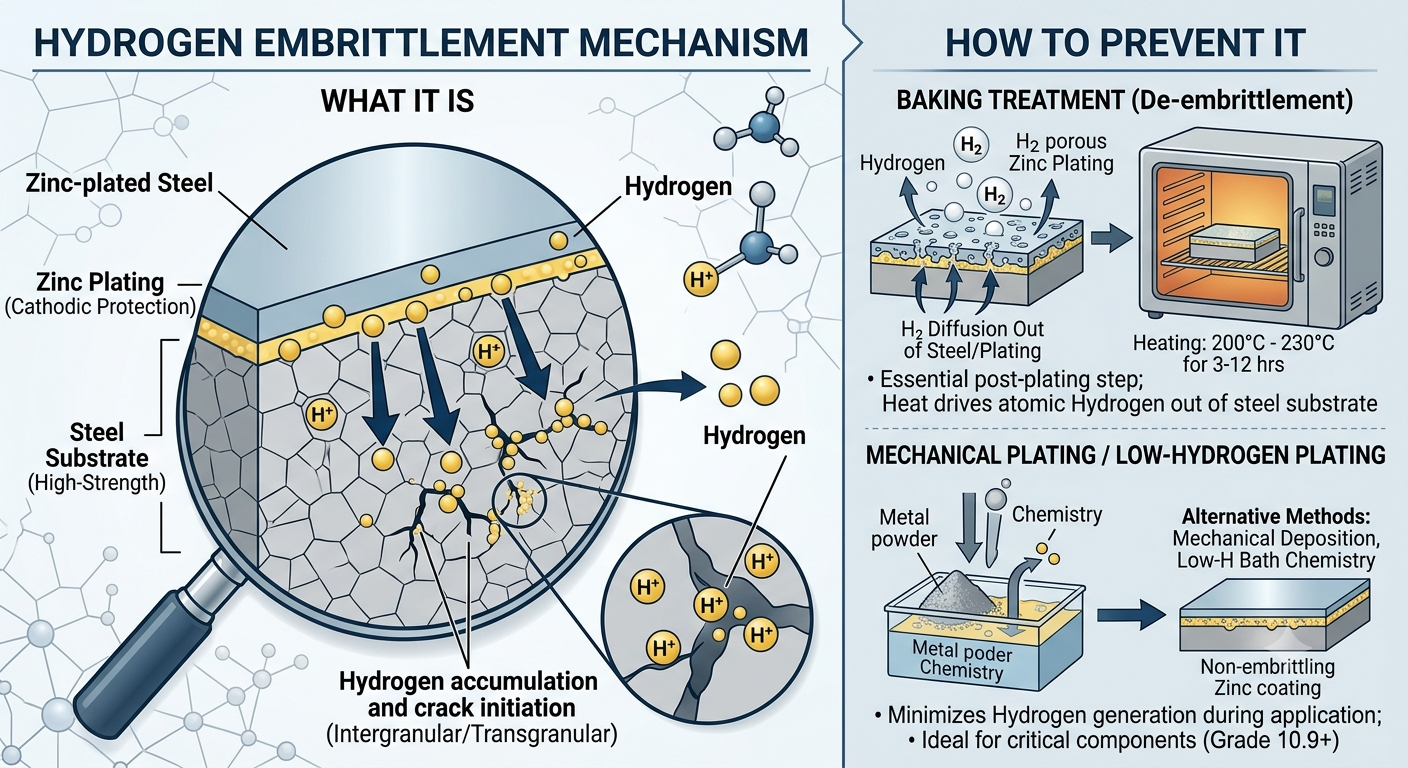
A fastener that passes every inspection before it ships then snaps under normal operating load weeks later. Hydrogen embrittlement is the silent failure mode that can turn a compliant zinc-plated part into a field disaster. Here’s the complete engineering and process guide to understanding, preventing, and specifying around it.
Of all the failure modes in metal finishing, hydrogen embrittlement is the one that keeps engineers awake at night and for good reason. Unlike surface rust or coating delamination, hydrogen embrittlement produces no visible warning before failure. A plated part can look perfect, measure on-spec, and pass every receiving inspection, then fracture abruptly under loads well within its rated capacity after weeks or months in service.
The problem is real, well-documented, and entirely preventable if you understand the mechanism, know which parts are at risk, and specify the right process controls with your plater. At Plateco, we’ve been zinc plating components for demanding applications since 1974. This guide covers everything manufacturers, engineers, and procurement teams need to know about hydrogen embrittlement in the context of zinc electroplating.
What Is Hydrogen Embrittlement?
Hydrogen embrittlement (HE) is a form of material degradation in which atomic hydrogen absorbed into the metallic lattice structure of steel during electroplating or acid cleaning reduces the metal’s ductility and fracture toughness. The result is a part that is more brittle than it was before plating: one that can fracture at stress levels significantly below its design yield strength, often without any plastic deformation or visible warning.
The phenomenon is sometimes called hydrogen-induced cracking (HIC), delayed fracture, or static fatigue. The “delayed” terminology is important: the fracture doesn’t necessarily occur during or immediately after plating. Hydrogen absorbed into the steel can remain trapped for hours, days, or weeks and the part may appear structurally sound until it’s put into service and placed under sustained load. That delayed failure mechanism is what makes hydrogen embrittlement particularly dangerous in fasteners, springs, and structural hardware.
Failure SignatureThe classic signature of a hydrogen embrittlement failure is brittle fracture under loads below the material’s rated yield strength, often occurring hours to weeks after installation. The fracture surface typically shows a flat, intergranular or transgranular crack morphology with no significant necking or plastic deformation sharply different from ductile overload failure.
The Atomic Mechanism
During electroplating, the zinc deposition process is driven by electrical current passing through an electrolyte solution. As a side reaction, hydrogen ions (H⁺) in the acidic electrolyte are reduced at the cathode surface the steel part to form atomic hydrogen (H). Some of this atomic hydrogen immediately recombines into molecular hydrogen (H₂) and bubbles off harmlessly. But a portion diffuses into the steel’s crystal lattice before it can escape.
Once inside the steel, atomic hydrogen migrates toward areas of high residual stress grain boundaries, existing micro-cracks, inclusions, and other lattice defects. It accumulates at these sites and, under sustained tensile stress, reduces the cohesive energy of the metallic bonds at the crack tip. This allows the crack to propagate at stress levels that would normally be insufficient to cause failure. The higher the steel’s strength, the more susceptible it is to this mechanism which is why hardened, high-strength steels are the primary concern.
Have Questions About Your Parts? – (608) 524-8241
Why Zinc Plating Specifically Creates Risk
Zinc electroplating creates hydrogen embrittlement risk through two distinct process stages, both of which introduce atomic hydrogen into the steel substrate:
- Acid cleaning and pickling (pre-plate): Before zinc can be deposited, the steel surface must be cleaned of oxides, scale, and contaminants. Acid pickling typically in hydrochloric or sulfuric acid dissolves these surface layers but simultaneously attacks the steel surface itself, generating significant atomic hydrogen at the metal surface. For high-strength steels, this pre-treatment step alone can introduce enough hydrogen to cause embrittlement.
- Electroplating process: The cathodic reduction reaction that deposits zinc also reduces hydrogen ions at the steel surface. The amount of hydrogen absorbed depends on current density, bath chemistry, pH, temperature, and plating time. Acid zinc bath systems (the most common commercial zinc plating chemistry) generate more hydrogen absorption than alkaline zinc systems, though both require attention for high-strength substrates.
The zinc coating itself complicates the problem: once deposited, it acts as a barrier that slows the outward diffusion of trapped hydrogen from the steel. This is why the bake relief process described in detail below must be performed promptly after plating, before the zinc coating fully seals the diffusion pathways.
Which Parts Are at Risk?
Not all zinc-plated parts carry the same hydrogen embrittlement risk. The susceptibility of a part depends almost entirely on the tensile strength of the steel substrate and the presence of sustained tensile stress in service. Understanding this relationship is critical to deciding when bake relief is required and when it can be omitted.
The 150 ksi Threshold
The industry-accepted threshold for hydrogen embrittlement concern is a tensile strength of 150,000 psi (150 ksi, approximately 1,034 MPa). Above this strength level, steel’s susceptibility to hydrogen-induced delayed fracture increases dramatically. Below it, most commercial steels have sufficient ductility to tolerate the hydrogen levels introduced by standard electroplating without significant risk of delayed fracture under normal service loads.
ASTM B633 explicitly requires hydrogen embrittlement relief baking for steel parts with hardness exceeding HRC 40 (approximately equivalent to 180 ksi tensile strength). AMS 2417 and other aerospace standards set the threshold lower at HRC 36 or 150 ksi reflecting the more conservative approach appropriate for safety-critical applications.
Hydrogen Embrittlement Risk by Steel Strength Class
| Tensile Strength | Hardness (HRC) | HE Risk Level | Bake Relief | Typical Examples |
|---|---|---|---|---|
| Below 150 ksi | Below HRC 36 | Low | Optional | Low-carbon steel hardware, mild structural fasteners, stampings |
| 150–180 ksi | HRC 36–40 | Moderate | Recommended | SAE Grade 8 fasteners, medium-alloy steel parts, heat-treated brackets |
| 180–220 ksi | HRC 40–50 | High | Required | High-strength structural bolts, hardened pins, suspension components |
| Above 220 ksi | Above HRC 50 | Very High | Required + Verify | Springs, lock wire, hardened specialty fasteners, tool steel parts |
High-Risk Part Categories
High Risk
Threaded Fasteners (Grade 8+)SAE Grade 8, Grade 10.9/12.9 metric bolts and studs. High stress concentration at thread roots creates ideal HE initiation sites.
High Risk
Springs & ClipsHigh-carbon spring steel under sustained pre-load. Extremely susceptible many aerospace standards prohibit electroplating springs above certain strength levels entirely.
High Risk
Hardened Pins & ShaftsThrough-hardened pins, roll pins, and shafts above HRC 40. Bending and shear stresses during service create conditions for delayed fracture.
Moderate Risk
Case-Hardened PartsParts with hard surface layers over softer cores. The hard case is susceptible; the core may mitigate total fracture risk but monitoring is still required.
Moderate Risk
Heat-Treated Alloy SteelQuenched and tempered alloy steel components in the 150–180 ksi range. Risk is process-dependent and manageable with proper bake relief.
Low Risk
Low-Carbon Steel HardwareStampings, brackets, mild steel fasteners below 150 ksi. Standard zinc plating processes are generally safe without supplemental bake relief for these substrates.
Hydrogen Embrittlement Relief: The Baking Process
The primary method for preventing hydrogen embrittlement damage in zinc-plated parts is hydrogen embrittlement relief baking a post-plate heat treatment that drives the absorbed atomic hydrogen out of the steel before it can cause delayed fracture. When performed correctly and promptly after plating, bake relief is highly effective at reducing hydrogen content to safe levels.
How Bake Relief Works
At room temperature, atomic hydrogen diffuses slowly through steel’s crystal lattice. At elevated temperatures (typically 375–450°F / 190–230°C), the diffusion rate increases dramatically, allowing trapped hydrogen to migrate to the surface and escape into the atmosphere before the passivated zinc coating fully closes the diffusion pathways.
The baking process does not remove all absorbed hydrogen it reduces hydrogen concentration to a level below which delayed fracture will not occur under normal service stresses. The effectiveness depends on three variables: temperature, time, and how quickly baking begins after plating.
Bake relief must begin within 4 hours of plating completion per ASTM B633 and most OEM specifications. After this window, the zinc and passivate coating have sufficiently densified to impede hydrogen outward diffusion, significantly reducing the effectiveness of baking. Parts that miss the 4-hour window may need to be rejected or subjected to extended baking with verification testing consult your plater and the applicable specification.
Standard Bake Relief Parameters
| Steel Hardness / Strength | Temperature | Minimum Duration | Timing After Plating | Standard Reference |
|---|---|---|---|---|
| HRC 36–40 (150–180 ksi) | 375°F (190°C) ± 25°F | 8 hours | Within 4 hours | ASTM B633 / SAE J124 |
| Above HRC 40 (180+ ksi) | 375°F (190°C) ± 25°F | 8–24 hours | Within 4 hours | ASTM B633 / AMS 2417 |
| Springs / HRC 50+ | 375°F (190°C) ± 25°F | Up to 24 hours | Within 1 hour | AMS 2417 / customer spec |
| Aerospace / safety-critical | Varies by spec | Per customer spec | Often within 1 hour | Per OEM / AMS / MIL-SPEC |
Why Temperature Matters and Its Limits
375°F (190°C) is the standard bake temperature because it represents a practical balance: hot enough to drive meaningful hydrogen diffusion in a reasonable time, but below the tempering temperature of most hardened steels. Baking at too high a temperature risks softening the part reducing its hardness and tensile strength below the values it was heat-treated to achieve. For many high-strength steel grades, the tempering temperature is between 400–500°F, meaning bake relief must stay below this threshold.
Before specifying bake relief for any heat-treated part, confirm the tempering temperature of the steel with your metallurgist or material supplier. If the bake temperature required by the specification approaches the steel’s tempering temperature, discuss alternative approaches including alkaline zinc plating processes that introduce less hydrogen with your plating partner.
The Bake Relief Process Step-by-Step
Parts are plated to specification, passivated (clear, yellow, or black chromate), and rinsed. The clock starts here the 4-hour window to begin baking begins at the end of the plating cycle.
Parts are loaded into a calibrated baking oven set to 375°F ± 25°F. Oven temperature must be verified with calibrated instrumentation process records must document the actual temperature throughout the bake cycle.
Parts are held at temperature for the full required duration typically 8 hours for commercial applications, up to 24 hours for high-strength or safety-critical components. Duration begins when the part (not just the oven air) reaches the target temperature.
Parts are allowed to cool to room temperature. Visual inspection and dimensional verification are performed. For high-strength applications, sustained load testing per ASTM F606 or ASTM F1624 may be required to verify embrittlement relief effectiveness.
Bake relief parameters (temperature, duration, timing from plating, oven calibration records) are documented in the job traveler and quality records. For OEM-controlled parts, this documentation is part of the required traceability package.
Process Controls That Reduce Hydrogen Introduction
Bake relief treats hydrogen after it has been absorbed. But equally important and often overlooked are the process controls upstream that reduce how much hydrogen enters the steel in the first place. A well-controlled plating process minimizes hydrogen absorption, making bake relief more reliably effective and reducing the risk of residual hydrogen above the threshold for delayed fracture.
Pre-Treatment: Controlling Acid Cleaning
Acid pickling is the largest single source of hydrogen absorption in most zinc plating operations. Several process controls reduce this risk significantly:
- Minimize acid exposure time: The longer the part sits in acid, the more hydrogen is absorbed. Process-controlled pickling with defined immersion times rather than open-ended “soak until clean” approaches dramatically reduces hydrogen uptake.
- Use inhibited acid solutions: Pickling inhibitors are chemical additives that suppress the attack of acid on the steel surface (and therefore hydrogen evolution) while still dissolving oxides and scale. They are standard practice in plating operations serving high-strength steel parts.
- Mechanical cleaning as alternative: For parts above HRC 40, some specifications require or prefer mechanical cleaning methods (shot blasting, abrasive blasting, or tumbling) over acid pickling to avoid hydrogen introduction entirely. Mechanical cleaning has its own trade-offs surface roughness, dimensional effects on precision parts but for extreme-high-strength steels it may be the only fully safe pre-treatment approach.
- Alkaline cleaning before acid: Thorough alkaline degreasing before acid exposure reduces the acid exposure time needed for adequate cleaning, limiting total hydrogen absorption.
Plating Bath Selection: Alkaline vs. Acid Zinc
The choice of zinc plating bath chemistry has a direct impact on hydrogen absorption during electrodeposition:
- Alkaline zinc (zincate bath, cyanide bath): Alkaline zinc systems operate at higher pH and introduce significantly less hydrogen into the substrate during deposition compared to acid zinc. For high-strength steel components, alkaline zinc plating is often the preferred process precisely because of its lower hydrogen embrittlement risk. The trade-off is generally lower deposit efficiency and slightly different zinc deposit properties.
- Acid zinc (chloride bath): Acid zinc systems produce excellent deposit quality, brightness, and efficiency, and are the dominant commercial process. They introduce more hydrogen during deposition than alkaline systems. For parts below 150 ksi, this is generally not a concern. For higher-strength parts, bake relief is more critical when acid zinc is used.
Process Selection GuidanceIf your parts are above HRC 40 (approximately 180 ksi tensile strength) and will be zinc electroplated, discuss with your plater whether alkaline zinc bath chemistry is available and appropriate for your application. The reduction in hydrogen introduction from alkaline processing, combined with proper bake relief, provides the best available protection against embrittlement in commercial zinc plating operations.
Current Density and Plating Parameters
Higher cathodic current density during plating increases the rate of hydrogen evolution at the part surface and therefore increases hydrogen absorption. Running at optimized rather than maximum current density, maintaining bath temperature within specification, and controlling zinc ion concentration all contribute to minimizing hydrogen uptake without compromising plating quality or throughput.
Testing for Hydrogen Embrittlement
Hydrogen embrittlement is essentially impossible to detect by visual inspection or standard dimensional gauging. The hydrogen is trapped inside the steel’s crystal lattice invisible from the outside. Verification that bake relief was effective requires mechanical testing under sustained load, not inspection of the coating.
ASTM F606 and F1624: Sustained Load Testing
The primary test methods for hydrogen embrittlement detection in fasteners are ASTM F606 (proof load testing) and ASTM F1624 (incremental step loading). In sustained load testing, a sample of the plated and baked fasteners is loaded to a defined percentage of proof load (typically 75–100%) and held for a defined period (typically 24–200 hours). Parts that fracture during the sustained load test have failed the hydrogen embrittlement requirement.
This testing is typically required for:
- First-article qualification of a new part, material, or plating process combination
- Any change in steel grade, heat treat condition, or plating process parameters
- Aerospace, automotive safety-critical, and defense applications where the consequence of embrittlement failure is severe
- Any situation where the 4-hour post-plate baking window was missed
Testing Is Not a Substitute for Process ControlSustained load testing is a verification tool, not a manufacturing strategy. Because hydrogen embrittlement failure is statistical not all parts in a lot will fail, even if conditions were unfavorable passing a sample lot test does not guarantee that every part in the lot is safe. Process control upstream (correct bake relief, inhibited acid, proper timing) provides population-level protection that sampling cannot.
Notch Tensile Testing
Notch tensile testing introduces a stress concentration (notch) in a test specimen and measures the ratio of notch tensile strength to unnotched tensile strength. A low notch-to-unnotch ratio indicates that the material is exhibiting notch sensitivity a sign of hydrogen embrittlement. This method is more sensitive than proof load testing for detecting moderate embrittlement but requires machined test specimens and is more commonly used in laboratory or aerospace qualification contexts than in routine commercial production.
How to Specify Hydrogen Embrittlement Relief on a Drawing
The most common cause of hydrogen embrittlement failures in production parts is not ignorance of the phenomenon it’s under-specification. Engineers who understand the risk often still fail to communicate the requirement completely on the part drawing or purchase order, leaving the plater without the information needed to apply the correct process.
A complete hydrogen embrittlement specification for a zinc-plated part must include: the base plating specification, the hardness or tensile strength of the substrate (so the plater can determine the applicable risk class), the bake relief parameters, and the timing requirement. For OEM-controlled parts, the applicable OEM or industry standard should be called out by document number.
Zinc electroplate per ASTM B633, SC3, trivalent yellow passivate (Type II). Steel hardness HRC 38–42. Hydrogen embrittlement relief bake required: 375°F ± 25°F for minimum 8 hours, commencing within 4 hours of plating completion. Bake relief documentation required with shipment. RoHS compliant per Directive 2011/65/EU. No hexavalent chromium.
Zinc electroplate per ASTM B633, SC3, trivalent yellow passivate (Type II). Material: SAE 4140 quenched and tempered, Rm = 1050–1200 MPa (152–174 ksi). Hydrogen embrittlement relief bake: 190°C ± 15°C for minimum 8 hours within 4 hours of plating. First-article sustained load test per ASTM F606 required. Full process traceability documentation required per ISO 9001. RoHS/ELV compliant.
What to Include and What Never to Leave Off
The three elements most commonly missing from specifications that result in embrittlement risk are: (1) the substrate hardness or tensile strength class, (2) the explicit bake relief call-out with time and temperature, and (3) the timing requirement (within 4 hours of plating). Any one of these omissions transfers full responsibility for the process decision to the plater who may not have the information needed to make the correct call.
If your purchase order simply says “zinc plate per ASTM B633, SC3” on a Grade 8 fastener drawing, the plater will likely plate to specification and may or may not apply bake relief depending on their standard operating procedures. Getting the explicit specification on the print is the only reliable way to ensure the correct process is applied every time, across every plating run.
OEM and Industry Standard Requirements
Major OEM customers have their own internal specifications governing hydrogen embrittlement requirements for zinc-plated components. Understanding how these specifications align with and in some cases exceed ASTM B633 is essential for manufacturers supplying into controlled supply chains.
Automotive OEMs (GM, Ford, Stellantis): Automotive OEM specifications for high-strength fasteners and structural components universally require hydrogen embrittlement relief baking for parts above HRC 32–36 depending on the specific document. Many automotive fastener specs call out SAE J124 (Embrittlement Testing of Components Made From High-Strength Steels) as the applicable test standard. First-article qualification typically requires sustained load testing per ASTM F606.
John Deere (JDM specifications): John Deere’s specifications for high-strength fasteners and structural hardware require bake relief for parts above HRC 36, with explicit temperature, time, and timing requirements consistent with ASTM B633. Plateco regularly processes parts to JDM specifications with full process documentation for traceability.
Aerospace (AMS 2417, MIL-SPEC): Aerospace specifications are the most stringent. AMS 2417 (the primary aerospace zinc plating specification) requires embrittlement relief for all steel parts with tensile strength above 150 ksi, with baking beginning within 1 hour of plating completion in many cases. For the highest-strength aerospace grades (above 200 ksi), electroplating may be prohibited entirely and mechanical galvanizing or other processes must be used instead.
Plateco OEM CapabilityPlateco is ISO 9001:2015 certified and processes zinc-plated parts to ASTM B633, John Deere JDM, Caterpillar CAT, Parker Hannifin, and major automotive OEM specifications including full bake relief with time, temperature, and traceability documentation. If your application involves high-strength steel components, send us your print and we’ll confirm the applicable specification requirements before your first run.
Hydrogen Embrittlement Prevention: The Complete Checklist
Preventing hydrogen embrittlement failures requires correct action at every stage of the process from engineering specification through production plating and final verification. Use this checklist as a practical reference for any zinc plating project involving steel above 150 ksi.
- Identify substrate hardness and tensile strength before specifying the plating process. Know your material’s condition before writing the drawing note.
- Specify bake relief explicitly on the drawing temperature (375°F ± 25°F), duration (minimum 8 hours), and timing (within 4 hours of plating). Never assume the plater will apply bake relief by default.
- Include hardness class in the specification so the plater can verify that their process controls are appropriate for the substrate being processed.
- Request alkaline zinc bath chemistry for parts above HRC 40 where the lower hydrogen introduction of alkaline systems provides additional safety margin.
- Confirm your plater uses inhibited acid pickling for high-strength substrates uninhibited acid pickling is a significant source of excess hydrogen absorption.
- Require process documentation oven calibration records, time-temperature charts, and timing-from-plating records with each production lot for traceability and quality system compliance.
- Specify first-article sustained load testing per ASTM F606 or F1624 for new part and process combinations involving safety-critical components above HRC 40.
- Review the tempering temperature of your steel and confirm it is above the bake relief temperature. For steels tempered at 375–450°F, bake relief may be incompatible discuss alternative processes with your plater and metallurgist.
- Confirm RoHS compliance of the passivate chemistry trivalent chromate systems are required for most automotive and electronics supply chains.
- Pass complete specifications through your supply chain don’t translate “plate per customer requirement” into a vague drawing note. Transcription of specifications loses critical process details.
” We treat zinc plating as an extremely complex process demanding state-of-the-art technology, painstaking planning, obsessive quality control, and a tremendous amount of talent. Because our customers don’t come to us for excuses they come to us for perfection. And we’ll do whatever it takes to give them nothing less.” Jim Schweich, Chief Executive Perfectionist, Plateco, Inc.
Frequently Asked Questions
Q. Does hydrogen embrittlement affect all steel parts that are zinc plated?
No. Hydrogen embrittlement is primarily a concern for high-strength steels above approximately 150 ksi (HRC 36) tensile strength. Low-carbon and mild steel hardware the majority of commercial zinc-plated parts by volume have sufficient ductility to tolerate the hydrogen introduced by standard plating processes without delayed fracture risk. The risk increases sharply above 150 ksi and becomes critical above 180 ksi.
Q. Can hydrogen embrittlement be detected visually after plating?
No. That’s what makes it so dangerous. A hydrogen-embrittled part is visually indistinguishable from a sound part. The hydrogen is trapped inside the steel lattice and produces no visible surface indication. Embrittlement is only detectable through mechanical testing specifically sustained load testing or notch tensile testing which is why process control (correct bake relief, proper timing) is the primary defense, not inspection.
Q. What happens if bake relief isn’t performed within the 4-hour window?
If the 4-hour window is missed, the zinc and passivate coating will have begun to densify, significantly reducing the outward diffusion of hydrogen during any subsequent baking. Parts that miss the window can still be baked it’s better than no bake at all but the effectiveness is reduced. For safety-critical applications, parts that miss the timing requirement should be evaluated against the applicable specification, which may require rejection, extended baking with verification testing, or disposition by the customer’s engineering team.
Q. Does bake relief affect the zinc coating or passivate appearance?
Baking at 375°F can cause some color shift in passivate finishes particularly trivalent yellow passivate, which may become slightly darker or more uniform after baking. This is a cosmetic effect and does not indicate a reduction in corrosion protection. Clear passivate is generally less affected visually. If consistent passivate appearance is critical for your application, discuss bake relief effects with your plater and request a sample baked part before production qualification.
Q. Are there alternatives to bake relief for hydrogen embrittlement prevention?
Yes, several. Mechanical galvanizing (tumble application of zinc powder, no electrochemical deposition, no hydrogen generation) is completely free of hydrogen embrittlement risk and is specifically recommended for high-strength fasteners in many specifications. Mechanical galvanizing does not require bake relief. Alkaline zinc electroplating introduces significantly less hydrogen than acid zinc systems, reducing (but not eliminating) the bake relief requirement. For the highest-strength steel grades, these alternatives may be the better engineering choice compared to electroplating with bake relief.
Q. How does hydrogen embrittlement differ from stress corrosion cracking?
Both produce brittle fracture under sustained load in high-strength steel, but through different mechanisms. Hydrogen embrittlement is caused by atomic hydrogen in the steel lattice, typically introduced during plating or pickling. Stress corrosion cracking (SCC) occurs when a susceptible material is simultaneously exposed to a corrosive environment and tensile stress the cracking is driven by ongoing corrosion at the crack tip, not pre-absorbed hydrogen. In practice, both can affect zinc-plated high-strength steel components, and they can be difficult to distinguish on a fracture surface without detailed metallographic analysis.
Q. Does Plateco perform bake relief in-house, and can I get documentation?
Yes on both counts. Plateco performs hydrogen embrittlement relief baking in-house with calibrated ovens and documented process records. Time-temperature data, oven calibration certificates, and timing-from-plating records are maintained as part of our ISO 9001:2015 quality management system and are available for customer review and OEM audits. For high-strength parts, let us know the substrate hardness and applicable specification at the time of quoting so we can confirm the correct process and include bake relief in the job traveler from the start.
Have a High-Strength Steel Component?
Plateco has processed zinc-plated parts to ASTM B633, SAE J124, John Deere JDM, and major automotive OEM specifications including full hydrogen embrittlement relief documentation since 1974. Tell us about your parts and we’ll confirm the correct process before the first run.