

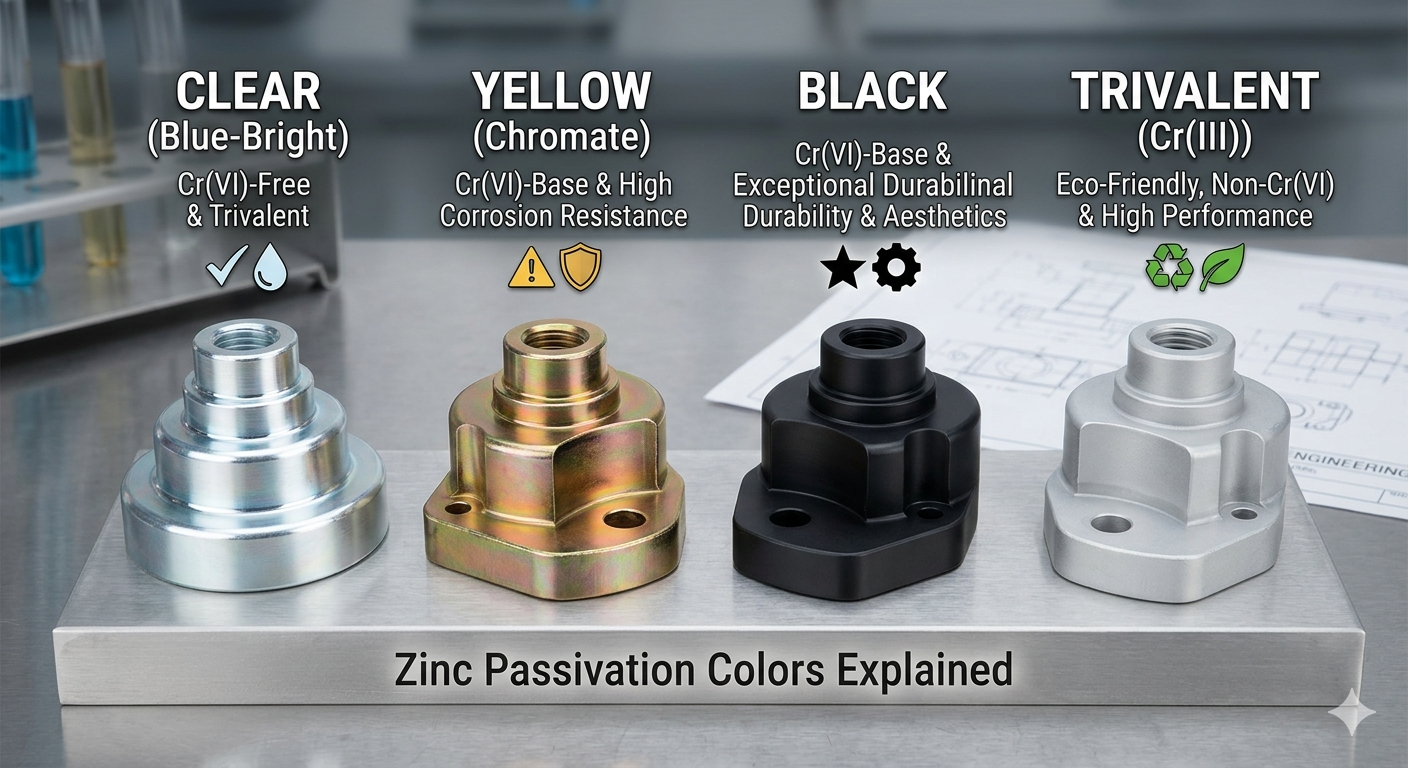
The Color Is Not Just a Cosmetic Choice
If you have ever held a zinc-plated bolt, bracket, or stamping and noticed that some parts look silvery-clear, others have a golden-yellow iridescence, and still others are a deep matte black you may have assumed the color was purely a cosmetic preference. A style choice. Something chosen for appearance.
That assumption is one of the most common and most costly misconceptions in metal finishing.
The color you see on a zinc-plated part is the visual signature of its passivate coating, and that passivate coating is doing the most important protective work of the entire finishing system. It is the chemical layer that sits between your zinc deposit and the corrosive forces of moisture, oxygen, and salt that the part will face in service. Choose the wrong passivate for your application, and your parts will fail their salt spray requirements, rust prematurely in the field, or fail regulatory compliance checks regardless of how well the zinc itself was applied.
At Plateco, we have been zinc plating parts since 1974. In that time, we have processed parts for automotive OEMs, agricultural equipment manufacturers, construction hardware suppliers, industrial fastener producers, and dozens of other industries. And one of the questions we answer most consistently from engineers, procurement professionals, and quality managers alike is this: what is the difference between all these passivate colors, and which one do I need?
This guide answers that question completely. We will explain what a passivate actually is, walk through every major passivate color clear, yellow, black, and olive drab explain the critical difference between trivalent and hexavalent chemistry, and give you a practical framework for choosing the right passivate for your parts.
Part 1: What Is Passivation and Why Does Every Zinc-Plated Part Need It?
To understand passivation, you first need to understand the chemistry of zinc itself.
Zinc is what metallurgists call a sacrificial metal. When zinc is applied to steel, it protects the base metal by corroding first. Because zinc is more electronegative than iron, environmental attack moisture, oxygen, salt hits the zinc before it ever reaches the steel underneath. The zinc gives itself up to protect the steel. This is why zinc plating is such an effective corrosion protection strategy, and why it is specified across so many demanding industries.
But here is the complication: bare zinc is actually very reactive. Left unprotected, zinc will begin forming zinc oxide on its surface almost immediately upon exposure to moisture and oxygen. You know this as white corrosion that chalky, powdery white deposit that forms on unprotected zinc surfaces. While white corrosion is not the same as the destructive red rust of corroding steel, it is still a problem. It signals that the zinc is being consumed rapidly, it looks unsightly on parts that will be visible, and it shortens the time before the zinc is depleted and the steel beneath becomes exposed to red corrosion.
This is where passivation comes in.
Passivation also called chromate conversion coating or chromating is a chemical treatment applied to the zinc surface immediately after plating. The passivate reacts with the zinc to form a thin, tightly bonded conversion coating that dramatically slows the rate at which the zinc oxidizes. Think of it this way: the zinc is your primary armor, and the passivate is the shield that protects the armor. Together, they form a two-layer defensive system.
At Plateco, we consider passivation to be one of the most critical phases of the zinc finishing process. The zinc deposit can be perfectly applied correct thickness, excellent adhesion, flawless coverage and still produce a part that fails its salt spray requirement if the passivate is wrong, poorly applied, or compromised during downstream processing such as hydrogen embrittlement relief baking.
Understanding passivation is not optional for anyone who specifies, purchases, or quality-inspects zinc-plated parts. It is fundamental.
THE ULTIMATE ZINC PLATING COMPANY – (608) 524-8241
Part 2: Trivalent vs. Hexavalent The Chemistry Difference You Cannot Ignore
Before we go color by color, we need to address the most important distinction in modern passivation chemistry: the difference between trivalent and hexavalent chromium passivates. This is not a technical detail it is a regulatory and commercial reality that affects every zinc plating specification written today.
Hexavalent Chromium (Cr6+): The Old Standard
For most of the twentieth century, the industry used hexavalent chromium passivates. These are the passivates that most people picture when they think of “yellow zinc” the bright, iridescent gold finish that was ubiquitous on hardware and fasteners for decades.
Hexavalent chromium passivates offered outstanding corrosion performance. Their self-healing capability was particularly valuable: if the passivate was scratched during shipping or assembly, the chromium ions within the coating could migrate toward the damaged area and re-passivate the exposed zinc, effectively healing the scratch at a chemical level. No paint or powder coat can do this.
The problem is that hexavalent chromium (Cr6+) is a known carcinogen and a serious environmental hazard. It is toxic in small quantities, hazardous to workers who apply it, and a significant environmental burden when it enters water systems.
Beginning in the early 2000s, major regulatory frameworks began restricting or prohibiting hexavalent chromium in finished products. The European Union’s RoHS Directive (Restriction of Hazardous Substances) effectively banned Cr6+ in electrical and electronic equipment. The REACH regulation placed it on the restricted substances list. Automotive OEMs followed with their own specifications that explicitly excluded hexavalent coatings from components on new vehicles. Defense and aerospace programs added their own restrictions.
Today, hexavalent chromium passivates are prohibited in the vast majority of commercial applications. At Plateco, all of our standard passivate offerings are trivalent REACH compliant, RoHS compliant, and safe for use in every modern application.
Trivalent Chromium (Cr3+): The Modern Standard
Trivalent chromium passivates use a different form of chromium Cr3+ that delivers excellent corrosion protection without the toxicity and regulatory problems of hexavalent chemistry. The trivalent ion is far less soluble and far less mobile than Cr6+, which means it does not present the same environmental or health hazards.
Modern trivalent passivates have been developed to a point where they match or approach the corrosion performance of hexavalent coatings in most applications. They are available in all of the same visual formats clear, yellow, and black and they meet or exceed the requirements of ASTM B633, automotive OEM specifications including GMW3044 and Ford WSS-M21P17, and the specifications of major industrial OEMs including John Deere (JDM), Case CNH, Caterpillar (CAT), and Parker Hannifin.
The one area where trivalent passivates differ from hexavalent is the self-healing mechanism. Because Cr3+ ions are less mobile, the self-repair capability of trivalent passivates is more limited than hexavalent. However, this is addressed in most high-performance applications through the use of supplemental sealers applied over the passivate layer a standard practice in modern zinc finishing.
All passivates discussed in the remainder of this guide are trivalent unless specifically noted otherwise.
Part 3: Clear Passivate The Everyday Workhorse
What It Looks Like
Clear passivate sometimes called trivalent clear or blue-bright passivate produces a finish that is transparent to slightly blue-iridescent in appearance. The natural silver-gray color of the zinc deposit shows through, giving parts a clean, metallic look. On highly polished or rack-plated parts, the finish can be quite bright and visually appealing.
How It Performs
Clear passivate provides meaningful corrosion resistance improvement over bare zinc, but it is the thinnest and least protective of the passivate options. In ASTM B117 salt spray testing, parts with trivalent clear passivate typically target 72 to 120 hours to first white corrosion, with red corrosion resistance depending heavily on the zinc thickness underneath.
For most general industrial applications indoor hardware, lightly exposed fasteners, components used in sheltered environments clear passivate provides entirely adequate protection. It meets the corrosion requirements for ASTM B633 SC1 and SC2 service conditions and is sufficient for a wide range of standard specifications.
When to Specify Clear Passivate
Clear passivate is the right choice when your application requires a neutral, clean metallic appearance and the part will not face severe corrosive environments. It is the standard choice for many interior automotive components, general machine hardware, electronic enclosure fasteners, and interior-use stampings.
It is also the default starting point for many specifications that do not explicitly call out a higher-performing passivate. If your drawing simply says “zinc plate per ASTM B633 SC2” without specifying a passivate type, clear trivalent is typically what you will receive.
Important Caveat
Clear passivate is not the right choice for parts that will be exposed to outdoor environments, road salt, agricultural chemicals, or other severe corrosive conditions. Engineers who specify clear passivate for parts used in those environments frequently find that their salt spray requirements which may call for 120, 200, or 240 hours to red rust cannot be met without moving to a higher-performance passivate.
Part 4: Yellow Passivate The Performance Standard
What It Looks Like
Trivalent yellow passivate sometimes called yellow iridescent, gold iridescent, or simply yellow chromate produces a warm golden-yellow iridescent finish. The color can range from a light golden tone to a richer amber-yellow depending on the passivate chemistry and the zinc bath from which the parts were processed. Under different lighting conditions, the iridescent layer shifts slightly, which is normal and expected.
This is the finish that most people associate with “classic” zinc plating it has been the dominant finish on industrial hardware, agricultural fasteners, and construction equipment components for generations.
How It Performs
Yellow passivate is significantly more protective than clear passivate because it deposits a thicker, more substantial conversion coating on the zinc surface. The chemistry creates a denser chromate layer with more chromium ions incorporated into the film, which provides a stronger barrier against moisture and oxygen penetration.
In salt spray testing per ASTM B117, trivalent yellow passivate typically targets 96 to 200+ hours to first white corrosion, with red corrosion resistance that can meet the requirements of many demanding OEM specifications. Combined with adequate zinc thickness, yellow passivate is the standard choice for parts going to John Deere, Case CNH, Caterpillar, and similar agricultural and construction OEMs whose specifications require 120 to 240 hours to red rust.
The protection differential between clear and yellow passivate is not marginal it is substantial. When a part needs to survive in field conditions involving road salt, moisture cycling, agricultural exposure, or outdoor industrial environments, yellow passivate is frequently the specification baseline.
When to Specify Yellow Passivate
Yellow passivate is appropriate for any application requiring higher corrosion resistance than clear passivate can provide, particularly outdoor or semi-outdoor environments. Key applications include agricultural equipment fasteners and hardware, construction equipment components, automotive underbody and chassis hardware, outdoor industrial machinery, and any part whose specification calls for 120 or more hours to red rust.
If your part is going to a customer who references John Deere JDM, Case CNH, Caterpillar CAT, or Parker Hannifin corrosion specifications, yellow trivalent passivate is almost always the required finish.
Yellow Passivate and Sealer Combinations
For applications requiring the highest corrosion resistance available through zinc plating, yellow passivate is frequently combined with a supplemental sealer applied over the passivate layer. The sealer fills microscopic pores in the passivate film and adds another barrier layer against moisture intrusion. This combination zinc plus yellow passivate plus sealer represents the peak of standard zinc finishing corrosion performance and can target 240, 480, or even 1,000+ hours to red rust when combined with heavier zinc deposits.
Part 5: Black Passivate The Aesthetic and Functional Option
What It Looks Like
Black passivate produces a dark, matte-to-semi-gloss black finish on zinc-plated parts. The depth and uniformity of the black color is highly dependent on the quality of the passivate chemistry, the zinc bath composition, and the consistency of application. A well-applied black passivate is a deep, even, visually striking finish. A poorly applied one can look blotchy, grayish, or uneven.
Achieving and maintaining a consistent black finish is one of the more demanding passivate applications in zinc finishing. It requires precise bath control, careful temperature management, and rigorous quality monitoring to produce uniform color across a batch of parts. This is why not all plating shops offer black passivate and why the ones that do vary significantly in the quality of their results.
How It Performs
In terms of corrosion protection, black trivalent passivate typically performs comparably to yellow passivate. A well-applied black passivate will target similar hours to white and red corrosion in salt spray testing, though the specific performance data depends on the chemistry used and the zinc thickness underneath. Because black passivate parts are frequently specified for applications where appearance is important and because the black color can mask early white corrosion it is particularly important that the underlying zinc and passivate be properly applied to ensure functional protection, not just a visually acceptable appearance.
Black passivate almost always requires a sealer topcoat. The sealer serves two purposes on black parts: it enhances corrosion resistance by filling pores in the passivate film, and it protects the black color from “silvering” the fading of the black surface to a grayish tone that occurs when the passivate is abraded or exposed to handling without a protective topcoat.
When to Specify Black Passivate
Black passivate is specified primarily when aesthetics are a significant consideration alongside corrosion protection. Common applications include automotive interior and trim hardware, aftermarket automotive components, architectural hardware, consumer electronics fasteners, medical device hardware, and any application where a black finish matches the design intent of the assembled product.
Black zinc passivate has become increasingly popular in the firearms industry, architectural fastening systems, and premium consumer product assembly as a cost-effective alternative to black oxide or black paint finishes that provide less corrosion protection.
Part 6: Olive Drab Passivate The Military and Specialty Finish
What It Looks Like
Olive drab passivate produces a dull, matte green-brown finish that most people immediately associate with military hardware. It is a deliberately non-reflective, field-appropriate finish designed to blend with camouflage environments and meet military specification requirements.
How It Performs
Olive drab passivate is one of the higher-performing passivate options in terms of corrosion resistance, though in the modern environment, most olive drab specifications have transitioned to trivalent formulations to meet environmental compliance requirements. Historically, olive drab was produced with hexavalent chromium and offered excellent corrosion resistance and self-healing properties. Modern trivalent olive drab formulations are available but require careful specification to ensure performance equivalency.
When to Specify Olive Drab Passivate
Olive drab is specified almost exclusively for military, defense, and government applications where the finish is required by MIL-SPEC or similar defense procurement standards. If your application does not involve a military or defense specification explicitly calling for olive drab, it is rarely the appropriate choice yellow or black passivate will deliver equivalent or superior corrosion protection in most commercial applications.
Part 7: The Passivation Process What Makes the Difference Between Good and Poor Results
Understanding the passivate options is important. Understanding what makes passivation succeed or fail in practice is equally important.
Bath Chemistry Control
The passivate bath is a chemically sensitive system. The pH of the bath must be maintained within a precise range if it becomes too acidic, it will strip the zinc coating off the parts rather than converting it. If it is not acidic enough, the conversion reaction will not take place effectively, and the passivate film will be thin and underperforming.
Contamination is another critical concern. Even small amounts of iron or copper dragged into the passivation tank from previous process stages can disrupt the conversion chemistry and produce passivate films with poor corrosion resistance even if the bath looks visually normal.
At Plateco, our lab department monitors passivate bath chemistry daily, with dedicated analytical personnel whose sole focus is ensuring that every chemical parameter stays within specification. This is not a once-a-week check it is a continuous monitoring program that forms the backbone of our quality system.
Temperature and Immersion Time
Passivate baths must be maintained at the correct temperature, and parts must remain in the bath for the correct immersion time to build the conversion coating to the right thickness. Too short a time and the film will be thin and underprotective. Too long or at too high a temperature and the film can become over-built or develop adhesion problems.
These are the kind of process variables that separate plating shops with genuine process control from those running on intuition and habit.
The Post-Bake Re-Passivation Requirement
One of the most consequential passivation quality issues involves hydrogen embrittlement relief baking. High-strength steel parts that have been zinc plated often require a baking cycle to relieve hydrogen that was introduced into the metal during the plating process. This baking typically occurs at temperatures of 375°F (190°C) or higher for periods of several hours.
The problem is that passivate coatings cannot survive these temperatures. At baking temperatures, the passivate film dehydrates and loses its protective capability a fact that is well documented but frequently overlooked by plating shops that bake parts and ship them without re-applying the passivate afterward.
At Plateco, we address this directly through our conveyor belt baking process. After baking, parts are returned to our production lines for a fresh application of passivate. This step is non-negotiable parts that are shipped with dehydrated passivate after baking will fail their salt spray requirements, and the customer will never know why unless they understand this specific process risk.
Our conveyor belt oven over 90 feet in length moves parts slowly through the baking cycle to ensure that every part reaches full temperature and holds there for the required time. This is fundamentally different from industrial door ovens, which do not guarantee uniform temperature distribution across a full load of parts.
Need Help Choosing the Right Passivate for Your Parts?
Talk to the Plateco team. We will review your specification, your corrosion requirements, and your OEM program requirements and recommend the right passivate system no guesswork. Learn About Our Zinc Plating Capabilities
Part 8: How Passivate Color Relates to Specification Requirements
Reading Your Drawing
Most engineering drawings that specify zinc plating do so by reference to ASTM B633, which is the standard specification for electrodeposited coatings of zinc on iron and steel. ASTM B633 defines four service conditions (SC1 through SC4) with corresponding minimum zinc thickness requirements and minimum salt spray performance expectations.
What ASTM B633 does not do is prescribe a specific passivate color. The passivate selection is typically driven by the corrosion performance target how many hours to white rust and red rust your specification requires and then translated into the appropriate passivate chemistry by your plating partner.
This means that the conversation about passivate color is fundamentally a conversation about corrosion performance. When you call Plateco and tell us what salt spray performance you need, we will recommend the passivate that delivers it.
OEM-Specific Requirements
Many OEM specifications do prescribe specific passivate types, not just performance targets. John Deere JDM specifications, Case CNH specifications, Caterpillar CAT specifications, and Parker Hannifin specifications all include specific requirements around passivate chemistry, zinc thickness, and salt spray performance that must be met simultaneously.
If your parts are going to any of these OEM customers, your plating partner needs to understand those specifications in detail not just the salt spray hours, but the specific passivate chemistry, the sealer requirements, the documentation requirements, and the PPAP process. Plateco has deep experience with all of these OEM programs and can guide you through the specification requirements for your specific part.
When Performance Data Matters
If you are in a product development or PPAP qualification process, you may need actual salt spray test data for your passivated parts not just a certificate of compliance with the passivate specification. Plateco’s lab team provides salt spray testing for PPAP submissions and supplemental corrosion data, with our chamber set up per ASTM B117 / ISO 9227 and checked daily by certified lab personnel.
This means when we give you salt spray data for your passivated parts, it reflects the actual performance of the parts as processed not theoretical performance based on the passivate specification alone.
Passivate Color Is a Performance Decision
The color of the passivate on your zinc-plated part is not a cosmetic afterthought. It is the visible indicator of the protective system that determines how long your part will resist corrosion in the field, whether it will meet your customers’ salt spray requirements, and whether it complies with the environmental and regulatory standards that govern your industry.
Clear passivate delivers a clean metallic appearance with solid general-purpose corrosion protection right for indoor, sheltered, and light-duty applications. Yellow passivate is the performance workhorse the standard choice for agricultural, construction, and demanding industrial applications where higher salt spray hours are a firm requirement. Black passivate combines functional corrosion protection with aesthetic versatility for applications where appearance is a design consideration. Olive drab serves the military and defense world where field-appropriate aesthetics and MIL-SPEC compliance are the governing criteria.
And underlying every one of these choices is the fundamental shift from hexavalent to trivalent chemistry a shift that is no longer optional in most commercial markets but that has been executed well enough by the industry that modern trivalent passivates deliver excellent performance across all applications.
At Plateco, we have spent over five decades perfecting not just the zinc plating process but every step that surrounds it including passivation. From bath chemistry monitoring to post-bake re-passivation, from process control to salt spray documentation, our goal is to ensure that the passivate on your part performs exactly as your specification requires, every batch, every time.
Need Help Choosing the Right Passivate for Your Parts?
Talk to the Plateco team. We will review your specification, your corrosion requirements, and your OEM program requirements and recommend the right passivate system no guesswork. Contact the Plateco Team
Frequently Asked Questions About Zinc Passivation Colors
Q: Is yellow passivate the same as “gold zinc” or “yellow chromate”?
In general usage, yes. Yellow passivate, gold chromate, and yellow chromate all refer to the same visual finish on zinc-plated parts. The important distinction today is whether the passivate chemistry is trivalent or hexavalent. Modern yellow passivates at Plateco are trivalent REACH and RoHS compliant and deliver the same warm golden-yellow iridescent appearance without the regulatory and environmental concerns of hexavalent chemistry.
Q: Can I get the same corrosion performance from clear passivate as yellow passivate if I increase the zinc thickness?
Increasing zinc thickness does improve red corrosion resistance because there is more zinc for the environment to consume before reaching the steel. However, the passivate is specifically responsible for protecting the zinc from white corrosion and no amount of additional zinc thickness compensates for a thinner passivate film when it comes to white rust performance. If your specification requires high hours to white corrosion as well as red corrosion, the passivate type matters independently of the zinc thickness.
Q: What happens to the passivate when parts are baked for hydrogen embrittlement relief?
The passivate dehydrates at baking temperatures and loses much of its protective capability. This is one of the most important process considerations in zinc finishing. At Plateco, we address this by re-applying a fresh passivate coat after every baking cycle through our production lines. Parts that are shipped without re-passivation after baking will fail their salt spray requirements even if the zinc was perfectly applied.
Q: Does black passivate protect as well as yellow passivate?
When properly applied, black trivalent passivate delivers corrosion performance comparable to yellow passivate. The critical difference is that black passivate almost always requires a sealer topcoat both to protect the color from silvering and to achieve full corrosion performance. Black passivate without a sealer is more vulnerable to performance degradation from handling and abrasion than yellow passivate without a sealer. For parts where black is specified, always confirm with your plating partner whether a sealer is included in the finish system.
Q: Are hexavalent passivates still available, and should I specify them?
Hexavalent chromium passivates are still technically available from some plating shops, but they are prohibited or restricted under RoHS, REACH, and most major OEM specifications for commercial applications. At Plateco, we do not recommend hexavalent passivates for any application where REACH and RoHS compliance is required. If your application genuinely requires hexavalent passivate a very narrow set of legacy or specialized defense applications consult with your engineering and compliance teams before specifying it, and verify that your plating partner can meet all associated regulatory requirements.
Q: How do I know which passivate my OEM customer requires?
The OEM’s specification document referenced on your engineering drawing will define the passivate requirement either directly (by chemistry type) or indirectly (by salt spray performance requirement). Common OEM specifications we work with at Plateco include John Deere JDM, Case CNH, Caterpillar CAT, and Parker Hannifin. If you are not sure which passivate your OEM requires, share the specification document with your Plateco sales representative and we will identify the correct passivate and finish system.
Related Resources from Plateco
- Salt Spray Testing for Zinc Plated Parts: What the Results Mean
- Zinc Plating Process Overview: Rack, Barrel, and Mechanical Galvanizing
- Hydrogen Embrittlement: What It Is and How to Combat It
- Case Study: To Passivate or Not to Passivate
- ASTM B633 Service Conditions: Which Zinc Thickness Do You Need?
Plateco, Inc. is a family-owned, perfection-obsessed zinc plating company located in Wisconsin, serving manufacturers across the country since 1974. We specialize exclusively in zinc plating barrel electroplating, rack electroplating, and mechanical galvanizing with trivalent passivation in clear, yellow, black, and olive drab finishes. REACH and RoHS compliant on all trivalent passivate coatings. ISO 9001:2015 compliant.
Call us at (608) 524-8241 or reach out at sales@plateco.net