

What you will learn in this guide: What zinc barrel plating is and how it works, why construction materials are uniquely vulnerable to corrosion, which specific construction components benefit most from barrel plating, the key advantages of this finishing method over alternatives, how to evaluate coating specifications for your project, and when to consult a zinc plating specialist.
Why Construction Hardware Corrodes Faster Than You Think
Every construction project, from a residential deck to a commercial high-rise, depends on thousands of small steel components holding it together. Anchor bolts, structural screws, joist hangers, concrete fasteners, framing connectors, and tie plates are the invisible backbone of every structure built. And nearly all of them are made from steel — one of the most corrosion-prone metals in common use.
Steel without surface protection begins to rust the moment it contacts moisture and oxygen. In construction environments, those two elements are everywhere: rain, groundwater, concrete curing moisture, coastal humidity, and winter road salt runoff all accelerate the electrochemical reaction that turns strong, reliable steel into brittle, flaking iron oxide.
The consequences of corroded construction fasteners and connectors are not just cosmetic. When structural hardware degrades, the load-bearing capacity of the entire assembly is compromised. Corroded anchor bolts lose their tensile strength. Rusted joist hangers crack under load. Degraded concrete fasteners pull free from their embedment. The result can range from costly repairs to catastrophic structural failures.
This is precisely why zinc barrel plating has become one of the most widely used corrosion protection methods for construction hardware. It is cost-effective, scalable, technically sound, and capable of extending the service life of small steel components by decades in demanding environments.
This guide explains what zinc barrel plating is, why it works particularly well for construction materials, and which specific use cases benefit most from this finishing method.
What Is Zinc Barrel Plating?
Zinc barrel plating — more formally known as zinc barrel electroplating — is an electrochemical surface finishing process that deposits a protective zinc coating onto steel components in high-volume batches. Unlike painting or powder coating, which apply a physical barrier layer on top of the metal, zinc plating uses electrical current and chemistry to bond zinc atoms directly to the steel surface at the molecular level.
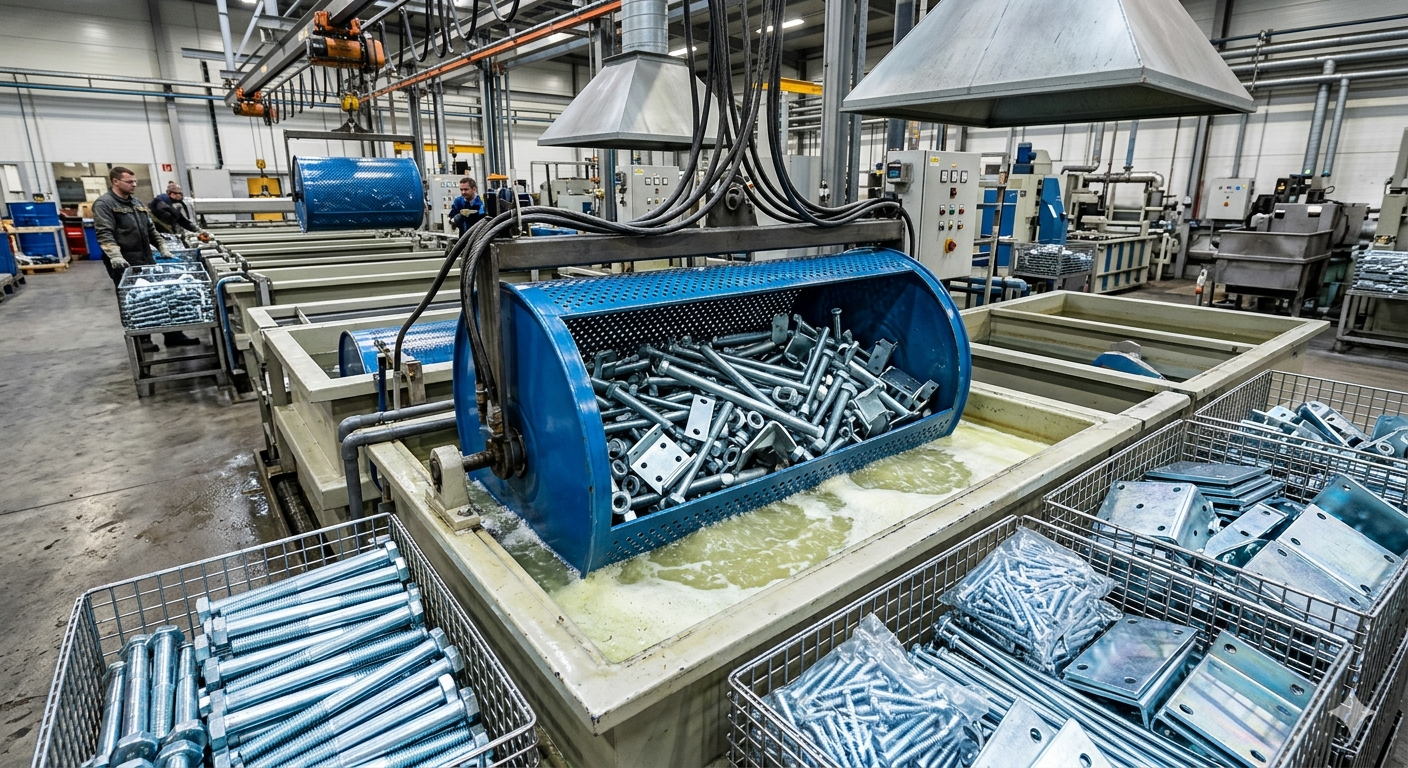
The “barrel” in barrel plating refers to a perforated rotating drum inside which hundreds or thousands of small parts tumble continuously during the plating process. This tumbling action ensures that every surface of every part — including threads, recesses, blind holes, and undercuts — gets exposed to the plating solution and receives a consistent zinc deposit.
Zinc plating works through a principle called sacrificial protection. Because zinc is more electrochemically active than steel, it corrodes preferentially — meaning zinc gives itself up to oxidation before the underlying steel is affected. Even if the zinc coating is scratched or chipped, the exposed steel nearby is still protected by the sacrificial action of the surrounding zinc.
This is fundamentally different from barrier-only coatings like paint. When a painted surface is scratched, the exposed steel is immediately vulnerable to rust. When a zinc-plated surface is scratched, the zinc around the scratch continues to protect the exposed area through galvanic action — buying significant additional protection before any rust develops.
Barrel plating is specifically designed for small to medium-sized components produced in large quantities. It is the industry-standard method for plating fasteners, stampings, clips, brackets, and connectors — the exact components that make up the bulk of construction hardware.
Why Construction Materials Face Severe Corrosion Challenges
Construction hardware operates in some of the harshest environments that small steel components ever encounter. Understanding why construction materials are so vulnerable to corrosion helps explain why zinc barrel plating is such a valuable solution for this industry.
Concrete and Alkaline Exposure
Freshly mixed concrete is highly alkaline, with a pH that can exceed 12. Steel embedded in or fastened near concrete during the curing process is exposed to this alkaline environment for weeks. While concrete’s alkalinity actually provides some protection to embedded rebar over time, steel fasteners and anchors at the concrete interface are in a more complex electrochemical environment. Zinc coatings provide a compatible, stable interface in these conditions, resisting the corrosive effects of cement chemistry while maintaining bond integrity.
Outdoor Weather Exposure
Most construction hardware — from roofing screws to deck fasteners to foundation anchor bolts — lives outdoors for the entire service life of the structure. In climates with significant rainfall, freeze-thaw cycles, or high humidity, unprotected steel fasteners can show visible surface rust within months of installation. In coastal environments where salt-laden air is a constant factor, corrosion rates are dramatically accelerated. For structures in northern climates, the annual application of road deicing salts creates additional corrosive runoff that reaches underground foundation hardware and below-grade connectors.
Dissimilar Metal Contact
Construction assemblies frequently bring steel fasteners into contact with aluminum framing, copper flashing, pressure-treated lumber, and other materials that can accelerate galvanic corrosion. Pressure-treated lumber, in particular, contains preservative compounds that are corrosive to unprotected steel. Zinc plating provides a stable intermediary layer that slows galvanic corrosion in these mixed-material assemblies.
Moisture Entrapment
Many construction connections create geometry that traps moisture — bolted joints, overlapping plates, and structural pockets all hold water against the steel surface long after rain has dried elsewhere. Trapped moisture dramatically accelerates corrosion, making surface protection for hardware in these locations especially important.
$276BAnnual cost of corrosion in U.S. infrastructure and construction
500+hrsSalt spray resistance achievable with zinc barrel plating + chromate
25–50%Reduction in per-part finishing cost vs. rack plating for small components
3–5xService life extension with proper zinc plating vs. uncoated steel
Key Benefits of Zinc Barrel Plating for Construction
1 Sacrificial Corrosion Protection That Works Even When Damaged
Unlike barrier coatings that fail the moment they are breached, zinc provides active electrochemical protection. During installation, construction fasteners are driven, torqued, and sometimes impacted — all of which can breach a paint or powder coat layer. Zinc plating’s sacrificial nature means the steel beneath remains protected even when the coating is damaged during normal installation processes.
2 Cost-Effective High-Volume Processing
Construction projects require enormous quantities of small hardware — sometimes tens of thousands of identical fasteners per project. Barrel plating processes hundreds of parts simultaneously in a single batch, dramatically reducing the per-part cost of corrosion protection. For construction hardware manufacturers supplying bulk quantities, barrel plating provides the best balance of protection quality and production economy available.
3 Consistent Coverage on Complex Geometry
Construction fasteners are geometrically complex. Threaded bolts, hex head screws, and anchor hardware have recesses, threads, and undercut features that are difficult to coat consistently with spray or dip methods. The continuous tumbling motion of barrel plating ensures plating solution reaches threads and recesses, depositing a uniform zinc layer across the entire part surface — including areas that manual or spray finishing cannot reliably reach.
4 Engineerable Corrosion Resistance Levels
Different construction applications require different levels of corrosion resistance. Interior structural screws in a dry climate need less protection than foundation anchor bolts in a coastal environment. Zinc barrel plating allows corrosion resistance to be engineered through three variables: zinc deposit thickness, chromate conversion coating type, and post-plate sealer application. This flexibility means construction hardware can be specified to meet the exact performance requirements of its environment.
5 Compliance with Industry Standards
The construction industry operates under well-defined material specifications. Zinc electroplating for construction hardware is governed by standards including ASTM B633, which specifies coating thickness and service condition classifications. Using a qualified, specification-compliant zinc plating provider ensures that hardware meets the requirements of building codes, structural engineering specifications, and quality audits — critical for commercial and infrastructure construction projects.
6 Fast Turnaround for High-Volume Production
Construction supply chains operate on tight schedules. Barrel plating’s high-throughput design — processing large batches continuously through automated lines — supports the production volumes and delivery timelines that construction hardware manufacturers and distributors require. Automated barrel plating lines minimize human variability and support consistent turnaround times at scale.
Construction Use Cases — What Gets Barrel Plated and Why
Zinc barrel plating is suited to the small, high-volume, geometrically complex hardware that construction depends on. Here are the most significant construction use cases for barrel plating:
🔩 Structural Screws and Wood Screws
Self-drilling and self-tapping structural screws used in framing, sheathing, and decking are ideal barrel plating candidates — small, produced in enormous quantities, and subject to outdoor weather exposure throughout their service life.
⚓ Anchor Bolts and Foundation Hardware
J-bolts, L-bolts, and threaded rod assemblies embedded in concrete foundations need zinc protection at the concrete-to-air interface where corrosion is most aggressive. Barrel plating provides consistent thread coverage critical for proper embedment performance.
🔗 Joist Hangers and Framing Connectors
Stamped metal framing connectors — joist hangers, post caps, angle brackets, and hurricane ties — are formed steel stampings produced in large quantities. Their formed geometry benefits from barrel plating’s ability to coat complex shapes uniformly, and their outdoor installation requires reliable corrosion resistance.
🏗️ Concrete Fasteners and Masonry Anchors
Wedge anchors, sleeve anchors, drop-in anchors, and masonry screws used to fasten structural elements to concrete and masonry walls are exposed to the alkaline chemistry of cementitious materials. Zinc barrel plating provides durable protection in these chemically active environments.
🔧 Hex Bolts, Nuts, and Washers
General structural bolting hardware — hex bolts, heavy hex nuts, flat washers, and lock washers — used in steel-to-steel and steel-to-wood structural connections are perhaps the largest volume category of barrel-plated construction hardware. Their simple geometry and identical dimensions make them ideal for high-volume barrel processing.
📎 Roofing and Cladding Fasteners
Roofing screws, cladding clips, and panel fasteners are exposed to direct weathering — rain, UV, and thermal cycling — throughout the building envelope’s service life. Zinc barrel plating with appropriate chromate treatment provides the corrosion resistance specification required by most commercial roofing and cladding systems.
⚡ Electrical Conduit Hardware
Conduit hangers, strut channel nuts, channel bolts, and pipe clamps used in electrical installation throughout commercial construction are small, high-volume stampings and fasteners suited to barrel plating. Their indoor and outdoor installation environments both benefit from zinc’s durable corrosion resistance.
🌊 Plumbing and Mechanical Fasteners
Pipe hanger hardware, threaded rod, and all-thread used in mechanical, plumbing, and HVAC installation throughout commercial and industrial construction are ideal candidates for zinc barrel plating. Their proximity to moisture-carrying systems makes corrosion protection especially important.
Zinc Barrel Plating vs. Other Corrosion Protection Methods
Construction hardware engineers and procurement teams frequently evaluate multiple corrosion protection options. Understanding how zinc barrel plating compares to alternatives clarifies when it is the right specification choice.
| Protection Method | Sacrificial Protection | High-Volume Suitability | Thread/Recess Coverage | Cost per Part | Best For |
|---|---|---|---|---|---|
| Zinc Barrel Plating | ✔ Yes | ✔ Excellent | ✔ Excellent | Low | Small fasteners, bulk hardware |
| Hot-Dip Galvanizing | ✔ Yes | Limited | May plug threads | Moderate–High | Large structural steel, beams |
| Powder Coating | ✘ No | Moderate | Poor (threads) | Moderate | Decorative, light exposure |
| Paint / Primer | ✘ No | Poor | Poor | Variable | Structural steel, large parts |
| Stainless Steel | ✘ N/A | ✔ Yes | ✔ Yes | Very High | Severe marine environments |
| Mechanical Galvanizing | ✔ Yes | Moderate | ✔ Good | Moderate | High-strength fasteners |
Hot-dip galvanizing — while excellent for large structural steel members like beams, angles, and grating — is generally not suitable for threaded fasteners and small hardware because the thick zinc coating it applies can fill threads and compromise dimensional tolerances. Zinc barrel electroplating deposits a precisely controlled, thin zinc layer that preserves thread geometry and dimensional accuracy.
How the Zinc Barrel Plating Process Works
For construction hardware buyers and engineers who want to understand what happens to their parts during barrel plating, here is a clear overview of the process from start to finish.
1 Parts Loading
Steel fasteners and hardware components are loaded in bulk into a perforated rotating barrel. Depending on part size and geometry, a single barrel load can contain hundreds to thousands of parts. The barrel is designed to allow plating solution to flow freely through the perforations while maintaining electrical contact between the tumbling parts.
2 Cleaning and Surface Preparation
Before any plating occurs, parts undergo a multi-stage cleaning sequence: alkaline degreasing to remove machining oils and manufacturing lubricants, acid pickling to remove surface oxides and mill scale, and thorough rinsing between each stage to prevent chemical carryover. Surface preparation quality is the single most important factor in plating adhesion — any contamination left on parts before plating will result in adhesion failures or plating voids.
3 Zinc Electrodeposition
The barrel containing clean parts is immersed in a zinc electrolyte solution — an aqueous bath containing dissolved zinc salts and chemical additives that control deposit quality. Electrical current is applied, with the steel parts serving as the cathode (negative pole). Zinc ions from the solution are attracted to the negatively charged steel surfaces and deposit as a metallic zinc layer. The continuous tumbling of the barrel ensures that parts shift position constantly, giving all surfaces equal exposure to the solution and uniform zinc deposition.
4 Chromate Conversion Coating
After zinc deposition, parts are typically treated with a chromate conversion coating. This thin chemical layer is applied directly over the zinc and significantly enhances corrosion resistance beyond what bare zinc alone provides. Chromate treatments are available in multiple types and colors: clear/blue (standard), yellow (enhanced corrosion resistance), black (aesthetic applications), and olive drab. The choice of chromate treatment is determined by the corrosion resistance specification required for the application.
5 Optional Topcoat Sealer
For applications requiring maximum corrosion resistance, a polymer topcoat sealer can be applied over the chromate conversion coating. This additional layer seals pores in the chromate film, further extending salt spray performance. Sealers are commonly specified for construction hardware destined for severe outdoor exposure, coastal environments, or applications where the hardware specification requires 500 or more hours of neutral salt spray resistance per ASTM B117.
6 Quality Inspection and Documentation
Completed parts undergo quality inspection including coating thickness measurement, visual examination for plating defects, and corrosion resistance verification. For construction hardware produced to ASTM B633 or customer-specific OEM specifications, documentation of process parameters and inspection results provides traceability for quality audits and compliance reviews.
Coating Specifications and Standards for Construction Hardware
When specifying zinc barrel plating for construction hardware, the most important reference standard is ASTM B633 — Standard Specification for Electrodeposited Coatings of Zinc on Iron and Steel. This standard defines four service condition classifications based on the severity of the exposure environment:
| Service Condition | Min. Zinc Thickness | Typical Application |
|---|---|---|
| SC1 — Mild | 5 µm (0.0002 in) | Indoor hardware, dry environments |
| SC2 — Moderate | 8 µm (0.0003 in) | Interior construction with occasional moisture |
| SC3 — Severe | 12 µm (0.0005 in) | Outdoor construction, weather-exposed hardware |
| SC4 — Very Severe | 25 µm (0.001 in) | Coastal, high-humidity, or aggressive industrial environments |
For most outdoor construction hardware — deck screws, anchor bolts, framing connectors — SC3 is the minimum appropriate specification. For coastal construction or applications with persistent moisture exposure, SC4 with an appropriate chromate and sealer combination is the prudent choice.
Working with a zinc plating specialist that operates under a certified quality management system — such as ISO 9001 — ensures that coating thickness targets are met consistently, process parameters are documented, and your hardware can pass third-party quality audits. This is especially important for commercial construction projects where material certifications are required at close-out.
Frequently Asked Questions
Is zinc barrel plating the same as galvanizing?
No, though both processes deposit zinc onto steel for corrosion protection, they work differently. Hot-dip galvanizing immerses steel in a bath of molten zinc at around 840°F, producing a very thick zinc-iron alloy coating. Zinc barrel electroplating uses electrical current to deposit zinc from a liquid solution at room temperature, producing a thinner, more precisely controlled coating. For threaded fasteners and small construction hardware, barrel electroplating is preferred because it preserves dimensional tolerances that hot-dip galvanizing’s thick coating would violate.
How long will zinc barrel plated construction hardware last outdoors?
Service life depends on the coating specification and environment. A properly specified SC3 zinc plating with yellow chromate on outdoor structural screws can provide 10 to 25 years of effective corrosion protection in typical North American climates. In coastal environments or applications with road salt exposure, SC4 specification with sealer should be used to achieve comparable longevity. Salt spray test results (per ASTM B117) provide a standardized basis for comparing corrosion resistance between specifications.
Can zinc barrel plated fasteners be used with pressure-treated lumber?
This depends on the preservative chemistry used in the lumber and the specific application. Modern ACQ and CA pressure-treated lumber is significantly more corrosive to steel than older CCA-treated lumber. For ACQ or CA treated lumber in outdoor decking and structural applications, the International Residential Code and most structural fastener manufacturers require hot-dip galvanized or stainless steel hardware rather than electroplated zinc. Always verify the fastener compatibility requirements of the specific pressure-treated lumber specification for your application.
What is the minimum order quantity for zinc barrel plating?
Barrel plating is most economical for high-volume orders. Minimum quantities vary by plating provider and part characteristics, but the process is generally cost-effective starting at a few hundred to a few thousand parts. For construction hardware manufacturers producing tens of thousands of identical fasteners per production run, barrel plating delivers the highest per-part economy of any zinc plating method available.
What is the difference between clear and yellow chromate on zinc plated hardware?
Clear (blue-bright) chromate provides a standard level of corrosion resistance and is the most common finish for indoor and light-duty outdoor hardware. Yellow (iridescent) chromate provides significantly enhanced corrosion resistance — often two to three times better than clear chromate in salt spray testing — by virtue of a thicker, more protective conversion coating layer. For outdoor construction hardware where maximum service life is the priority, yellow chromate is generally the better specification choice.
Working with a Zinc Plating Specialist for Construction Hardware
The performance of zinc barrel plated construction hardware is only as good as the quality systems behind the plating process. Choosing a zinc plating partner with demonstrated expertise and controlled processes is as important as specifying the right coating thickness.
A qualified zinc barrel plating specialist for construction hardware should be able to demonstrate the following capabilities: plating to recognized industry specifications such as ASTM B633, documented process controls for zinc thickness and chromate chemistry, quality management system certification such as ISO 9001, salt spray testing capability or third-party test access, and the capacity to handle the production volumes and turnaround schedules that construction hardware supply chains require.
At Plateco, Inc., zinc plating is not a secondary service — it is the entire focus of the operation. With fully automated barrel electroplating lines, an ISO 9001 certified quality management system, and a documented 0.22% customer return rate, Plateco brings the technical depth and process discipline that construction hardware demands. Whether you are producing structural screws, anchor hardware, framing connectors, or mechanical fasteners, Plateco’s barrel plating capability is engineered to deliver consistent, specification-compliant corrosion protection at the volumes and turnaround speeds construction supply chains require.
Further Reading from the Plateco Blog
If this guide gave you a clearer picture of zinc coating specifications, these related articles from the Plateco blog go deeper on the processes and topics referenced throughout:
| Blog Title | Description | Link |
|---|---|---|
| Understanding Zinc Plating | ||
| What Is Zinc Plating? Process, Types & Applications | A foundational overview of zinc plating and where it’s used across industries. | Read → |
| Complete Industrial Zinc Plating Process Explained | Step-by-step breakdown of what happens inside a zinc plating facility. | Read → |
| Zinc Electroplating: A Complete Beginner’s Guide | Process, benefits, and industrial applications — written for engineers. | Read → |
| Choosing the Right Plating Method | ||
| Rack Plating vs. Barrel Plating: The Definitive Guide | How to choose based on part geometry, volume, and tolerance requirements. | Read → |
| What Is Zinc Rack Electroplating? | A dedicated look at rack plating for larger or cosmetically sensitive parts. | Read → |
| What Is Zinc Barrel Electroplating? | The case for barrel plating for high-volume fasteners and small parts. | Read → |
| What Is Mechanical Galvanizing? | The cold-process alternative achieving thicker coatings without embrittlement. | Read → |
| Passivation & Corrosion Resistance | ||
| Why Zinc Passivation Matters | How chromate and trivalent conversion coatings affect salt spray performance. | Read → |
| Corrosion-Resistant Zinc Plating Guide | How zinc protects steel through sacrificial and barrier mechanisms. | Read → |
| Quality & Material Considerations | ||
| Case Study: Hydrogen Embrittlement Relief | Real test data on corrosion resistance with and without passivate reapplication. | Read → |
| More Lead, More Problems | Why leaded steel creates adhesion challenges for your part design. | Read → |