

If you’ve ever handed over a print to a zinc plater and seen a call-out like Fe/Zn 8 SC2 or ASTM B633 Fe/Zn 12 Type II, you know that zinc coating specifications can look like a foreign language. But those letters and numbers aren’t arbitrary — they represent carefully engineered decisions about how long your parts will survive in the real world before corrosion takes hold. Understanding them is the difference between parts that last and parts that fail prematurely.
This guide breaks down the two most widely used zinc coating thickness standards — ASTM B633 and ISO 2081 — explains what each designation means in plain terms, and helps you choose the right specification for your application.
Why Zinc Coating Thickness Matters More Than You Think
Zinc is one of the most practical and cost-effective coatings in industrial manufacturing. It protects steel through a dual mechanism: it forms a physical barrier against moisture and oxygen, and it acts as a sacrificial coating, meaning the zinc corrodes before the underlying steel does. When you see white powder forming on a zinc-plated surface, that’s the zinc doing its job. When red rust appears, the zinc has been depleted and the base metal is now exposed.
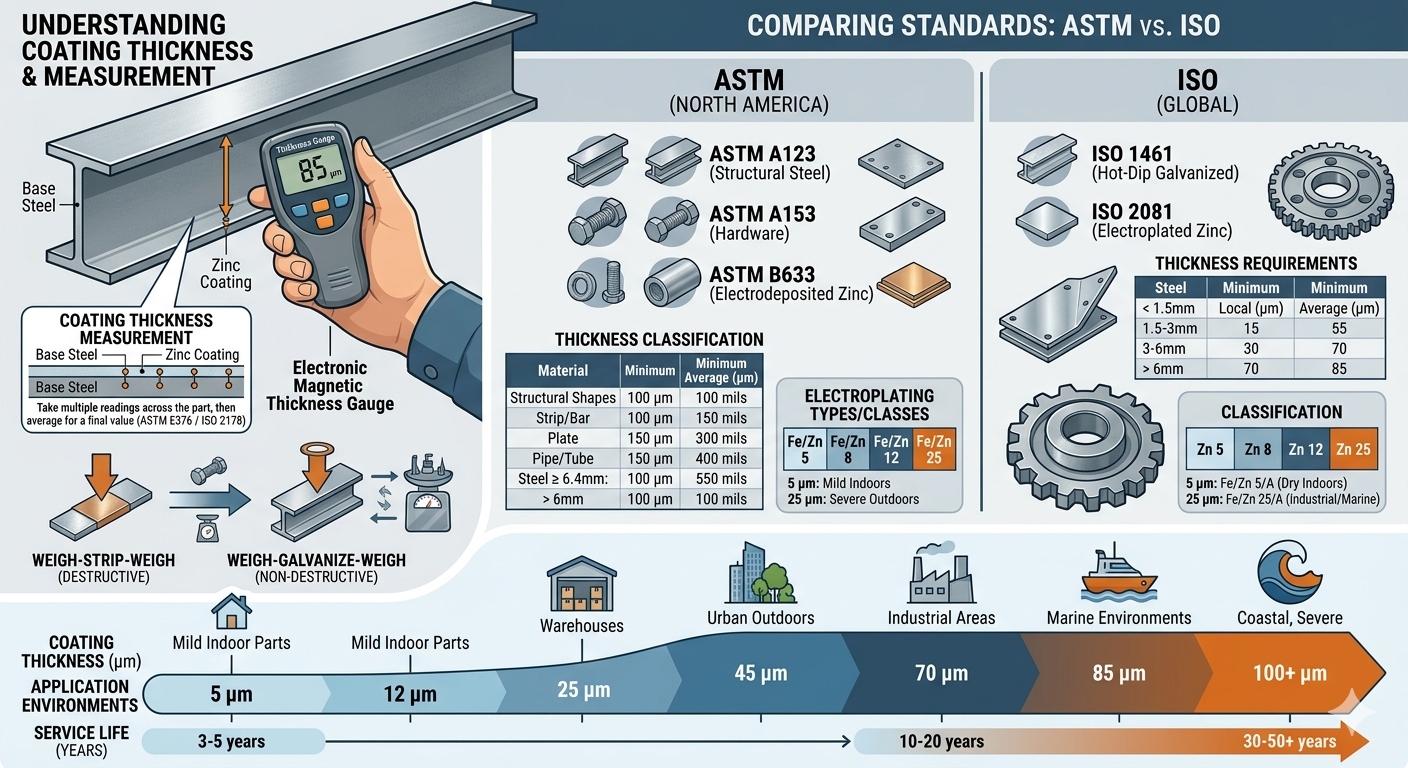
The single greatest variable controlling how long a zinc coating lasts in a given environment is thickness. A zinc coating that is 5 micrometers (µm) thick will fail far sooner than one that is 25 µm thick, even if everything else — the chemistry, the passivation, the environment — is identical. Industry research and large-scale corrosion testing accumulated over decades confirm this: the service life of a zinc coating scales directly with its thickness and the aggressiveness of the environment it faces.
This is precisely why standard-setting bodies like ASTM International and the International Organization for Standardization (ISO) have developed formal thickness specifications. These standards give engineers, manufacturers, and platers a shared language. Without them, a request for “zinc plating” on a purchase order is essentially meaningless — it says nothing about how thick the coating should be, what surface treatment goes on top, or how the part is expected to perform in service.
When you specify to a standard, you’re not just checking a compliance box. You’re communicating the full picture of what your part needs to survive its operating environment.
ASTM B633: The American Standard for Electrodeposited Zinc
ASTM B633 is the most widely used zinc plating standard in North American manufacturing. Published by ASTM International and regularly updated (the current version is B633-23), it covers the requirements for electrodeposited zinc coatings applied to iron or steel articles specifically for corrosion protection. It does not apply to continuously processed zinc-coated wire or sheet stock, and it carries an important note that high-strength steels with tensile strength above 1700 MPa (approximately 46 HRC) should not be zinc electroplated under this standard due to hydrogen embrittlement risk.
The Two-Part System: Service Conditions and Types
ASTM B633 organizes its requirements around two dimensions: Service Condition (SC), which determines minimum coating thickness, and Type, which determines the supplementary finish applied over the zinc.
Service Conditions — Defining the Environment
The Service Condition number directly ties the coating thickness requirement to the environment your part will live in. There are four levels:
SC 1 — Mild: Indoor environments with minimal exposure to moisture, condensation, or abrasion. Think of parts housed in dry, climate-controlled enclosures — office equipment, indoor machine components, items rarely handled after assembly. The minimum zinc thickness for SC 1 is 5 µm (designated Fe/Zn 5).
SC 2 — Moderate: Parts exposed mostly to dry indoor conditions but subject to occasional condensation, wear, or abrasion. Common examples include tools, zippers, pull shelves, machine parts, and similar components. The minimum thickness is 8 µm (Fe/Zn 8).
SC 3 — Severe: Parts exposed to condensation, perspiration, infrequent wetting by rain, and cleaning agents. This category covers a wide range of hardware — tubular furniture, window fittings, builder’s hardware, military hardware, bicycle parts, and washing machine components. The minimum thickness is 12 µm (Fe/Zn 12).
SC 4 — Very Severe: The most demanding category. Parts exposed to harsh conditions including frequent moisture, saline solutions, or cleaners, plus likely physical damage from denting, scratching, or abrasive wear. Plumbing fixtures and pole line hardware are classic examples. The minimum thickness here is 25 µm (Fe/Zn 25).
The step up from SC 1 to SC 4 represents a fivefold increase in minimum zinc thickness — a decision that profoundly affects both performance and cost.
Finish Types — What Goes on Top of the Zinc
Once the zinc layer is deposited, ASTM B633 specifies up to six types of supplementary finishes that can be applied over it. The supplementary treatment — typically a chromate or passivate conversion coating — dramatically extends corrosion resistance and gives the surface its visual appearance.
Type I: As-plated, no supplementary treatment. This is bare zinc with no conversion coating. It offers the least corrosion resistance of the finish types and is primarily used in applications where appearance is not important and short-term protection is acceptable.
Type II: Colored chromate conversion coating. Historically this meant a gold or yellow hexavalent chromate; today, equivalent trivalent chromate formulations are widely used to meet RoHS and REACH compliance requirements. Type II coatings must meet a minimum 96-hour neutral salt spray (per ASTM B117) before showing red corrosion. This is one of the most common specifications in North American manufacturing.
Type III: Colorless (clear) chromate conversion coating. This produces a bright, clear, or faintly iridescent finish. It is more aesthetically neutral than Type II but offers a shorter minimum salt spray performance — 12 hours before white corrosion begins. It is popular for parts where a clean, metallic appearance is preferred.
Type IV: Phosphate conversion coating. Less common than Types II and III, phosphate coatings are used in specific applications, often as a paint primer layer rather than for standalone corrosion resistance.
Types V and VI: Non-chromate passivate treatments added in recent revisions to address RoHS requirements. These allow the use of alternative, chromate-free conversion coatings in replacement of hexavalent chromium treatments.
Reading an ASTM B633 Designation
A complete ASTM B633 callout on a drawing might look like this:
Fe/Zn 12 Type II SC 3
This tells the plater: the substrate is iron or steel (Fe), apply electrodeposited zinc (Zn) to a minimum thickness of 12 µm, with a colored chromate supplementary finish (Type II), appropriate for a severe service environment (SC 3). Every element is there — the substrate, the process, the thickness, the finish, and the intended service environment.
ISO 2081: The International Standard
ISO 2081 is the international counterpart to ASTM B633. Published by the International Organization for Standardization and most recently updated in 2018, it covers electroplated coatings of zinc with supplementary treatments on iron or steel. It is the governing standard in much of Europe and widely referenced globally. The current version — ISO 2081:2018 — includes several updates from the 2008 edition, including reduced reliance on hexavalent chromium references and expanded guidance on trivalent chromium treatments.
Thickness Classes Under ISO 2081
ISO 2081 also categorizes zinc coatings by thickness, but it uses a somewhat different framework. Thickness is expressed directly in the designation using the “Zn” symbol followed by the minimum local thickness in micrometers. Common thickness levels include Zn 5, Zn 8, Zn 12, Zn 15, Zn 20, and Zn 25.
The standard distinguishes between minimum local thickness — the lowest value measured at any point on the significant surface of a single part — and the average thickness across the surface. For some critical applications, ISO 2081 recommends a minimum local thickness of 14 µm for service condition 3, rather than the standard 12 µm. For threaded items with a diameter under 20 mm, a minimum of 10 µm is recommended, recognizing that heavier coatings on threads can interfere with fit and function.
Supplementary Treatment Designations
ISO 2081 uses letter codes appended to the designation to describe the supplementary finish applied over the zinc layer:
- A: Transparent or colorless conversion coating (similar to ASTM Type III)
- B: Yellow chromate conversion coating (similar to ASTM Type II)
- C: Olive drab chromate coating
- D: Black chromate coating
Additional supplementary treatment codes can be specified for sealants and other post-treatments using the “T” prefix (e.g., T1, T2, T3).
Reading an ISO 2081 Designation
An ISO 2081 designation might appear as:
Electrodeposited coating ISO 2081 – Fe/Zn 15/B
This means: iron or steel substrate (Fe), electrodeposited zinc coating to a minimum local thickness of 15 µm (Zn 15), with a yellow chromate conversion coating (B). The format is elegant and compact — the basis metal, the process, the thickness, and the finish are all embedded in the designation string.
A more complex designation — for a part requiring pre-plating stress relief and post-plating embrittlement relief bake — might look like:
ISO 2081 – Fe/SR(250)≥3/Zn 10/ER(200)10/D/T3
Here, SR(250)≥3 indicates a stress relief heat treatment at 250°C for a minimum of 3 hours before plating, ER(200)10 specifies a hydrogen embrittlement relief bake at 200°C for 10 hours after plating, D is a black chromate finish, and T3 identifies an organic sealant. The ISO designation system is particularly powerful for high-strength parts where pre- and post-treatment requirements are safety-critical.
ASTM B633 vs. ISO 2081: Key Similarities and Differences
Both standards exist to solve the same problem — providing consistent, predictable corrosion protection for steel parts — but they approach the task with different conventions and terminology.
Thickness values are equivalent. Both standards recognize the same fundamental thickness levels (5, 8, 12, 25 µm are common to both), and the underlying science of zinc corrosion protection is identical. A 12 µm zinc coating with a chromate finish will perform essentially the same way regardless of which standard document governs the specification.
Passivation treatment classifications differ. ASTM B633 uses Roman numeral Types (I through VI), while ISO 2081 uses letter codes (A, B, C, D). The finish categories don’t always map one-to-one, which can create confusion when working across markets. Type II in ASTM (yellow/colored chromate) roughly corresponds to code B in ISO 2081, but a specifier should verify that the exact salt spray requirements match.
Service conditions vs. thickness-first approach. ASTM B633 links coating thickness to a described service environment through the SC numbering system. ISO 2081 places the thickness value directly in the designation without an explicit SC call-out, putting more responsibility on the designer to select an appropriate thickness for the intended use.
Corrosion test references. ASTM B633 references ASTM B117 for salt spray testing. The updated ISO 2081:2018 references ISO 9227 for neutral salt spray testing, which is closely aligned but not always identical in every procedural detail.
Global reach. ISO 2081 is the expected specification in European markets and in global supply chains where parts are designed to EN ISO standards. ASTM B633 dominates in North American manufacturing. Companies sourcing or selling internationally often need to specify under both systems or ensure cross-referencing in their documentation.
How Coating Thickness Is Measured
Specifying a minimum thickness is only meaningful if it can be verified. Both ASTM B633 and ISO 2081 reference multiple test methods for measuring zinc coating thickness:
Magnetic induction is the most common non-destructive method for measuring zinc on steel substrates. A calibrated gauge induces a magnetic field; the intensity of the field response varies with coating thickness. This method is fast, non-destructive, and widely used for production inspection.
Beta backscatter is another non-destructive method, using the backscattering of beta radiation to determine coating thickness. It is particularly useful for thin coatings and complex geometries.
Microscopical cross-section (referenced in ASTM B487) involves cutting and polishing a sample to view the coating layer in cross-section under a microscope. This is a destructive method but provides direct visual confirmation of coating thickness and is often used for referee testing or quality investigations.
X-ray fluorescence (XRF) is increasingly used in modern quality labs. It is non-destructive, rapid, and capable of measuring coating thickness and composition simultaneously.
At quality-focused plating facilities, the measurement protocol matters as much as the specification itself. Coating thickness must be measured at the significant surfaces — the surfaces visible when the part is assembled as designed, or the surfaces most exposed to the environment. Deep recesses, blind holes, and sharp interior corners are typically excluded from minimum thickness requirements because plating geometry makes it physically impossible to achieve the same thickness in these areas as on flat or convex surfaces.
Choosing the Right Specification for Your Parts
Selecting the appropriate zinc coating specification requires thinking through three questions:
1. Where will the part live? The service environment drives everything else. An interior bracket in a dry assembly line environment is an SC 1 or SC 2 part. A fastener on outdoor farm equipment operating in Wisconsin winters, exposed to road salt, moisture, and freeze-thaw cycling, is at minimum an SC 3 and more likely an SC 4 application.
2. What performance milestones must the part meet? In many industries — automotive, military, construction — parts must pass a minimum number of hours in neutral salt spray testing before red corrosion appears. Your zinc plater’s quality department can validate performance against these milestones with documented test data.
3. Are there functional or dimensional constraints? Coating thickness is not zero-dimensional. On precision components, every micrometer of zinc changes the part’s external dimensions. For close-tolerance fits, interfering threads, or tight clearances, the coating thickness must be accounted for during design. In these cases, a lower SC class with a higher-performance passivation treatment may be preferable to thicker zinc. Mechanical galvanizing — a process that bonds zinc powder to the surface through tumbling rather than electrical deposition — can achieve greater thickness with different distribution characteristics, which may better suit heavy-duty hardware applications.
The Role of Passivation in Meeting Specification Requirements
Zinc alone, freshly deposited, is not highly corrosion-resistant. Bare zinc oxidizes relatively quickly in atmospheric conditions, forming zinc oxide and eventually white zinc carbonate — what most people recognize as the dull white powder on unprotected zinc. The chromate or passivate conversion coating applied over the zinc is what provides the visual appearance and the bulk of the corrosion resistance promised by most specifications.
A properly applied trivalent passivate — the modern, RoHS-compliant alternative to hexavalent chromate — seals the zinc surface and significantly extends the time to white and red corrosion. The specific chemistry, thickness, and quality of that passivate layer are just as critical as the zinc thickness itself. This is why precision platers maintain dedicated laboratory operations to monitor passivate chemistry on a continuous basis, ensuring that the conversion coating applied to the last part in a production run performs identically to the first.
For applications requiring extreme corrosion performance, a topcoat sealer applied over the passivation layer can push salt spray performance well beyond what zinc and passivate alone can achieve.
What Happens When Specification Isn’t Followed
The consequences of under-specifying or failing to achieve the specified zinc coating thickness are rarely abstract. They show up in the field:
A fastener batch plated to 4 µm instead of the specified 8 µm may pass a cursory visual inspection but fail in service months earlier than expected, leading to warranty claims and costly field replacements. Structural hardware on outdoor infrastructure that receives a light coating at a low price may corrode through to the base metal within a season rather than lasting years. In regulated industries — aerospace, defense, medical devices — specification non-conformance can trigger corrective action requirements, product holds, and supply chain disruptions.
This is why engineering drawings should call out zinc specifications explicitly and completely, and why plating suppliers should be evaluated not just on price but on their quality systems, measurement capabilities, and documented process controls. A plater that runs a calibrated coating thickness verification on every production lot, maintains meticulous chemistry controls, and carries ISO 9001:2015 certification is operating at a fundamentally different level than one treating plating as a commodity service.
Putting It All Together: A Practical Reference
To summarize the key thickness classes in one place:
ASTM B633 Thickness Classes:
- Fe/Zn 5 (SC 1) — 5 µm minimum — Mild indoor environments
- Fe/Zn 8 (SC 2) — 8 µm minimum — Moderate indoor/outdoor exposure
- Fe/Zn 12 (SC 3) — 12 µm minimum — Severe exposure, condensation, rain, cleaners
- Fe/Zn 25 (SC 4) — 25 µm minimum — Very severe, saline or abrasive environments
ISO 2081 Common Thickness Designations:
- Zn 5 — Light indoor protection
- Zn 8 — Moderate protection
- Zn 12 — General outdoor or humid environments
- Zn 15 — Enhanced protection for demanding environments
- Zn 25 — Heavy-duty and very severe service conditions
In both systems, the supplementary finish (passivate type) is a co-equal part of the specification and must be chosen in conjunction with the thickness class to achieve the required salt spray performance.
Working With a Zinc Plating Partner Who Understands Standards
Zinc coating thickness standards exist to make communication between designers, manufacturers, and platers precise and unambiguous. But a specification on paper is only as good as the process behind it. Meeting ASTM B633 or ISO 2081 requirements demands disciplined chemistry control, calibrated thickness measurement equipment, rigorous surface preparation, and an engineering mindset applied at every stage of the process.
At Plateco, every part that comes through the door is treated to a complete engineering review. The coating process — the chemistry, the racking or barrel configuration, the cleaning stages, the passivation chemistry, the bake cycle if hydrogen embrittlement relief is required — is documented in a detailed work order that accounts for the specific geometry, material, and specification of each part. Nothing is left to assumption. Thickness is verified, corrosion performance is tested, and parts leave the facility meeting or exceeding the specification every time.
If you’re developing a new part, updating an existing zinc specification, or evaluating whether your current plating supplier is actually hitting your requirements, the place to start is a conversation about the environment your part will face and the performance it needs to deliver. From there, the right standard, the right thickness class, and the right supplementary finish become a straightforward engineering decision — not a mystery.
Plateco, Inc. has been a family-owned, perfection-focused zinc plating company since 1974. Specializing exclusively in zinc-based coatings — rack electroplating, barrel electroplating, and mechanical galvanizing — Plateco serves manufacturers across Wisconsin and beyond with plating processes that meet strict engineering standards and deliver consistent, documented performance. For zinc plating questions or a quote, contact the Plateco team at plateco.net.
Further Reading from the Plateco Blog
If this guide gave you a clearer picture of zinc coating specifications, these related articles from the Plateco blog go deeper on the processes and topics referenced throughout:
| Blog Title | Description | Link |
|---|---|---|
| Understanding Zinc Plating | ||
| What Is Zinc Plating? Process, Types & Applications | A foundational overview of zinc plating and where it’s used across industries. | Read → |
| Complete Industrial Zinc Plating Process Explained | Step-by-step breakdown of what happens inside a zinc plating facility. | Read → |
| Zinc Electroplating: A Complete Beginner’s Guide | Process, benefits, and industrial applications — written for engineers. | Read → |
| Choosing the Right Plating Method | ||
| Rack Plating vs. Barrel Plating: The Definitive Guide | How to choose based on part geometry, volume, and tolerance requirements. | Read → |
| What Is Zinc Rack Electroplating? | A dedicated look at rack plating for larger or cosmetically sensitive parts. | Read → |
| What Is Zinc Barrel Electroplating? | The case for barrel plating for high-volume fasteners and small parts. | Read → |
| What Is Mechanical Galvanizing? | The cold-process alternative achieving thicker coatings without embrittlement. | Read → |
| Passivation & Corrosion Resistance | ||
| Why Zinc Passivation Matters | How chromate and trivalent conversion coatings affect salt spray performance. | Read → |
| Corrosion-Resistant Zinc Plating Guide | How zinc protects steel through sacrificial and barrier mechanisms. | Read → |
| Quality & Material Considerations | ||
| Case Study: Hydrogen Embrittlement Relief | Real test data on corrosion resistance with and without passivate reapplication. | Read → |
| More Lead, More Problems | Why leaded steel creates adhesion challenges for your part design. | Read → |