
A purchase order lands with “Zinc plate per JDM F23” written on the print, and the fabricator sourcing the plating has two options assume it’s close enough to a standard ASTM zinc finish and send it to whichever plater is fastest, or actually confirm the JDM requirement is being met by a shop that can document it. The first option works fine until it doesn’t, usually at John Deere’s own incoming inspection, or worse, months later when a part corroding in the field triggers a supplier audit. If you’re sourcing components for a John Deere supply chain, understanding what JDM specifications actually require, and how they differ from the general ASTM standards most platers are used to, is the difference between a supplier relationship that survives an audit and one that doesn’t.
John Deere’s internal material specifications, commonly referred to as JDM standards, govern plating and coating requirements across an enormous range of agricultural, construction and forestry equipment components. If you’re a fabricator, machine shop or Tier 2 supplier producing parts that eventually carry a John Deere part number, there’s a strong chance your print references a JDM specification directly and there’s an equally strong chance that specification gets treated more casually than it should be by whoever is actually sourcing the plating.
This isn’t a generic overview of zinc plating standards. This piece is built specifically for suppliers working within, or trying to break into, the John Deere supply chain and it walks through what the most common JDM plating specifications actually require, how they relate to and differ from ASTM B633, what documentation John Deere’s quality system expects, and what to verify before you commit a John Deere-bound order to a plating partner.
F13 / F23
The two most common JDM specifications governing zinc coatings on Deere parts
2014
Year JDM F23 formally replaced the earlier JDS 117 specification
1
John Deere manufacturing facility located directly in Wisconsin (Horicon Works)
What JDM Specifications Actually Are
JDM stands for John Deere Material specification, part of a broader family of internal Deere standards that also includes JDS (John Deere Standard) and JDQ (John Deere Quality) designations. These specifications exist because ASTM standards, while providing the underlying technical framework for coatings, don’t capture everything a specific OEM needs for its own supply chain John Deere-specific corrosion testing durations, torque-tension requirements for coated fasteners, approved supplier documentation and environmental restrictions tied to Deere’s own regulatory compliance program.
This is a pattern common across major OEMs, Caterpillar has its own CAT specifications, Ford and GM have their own WSS and GMW designations and John Deere’s JDM family serves the same purpose taking the general vocabulary of ASTM plating standards and translating it into specific, auditable requirements tied to Deere’s own equipment, testing protocols, and supplier approval process. A plater who understands ASTM B633 thoroughly still needs specific familiarity with the JDM specifications themselves to reliably serve a Deere-bound supply chain, because the two are related but not interchangeable.
Why This Distinction Matters at the Purchase Order Level
If a print calls out “JDM F23” and a plater quotes and delivers a coating meeting only general ASTM B633 requirements without confirming the specific JDM F23 provisions, corrosion test durations, chromate type, documentation, that shipment can pass a basic visual and thickness check and still fail a customer’s actual incoming inspection against the print. The spec on the drawing, not a general category of “zinc plating,” is what governs acceptance.
Have a Question About Your JDM Requirements? Contact Us → (608) 524-8241
The Core JDM Plating Specifications You’ll Encounter
John Deere’s plating and coating specifications cover several distinct coating technologies and knowing which one applies to your part is the first and most important step in sourcing it correctly.
JDM F23: Electrodeposited Zinc Coatings
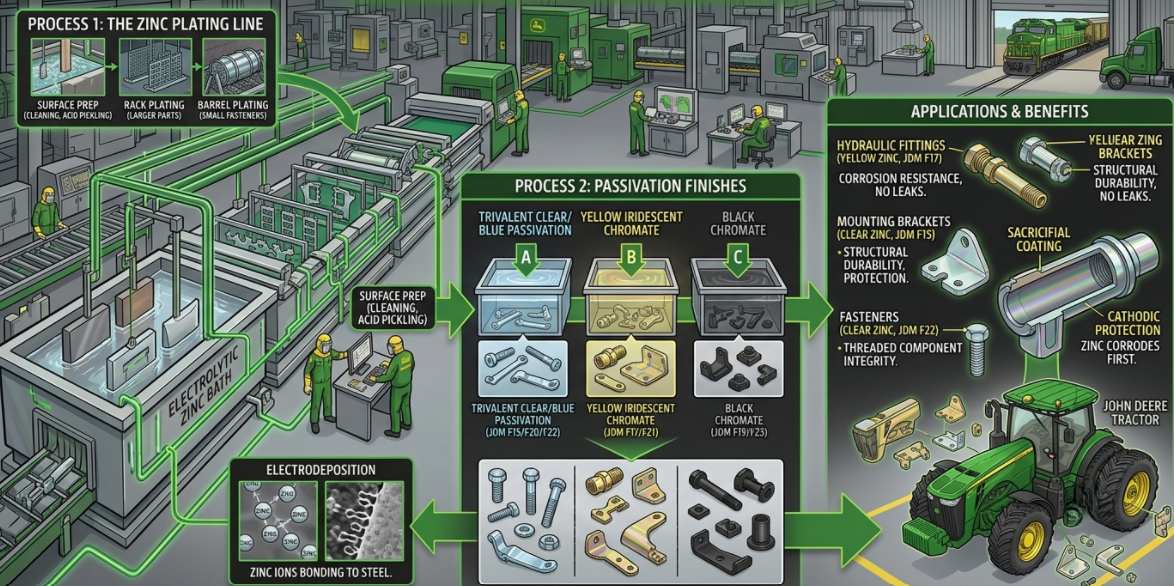
JDM F23 is the current specification governing electroplated zinc coatings on John Deere parts, having formally replaced the earlier JDS 117 specification effective November 2014. One of the most significant changes introduced with JDM F23 was the elimination of hexavalent chromium passivates in favor of trivalent chromate systems, aligning the specification with broader industry and regulatory moves away from hexavalent chromium. JDM F23 defines corrosion resistance requirements typically expressed as hours to white rust and hours to red rust under salt spray testing, with a commonly cited high-corrosion clear trivalent finish rated in the range of 120 hours to white rust and 144 hours to red rust, though exact requirements vary by finish class and should always be confirmed against the current revision referenced on your specific print.
This is the specification most directly comparable to ASTM B633, and most standard zinc electroplated fasteners and small components on Deere equipment fall under JDM F23 rather than the zinc flake coatings described below.
JDM F13: Zinc Flake Coatings
JDM F13 governs non-electrolytically applied zinc flake coatings, a distinctly different coating technology from electroplating. Zinc flake coatings are applied by dipping or spraying a suspension of zinc (and often aluminum) flake particles suspended in an organic or inorganic binder, then curing at elevated temperature, rather than depositing zinc through an electric current in a plating bath. JDM F13 specifies multiple grades covering different levels of corrosion resistance and lubricity, and importantly, these coatings are inherently free of hexavalent chromium given the coating chemistry involved.
Zinc flake coatings are frequently specified for high-strength fasteners specifically because the non-electrolytic application process avoids the hydrogen embrittlement risk associated with electroplating, which is why JDM F13 shows up disproportionately often on higher-grade structural fasteners compared to the general-purpose components more commonly covered under JDM F23.
JDM F15: Torque-Tension Requirements for Coated Fasteners
JDM F15 addresses a factor that’s easy to overlook if you’re focused purely on corrosion resistance how a coating affects the torque-tension relationship on a fastener during installation. A coating changes the friction characteristics of a fastener’s threads and bearing surface, which directly affects how much torque is required to achieve a given clamp load. JDM F15 establishes testing and documentation requirements to confirm that a coated fastener’s torque-tension performance falls within the range Deere’s assembly specifications expect, which matters enormously for structural and safety-critical fastened joints where under- or over-torquing due to unexpected coating friction can cause a real assembly problem.
A plater working to JDM F15 requirements needs to understand not just corrosion performance, but how their specific coating and any integral lubricant affects installation torque, and be able to provide test data supporting that performance when requested.
JDM F19 and JDM F21: Additional Coating and Testing Provisions
JDM F19 and the more recently introduced JDM F21 address additional coating requirements within Deere’s broader specification family, with JDM F21 specifically covering zinc-nickel alloy coatings, a higher-performance option increasingly specified for components facing especially demanding corrosion environments where standard zinc coatings, electroplated or flake, don’t provide sufficient protection. As with all JDM specifications, the exact current revision and specific requirements should always be confirmed directly against what’s referenced on your print, since Deere periodically updates these specifications and a supplier working from an outdated revision can create compliance gaps without realizing it.
JDQ 88: In-Process Inspection Requirements
JDQ 88 falls under Deere’s quality (JDQ) designation rather than the material (JDM) family, but it’s directly relevant to plating suppliers because it establishes in-process inspection requirements that a supplier’s quality system needs to demonstrate, not just final part conformance, but documented control throughout the production process itself. This is the kind of requirement that connects directly back to whether a plating supplier maintains a certified quality system capable of producing the ongoing documentation Deere’s supply chain expects.
JDM Specification Quick Reference
Specification Coating Type Key Focus JDM F23 Electrodeposited zinc General corrosion protection, replaced JDS 117 JDM F13 Zinc flake (non-electrolytic) High corrosion resistance, hydrogen embrittlement avoidance JDM F15 N/A (testing protocol) Torque-tension performance of coated fasteners JDM F19 Coating requirements Additional Deere-specific coating provisions JDM F21 Zinc-nickel alloy Higher-performance corrosion resistance for severe environments JDQ 88 N/A (quality protocol) In-process inspection and documentation requirements
Why the JDM F13 vs. JDM F23 Decision Matters So Much
The choice between zinc flake coatings under JDM F13 and electroplated zinc under JDM F23 isn’t a minor process detail, it reflects a fundamentally different coating technology with different practical implications for a supplier trying to fulfill the order correctly.
Hydrogen embrittlement risk. This is the single biggest reason JDM F13 zinc flake coatings show up so often on higher-strength fasteners. Electroplating processes generate hydrogen that can diffuse into high-strength steel and cause delayed, brittle failure if not properly relieved through post-plating baking. Zinc flake coatings under JDM F13, being non-electrolytic, avoid this risk mechanism entirely, which is why many high-strength fastener applications default to JDM F13 rather than JDM F23 specifically for this reason.
Coating appearance and thickness characteristics. Zinc flake coatings tend to produce a somewhat different visual appearance and coating buildup pattern than electroplated zinc, and can be applied in ways that build slightly different thickness profiles across complex geometries. This occasionally matters for parts with tight dimensional tolerances, where the two coating types may behave differently enough to affect fit.
Supplier capability. Not every plating shop offers both electroplating and zinc flake coating capability, since they require genuinely different equipment and process expertise. If your print calls for JDM F13 specifically, confirming your supplier actually has zinc flake coating capability, rather than assuming any “zinc plating” supplier can fulfill it, is a critical first filter before quoting the job at all.
A Mistake Worth Avoiding
Treating JDM F13 and JDM F23 as interchangeable because both ultimately produce a “zinc coated” part is a genuine specification error, not a minor technicality. If your print specifies one and a supplier delivers the other, even with excellent corrosion performance, that part has not been plated to the specification on the drawing, and it’s reasonable for Deere’s incoming inspection or a supplier audit to flag it as a nonconformance regardless of how the part actually performs.
What John Deere’s Supply Chain Actually Expects From a Plating Partner
Beyond the technical coating requirements themselves, sourcing plating for a John Deere-bound part means working within Deere’s broader supplier quality expectations, which extend well beyond the plating specification alone.
Documented conformance to the specific revision on the print. JDM specifications are periodically revised, and a supplier needs to confirm they’re working to the current revision referenced on your drawing, not an older version they may have qualified against previously. Asking directly which revision a supplier’s process documentation currently reflects is a reasonable and important qualifying question.
Test data supporting corrosion and, where applicable, torque-tension performance. For fasteners falling under JDM F15’s torque-tension provisions, a supplier should be able to provide test data demonstrating their specific coating and lubricant combination falls within the expected torque-tension range, not just general reassurance that their coating “meets Deere specs.”
A quality system capable of the traceability JDQ 88 and similar provisions expect. This is where a supplier’s broader quality certification, ISO 9001 at minimum, and increasingly IATF 16949 for suppliers feeding into Deere’s more integrated component programs, becomes directly relevant. A plater without a certified, documented quality system is going to struggle to produce the ongoing in-process and lot-level documentation Deere’s supply chain requirements expect.
RoHS and environmental compliance specific to Deere’s own program. Since both JDM F23 and JDM F13 have moved decisively away from hexavalent chromium, confirming a supplier’s process is fully compliant with current environmental restrictions, not relying on a legacy hexavalent process for older jobs, is a straightforward but important verification step.
Why Wisconsin Matters Specifically for John Deere Sourcing
John Deere’s Horicon Works facility, located in Horicon, Wisconsin, has been a major production site for the company’s residential and commercial mowing and utility equipment for decades, making Wisconsin a genuinely significant node in Deere’s own manufacturing footprint, not just a convenient regional location for suppliers serving Deere indirectly. Beyond Horicon Works itself, Wisconsin’s broader manufacturing base includes numerous Tier 1 and Tier 2 suppliers producing components that flow into Deere’s agricultural, construction, and turf equipment programs across the wider Midwest.
For a supplier producing parts destined for a Deere facility, sourcing zinc plating from a Wisconsin-based partner offers the same practical logistics advantage that applies across other Midwest OEM supply chains shorter transit times, faster turnaround on schedule changes, and the ability to resolve a specification question or a quality concern through direct conversation rather than a multi-day shipping delay in either direction. Combined with a plating partner who already has specific, demonstrated familiarity with JDM specifications rather than general ASTM experience alone, this regional proximity becomes a genuine sourcing advantage rather than just a convenience.
A Practical Sourcing Consideration
If your supply chain feeds directly or indirectly into Horicon Works or another Wisconsin-adjacent Deere facility, evaluating plating partners with both genuine JDM specification experience and Wisconsin-based operations addresses two risk factors at once specification literacy and logistics reliability. Neither should be assumed from the other, verify both directly during supplier qualification.
Questions to Ask a Plating Supplier Before Committing a JDM-Specified Job
Given how specific and periodically revised JDM specifications are, a few direct questions during supplier evaluation reveal whether a prospective partner genuinely understands what they’re being asked to produce, or is treating the requirement as a generic zinc plating job.
“Which JDM specifications and revisions have you actively plated to, and can you show documentation from a recent job?” A supplier with genuine, current experience will answer specifically and be able to produce recent, relevant documentation without hesitation.
“For a JDM F13 zinc flake requirement, do you have zinc flake coating capability in-house, or would this need to be subcontracted?” This is a critical question given that electroplating and zinc flake coating are genuinely different processes a supplier without in-house zinc flake capability who doesn’t disclose that a JDM F13 job would be subcontracted is a meaningful transparency concern.
“Can you provide torque-tension test data for fasteners falling under JDM F15?” If your part is a fastener subject to torque-tension requirements, this data should be available and specific to the actual coating and lubricant combination being applied, not a generic industry reference.
“What’s your process for confirming you’re working to the current revision of a JDM specification referenced on a print?” A mature supplier will describe an active document control process tied to customer prints, rather than relying on institutional memory of a specification they qualified against years earlier.
“Are you ISO 9001 certified, and does your quality system support the in-process documentation JDQ 88 and similar provisions expect?” This connects the specific JDM plating requirement back to the broader quality system question, since Deere’s supply chain expectations extend well beyond the coating specification alone.
A Red Flag Worth Taking Seriously
If a plating supplier responds to a JDM specification question with general reassurance, “we meet all major OEM specs”, rather than specific detail about which JDM specifications, revisions, and testing protocols they actively work to, treat that vagueness as meaningful information. Genuine JDM experience produces specific, confident answers; unfamiliarity tends to produce confident-sounding generalities instead.
Getting This Right the First Time
Sourcing zinc plating for John Deere-bound parts carries genuinely higher specification stakes than general commercial or industrial plating work, not because the underlying chemistry is more exotic, but because Deere’s own supply chain expectations, specific JDM revisions, torque-tension documentation, in-process traceability under JDQ 88, layer real requirements on top of the coating itself. Treating a JDM specification as a rough equivalent to a general “zinc plate” callout is exactly the kind of gap that surfaces at incoming inspection or, worse, during a supplier audit well after parts have already shipped.
Plateco has plated to John Deere JDM specifications, alongside ASTM B633, Caterpillar CAT, and Parker Hannifin requirements, for Wisconsin and Midwest manufacturers since 1974, with the ISO 9001 certified process controls and specification-specific documentation this piece has walked through. If you’re sourcing plating for a print that references a JDM specification, we’re glad to walk through exactly what our process can document against it before you commit the order.
Frequently Asked Questions
What’s the difference between JDM F23 and the older JDS 117 specification?
JDM F23 formally replaced JDS 117 effective November 2014, with the most significant change being the elimination of hexavalent chromium in favor of trivalent chromate systems. If you’re working from an older print that still references JDS 117, it’s worth confirming with your engineering team or Deere contact whether the drawing should be updated to reference JDM F23 instead, since the underlying coating chemistry requirements have changed.
How do I know whether my part needs JDM F13 zinc flake coating or JDM F23 electroplated zinc?
This should be specified directly on your print or drawing by the engineer who designed the part, since the choice depends on factors like fastener strength grade, hydrogen embrittlement risk, and the specific corrosion and torque-tension performance the application requires. If your print is ambiguous or simply says “zinc plate” without specifying which standard, confirm directly with your Deere contact or engineering team before sourcing the plating, rather than assuming which specification applies.
Does a plater need special certification to work to JDM specifications, or is ISO 9001 sufficient?
ISO 9001 certification is a meaningful baseline indicating a documented, auditable quality system, but it doesn’t by itself confirm specific JDM specification experience or qualification. Ask directly about a supplier’s demonstrated history plating to the specific JDM specification and revision your part requires, in addition to confirming their general ISO 9001 certification status.
What is torque-tension testing under JDM F15, and why does it matter for coated fasteners?
Torque-tension testing measures how much installation torque is required to achieve a target clamp load on a coated fastener, since a coating changes the friction characteristics of the threads and bearing surface compared to bare steel. JDM F15 establishes requirements for this testing because a fastener that requires meaningfully more or less torque than an assembly line expects, due to unanticipated coating friction, can result in under- or over-tightened joints, a genuine assembly quality concern separate from the coating’s corrosion performance.
If my part is only an indirect Tier 2 or Tier 3 supplier component, do JDM specifications still apply to me?
Yes, if the print or purchase order you’ve received references a JDM specification, it applies regardless of how many tiers removed you are from Deere directly. OEM supply chain requirements typically flow down through every tier of suppliers, and a Tier 2 or Tier 3 supplier is just as responsible for meeting the specified JDM requirement as a direct Tier 1 supplier would be.
Why does Wisconsin specifically matter for John Deere supply chain sourcing?
John Deere’s Horicon Works facility is located directly in Horicon, Wisconsin, and the broader Wisconsin manufacturing base includes numerous suppliers feeding into Deere’s agricultural, construction, and turf equipment programs. Sourcing plating from a Wisconsin-based partner offers genuine logistics advantages, shorter transit times and faster turnaround, for any supply chain running through or near this regional manufacturing base, in addition to whatever specification-specific expertise a given plater has developed.
What happens if a supplier plates a JDM-specified part to general ASTM B633 requirements instead of the specific JDM standard?
The part may still perform reasonably well from a corrosion resistance standpoint, but it has not been produced to the specification actually referenced on the print, which creates real risk of rejection at incoming inspection, a supplier audit finding, or a documentation gap that surfaces later if the part is ever involved in a field failure investigation. Confirming your supplier is genuinely plating to the specific JDM standard, not a general ASTM equivalent, is worth verifying directly rather than assuming.
Ready to Source Plating That Actually Meets Your JDM Print?
Tell Us About Your Project
Plateco has plated to John Deere JDM specifications for Wisconsin and Midwest manufacturers since 1974, with the certified process controls and specification-specific documentation your supply chain and Deere’s own quality expectations require. Send us your print and we’ll confirm exactly what our process can document against it.