

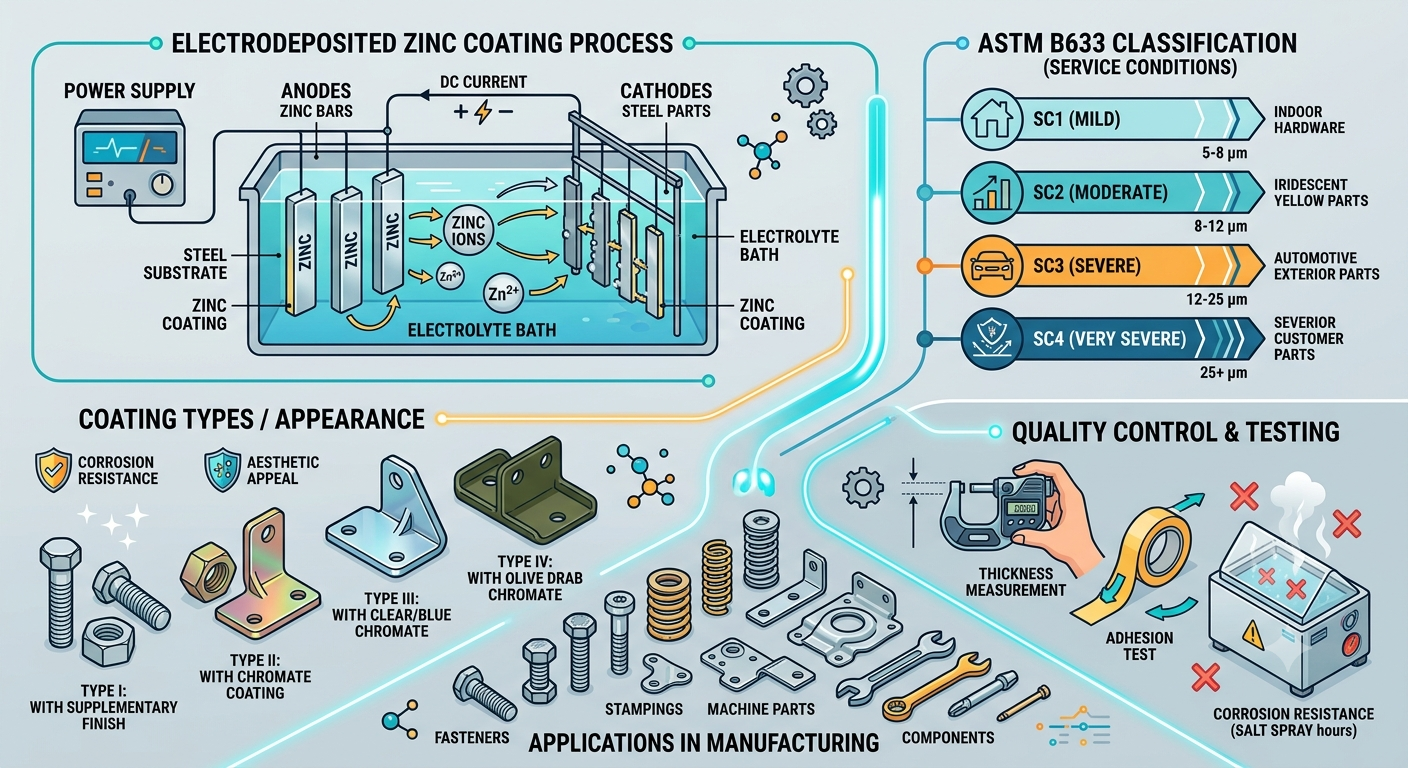
If your parts are zinc-plated, ASTM B633 is the standard governing how that plating performs. This guide explains everything manufacturers need to know what the standard covers, how to read service class designations, how to choose the right finish type, and how to write specifications that produce parts that actually survive their operating environment.
Every day, millions of zinc-plated parts ship out of manufacturing facilities across North America under the assumption that “zinc plated” means consistent, reliable corrosion protection. Often, it does. But the actual performance of a zinc-plated part how long it survives outdoor exposure, what salt spray hours it will reach, whether it meets your customer’s incoming inspection requirements is not determined by the words “zinc plated” on the drawing. It is determined by the specification written beneath them. And that specification, in most manufacturing contexts, starts with ASTM B633.
For purchasing teams writing RFQs, engineers specifying surface finishes, and quality managers reviewing supplier certifications, ASTM B633 is the foundational document. It defines the service classes, finish types, thickness requirements, testing protocols, and hydrogen embrittlement relief requirements that govern electrodeposited zinc plating across virtually every industrial application. Understanding it thoroughly is not optional for manufacturers who want to write specifications that work and avoid the field failures that come from specifications written without it.
This guide covers everything: what ASTM B633 is, what it covers and does not cover, how to read and apply its service class system, how to choose the right finish type, how to write a correct specification, and what it means for the day-to-day reality of manufacturing zinc-plated parts at volume.
What Is ASTM B633?
ASTM B633 is the standard specification for electrodeposited coatings of zinc on iron and steel, published by ASTM International the American Society for Testing and Materials. The current version is ASTM B633-23, updated in 2023. It is the primary engineering reference governing how zinc is electrolytically deposited onto steel substrates for corrosion protection.
The standard was not created arbitrarily. It is the product of decades of accumulated field data, laboratory testing, and industry-wide consensus about how much zinc is required under what conditions, how supplementary treatments extend that protection, and what testing methods establish objective proof that a coating system performs as specified. When a manufacturer writes “zinc plate per ASTM B633, SC3, Type II” on a drawing, every element of that call-out has a precise, testable meaning and a plating shop that claims compliance to ASTM B633 is committed to delivering against that meaning.
What ASTM B633 Governs
ASTM B633 specifically covers zinc coatings applied by electrodeposition the process of using electrical current to deposit zinc ions from a bath solution onto a steel substrate. It governs:
- Minimum zinc coating thickness by service condition class (SC1 through SC4)
- Supplementary finish types applied over the zinc (passivate / chromate conversion coatings)
- Testing methods for coating thickness verification (magnetic gauges, coulometric stripping)
- Salt spray testing requirements referencing ASTM B117
- Hydrogen embrittlement relief requirements for high-strength steel parts
- Basis-of-rejection criteria and acceptance standards for delivered parts
- Significant surface designation where thickness requirements apply
What ASTM B633 Does Not Govern
Equally important is understanding what ASTM B633 does not cover. It does not govern mechanically deposited zinc coatings those are covered by ASTM B695. It does not govern hot-dip galvanizing, which falls under ASTM A153 and ASTM A123. It does not specify bath chemistry, equipment requirements, or the details of the plating process itself the standard defines the output requirements, not the process used to achieve them. And it does not replace OEM-specific requirements: a part specified to GMW3044 or JDM F15 must meet those specifications in addition to any underlying ASTM B633 reference they contain.
Why It Matters for ManufacturersA drawing that says “zinc plate” with no further specification tells a plating shop almost nothing. The plater must choose a zinc thickness, a passivate type, and a finish system and without guidance, they will choose what is easiest and cheapest to produce, not what the application requires. ASTM B633 provides the language to specify exactly what you need. Using it correctly is the difference between a parts program that runs without corrosion complaints and one that generates field failures and warranty claims.
The Four Service Classes: The Core of ASTM B633
The most consequential element of ASTM B633 for manufacturers is the service class system. ASTM B633 defines four service conditions SC1 through SC4 each corresponding to a specific operating environment and carrying a minimum zinc coating thickness requirement. The correct assignment of a service class to a part is the most important specification decision available to an engineer working with zinc-plated components.
| Service Class | Min. Zinc Thickness | Min. Thickness (Inches) | Typical Hours to Red Rust* | Operating Environment |
|---|---|---|---|---|
| SC1 — Mild | 5 µm (0.2 mil) | 0.0002″ |
48–96 |
Indoor, climate-controlled, no moisture exposure |
| SC2 — Moderate | 8 µm (0.3 mil) | 0.0003″ |
96–200 |
Sheltered outdoor, occasional moisture, general industrial |
| SC3 — Severe | 12 µm (0.5 mil) | 0.0005″ |
120–300 |
Direct outdoor exposure agricultural, construction, automotive |
| SC4 — Very Severe | 25 µm (1.0 mil) | 0.001″ |
240–500+ |
Harsh outdoor road salt, continuous moisture, chemical exposure |
*Hours to red rust with yellow trivalent passivate + sealer. Actual performance depends on passivate chemistry, sealer presence, surface preparation quality, and bath chemistry control.
SC1: Mild Service
Minimum zinc thickness: 5 µm (0.0002 inches). SC1 is appropriate for parts that spend their entire service life in a controlled indoor environment office equipment, indoor electronics hardware, machine components in climate-controlled factories, and protected interior assemblies where moisture exposure is not a realistic possibility. If there is any regular condensation, handling moisture, or intermittent outdoor exposure, SC1 is the wrong classification.
SC1 is frequently over-specified as a cost-saving measure for parts that actually operate in SC2 or SC3 conditions. This is among the most common sources of premature corrosion failures in manufactured goods the plating cost savings at SC1 versus SC3 is measured in fractions of a cent per part, while the warranty cost of an SC1-plated part that fails in an SC3 environment is measured in dollars.
SC2: Moderate Service
Minimum zinc thickness: 8 µm (0.0003 inches). SC2 covers components that may encounter occasional moisture, condensation, or brief outdoor exposure in sheltered conditions. General-purpose industrial hardware, tools that are regularly handled by workers, agricultural components in protected storage environments, and outdoor hardware in low-humidity climates are typical SC2 applications. The key qualifier for SC2 is that moisture exposure is occasional and controlled not continuous or aggressive.
SC3: Severe Service
Minimum zinc thickness: 12 µm (0.0005 inches). SC3 is the most widely specified service class in industrial manufacturing. It covers components in direct outdoor exposure where weather contact, condensation, rain, and temperature cycling are normal operating conditions. Agricultural equipment hardware, construction fasteners, automotive underhood components, and general outdoor industrial equipment all operate in SC3 environments. For any part that will be directly exposed to weather even in a region with mild climate and no road salt SC3 is the appropriate starting point, with SC4 required where road salt or chemical exposure adds additional aggressiveness.
SC4: Very Severe Service
Minimum zinc thickness: 25 µm (0.001 inches). SC4 represents the most demanding electroplated zinc service conditions continuous moisture, direct road-salt exposure, marine atmosphere, or chemical environments where corrosion is persistent and aggressive. Direct-exposure underbody automotive hardware, coastal infrastructure hardware, pole-line equipment, and plumbing fixtures in aggressive water conditions are SC4 applications. At SC4, zinc thickness alone is rarely sufficient a yellow trivalent passivate combined with a sealer topcoat is the standard system for meeting the 400–500+ hour salt spray requirements typical of SC4 specifications.
The single most important specification decision for a zinc-plated part is the correct service class assignment. Choose SC1 for a part that lives in an SC3 environment, and the corrosion protection failure is engineered into the specification before the part is even quoted.
Finish Types: The Supplementary Treatment System
Once the zinc is electrodeposited to the required minimum thickness, ASTM B633 specifies six finish types designated Type I through Type VI that govern what supplementary treatment, if any, is applied over the zinc. The passivate or chromate conversion coating applied at this stage is the second major variable in corrosion performance, capable of dramatically extending the effective life of the coating system beyond what the zinc layer alone delivers.
Understanding the finish types is essential to writing specifications that produce the salt spray performance your application requires and to evaluating whether a plating vendor’s process is delivering what the specification calls for.
| Type | Treatment Description | Appearance | Min. White Rust (B633) | REACH / RoHS |
|---|---|---|---|---|
| Type I | As-plated no supplementary treatment | Dull silver-gray | Not specified | ✓ |
| Type II | Colored chromate conversion coating (yellow/gold) | Yellow-gold iridescent | 96 hours minimum | Trivalent only ✓ |
| Type III | Colored chromate olive drab | Olive-brown | 96 hours minimum | Trivalent only ✓ |
| Type IV | Colored chromate conversion coating (black) | Black to dark gray | 96 hours minimum | Trivalent only ✓ |
| Type V | Clear chromate conversion coating | Clear to blue-iridescent | 72 hours minimum | Trivalent only ✓ |
| Type VI | Phosphate conversion coating | Gray, matte | Not specified | ✓ |
The Hexavalent Chromium Issue
Historically, chromate conversion coatings used hexavalent chromium (Cr6+) chemistry and hexavalent chromate delivered exceptional corrosion performance, often 30–50% better than equivalent trivalent formulations at the same zinc thickness. However, hexavalent chromium is a recognized carcinogen and is now prohibited under RoHS (Restriction of Hazardous Substances), restricted under REACH, and explicitly banned by all major automotive OEMs including General Motors (GMW3044) and Ford (WSS-M21P17).
Modern ASTM B633 compliance means trivalent chromium passivates across all finish types and today’s advanced trivalent formulations, particularly yellow trivalent chemistry, achieve corrosion performance that closely approaches the legacy hexavalent systems they replaced. At Plateco, all standard passivate offerings are trivalent, fully REACH and RoHS compliant, and tested monthly to verify salt spray performance against published targets.
The Sealer: Beyond the Standard’s Minimums
ASTM B633 specifies finish types but does not mandate sealers. For applications requiring salt spray performance above approximately 300 hours to red rust which includes many automotive, agricultural, and construction OEM specifications a wax or polymer sealer applied over the passivate is the mechanism that bridges the gap. A 25 µm SC4 zinc coating with Type II yellow passivate and sealer routinely achieves 400–500+ hours in ASTM B117 testing. The same coating without the sealer may not exceed 300 hours. When a customer specification calls for 500 hours (JS-500 compliance, for example), the sealer is not optional it is the element that makes the number achievable.
How to Read an ASTM B633 Specification Call-Out
A properly written ASTM B633 specification call-out on a drawing contains multiple elements, each independently controlling a different aspect of the coating system. Many engineers write partial specifications that leave critical variables undefined which means the plater chooses them, and the plater’s default choice is the lowest-cost option, not necessarily the correct one for the application. Understanding what each element of the call-out controls gives engineers the ability to write specifications that produce the right outcome.
Decoding a Full Specification: Fe / Zn 12 · Type II · SC3 per ASTM B633-23
Fe
Iron / Steel
substrate
Zn
Electrodeposited
zinc
12
12 µm on all
significant surfaces
Type II
Yellow chromate
(trivalent)
SC3
Severe outdoor
environment
B633-23
Current edition
2023
The “Significant Surface” Rule
ASTM B633 thickness requirements apply to “significant surfaces” surfaces that are functional, visible, or critical to the performance of the part. For a flat stamped washer, essentially all surfaces are significant. For a hex bolt, the shank, thread flanks, and hex faces are significant; the thread root valleys and the undersurface of the bolt head adjacent to the shank are not held to the same minimum. Understanding which surfaces of your specific part geometry are significant under B633 allows you to write thickness requirements that are achievable and meaningful and to evaluate measurement data from your plating supplier correctly.
Common Specification Errors to Avoid: Writing “zinc plate” with no service class designation (leaves everything to the plater’s discretion). Specifying SC1 or SC2 for components that operate in SC3 environments to reduce plating cost. Omitting the finish type when a colored or clear passivate is specifically required. Not specifying hydrogen embrittlement relief baking requirements for high-strength steel parts. Writing a salt spray hour requirement without specifying the passivate and sealer system needed to achieve it.
Hydrogen Embrittlement: The High-Strength Steel Requirement
One of the most safety-critical provisions of ASTM B633 and one of the most frequently overlooked by manufacturers who don’t work with high-strength steel parts is the hydrogen embrittlement relief requirement. It applies specifically to high-strength steels and has direct implications for part safety in structural applications.
Why Hydrogen Embrittlement Occurs During Electroplating
The electroplating process generates hydrogen at the cathode surface as a byproduct of the electrochemical reaction. A fraction of this hydrogen absorbs into the steel substrate rather than escaping as gas. In low and medium-strength steels typically those below Rockwell C 34 the absorbed hydrogen dissipates harmlessly over time. In high-strength steels, the hydrogen becomes trapped in the steel’s crystalline microstructure, creating internal stress concentrations at grain boundaries and micro-cracks. Under sustained tensile loading exactly the condition high-strength fasteners experience in service these concentrations can initiate and propagate fractures at loads far below the fastener’s rated capacity. The failure mode is sudden, brittle, and without visible warning.
The ASTM B633 Relief Baking Requirement
ASTM B633, in conjunction with ASTM F1941 and SAE/USCAR-5, requires that steel parts with a hardness of Rockwell C 34 or higher, or those that have been cold-worked to induce tensile stresses, be subjected to hydrogen embrittlement relief baking within four hours of electroplating, before passivate application. The bake cycle requirements: 375°F (190°C) minimum temperature, maintained for a minimum of three to four hours, with time-at-temperature verified across the full part load not just at the oven thermostat.
Plateco Baking InfrastructurePlateco uses a conveyor belt oven exceeding 90 feet in length for hydrogen embrittlement relief baking. This ensures every part including those at the center of a dense load passes through the full required temperature profile. Batch ovens that rely on surface heating can leave center-load parts insufficiently baked. For Grade 8, 10.9, 12.9, and high-tension structural fasteners, the documentation of time-at-temperature across the full load is not a quality nicety it is the engineering evidence that the relief was effective.
When to Specify Mechanical Galvanizing Instead
For very high-strength steel applications Grade 8 structural bolts, prevailing-torque fasteners, spring-hardened clips the hydrogen embrittlement risk of electroplating combined with the baking complexity and documentation overhead sometimes makes a different process preferable: zinc mechanical galvanizing per ASTM B695. Mechanical galvanizing deposits zinc through mechanical impaction rather than electrochemistry, generating no hydrogen in the substrate. Parts processed by mechanical galvanizing require no embrittlement relief baking. For Grade 8 and above fasteners in critical structural applications, ASTM B695 mechanical galvanizing is often the correct specification not ASTM B633 electroplating.
Testing Requirements: Thickness Measurement and Salt Spray
ASTM B633 compliance is not a self-certification it requires objective measurement. Two testing methods are central to verifying that a zinc-plated part meets its specification: coating thickness measurement and salt spray testing.
Coating Thickness Measurement
ASTM B633 specifies two approved methods for measuring zinc coating thickness. The first is the magnetic induction or eddy current method, using calibrated handheld gauges that are non-destructive and fast enough for production sampling. These gauges are the standard for in-process and incoming inspection across most manufacturing operations. The second is coulometric stripping, a destructive method that dissolves the zinc from a defined area and calculates thickness from the charge required used for referee testing when disputes arise or when extreme precision is required.
ASTM B633 requires that thickness measurements be taken on significant surfaces and that the minimum specified thickness be met at every measured location. A part that averages 13 µm across five measurements but shows 10 µm at one point on a significant surface is non-conforming at that point, even if the average exceeds the minimum. This is a point suppliers and incoming inspection teams frequently misapply averages do not substitute for location-specific minimums.
Salt Spray Testing per ASTM B117
The functional performance test referenced by ASTM B633 is the salt spray test conducted per ASTM B117 the Standard Practice for Operating Salt Spray (Fog) Apparatus. In this test, zinc-plated parts are exposed to a continuous 5% sodium chloride solution mist at 35°C. The test records two milestones: hours to first white rust (zinc oxide formation the zinc sacrificing itself) and hours to first red rust (iron oxide the steel substrate corroding, indicating zinc depletion). Red rust is the primary failure criterion.
Chamber Calibration
The salt spray chamber must be set up and calibrated per ASTM B117 including verified salt concentration, temperature uniformity, and fog fall rate. Uncalibrated chambers produce unreliable data. At Plateco, the chamber is verified daily by certified lab personnel.
Exposure Period
Parts are placed in the chamber and exposed continuously. The specification determines the required hours 96, 120, 240, 480, or 1,000 hours are common OEM requirements. Testing runs uninterrupted except for brief inspection intervals at specified checkpoints.
Inspection and Recording
Parts are inspected at specified intervals and at test end. Results are recorded as hours to first white rust and hours to first red rust at any point on significant surfaces. The test report documents part identification, coating system (zinc thickness + passivate + sealer), chamber conditions, and results.
Compliance Determination
Parts pass if they show no red rust on significant surfaces at the specified test duration. White rust appearance before the specified hours is acceptable under most ASTM B633 interpretations, though many OEM specifications impose stricter white rust limits that supersede the base ASTM standard.
ASTM B633 in Practice: Applications Across Manufacturing
Understanding how ASTM B633 service classes map to real-world applications in the industries where Plateco’s customers actually manufacture translates the standard from an abstract reference into an actionable specification tool.
Agricultural Equipment
Typical spec: SC3 Type II (JDM F15/F22/F23)
Fasteners, brackets, hydraulic fittings, and implement hardware face direct outdoor exposure, seasonal field dust and moisture, and extended storage outdoors between seasons. SC3 with yellow trivalent passivate is the baseline for most John Deere and Case CNH programs. High-strength structural hardware specifies mechanical galvanizing per ASTM B695. Plateco plates to JDM F15, JDM F22, and JDM F23 for John Deere supply chain customers.
Automotive Manufacturing
Typical spec: SC3–SC4 Type II/V (GMW3044, Ford WSS-M21P17)
Interior fasteners and protected hardware (SC2, clear passivate). Underhood brackets and clips (SC3, yellow passivate). Chassis and underbody hardware exposed to road salt (SC4, yellow + sealer). OEM specifications layer trivalent-chromium-only requirements on top of ASTM B633 hexavalent chromium is universally prohibited in automotive programs. A single vehicle may contain hundreds of ASTM B633-specified zinc-plated components.
Construction & Infrastructure
Typical spec: SC3–SC4 or ASTM B695 Class 25–50
Structural fasteners, anchor bolts, post-frame hardware, and embedded hardware in concrete. High-strength structural applications (Grade 8 or equivalent) require mechanical galvanizing per ASTM B695 not electroplating to eliminate hydrogen embrittlement risk. Standard construction hardware fasteners in outdoor applications specify ASTM B633 SC3 or SC4 depending on coastal or road-salt exposure proximity.
General Industrial Manufacturing
Typical spec: SC2–SC3 Type II or Type V
Machine hardware, pump and valve components, conveyor parts, material handling equipment, and general plant maintenance fasteners. Service class selection depends on whether parts are in protected indoor environments (SC2) or exposed to factory moisture, cleaning chemicals, and outdoor interfaces (SC3). Many industrial customers start with a generic ASTM B633 reference and discover they need OEM-equivalent spec language when their customer base demands documented compliance.
How OEM Specifications Relate to ASTM B633
ASTM B633 is the baseline standard but in automotive, agricultural, and heavy equipment supply chains, the specification that actually governs production parts is almost always an OEM-specific document that references and extends ASTM B633. Understanding the relationship prevents the common mistake of treating OEM spec compliance and ASTM B633 compliance as interchangeable when they are not.
- Service class (SC1–SC4) and minimum zinc thickness
- Finish type (Type I–VI) for supplementary treatment
- Testing method for thickness measurement
- Salt spray test reference (ASTM B117)
- Hydrogen embrittlement relief requirements
- Basis of rejection and acceptance criteria
- Significant surface definition
OEM Specifications Add
- Explicit trivalent-only requirements (no Cr6+)
- Specific salt spray hour floors (e.g., 240 hrs, 480 hrs)
- Sealer requirements at specific service conditions
- Part-specific thickness zones beyond significant surface
- PPAP documentation and first-article testing requirements
- Specific bath chemistry restrictions
- OEM audit rights and supplier qualification requirements
The practical implication: a plating supplier claiming “ASTM B633 compliance” is confirming they meet the base standard’s minimum requirements. That is not the same as confirming compliance with GMW3044, JDM F15, Ford WSS-M21P17, or CAT 1E0397. If your end customer operates under an OEM specification, your plating vendor must be qualified to and actively running production against that OEM specification not just the underlying ASTM B633 reference within it.
Plateco plates to ASTM B633 across all four service classes, as well as to John Deere (JDM F15, F22, F23), Case (CNH), Caterpillar (CAT 1E0397), Parker Hannifin, Toro (M-300/M-310), JLG, and several other OEM-specific standards with full documentation and traceability maintained for quality audits.
Writing a Correct ASTM B633 Specification for Your Parts
With the full standard framework understood, writing a correct specification for zinc-plated parts becomes a systematic process. The following checklist covers the elements that should appear on every drawing or purchase specification for zinc-plated steel components.
- Identify the service environment. Where will this part spend its service life? Use the SC1–SC4 definitions to assign the correct minimum service class based on the actual operating environment not based on cost preference or what was on a similar drawing.
- Specify the finish type. Write the Type designation: Type V (clear) for interior parts where appearance is neutral; Type II (yellow) for outdoor parts requiring 200+ hours to red rust; Type IV (black) where a black appearance is specified. Do not leave the finish type open-ended.
- Write the full call-out in standard notation. Fe/Zn [thickness] [Type] [SC class] per ASTM B633-23. Example: Fe/Zn 12 Type II SC3 per ASTM B633-23. This notation is unambiguous and universally understood by qualified plating operations.
- Specify salt spray hours if an OEM or customer requirement exists. If your customer requires 240 hours to red rust per ASTM B117, write that on the drawing — it gives the plater the performance target, not just the thickness minimum.
- Add hydrogen embrittlement relief if the steel is high-strength. For parts with Rockwell C hardness at or above C 34, write: “Hydrogen embrittlement relief bake required per ASTM F1941.” This creates an explicit, auditable requirement.
- Reference OEM specifications where applicable. If your customer is John Deere, write “per JDM F15” or “per JDM F22” in addition to or instead of the bare ASTM B633 reference. OEM specifications are the governing documents in those supply chains.
- Add REACH/RoHS compliance language if required. For European supply chains or automotive programs: “Trivalent chromate passivate required. Hexavalent chromium (Cr6+) prohibited per REACH/RoHS.”
Why Manufacturers Choose Plateco for ASTM B633 Compliance
Writing a correct specification is only half the challenge. The other half is finding a plating partner with the process capability, quality systems, and engineering infrastructure to consistently deliver against it. Plateco, Inc. has specialized exclusively in zinc plating since 1974 barrel electroplating, rack electroplating, and mechanical galvanizing from a single facility in Reedsburg, Wisconsin.
Proven ASTM B633 compliance across all four service classes. SC1 through SC4, Type I through Type VI, clear and yellow and black trivalent passivates, with sealer options for SC4 and JS-500 applications. Every process is validated with in-house ASTM B117 salt spray testing not periodic or on-request, but monthly across the most-run processes, with daily chamber verification by certified lab personnel.
ISO 9001:2015 certified quality management system. Documented processes, calibrated measurement equipment for thickness verification, trained and competency-certified personnel, and a corrective action infrastructure capable of supporting PPAP submissions, first-article testing, and OEM audit requirements. When a specification calls for documentation and traceability, Plateco’s quality system is the mechanism that produces it.
0.13% documented reject rate. This is not a design target or a marketing claim it is a measured operational result. The mechanisms behind it: seven-stage integrated cleaning that eliminates contamination-driven adhesion failures; automated bath chemistry monitoring and dosing that prevents performance drift across production runs; and a 90+ foot conveyor bake oven that ensures complete hydrogen embrittlement relief for every part in a high-strength load, not just the parts on the outside of the batch.
OEM specification breadth. ASTM B633, ASTM B695, GMW3044, Ford WSS-M21P17, JDM F15/F22/F23, CAT 1E0397, Parker Hannifin, Toro M-300/M-310, JLG, JS-500 among others. One supply relationship covers the full range of specifications your manufacturing program may require, with engineering support available to review your drawings and confirm the correct specification before production begins.
Need a Zinc Plating Partner Who Knows ASTM B633 Cold?
Send us your drawing, OEM specification, or the application environment description and we will confirm the correct service class, finish type, and coating system — with documented salt spray data to support the recommendation.