

A lot of production delays that get blamed on a plating vendor actually start well before the parts ever reach the vendor’s dock. A pallet arrives with no clear lot identification, and the receiving team has to stop and call the customer to confirm which purchase order it belongs to. Parts arrive loose in a bin, already lightly rusted from contact corrosion during transit, before they’ve even entered the plating process. A rush order shows up with no indication it’s a rush order, and it sits in the normal queue until someone happens to notice the ship date on the paperwork. None of these are plating problems. They’re shipping and logistics problems, and they’re almost entirely preventable with a bit of upfront attention to how parts actually leave your facility and arrive at your plater’s.
This guide walks through exactly what a well-prepared shipment to a zinc plating facility should look like, covering packaging, labeling, documentation, and the logistics decisions that actually affect your turnaround time. We’ve built this from patterns we’ve seen consistently across five decades of receiving parts from Wisconsin manufacturers, fabricators, and OEMs at Plateco, and the goal is simple help your parts move through receiving, into production, and back out the door as quickly and smoothly as your plater’s actual process allows, without losing time to preventable friction at the shipping and receiving stage.
50+ Years
Of receiving shipments from Wisconsin manufacturers, giving us a clear pattern on what preparation actually speeds up turnaround
1 Day
Is roughly how much time a poorly labeled or documented shipment can add to your production cycle before it’s even sorted into a work order
0.1%
Current defect rate across Plateco’s production lines, a standard that starts with parts arriving in good, identifiable condition
Why Shipping Preparation Actually Affects Your Plating Turnaround
It’s worth explaining directly why this matters before getting into the specifics, because it’s easy to assume shipping and logistics are separate from the actual plating process, when in practice they’re the first stage of it.
Every shipment that arrives at a plating facility needs to be received, verified against a purchase order, sorted into the correct production queue, and, in many cases, matched to a specific customer specification before a single part touches a plating bath. A well-prepared shipment, clearly labeled, properly documented, packaged to prevent damage, moves through that receiving process quickly and accurately. A poorly prepared shipment creates delays and, in worse cases, genuine risk of error, parts getting matched to the wrong specification, a rush order getting missed entirely, that no amount of skill on the plating floor can fully correct after the fact.
This is also directly connected to something we’ve covered in other guides on this blog the documentation and process control that produces consistent, high-quality plated parts starts with accurate information about what’s actually being processed. A shipment that arrives without clear lot identification or specification information forces a plater to either delay processing while they track down that information, or, in a worse scenario, make an assumption that turns out to be wrong. Neither outcome serves you well, and both are avoidable with the preparation covered in this guide.
Have Questions About Your Parts? – (608) 524-8241
Packaging: Protecting Parts Before They Ever Reach the Plating Bath
Preventing Contact Corrosion and Damage in Transit
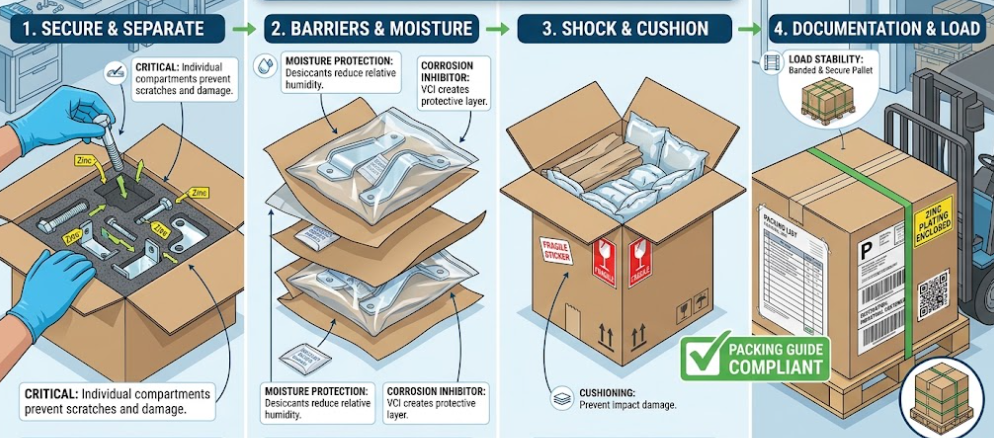
Parts shipped loose, stacked directly on top of each other, or packed without adequate separation are genuinely at risk of contact corrosion, surface scratching, or physical damage during transit, before they’ve even arrived at the plating facility. This matters more than it might initially seem, because surface condition going into the plating process affects the final result. A part with existing surface damage, corrosion, or deep scratches may not plate as cleanly as an undamaged part, and in some cases, pre-existing corrosion can compromise adhesion in the affected area entirely.
Practical packaging guidance: Use appropriate dividers, trays, or individual compartmentalization for parts prone to contact damage, particularly for parts with precision surfaces, threads, or tight tolerances where even minor transit damage could affect fit or function after plating. For bulk fastener or small hardware shipments, ensure containers are appropriately sized and not overloaded in a way that creates excessive pressure between parts during transit and handling.
Weight Limits and Container Selection
Overloaded containers, whether that’s a box packed beyond its rated capacity or a pallet stacked higher than it can safely support, create genuine handling risk both during transit and once the shipment arrives at receiving. A container that fails during handling doesn’t just risk part damage, it can create a safety hazard for the receiving team handling it.
Practical packaging guidance: Match container selection and weight to what the container and packaging method are actually rated to handle safely, and confirm with your plating vendor whether they have specific container or palletization preferences for high-volume or particularly heavy shipments, since many platers have handling equipment and dock configurations suited to particular container types.
Protecting Parts From Moisture and Environmental Exposure During Transit
Particularly relevant for shipments during Wisconsin’s more humid months or for longer transit routes, moisture exposure during shipping can contribute to surface corrosion before parts ever reach the plating facility, especially for parts that will sit in a receiving queue for any length of time before processing begins.
Practical packaging guidance: For shipments with any meaningful transit time or exposure risk, consider appropriate protective wrapping or desiccant packaging, particularly for parts made from more corrosion-prone steel grades or parts with tight tolerances where even light surface corrosion could be problematic.
Labeling: The Single Highest-Impact Thing You Can Get Right
If there’s one section of this guide worth reading most carefully, it’s this one, because labeling errors and omissions are, by a wide margin, the most common preventable cause of receiving delays across the plating industry generally.
What Every Shipment Should Include on Its Labeling
Your company name and a direct contact for questions. This sounds obvious, but shipments arriving without clear sender identification, or with only a shipping department’s general information rather than a contact who can actually answer a specification question, create real delays if anything about the shipment needs clarification.
Your purchase order number, clearly and prominently. This is the single piece of information a receiving team needs most immediately to match an incoming shipment to the correct work order and specification. A shipment without a visible purchase order number often requires a phone call before it can even be logged into the correct production queue.
Part number and quantity per container. Particularly important for shipments containing multiple part numbers or a mixed load, clear labeling of what’s actually inside each specific container prevents a receiving team from needing to open and manually verify every box before sorting begins.
Any specification callouts relevant to that specific lot. If a shipment includes parts requiring a specific service condition classification, a particular finish, or any other specification detail that varies from your standard order, that information belongs on the shipment’s labeling, not just buried in an email sent separately.
Rush order status, clearly flagged. If a shipment is a genuine rush order, this needs to be immediately visible on the shipment itself, not something a receiving team discovers only after opening and processing paperwork through the standard queue. A verbal or emailed heads-up to your account contact is valuable, but it should be reinforced with clear physical labeling on the actual shipment.
Common Labeling Mistakes Worth Avoiding
Labeling only the outermost pallet wrap, not individual containers within a mixed pallet. If a single pallet contains multiple purchase orders or part numbers, each individual container needs its own clear labeling, since pallet-level labeling alone doesn’t give a receiving team what they need to sort a mixed load correctly.
Using labeling that fades, smears, or detaches during transit. Handwritten labels on standard paper, especially without protective covering, are genuinely vulnerable to becoming illegible during shipping, particularly in wet or humid conditions. Use durable, weather-resistant labeling for anything traveling any meaningful distance.
Failing to update labeling when a shipment’s contents or status changes. If a shipment’s composition changes after initial preparation, additional parts added, a different quantity confirmed, make sure labeling is updated to reflect the actual final contents, since outdated labeling creates exactly the kind of discrepancy that triggers a delay while it’s sorted out.
The Misconception We Hear Most Often From Shipping Teams
That labeling requirements are the plating vendor’s problem to sort out on their end, since “they’ll figure out which order it is.” In practice, a receiving team processing shipments from many customers simultaneously depends heavily on accurate, visible labeling to move a shipment through sorting and into the correct production queue quickly. The few extra minutes it takes to label a shipment clearly and completely on the sending end routinely save considerably more time than that on the receiving end, time that translates directly into how quickly your parts actually enter production.
Documentation: What Should Travel With Your Shipment
A packing list matching what’s physically in the shipment. This should list part numbers, quantities, and purchase order references clearly, and should match the actual physical contents exactly, discrepancies between a packing list and actual contents are a common source of processing delays while they’re reconciled.
Specification documentation for any non-standard or first-time order. If you’re shipping a part type or specification your plating vendor hasn’t processed for you before, include relevant print callouts or specification details directly with the shipment, rather than assuming this information has already been fully communicated through a separate channel.
Any special handling or processing instructions. If specific parts require particular handling consideration, delicate surfaces, unusual geometry requiring specific rack design attention, note this directly with the shipment so it reaches the production floor, not just a sales or customer service contact.
Logistics: Timing, Carrier Selection, and Scheduling Considerations
Building Realistic Transit Time Into Your Production Schedule
As discussed in our guides on regional plating considerations, transit time to and from your plating vendor is a real, quantifiable part of your overall production cycle, not a variable that exists outside your planning. Build your actual, realistic transit time, in both directions, into your production schedule explicitly, rather than treating your plater’s quoted turnaround time as the entire cycle time your schedule needs to account for.
Coordinating Shipment Timing With Your Vendor’s Production Schedule
For manufacturers with recurring, predictable plating volume, it’s worth having a direct conversation with your vendor about the best timing for regular shipments, since arriving at a consistent, predictable time can help a vendor plan their own production scheduling more efficiently around your volume, which can translate into more reliable turnaround for you.
Choosing the Right Carrier and Service Level for the Shipment’s Actual Urgency
Not every shipment needs expedited service, and using standard freight for routine, non-urgent shipments while reserving expedited service specifically for genuine rush orders keeps your overall shipping costs proportionate to actual urgency, rather than defaulting to premium service out of habit or uncertainty about turnaround timing.
Confirming Delivery Windows and Dock Availability
For larger shipments or palletized freight requiring specific unloading equipment, confirm delivery windows directly with your plating vendor’s receiving team in advance, particularly for a first-time shipment or an unusually large order, to avoid a shipment arriving outside receiving hours or without appropriate unloading capability available.
Return Shipping: Planning the Trip Back, Not Just the Trip There
It’s easy to focus entirely on getting parts to a plating vendor and think less carefully about the return leg, but return shipping deserves the same attention. Confirm how completed lots will be returned, whether that’s your own scheduled pickup, a vendor’s outbound delivery service, or a third-party carrier, and build that return transit time into your overall schedule with the same rigor you apply to the outbound leg.
“The manufacturers who get the most consistent turnaround from us aren’t necessarily the ones with the largest volume, they’re the ones who’ve gotten shipping preparation genuinely dialed in. Clear labeling, accurate documentation, and realistic scheduling on their end lets our receiving and production teams do their job efficiently from the moment a shipment hits our dock, instead of spending time sorting out avoidable confusion before the actual plating process even begins.”
Jim Schweich, Chief Executive Perfectionist, Plateco, Inc.
Reusable Containers, Racks, and Returnable Packaging
For manufacturers with recurring, ongoing plating volume, it’s worth raising a logistics question that doesn’t come up on a first shipment but becomes genuinely relevant over time whether returnable or reusable packaging makes sense for your specific relationship with a plating vendor.
Returnable containers reduce packaging waste and cost over a long-term relationship. Rather than sourcing new boxes, trays, or dividers for every shipment, a returnable container system, where empty containers are sent back with completed lots for reuse on your next shipment, can meaningfully reduce ongoing packaging costs for a manufacturer shipping plating volume on a regular, predictable cadence.
Standardized containers can improve handling consistency and reduce damage risk. A consistent container type that both your team and your vendor’s receiving team are familiar with tends to reduce the kind of handling inconsistency that leads to transit damage, compared to a rotating mix of whatever packaging happens to be available for a given shipment.
This is worth raising directly with your vendor if your volume justifies it. Not every plating relationship needs a formal returnable packaging arrangement, but for higher-volume, recurring customers, it’s a conversation worth having explicitly rather than assuming standard one-way packaging is the only option available.
Special Considerations for Different Part Types
Fasteners and small hardware shipped in bulk. These benefit most from appropriately sized, non-overloaded containers and clear labeling of quantity per container, since a bulk fastener shipment with an inaccurate quantity count on its labeling creates real reconciliation work for a receiving team before processing can begin.
Larger structural or heavy components. These require particular attention to weight limits and container or pallet rating, discussed earlier in this guide, and often benefit from direct coordination with your vendor’s receiving team regarding unloading equipment and dock scheduling given their size and handling requirements.
Parts with precision surfaces or tight tolerances. These warrant the most careful individual packaging attention, dividers, trays, or protective wrapping, discussed in the packaging section above, since even minor transit damage can affect fit or function in ways that a more forgiving structural part would never show.
Mixed-material shipments involving multiple substrate types. If a single shipment includes parts of different steel grades or alloys requiring different processing parameters, clear labeling distinguishing between them is particularly critical, since this is exactly the kind of shipment where an ambiguous or incomplete labeling approach creates the highest risk of a processing error.
A Pre-Shipment Checklist
Before your next shipment leaves your facility, it’s worth running through a quick checklist to confirm you’ve covered the fundamentals this guide has walked through.
Are parts packaged to prevent contact corrosion and transit damage, with appropriate dividers, trays, or protective wrapping for the specific parts being shipped?
Is the container or pallet appropriately sized and not overloaded, based on your packaging method’s actual rated capacity?
Is your purchase order number clearly and prominently visible on every individual container, not just the outer pallet wrap?
Does labeling include part numbers and quantities per container, particularly for any mixed-load shipment containing multiple part numbers or specifications?
Is any rush order status clearly flagged on the physical shipment itself, not communicated only through a separate email or phone call?
Does your packing list match the shipment’s actual physical contents exactly?
Have you included any relevant specification documentation for a non-standard or first-time order?
Have you built realistic transit time, in both directions, into your actual production schedule?
Have you confirmed delivery windows with your vendor’s receiving team, particularly for a large or unusual shipment?
Frequently Asked Questions
What’s the single most common shipping mistake that delays plating turnaround?
Inadequate or unclear labeling, particularly missing purchase order numbers on individual containers within a mixed-load shipment, is by a wide margin the most common preventable cause of receiving delays, since it forces a receiving team to stop and verify information before a shipment can even be sorted into the correct production queue.
How far in advance should I coordinate a large or first-time shipment with my plating vendor?
For any shipment significantly larger than your typical volume, or your first shipment to a new vendor, it’s worth reaching out at least a few days in advance to confirm delivery windows, unloading capability, and any specific packaging or labeling preferences your vendor has, rather than assuming standard shipping practices will be sufficient.
Does packaging quality actually affect the final plated finish, or is it purely a shipping concern?
It can genuinely affect the final result. Parts damaged or corroded during transit before they reach the plating process may not achieve the same finish quality as undamaged parts, and in some cases, pre-existing surface corrosion can affect coating adhesion in the affected area, which is why packaging quality is worth treating as a genuine part of your overall quality process, not just a shipping logistics concern.
Should I always use expedited shipping to make sure my parts get processed quickly?
No, expedited shipping is worth reserving for genuine rush orders where the added cost is justified by the actual urgency. For routine, non-urgent shipments, standard freight combined with clear labeling and accurate documentation is typically sufficient to keep your parts moving through a vendor’s normal production queue efficiently.
What should I do if I’m not sure how to label a mixed-load shipment with multiple part numbers?
Reach out to your plating vendor’s receiving or customer service team directly before shipping, most platers are glad to walk through their specific labeling preferences for complex or mixed shipments, and getting this right upfront avoids the delay of a receiving team needing to sort out an ambiguous shipment after it’s already arrived.
How does Plateco handle receiving and sorting incoming shipments?
Plateco’s receiving process is built around the same process discipline that governs our production floor, with clear procedures for matching incoming shipments to purchase orders and specifications quickly and accurately. The preparation steps in this guide reflect exactly what helps that process run as smoothly and quickly as possible for your specific shipment.
Ready to Ship Your Next Order With Confidence?
Tell Us About Your Project
Plateco has been receiving, processing, and returning zinc-plated parts for Wisconsin manufacturers, fabricators, and OEMs since 1974. If you have questions about how to prepare a shipment for your specific parts, or want to confirm our receiving preferences before your next order, reach out directly, we’re glad to walk through it with you.