

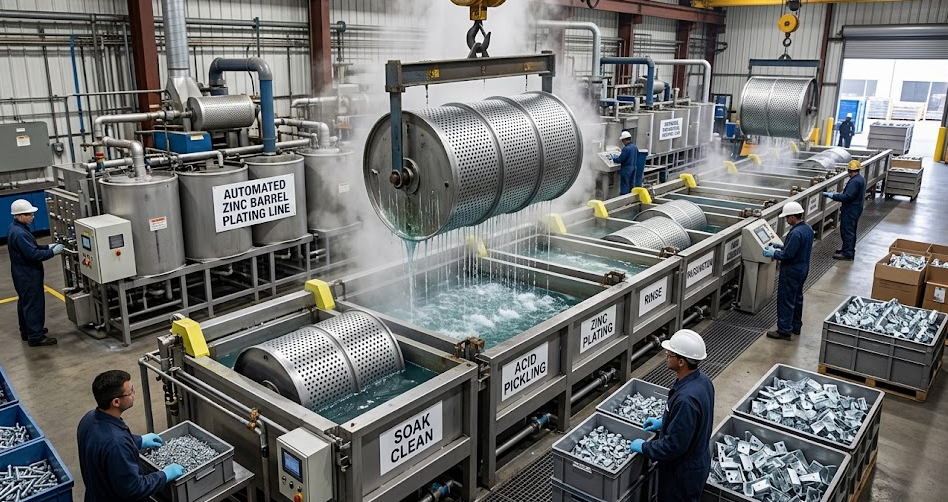
If you buy, manufacture, or distribute small steel parts by the thousand, you already know that coating is where a good production run can quietly go wrong. Screws arrive with patchy coverage. A lot ships late and stalls your assembly line. A supplier that handled 5,000 pieces comfortably struggles at 500,000. The parts were never the problem. The plating partner was either not built for volume, not disciplined about process control, or not clear about what the specification actually required.
Zinc barrel electroplating exists to solve the volume problem. It coats hundreds or thousands of small components at once, delivers sacrificial corrosion protection, and keeps per-piece finishing cost low enough to survive a procurement review. For OEMs, contract manufacturers, fastener distributors, and industrial supply houses, it is the workhorse process behind much of the hardware on the market.
This guide is written for buyers who are ready to evaluate vendors and place work. We explain how barrel plating works, what a vendor needs in order to run it at scale, how to write a specification that prevents disputes, what drives price and lead time, and exactly what to send when you request a quote. Everything here reflects what we do at our Reedsburg, Wisconsin facility. Where an answer depends on your part or your print, we say so instead of guessing.
Why Plating Capacity Is a Purchasing Decision, Not Just a Production Detail
Most buyers compare plating vendors on price per pound or price per thousand. That number matters, but it is the least informative number in the quote. Two vendors can quote the same rate and deliver completely different outcomes, because the real cost of plating sits in what happens around the quote whether the lot passes inspection, whether it ships on the date promised, and whether the coating lasts as long as your customer expects.
Consider what a weak plating partner costs a volume buyer. A rejected lot means rework or scrap, plus the freight to move parts twice. A missed ship date means expedited shipping, or worse, a stopped line at your own facility. A coating that fails in the field means warranty claims, returns, and a damaged relationship with your end customer. Those costs dwarf any savings from a slightly lower rate.
The Upper Midwest raises the stakes. Winter brings road salt and deicing chemicals, followed by thaw and refreeze cycles that drive chlorides into every thread and recess. Summer adds humidity. Agricultural settings add fertilizer and washdown. Automotive and construction hardware is exposed to all of it. Small steel components are rarely the expensive part of an assembly, but they are often the first part to show rust, and customers judge the whole product by what they see.
That is why coating capacity belongs in the procurement conversation. The question is not simply who can plate your part. It is who can plate it consistently, at your volume, on your schedule, to a specification you can verify, and keep doing it next quarter. Barrel electroplating is the process built for that kind of repeatable scale, provided the vendor behind it is built for it too.
What Is Zinc Barrel Electroplating?
Zinc barrel electroplating is an electrochemical process that deposits a protective zinc coating onto small steel parts in bulk. Rather than mounting parts one at a time, the operator loads large quantities into a perforated, rotating barrel. The barrel turns inside a zinc electrolyte solution while electrical current flows through the system. Zinc ions are drawn to the negatively charged steel surfaces, and a controlled zinc layer forms on every exposed surface.
The perforations let solution flow freely while the tumbling keeps parts in electrical contact. The constant motion also helps solution reach threads, blind holes, recesses, and undercuts, which improves coverage consistency on the geometry that causes the most trouble for static processes.
Barrel plating is designed for:
- High-volume production runs
- Small to medium-sized components
- Fasteners, stampings, clips, and machine screws
- Applications where cost efficiency is a priority
- Parts where protection matters more than cosmetic perfection
Zinc protects steel in two ways. It acts as a barrier that keeps moisture and oxygen from the steel surface, and it is sacrificial. If the coating is scratched or nicked, the surrounding zinc corrodes in preference to the steel. That is why a zinc-plated screw with a scuffed thread often keeps performing long after a painted part with the same scuff would have started to rust.
How Barrel Plating Works at Industrial Scale
Every plating shop runs the same basic sequence. What separates a volume partner from a small job shop is how tightly each step is controlled and how repeatable the result is from lot to lot. Here is how the process runs at Plateco.
1. Bulk part loading
Large quantities of small steel components go into a perforated rotating barrel. The design allows plating solution to flow freely while maintaining electrical contact between parts. Loading practices matter more than most buyers realize. An overloaded barrel limits solution flow and produces uneven coverage, and an underloaded one can allow delicate parts to be damaged by excessive tumbling. Experienced operators size each load to the part, not to the barrel.
2. Cleaning and surface preparation
Before any zinc is deposited, parts are degreased to remove oils, acid pickled to remove oxides, and rinsed to control contamination. This is the single biggest factor in coating adhesion. Skipping or rushing preparation is the most common cause of blistering, poor adhesion, and rejected lots across the industry. A vendor that cannot describe its cleaning sequence in detail is a vendor to question.
3. Zinc deposition
Once the barrel is submerged in the electrolyte, current passes through the solution and between the tumbling parts. Continuous rotation exposes every piece evenly to the solution, and zinc builds up on all exposed surfaces. Deposition is governed by electrolyte chemistry, current density, temperature, and time. At volume, those variables need to be monitored continuously rather than checked occasionally.
4. Post-plating treatment
After deposition, parts typically receive a chromate conversion coating to improve corrosion resistance and set the finish color. Available finishes include clear (blue), yellow, black, olive drab, and custom options. These treatments significantly increase salt spray performance and extend service life, and sealers can be added where a higher corrosion target applies.
Each of these steps is a place where inconsistency can enter. In a high-volume program, a small variation repeated across a hundred thousand parts becomes a large problem, which is why automation and documented controls matter so much, as the next section explains.
Have a part you want evaluated?
Have Questions About Your Parts? – (608) 524-8241
Capacity and Throughput: What to Ask Any Barrel Plating Vendor
Capacity is the most overused word in plating sales conversations. Almost every shop claims it. Buyers should ask for specifics, because the answers separate genuine volume partners from shops that will struggle when your program grows.
At our Reedsburg facility, we operate fully automated zinc barrel electroplating lines designed for precision and throughput. Our capabilities include:
- Up to 800 pounds per barrel, supporting large production lots in fewer cycles.
- Very small parts. Specialized barrel configurations handle extremely fine diameters.
- Controlled rotation speeds for delicate components that would be damaged by aggressive tumbling.
- Automated chemistry monitoring for consistent deposition across a shift and across a week.
Automation matters because it reduces human error and increases repeatability. When bath chemistry is monitored and adjusted automatically, the thousandth pound of parts looks like the first. For OEM programs with standing orders and blanket releases, that consistency is what keeps incoming inspection quiet.
Questions worth asking every vendor you evaluate:
- What is your maximum load per barrel, and how do you size loads for small or delicate parts?
- How is bath chemistry monitored, and how often?
- How is thickness verified, and on what sampling plan?
- What is your on-time delivery rate, and how do you measure it?
- What happens when a lot is rejected for a quality problem that is your fault?
A vendor with real process control answers these questions specifically and without hesitation. Vague answers, or answers that change depending on who you ask, are a warning sign. Our own answers are consistent a 95% on-time commitment, thickness measurement as a standard control, and a simple promise: on spec, on time, or it’s on us.
Barrel vs. Rack vs. Mechanical Galvanizing
Barrel plating is not the right answer for every part, and a trustworthy vendor will tell you so. Plateco runs barrel, rack, and mechanical galvanizing lines, so we can recommend the process that fits your part rather than the one we happen to have available.
| Factor | Zinc Barrel Electroplating | Zinc Rack Electroplating | Mechanical Galvanizing |
|---|---|---|---|
| Best suited for | Small parts in high volume | Larger or cosmetically demanding parts | Heavy-duty small to medium hardware |
| Part handling | Bulk, tumbled in a barrel | Mounted individually | Tumbled with zinc powder |
| Cost per piece at volume | Lowest | Higher | Higher, thicker coating |
| Coverage on threads and recesses | Very good | Good | Very good |
| Coating thickness | Moderate, adjustable | Moderate, adjustable | High |
| Cosmetic finish | Functional | Best | Functional |
Comparison reflects general industry characteristics. Always confirm against the specification your part requires.
When barrel plating is the right choice
Choose barrel electroplating for small parts, high-volume production, cost-sensitive programs, components that do not require cosmetic perfection, and applications with standard corrosion resistance requirements. For most fasteners and small stampings, barrel plating delivers the best combination of protection and efficiency. A frequent question is whether barrel plating is as durable as rack plating. For small components in volume production, properly controlled barrel plating provides comparable corrosion protection.
When to consider another process
Rack plating may be preferred for larger or highly cosmetic parts, where individual mounting avoids part-to-part contact marks. For heavy-duty hardware facing constant road salt, burial, or ground contact, a thicker mechanically bonded coating may give a longer service life, and we explain that choice in our guide to mechanical galvanizing for steel hardware. Sending us the part and the environment lets us recommend the right one, even when it is not the barrel line.
Parts and Industries That Benefit Most
Barrel electroplating suits any program where the same small steel component is needed in large quantities. Common examples we see include:
- Automotive suppliers: fasteners, clips, brackets, and mounting hardware exposed to road salt.
- Agricultural equipment makers: outdoor hardware subjected to moisture, fertilizer, and soil conditions.
- Industrial machinery producers: machine screws and internal mechanical components.
- Construction hardware companies: anchors, bolts, and connectors exposed to weather.
- Stamping and fabrication shops: stampings and small formed parts that need protection before assembly.
For distributors and industrial supply houses, there is a commercial angle as well. Hardware that holds up in the field generates fewer complaints and returns. If you stock fasteners and small components for contractors, equipment dealers, or OEM maintenance buyers, working with a consistent plating partner protects your brand in categories where customers have been burned by coatings that did not last.
It also helps to understand the threaded-part question, since it comes up on nearly every fastener quote. The tumbling motion gives solution access to threaded features, which provides consistent coverage. Coating thickness still has to be planned against thread tolerances, because a heavier coating can interfere with nut fit. If your hardware must mate with nuts or tapped holes, tell us at quote stage so thickness can be planned deliberately.
Specifications, Thickness, and Finish: What to Put on the Purchase Order
The most expensive mistake in buying plated parts is a vague specification. “Zinc plated” on a purchase order means very different things to different suppliers, and disputes usually trace back to an order that did not say what was needed. A clear specification protects both sides.
The governing standard
We plate to widely recognized industry specifications such as ASTM B633, which covers electrodeposited zinc coatings on iron and steel, as well as customer-specific OEM standards and industry corrosion performance requirements. If your drawing, customer, or industry calls out a standard and class, tell us. If it does not, describe the environment and the service life you need, and we will help identify an appropriate requirement. You can review the standards we work to on our Certifications & Specifications page.
Thickness
Thickness is the most important number for corrosion life. Performance levels can be engineered by adjusting zinc thickness, chromate system, and post-treatment sealers. State the minimum thickness or class explicitly rather than relying on a general description, and remember that thicker is not automatically better on threaded parts.
Chromate and finish
Specify the post-treatment and color you need: clear (blue), yellow, black, olive drab, or a custom finish. The chromate system has a direct effect on salt spray performance, so if you have a corrosion target, include it. Our guide to salt spray testing for zinc parts explains how those requirements are typically verified.
High-strength parts and hydrogen embrittlement
Electroplating can introduce hydrogen into hardened steel, which creates a risk of delayed cracking under load. If your parts are high-strength or through-hardened, say so in your request so handling requirements can be confirmed before work begins. Our overview of hydrogen embrittlement in zinc plating covers the issue in more detail. If you are unsure whether a part is at risk, ask before you order rather than after parts ship.
Specialized certifications
If your application involves aerospace, defense, or another specialized requirement, confirm it directly with us before placing volume. We would rather answer that question at the start than have you discover a gap later. Our guide to zinc plating for defense and aerospace is a useful starting point.
The misconception we hear most often that the cheapest specification is the safest choice. A thin coating on a part headed for road salt saves pennies and costs dollars. The right answer is the thickness and finish your environment demands, specified deliberately.
Process Control and Documentation: Proof, Not Promises
A coating you cannot verify is a coating you are taking on faith. Buyers placing volume work need a vendor that can show what was delivered, and that is where specialization matters.
High-quality barrel plating depends on strict operational control electrolyte chemistry balancing, current density regulation, temperature control, thickness measurement, and contamination prevention. Automated chemistry monitoring on our lines keeps those variables in range, and thickness is measured rather than assumed. Documentation and traceability are available to support quality audits and compliance reviews, which matters if your own customers audit your supply chain.
Plateco focuses exclusively on zinc plating. Unlike general metal finishing companies that spread attention across many chemistries, a zinc specialist builds deeper technical knowledge, refines its operating systems around one process, and sees fewer defects as a result. We have been named a Products Finishing Top Shop for seven straight years, and our quality system is ISO 9001 certified through the Performance Review Institute.
“We treat zinc plating as an extremely complex process demanding state-of-the-art technology, painstaking planning, obsessive quality control, and a tremendous amount of talent. Because our customers don’t come to us for excuses, they come to us for perfection.”
— Jim Schweich, Chief Executive Perfectionist, Plateco, Inc.
Our commitment is simple: on spec, on time, or it’s on us. If you reject a plated part for a quality problem that is our fault, you are not charged for that part. For a procurement team, that guarantee transfers part of the risk of a bad lot back to the vendor, where it belongs. You can read how we compare on the points that matter in Plateco vs Competitors: Why Wisconsin Manufacturers Choose Plateco.
What Drives the Cost and Lead Time of Barrel Plating
We do not publish a flat price list, because the honest answer to “what does it cost?” depends on your part and your specification. What we can do is explain which factors move the number, so you can compare quotes sensibly and structure orders for the best value.
Factors that influence price
- Part size, weight, and geometry. These determine how many pieces fit in a load and how much zinc is consumed.
- Required thickness. A heavier requirement means longer plating time and is priced accordingly.
- Lot size and repeat volume. Barrel plating rewards volume. Standing orders and blanket releases allow more efficient scheduling than one-off lots.
- Part condition on arrival. Heavy scale, rust, or oil requires more preparation. Clean, well-packaged parts move faster and cost less.
- Chromate and finish. Black, olive drab, or sealed finishes add steps and should be named up front.
- Documentation. Any certification or reporting beyond standard belongs in the request for quote.
Compare total landed cost
The cheapest quote is rarely the cheapest outcome. Add rejected lots, expedited freight, internal labor spent chasing a vendor, and warranty exposure from a failed coating, and a slightly higher rate from a reliable partner often wins on total cost. Cost efficiency in barrel plating comes from plating many parts at once, which lowers labor per part, shortens production time, and keeps finishing costs competitive, but only if the lot passes the first time.
Lead time
Our on-time commitment is 95%, and we hold ourselves to it. Actual turnaround depends on lot size, thickness, finish, current scheduling, and how quickly parts reach us, so we quote lead time for your order rather than offering a generic number. If you have a hard deadline, say so in your request. We would rather decline an unrealistic date than promise one and miss it. Our guide to shipping parts to a zinc plating facility covers packaging that keeps lots moving.
How to Order: What to Send With Your Request for Quote
Accurate quotes come from complete information. This checklist is the shortest path from request to coated parts.
- Send prints and specifications. Include part drawings, material and hardness information, and the coating standard and class if you have one.
- Describe the application and environment. Road salt, outdoor, washdown, indoor assembly. This lets us confirm the specified thickness fits the exposure.
- Give volume and delivery expectations. Share first-order quantity, annual volume, and required return date. Repeat volume often changes how we schedule.
- Name special requirements. Chromate color, thread fit, documentation, packaging, and any high-strength handling belong in the RFQ.
- Run a trial on your hardest part. If you are evaluating us against a current supplier, send the most demanding part first. It is the clearest comparison.
- Review the quote and approve. We respond with pricing and any recommendations, such as an adjusted thickness or process.
If you are new to us, What to Expect on Your First Zinc Plating Order walks through the full process, and our Plateco Transfer page explains how to move work from an existing vendor.
Frequently Asked Questions
Is zinc barrel electroplating suitable for threaded parts?
Yes. The tumbling motion gives solution access to threaded features and provides consistent coverage. Tell us your thread fit requirements so coating thickness can be planned around them.
Can very small parts be plated?
Yes. Specialized barrel configurations and controlled rotation speeds allow plating of extremely small components.
Does barrel plating damage parts?
With controlled rotation speeds and proper loading practices, part damage is minimized and managed carefully. Flag delicate or tightly toleranced parts in your request.
How much can you process per load?
Our automated barrel lines process up to 800 pounds per barrel. Actual load size depends on part size and geometry.
What finishes are available?
Clear (blue), yellow, black, olive drab, and custom chromate finishes, with sealers available for higher corrosion targets.
Can you provide documentation for audits?
Yes. Documentation and traceability are available to support quality audits and compliance reviews. Name any requirement in your RFQ.
What do I need to send to get a quote?
Prints, specifications, material details, expected volume, delivery date, and the environment the parts will see. The more complete your request, the faster and more accurate our quote.
What if a lot doesn’t meet my requirements?
On spec, on time, or it’s on us. If you reject a part for a quality problem that is our fault, you are not charged for it.
Ready to Scale Your Plating With a Partner Built for Volume?
Share your part specifications, annual volume, and corrosion requirements. We will recommend the most efficient zinc barrel electroplating solution for your application. Reject excuses. Demand perfection. Better yet,