

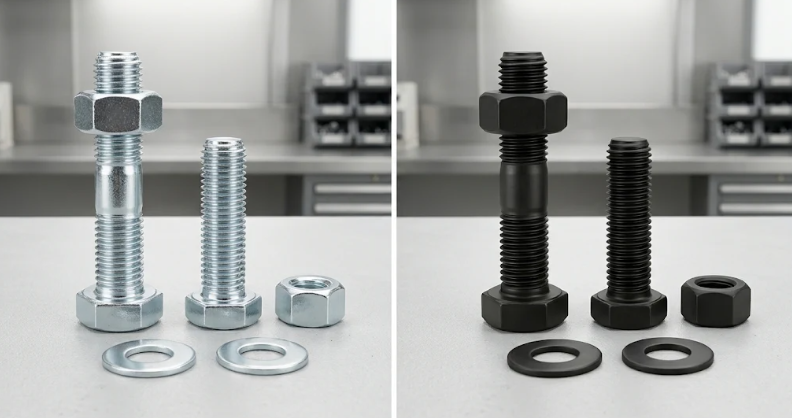
A practical, data-driven comparison for design engineers, quality managers and buyers who must decide between a sacrificial zinc coating and a thin black oxide conversion finish and write a specification that gets exactly what the application needs.
Zinc plating and black oxide are two of the most commonly specified finishes on steel fasteners, fittings, tooling and machined components, yet they are not interchangeable. One is a metallic coating that protects steel by sacrificing itself. The other is a thin chemical conversion layer that mostly changes how the surface looks and behaves. Drawings that call out “black oxide” where the part will live outdoors, or “zinc” where a tight tolerance fit is critical, are a routine source of field failures, assembly problems and rework.
This guide compares the two finishes on the criteria that matter in an engineering review: corrosion performance in salt spray hours, thickness and dimensional change, hydrogen embrittlement risk, friction and torque behavior, heat tolerance, appearance, compliance, standards and total cost. It ends with a decision framework and a list of specification mistakes we see most often. Where numbers appear, they are typical values for well-controlled processes; always confirm against your governing specification and your plating partner’s test data.
The Short Answer: Which Finish Is Right?
If the part will see moisture, condensation, road salt, rain or washdown, choose zinc plating with a trivalent passivate (and a sealer when hours demand it). If the part lives indoors, is oiled or lubricated in service, needs near-zero dimensional change, and is chosen mostly for a uniform black, low-glare appearance, black oxide is often the better and cheaper fit. If you need both a black look and real corrosion resistance, the answer is usually neither finish alone: it is zinc plating with a black trivalent passivate.
| Criterion | Zinc Plating (with passivate) | Black Oxide (hot, oil-finished) |
|---|---|---|
| Mechanism | Electrodeposited or mechanically deposited metallic zinc; barrier plus sacrificial protection | Chemical conversion of steel surface to magnetite (Fe₃O₄); barrier only when oiled or waxed |
| Typical thickness | 5–25 µm (0.0002–0.001″); up to 75 µm mechanical galvanizing | 0.5–1.5 µm (0.00002–0.00006″) |
| Dimensional change | Adds roughly twice the thickness per diameter; must be planned for on threads and fits | Negligible; usually within normal tolerance |
| Salt spray to red rust | 96 to 500+ hrs depending on thickness, passivate and sealer | Typically under 24 hrs with oil; around 48–96 hrs with premium wax or topcoat |
| Sacrificial protection at scratches | Yes | No |
| Hydrogen embrittlement risk | Present on high-strength steel; baking per ASTM F1941 or B850 required | Very low; no cathodic hydrogen generation, though pickling must be controlled |
| Appearance | Clear, yellow, olive or black trivalent finishes | Deep, uniform black; low glare |
| Heat tolerance | Passivate degrades above roughly 150–200°C depending on type | Oxide stable to high temperature; oil burns off |
| Relative cost | Moderate | Low to moderate |
How Each Process Works
Zinc Plating
Zinc plating deposits a layer of metallic zinc on steel. In electroplating (barrel or rack), parts are cleaned, activated and immersed in a zinc electrolyte where current reduces zinc ions onto the part surface. In mechanical galvanizing (ASTM B695), zinc powder is cold-welded to the part by tumbling with glass media and chemical promoters, with no current and therefore no hydrogen generation from plating.
After plating, a conversion layer called a passivate is applied. Modern trivalent passivates come in clear/blue, yellow-iridescent and black. The passivate slows zinc consumption, and a wax or polymer sealer can be added on top for demanding specifications. The combined system (zinc thickness plus passivate plus sealer) determines performance, as explained in our guide to how zinc plating thickness affects salt spray hours.
Black Oxide
Black oxide is a chemical conversion of the steel surface, not a deposited coating. In the common hot process, parts are cleaned, then immersed in a strongly alkaline, oxidizing salt bath at roughly 140–150°C (285–300°F). The surface iron converts to magnetite, a black oxide only about a micron thick. Mid-temperature and cold (copper selenide) variants exist; they run cooler and are easier to operate, but they generally produce a less durable finish than hot black oxide.
Magnetite is porous and offers almost no corrosion protection by itself. The part is therefore post-treated with oil, wax or a lacquer, and nearly all of the corrosion resistance a black oxide part has comes from that supplementary layer. Once the oil is wiped away, washed off or dried out, protection falls off quickly.
Have Questions About Your Parts? – (608) 524-8241
Corrosion Resistance: The Largest Performance Gap
Corrosion life is where the two finishes separate most clearly. Salt spray testing per ASTM B117 is a comparative test, not a real-world simulation, but it is the benchmark most specifications use, and the gap it shows is large.
| Finish system | Typical thickness | Typical hours to red rust |
|---|---|---|
| Black oxide, no post-treatment | ~1 µm | Roughly 1 hr or less |
| Black oxide + oil | ~1 µm + oil film | ~4–24 hrs |
| Black oxide + premium wax or lacquer | ~1 µm + topcoat | ~48–96 hrs |
| Zinc, clear passivate (SC2) | 8 µm | 96–160 hrs |
| Zinc, yellow passivate (SC3) | 12 µm | 120–300 hrs |
| Zinc, black trivalent passivate (SC3) | 12 µm | ~200–300 hrs |
| Zinc, yellow + sealer (SC4) | 25 µm | 400–500+ hrs |
| Mechanical galvanizing (B695 Class 50) | 50 µm | 500–800 hrs |
Ranges are typical of well-run operations. Bath control, surface preparation, part geometry and passivate timing can shift results by 30–50%.
Why the Difference Is So Large
Zinc is less noble than iron. When steel is exposed at a scratch, chip or thread crest, the surrounding zinc corrodes preferentially and protects the steel galvanically. Red rust appears only after the zinc in that area has been consumed. Black oxide has no such mechanism. A scratch through the oxide and oil film exposes bare steel to the environment with nothing nearby to sacrifice, so rust can start almost immediately.
White rust on zinc is therefore a performance milestone, not an automatic failure: it signals the zinc doing its job. On black oxide, any visible orange-brown rust means the substrate itself is corroding.
Real Environments
- Outdoor, agricultural, automotive underbody, construction: black oxide is not appropriate. Use zinc SC3 or SC4 with yellow or black trivalent passivate, sealer when hours exceed about 300.
- Indoor, climate-controlled, regularly oiled: black oxide with oil is acceptable and frequently preferred for tooling, firearms components, dies, gears and machine parts that are maintained with lubricant.
- Intermittent condensation, warehouse storage, shipping: both finishes can survive if packaging is controlled, but black oxide parts stored for months in humid conditions often show rust before they are ever installed. Zinc tolerates this far better.
Thickness, Tolerance and Dimensional Change
Black oxide’s main engineering advantage is that it effectively adds no thickness. A film of roughly 0.5–1.5 µm per surface is normally inside the machining tolerance of the part, so close-fit components, precision pins, bearing seats, dowels, gauge-critical surfaces and tight-tolerance threads can be finished without compensation.
Zinc plating adds measurable material. A 12 µm deposit on a thread flank thickens each side, and the combined effect on pitch diameter is roughly twice the per-surface thickness multiplied by the flank-angle factor. For fasteners, this is why standard external threads are held to allowances in ASME B1.1, ISO 965 and similar standards before coating, and why ASTM F1941 and ISO 4042 define thickness at specified locations.
Thickness Distribution on Zinc
Electroplated zinc is not uniform. High-current-density areas such as edges, thread crests and exposed corners receive more zinc; low-current areas such as recesses, blind holes and thread roots receive less. A 12 µm measurement on a flat significant surface may be 6–8 µm in a thread valley. This matters for both fit and corrosion: the thinnest region is where red rust will begin. Mechanical galvanizing produces more uniform thickness on complex shapes and is often chosen for that reason.
Practical Guidance
- For parts with H, G or class 2A/2B thread fits that cannot accept added thickness, consider black oxide, or specify zinc thickness and thread allowance together and confirm go/no-go gauging after plating.
- If corrosion resistance is required and tolerance is tight, discuss a thinner zinc deposit with high-performance passivate and sealer before compromising on the finish itself.
- Always specify where thickness is measured. “Fe/Zn 12” without a significant-surface definition invites disagreement at inspection.
Hydrogen Embrittlement and High-Strength Steel
Electroplating generates atomic hydrogen at the cathode, and some of it diffuses into the steel. In hardened or high-strength parts, generally those at or above roughly 1,000 MPa tensile strength or about 32 HRC and above (limits vary by specification), trapped hydrogen can cause delayed brittle fracture under sustained load. This is a serious concern for grade 10.9 and 12.9 bolts, spring steels, clips and through-hardened components.
Zinc electroplating of such parts requires a hydrogen embrittlement relief bake, typically at about 190–220°C (375–425°F) for several hours, started promptly after plating and before passivate application, as required by ASTM F1941 and ASTM B850. Baking after passivation damages the conversion layer and reduces corrosion performance.
Black oxide is a non-electrolytic chemical process, so it does not generate hydrogen by cathodic reaction, and it is commonly selected for high-strength fasteners and hardened tooling for this reason. Pre-treatment steps such as acid pickling can still introduce hydrogen on very hard parts, so the process route matters. Mechanical galvanizing is also non-electrolytic and is widely used for high-strength structural hardware where the engineer wants zinc protection without electroplating hydrogen risk.
Friction, Torque-Tension and Wear
Fasteners
Finish choice shifts the torque-tension relationship because it changes surface friction. Dry zinc with a clear or yellow passivate generally produces higher and more scattered friction than a lubricated surface. Sealers and wax topcoats lower it. Oiled black oxide is typically lubricious, so a torque value developed on dry zinc can over-tension an oiled black oxide bolt, with potentially serious consequences for yield and fatigue life.
Best practice is to specify the finish, any lubricant or sealer, and a target friction coefficient range when the joint is critical (see ISO 16047 and VDI 2230 approaches), and to validate torque in the final coating condition. Never swap finishes on a released design without re-qualifying the joint.
Galling and Wear
Black oxide does not prevent galling by itself, but the porous surface retains oil well, which improves running-in behavior of gears, slides and sliding fits. Zinc is relatively soft and can transfer or smear under heavy sliding contact, so it is not the right choice for a bearing surface or a wear face. For repeated assembly and disassembly of stainless-to-stainless or similar galling pairs, neither finish is a substitute for a proper anti-seize or dry-film lubricant.
Heat, Conductivity and Operating Environment
- Elevated temperature: black oxide itself is stable at high temperature, but its oil film is not; the finish continues to look black while protection disappears. Trivalent passivates lose effectiveness as temperature rises, and heat-stable formulations are specified for under-hood zones above about 150°F in some OEM systems. Check the specification zone table rather than assuming.
- Electrical: zinc with clear or yellow passivate offers reasonable surface conductivity; a thick sealer reduces it. Black oxide is a poor electrical surface by comparison when oiled, and the oxide itself is semiconducting. Grounding studs and bonding hardware are normally zinc, not black oxide.
- Glare and optics: black oxide’s low-reflectivity finish is commonly used on optical, instrument and firearm components where stray reflection matters. Black zinc is also matte but varies with passivate chemistry.
- Chemical exposure: both finishes are attacked by strong acids; zinc is attacked by strong alkalis and prolonged exposure to certain cleaning agents; black oxide’s oil can be stripped by solvents, which collapses its corrosion protection.
Appearance and the “Black Zinc” Middle Path
Many black oxide requests are driven by appearance rather than performance. Designers want a black fastener for visible assemblies, consumer products, automotive interiors or enclosures, then discover the black oxide parts rust in shipment or in field use.
Black trivalent passivate on zinc plating solves this. It provides a matte to semi-gloss black appearance on top of a sacrificial zinc layer, with salt spray performance comparable to yellow passivate at the same thickness, typically in the 200–300 hr range at SC3 and more with sealer. The black comes from the conversion layer, so its color is slightly different from the very deep black of black oxide, and shade can vary with substrate, thickness and sealer. If color matching is critical, ask for sample parts and approve a master.
It is also fully compatible with REACH and RoHS, unlike legacy hexavalent black chromates. Hexavalent chromium (Cr6+) is prohibited by major automotive OEM specifications and restricted under RoHS and REACH, so any black zinc specification today should call out trivalent chemistry explicitly.
Standards and Specification Call-Outs
Black Oxide
Common references include MIL-DTL-13924 (black oxide coating for ferrous metals; it defines multiple classes by process and base metal) and AMS 2485 (black oxide treatment of steel parts). These documents define class, post-treatment and test requirements. Call-outs such as “black oxide per MIL-DTL-13924 Class 1, oil finish” are far clearer than “black oxide.” Specify the supplementary treatment, because it controls the corrosion result.
Zinc Plating
Typical references include ASTM B633 (electrodeposited zinc on iron and steel, with service conditions SC1 through SC4 and finish types), ASTM B695 (mechanically deposited zinc, Class 5 through 75), ASTM F1941 and ISO 4042 for fasteners, and OEM documents such as GMW3044, Ford WSS-M21P17 and John Deere JDM series. A complete call-out defines base metal, thickness, passivate, sealer and bake: for example, “Fe/Zn 12 SC3, yellow trivalent passivate, per ASTM B633, baked per ASTM F1941.”
| Requirement | Best-fit finish | Example call-out |
|---|---|---|
| Indoor, oiled, tight tolerance, black look | Black oxide + oil | Black oxide per MIL-DTL-13924, oil finish |
| Indoor hardware, moderate protection | Zinc SC2 | Fe/Zn 8 SC2, clear trivalent |
| Outdoor equipment, automotive, ag | Zinc SC3, yellow | Fe/Zn 12 SC3, yellow trivalent |
| Black appearance and 200+ hrs | Zinc + black trivalent | Fe/Zn 12 SC3, black trivalent, sealer |
| 500-hr heavy equipment spec | Zinc SC4 + yellow + sealer | Fe/Zn 25 SC4, yellow trivalent, sealer |
| High-strength structural, no plating hydrogen | Mechanical galvanizing | ASTM B695 Class 50, trivalent passivate |
Cost, Lead Time and Total Cost of Ownership
Black oxide is usually the lowest-cost decorative or conditioning finish per piece, particularly in large lot sizes for machined parts, because the process is simple, fast and does not require deposition of metal. Zinc plating is typically somewhat more expensive per part but is still among the most economical engineered corrosion protection systems available. Thickness class, passivate type, sealer and bake all affect price; the difference between SC2 and SC3 on a standard fastener is commonly a small fraction of a cent per part.
Piece price is the wrong comparison. A black oxide part used where zinc was needed leads to corrosion complaints, warranty exposure, re-work and rejected shipments, all of which dwarf the plating cost. The relevant question is cost per year of service life in the actual environment. Likewise, specifying heavy zinc and sealer on an oil-lubricated indoor machine part adds cost with no benefit.
Lead time depends on supplier capabilities. Most high-volume zinc shops run barrel lines for small parts and rack lines for larger or delicate parts, and handle certain parts baked for embrittlement relief with defined schedules. Confirm lead time, packaging, containers and lot traceability up front, especially for PPAP programs.
Decision Framework: Seven Questions
- Where does the part live? Moisture, salt or outdoor exposure points to zinc. Dry, oiled, indoor service permits black oxide.
- What salt spray hours does the specification require? Anything above about 96 hours realistically requires zinc.
- How tight is the tolerance? If the part cannot absorb 5–25 µm, plan for black oxide or reserve thread allowance for zinc.
- What is the strength level? At roughly 32 HRC and above, address hydrogen embrittlement: bake zinc electroplate, consider mechanical galvanizing, or use black oxide.
- Is appearance a driver? If black is required and corrosion matters, specify black trivalent zinc and approve color on samples.
- How will it be assembled? Define lubricant, torque or tension targets, and requalify joints when changing finish.
- What regulations apply? Require trivalent passivates and REACH/RoHS compliance; confirm any OEM-specific restrictions.
Common Specification Mistakes
- Calling “black oxide” for outdoor use. The most common error. Oil-finished black oxide cannot deliver outdoor corrosion life.
- Omitting the supplementary treatment. Black oxide with no oil or wax is essentially unprotected steel.
- Specifying zinc with no service class, passivate or thickness. “Zinc plate per ASTM B633” tells a plater nothing about the performance you need.
- Ignoring thread allowance on zinc. Plated parts that no longer assemble are a drawing problem, not a plater problem.
- Ignoring embrittlement on hardened parts. Baking is mandatory for high-strength electroplated parts and must precede passivate.
- Swapping finishes without requalifying torque. Friction changes the clamp load.
- Assuming black means black. Black zinc and black oxide are different colors and finishes; approve samples.
Frequently Asked Questions
Is black oxide better than zinc plating for corrosion?
No. Zinc plating provides substantially longer corrosion life than black oxide, including sacrificial protection at scratches. Black oxide with oil may suffice indoors under good maintenance but is not a substitute for zinc outdoors.
Can zinc plating be black?
Yes. Black trivalent passivate over zinc gives a black finish with corrosion performance similar to yellow passivate at equivalent thickness, and it is REACH and RoHS compliant.
Does black oxide change part dimensions?
Only negligibly, roughly 0.5–1.5 µm per surface, which is generally within tolerance. Zinc plating adds measurable thickness that must be accounted for on threads and fits.
Which causes hydrogen embrittlement?
Zinc electroplating can, on high-strength steel, and requires baking. Black oxide generally does not, and mechanical galvanizing avoids plating hydrogen.
Can I zinc plate over black oxide, or black oxide over zinc?
No. They are separate processes with incompatible surface chemistry, and the existing finish must be fully removed before applying the other.
Need Help Choosing Between Zinc and Black Oxide?
Plateco has specialized exclusively in zinc plating since 1974, including barrel and rack electroplating and mechanical galvanizing, with trivalent passivates (including black), in-house ASTM B117 salt spray testing and ISO 9001:2015 quality systems. If your application needs corrosion protection, we will map your drawing, OEM specification and target salt spray hours to a documented zinc system. If your requirement is a conversion finish such as black oxide only, we will tell you honestly whether zinc is the better route.