

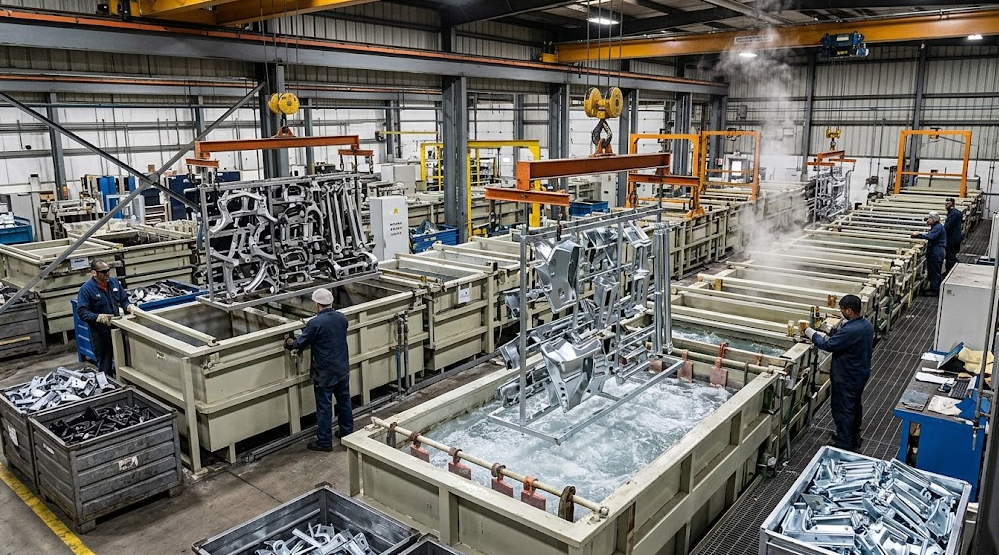
By the time a buyer searches for a zinc rack electroplating service, the decision is rarely “should we plate this?” It is “who can plate this correctly, every time, with paperwork we can defend?” You have a print, a corrosion target, a cosmetic expectation, and a production schedule that does not have room for a rejected lot. Choosing the wrong vendor means rework, line-down conversations with your own customers, and quality escalations that eat engineering time.
This guide is written for purchasing managers, quality engineers, and manufacturing engineers who are at the vendor-selection stage. It explains what rack electroplating actually delivers, how to confirm a plater can meet your specification, what a fair quote request looks like, and which questions separate a dependable partner from a risky one. It also explains how Plateco, a Wisconsin zinc plating company operating since 1974, approaches industrial rack work.
Why Rack Electroplating Is the Right Choice for Quality-Critical Parts
Zinc rack electroplating mounts individual parts on engineered racks and immerses them in a zinc electrolyte. Electrical current drives zinc ions onto the steel surface, building a sacrificial protective layer. Because each part is held in a fixed position with a dedicated electrical contact, you gain control that bulk processes cannot offer: predictable thickness, consistent appearance, and traceable handling.
That matters most when your part is large, heavy, geometrically complex, cosmetically visible, or governed by a tight engineering specification. If you are sourcing small fasteners by the thousand, barrel plating is usually the more economical route. If your component is a bracket, frame, machined housing, linkage, or assembly where finish and thickness are part of the acceptance criteria, rack plating is typically the right fit.
Rack vs. Barrel: A Buyer’s Comparison
| Factor | Rack Plating | Barrel Plating |
| Best for | Larger, complex, or quality-critical parts | Bulk small parts, fasteners |
| Thickness control | Precise, part-by-part | Good for bulk, less exact |
| Cosmetic finish | Smooth, consistent, bright | Less cosmetic control |
| Cost per part | Higher, justified by quality | Highly cost-efficient for small parts |
| Part-damage risk | Low; parts are not tumbled | Possible contact marks and nesting |
The honest answer on price is that rack plating costs more per piece than barrel plating for small parts. The question is whether the extra control prevents costs elsewhere: scrapped lots, cosmetic rejects, assembly fit problems, or field corrosion claims. For the right part, it nearly always does.
What Industrial Clients Should Expect From a Rack Process
A capable rack line is more than a tank and a rectifier. When you evaluate a vendor, it helps to understand each stage and what can go wrong, because those failure points should shape your questions.
1. Surface Preparation
Parts are cleaned to remove oils, lubricants, oxides, and particles. Contamination at this stage is the root of many adhesion failures and blistering defects. If your parts arrive with heavy machining coolant, weld scale, or heat-treat oxide, tell the plater up front so cleaning steps can be set accordingly.
2. Acid Activation and Rinsing
Acid treatment activates the steel so zinc bonds properly, and multiple rinses remove residues. Weak rinsing leads to staining, poor chromate formation, and cosmetic complaints that surface days after shipment.
3. Rack Mounting
Mounting determines electrical contact, positioning, and current distribution. Poor racking produces thin spots, burning in high-current areas, and visible contact marks in the wrong place. Custom fixtures and hook placement matter, particularly for unusual geometries. Ask any vendor how contact points are chosen and where marks will appear on your part.
4. Zinc Deposition
Current intensity and time set the coating thickness. Rack plating lets engineers tailor deposition to your specification rather than accept whatever a bulk process produces. Recesses, internal features, and edges still behave according to the physics of current density, so complex parts benefit from a plater who understands racking and anode strategy, not just bath chemistry.
5. Chromate Conversion and Finishing
After zinc deposition, parts may receive a chromate conversion or passivate that increases corrosion resistance and sets the final appearance. Finish selection is one of the most common points of confusion between buyers and platers, so it deserves its own section below.
A rack line is only as good as its weakest control: chemistry, temperature, current, rinsing, and chromate finishing all have to stay in balance from the first lot to the hundredth.
Have Questions About Your Parts? – (608) 524-8241
Finish Options and What They Mean for Performance
Plateco offers a range of finishes for rack-plated parts. Choosing among them is a balance of corrosion expectations, appearance, and any customer or industry requirement on your drawing.
- Clear zinc: classic corrosion protection with a clean, bright look. Good for general industrial hardware and assemblies where appearance is subtle.
- Yellow chromate: enhanced corrosion resistance with the familiar gold tone. Often chosen when more salt-spray performance is needed than a clear finish provides.
- Black trivalent: a functional and aesthetic option for visible parts, with a uniform dark finish.
- Olive drab: used for specific industrial applications where color and protection are both defined.
- Custom color finishes: engineered to your specification when standard options do not match your requirement.
When you request a quote, state the finish by name and cite the specification that governs it. If your print says only “zinc plate,” expect your vendor to ask what thickness class, finish, and testing are intended. That is a good sign, not an annoyance. A vendor who quotes without asking is often guessing.
Specifications, Thickness, and Documentation: What to Lock Down Before You Award
At the bottom of the funnel, the difference between a smooth program and a painful one is usually specification clarity. Before you issue a purchase order, confirm the following with your vendor in writing.
Coating Thickness and Class
Thickness is the single most important variable you can control through rack plating. Confirm the required minimum thickness, how and where it will be measured on the part, and whether your drawing defines significant surfaces. Recessed areas and internal features may not reach the same thickness as exposed faces, so agree on measurement locations early. Plateco’s rack systems are built around repeatable coating thickness and precise current distribution, with thickness measurement as part of standard inspection.
Governing Standards
Commonly referenced zinc plating requirements, such as ASTM B633, appear in automotive, agricultural, industrial, and OEM drawings. Where your print cites a customer-specific or industry specification, send it with your quote request so the vendor can confirm capability before any parts ship. You can review Plateco’s current certifications and specifications directly, and our team will confirm how they map to your program.
Quality System and Certification
Plateco’s quality system is supported by ISO 9001 certification. For any program with additional requirements, such as industry-specific accreditations or customer source approval, ask your vendor to document exactly what they hold today. Certification status changes over time, so verify it rather than assume it.
Documentation and Test Data
Custom documentation, coating thickness reports, and test data can be provided to support your quality system and audits. Decide in advance what you need: certificate of conformance only, thickness readings per lot, adhesion test results, or corrosion test data. Agreeing on this before the first lot avoids delays at receiving inspection.
Hydrogen Embrittlement Considerations
If your parts are high-strength steel, electroplating introduces a risk of hydrogen embrittlement. Your drawing may call for a post-plate bake, with timing and temperature defined by the governing specification. Flag this at the quote stage so the process is planned, scheduled, and documented. If hydrogen embrittlement is a serious concern for the application, discuss whether another process, such as mechanical galvanizing, is worth evaluating with your engineering team.
Corrosion Protection That Is Engineered, Not Assumed
Zinc is a sacrificial coating. Even if the surface is scratched, zinc corrodes before the underlying steel does, which extends the service life of the part. That behavior is why zinc is so common on components exposed to road salt, moisture, industrial humidity, agricultural environments, and outdoor weathering.
But “zinc plated” is not a performance guarantee. Real-world life depends on thickness, finish, part geometry, and the environment. A bracket on a farm implement sees something very different from a hidden hardware item in a dry enclosure. The value of rack electroplating is that you can tailor thickness and finish to the exposure instead of buying one-size-fits-all protection. When you discuss your application with a vendor, describe the end environment, expected service life, and any corrosion test requirement on the print. A good plater will translate that into a thickness and finish recommendation, and tell you plainly if the target looks unrealistic for standard zinc.
Process Control: The Difference Between a Good Lot and a Repeatable Process
Any plater can produce a good-looking sample. Industrial clients need the thousandth lot to look like the first. That depends on disciplined process management across several areas:
- Electrolyte chemistry balance so deposit quality and brightness stay consistent.
- Temperature regulation to keep the bath within its operating window.
- Precise current control so thickness stays predictable across the rack.
- Thorough rinsing systems to prevent drag-out contamination and staining.
- Consistent chromate finishing so color and corrosion performance stay uniform.
- Controlled drying and post-treatment to protect the finish before packaging.
Automated monitoring and control systems reduce variability across production batches. When you tour a facility or review a vendor’s capabilities, ask how chemistry is monitored, how often it is adjusted, and what happens when a reading drifts out of range. Vague answers here usually predict inconsistent results later.
Inspection Built Into the Process
Because rack-plated parts are handled individually, inspection can be more thorough than with bulk processing. Typical controls include visual finish assessment, coating thickness measurement, standardized adhesion testing, and corrosion resistance evaluation. Ask which of these are routine on every lot and which are performed on request, and make sure your purchase order states which ones you expect.
Who Uses Rack Electroplating, and Why
Rack plating serves manufacturers whose parts are larger, more intricate, or more visible than typical bulk hardware. Common applications include:
- Automotive suppliers: brackets, frames, and visible hardware where appearance and consistency are checked on receipt.
- Agricultural equipment manufacturers: linkage components and structural parts that face mud, moisture, fertilizer, and outdoor exposure.
- Industrial machinery producers: machined components and assembly hardware that must hold tolerance and resist shop-floor humidity.
- Construction hardware companies: anchors, connectors, and fasteners that must meet corrosion requirements.
- OEM component manufacturers: engineered parts with strict customer specifications and audit expectations.
What these clients share is a need for repeatability and documentation. They are not buying a coating; they are buying predictability they can pass on to their own customers.
Capabilities at Plateco’s Reedsburg, Wisconsin Facility
At our Reedsburg facility, Plateco operates zinc rack plating systems designed to handle large or heavy components, multiple part configurations, and critical engineering tolerances. Our equipment is optimized for precise current distribution, repeatable coating thickness, controlled solution chemistry, and consistent drying and post-treatment.
Custom rack engineering is a key piece of that capability. Individual fixtures and hooks can be configured to match part geometry, with optimized hook placement for repeatable results across production runs. For a buyer, that translates into fewer surprises when a program moves from prototype quantities to full release.
Plateco has served Wisconsin manufacturers since 1974, and also supports customers across the Midwest, including Illinois, Indiana, Iowa, Michigan, and Minnesota. If you are sourcing from outside Wisconsin, Plateco Transfer and our regional service pages explain how logistics are handled.
How to Evaluate a Zinc Rack Electroplating Vendor: A Practical Checklist
Use these questions in your next vendor review. They are designed to produce specific answers, not marketing language.
Capability and Fit
- What is the largest and heaviest part you can rack, and how do you fixture parts like mine?
- Do you design custom racks in-house, and who owns the fixtures?
- Which finishes do you run, and how do you control color consistency lot to lot?
Quality and Documentation
- What certifications do you currently hold, and can I see current documentation?
- What does your standard documentation package include, and can I review a sample?
- How do you measure coating thickness, and where on the part?
- What happens when a lot is nonconforming? Walk me through the process.
Process and Risk
- How are chemistry, temperature, and current monitored and recorded?
- How do you handle high-strength steel and post-plate baking requirements?
- How do you protect finished parts from damage during drying, handling, and packaging?
Commercial and Logistics
- What are your typical lead times, and how do you handle expedited requests?
- How do you communicate if a schedule is at risk?
- What are the quoting inputs you need from us?
A vendor that answers these questions directly and invites follow-up is showing you how they will behave when something goes wrong. A vendor that deflects is doing the same.
What to Send With Your Quote Request
A fast, accurate quote depends on a complete package. The more you include, the less time is lost in back-and-forth clarification.
- Drawings or prints, including any plating callouts, notes, and revision level.
- Governing specifications, both industry and customer-specific.
- Material and heat treatment, especially for high-strength steel.
- Part dimensions and weight, plus any features that trap solution or shield current.
- Finish requirement, such as clear, yellow, black trivalent, olive drab, or custom.
- Annual volume and release size, so racking and scheduling can be planned.
- Documentation requirements, including thickness reports, test data, and packaging or labeling needs.
- End-use environment, so thickness and finish can be matched to actual exposure.
If you do not have all of these, send what you have. A good plater will tell you what is missing and help you fill in the gaps.
Ready to Quote Your Rack-Plated Parts?
Send your prints, specifications, volumes, and corrosion targets, and Plateco will recommend the right zinc rack electroplating solution for your application.
Understanding Cost, Lead Time, and Total Value
Price per piece is only part of the picture. For industrial clients, the real cost of plating includes everything that happens if the result is not right.
What Drives Rack Plating Cost
Rack plating is a labor-intensive process by nature, because parts are individually mounted and removed. Cost is driven by part size and geometry, the number of parts per rack, fixture complexity, thickness requirement, finish selection, testing and documentation scope, and volume. Larger releases generally improve efficiency because racks can be designed once and reused.
Where Cheaper Plating Gets Expensive
Low-cost plating can become costly when it produces uneven thickness that fails inspection, cosmetic defects that force rework, adhesion problems that show up in the field, or incomplete documentation that stalls shipments. Each of these consumes engineering and quality time. When comparing quotes, ask what is included in each, and weigh capability and consistency alongside price.
Lead Time and Scheduling
Lead time depends on queue, part complexity, finish, and any required post-plate treatments or testing. Share your required ship dates and release cadence at quote time. If your program has recurring releases, a standing schedule often provides better results than ad hoc orders because racks and processes are already set.
Common Mistakes Buyers Make When Selecting a Rack Plater
- Choosing on price alone. The lowest quote often reflects reduced inspection, thinner coatings, or less documentation.
- Vague specifications. “Zinc plate per print” is not a specification. Define thickness, finish, testing, and documentation.
- Ignoring part geometry. Deep recesses, blind holes, and overlapping surfaces affect coverage. Raise these early.
- Skipping a sample or first-article review. Approving the process on a representative lot is cheaper than finding problems at scale.
- Assuming certification. Always verify current status and scope with documentation.
- Overlooking embrittlement risk. High-strength parts need explicit baking and documentation requirements.
- Treating plating as a commodity. It is a special process; results depend heavily on control and experience.
Why Industrial Clients Choose Plateco
Plateco is built around zinc. That focus shows in how we run our lines and how we talk to customers.
- Zinc plating expertise since 1974, serving Wisconsin manufacturers, fabricators, and OEMs.
- Precision process control, with controlled chemistry, temperature, current, and rinsing.
- Multiple zinc processes under one roof, including rack, barrel, and mechanical galvanizing, so you can match the process to the part instead of forcing the part to fit the process.
- Custom rack engineering for unusual geometries and repeatable production.
- Supporting documentation, including thickness reports and test data for your audits.
- Direct communication. If a requirement is outside our current capability, we will say so rather than let you assume.
That last point matters. We would rather have a clear conversation about your specification before you commit than discover a mismatch after parts are on the dock. See how we compare in our post on why Wisconsin manufacturers choose Plateco.
Next Steps: From Evaluation to First Lot
Here is a simple path from shortlist to production.
- Send your package. Submit prints, specifications, finish, volumes, and documentation needs through our quote form.
- Review and clarify. Our team will confirm thickness requirements, finish, racking approach, and any special handling or testing.
- Approve a first lot. Start with a representative run, review thickness data, finish, and documentation against your requirements.
- Release to production. Once approved, set your release schedule and communication cadence.
- Review and improve. Share feedback so the process continues to meet your needs as volumes grow.
Frequently Asked Questions
What parts are best suited to zinc rack electroplating?
Larger, heavier, complex, or cosmetically important components, such as brackets, frames, machined parts, linkage, and engineered assemblies. Small parts in bulk are usually better suited to barrel plating.
Can rack plating meet a specific thickness requirement?
Yes. Because current and time are controlled per rack, coatings can be engineered to specific thickness targets. Agree on measurement locations and tolerances with your vendor in advance.
Is rack plating more expensive than barrel plating?
For small parts, barrel plating is generally more cost-efficient. For parts needing quality finish, exact thickness, and controlled coverage, rack plating delivers value that typically justifies the added cost.
What finishes are available?
Clear zinc, yellow chromate, black trivalent, olive drab, and custom color finishes engineered to specification.
Can you provide documentation for our quality system?
Yes. Custom documentation, coating thickness reports, and test data can be provided to support customer quality systems and audits. Tell us what your program requires when you request a quote.
What if my parts are high-strength steel?
Flag this early. Electroplating can introduce hydrogen embrittlement risk, and your drawing may require a post-plate bake with defined timing and temperature. We will plan and document that with you, and discuss alternatives if appropriate.
Do you only serve Wisconsin customers?
Our facility is in Reedsburg, Wisconsin, and we serve manufacturers across Wisconsin and the surrounding Midwest, including Illinois, Indiana, Iowa, Michigan, and Minnesota.
What should I include in a quote request?
Prints, specifications, material, dimensions, finish, annual volume, release size, documentation needs, and end-use environment. Send what you have and we will help identify gaps.
Partner With Wisconsin’s Rack Electroplating Experts
If your components need precise corrosion protection, consistent coating thickness, a quality surface finish, and engineered performance, zinc rack electroplating may be the right solution. Tell us about your part specifications, volume, and corrosion targets.