

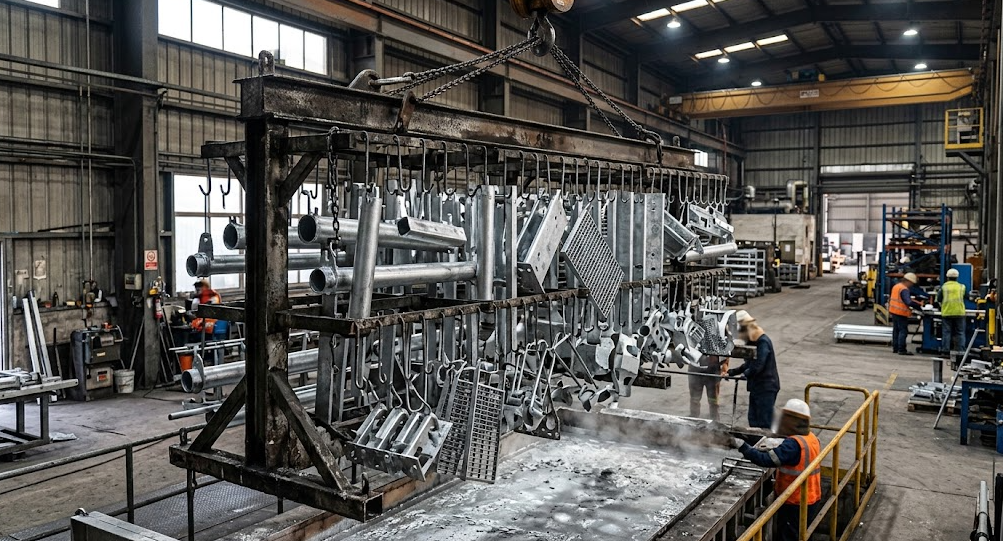
An industrial supplier receives a purchase order for 4,000 steel brackets, each about eighteen inches long, with a bend, two slotted holes and a cosmetic requirement “zinc plated, corrosion resistant.” The supplier sends the order to a plater who runs everything in a barrel. Three weeks later the brackets come back nested, scuffed, slightly bent and plated unevenly inside the bend. The buyer rejects the lot, the end customer’s line sits idle and everyone argues about whose fault it was. The root cause wasn’t the zinc. It was the process. This guide explains how zinc rack coating works, when it’s the right choice for steel hardware, what to specify so the coating performs in the field and how industrial supply buyers can avoid rejected lots.
Steel hardware has a corrosion problem that never goes away. Bare steel starts oxidizing the moment it meets moisture, and every distributor, OEM and maintenance buyer has seen what happens next red rust on brackets in a warehouse, seized fasteners on an outdoor installation, a customer return that traces back to a coating that wasn’t up to the environment.
Zinc is still the most widely used and most cost-effective corrosion protection for steel hardware. But “zinc plated” describes an outcome, not a process. How the zinc gets onto the part matters as much as how much zinc ends up there. For larger, longer, flatter, more delicate or more cosmetically demanding hardware, that process is rack electroplating.
At Plateco, we’ve been zinc plating for industrial customers since 1974, and we see the same pattern on incoming drawings and purchase orders a corrosion callout vague enough to leave the process, the thickness and the finish to chance. This guide is written to close that gap. It covers how zinc protects steel, how rack plating differs from barrel plating, which ASTM B633 service condition fits which application and what industrial buyers should put on a PO so the hardware they receive is the hardware they ordered.
Rack
Each part is individually fixtured, so there’s no tumbling damage or nesting
SC1–SC4
Range of ASTM B633 service conditions available for zinc coatings
1974
Year Plateco began providing zinc plating services
How Zinc Protects Steel: The Science in Plain Terms
Zinc protects steel in two ways, and understanding both explains why it has remained the industry default for so long.
Barrier Protection
A zinc coating physically separates the steel from moisture, oxygen and salts. As long as the layer is continuous, the steel underneath has nothing to react with. This is the same principle behind paint, but zinc bonds to the steel metallurgically rather than sitting on top of it.
Sacrificial (Galvanic) Protection
Zinc is more electrochemically active than iron. When a scratch, drilled hole or cut edge exposes bare steel, the surrounding zinc corrodes in preference to the steel, protecting the exposed area. This is why a zinc-plated bolt with a thread nick doesn’t rust the way a painted bolt does. The zinc keeps working even where the coating is damaged.
Corrosion Rate Depends on Thickness and Environment
Zinc corrodes slowly in most atmospheres, and the rate climbs sharply in environments with salt, acidic industrial pollutants or constant condensation. That’s why zinc thickness is the single biggest lever a buyer controls. A coating that lasts years in a dry warehouse may last only a season or two on hardware exposed to road salt. Zinc consumption is predictable, which means it can be specified rather than guessed.
The Passivate Layer
Zinc plating on its own forms white corrosion products (often called white rust) when it’s exposed to moisture. A chromate conversion coating, called a passivate, applied right after plating slows that reaction and extends the time before the zinc is consumed and the steel beneath begins to corrode. Modern passivates are trivalent chromium based and RoHS compliant. Clear, yellow, black and other finishes are available, and they differ in corrosion performance and appearance.
What Is Zinc Rack Plating?
Zinc rack electroplating is an electrodeposition process in which each part is mounted on a fixture, called a rack, that holds it in place while it moves through a series of process tanks cleaning, rinsing, acid activation, the zinc plating bath, rinsing, passivation and drying.
During the plating step, the rack carries electrical current to the parts. The parts act as the cathode in the plating bath, and zinc ions in the solution are reduced and deposited onto the steel surface as a metallic coating. Because each part is fixtured individually, it’s electrically connected, positioned in the bath and oriented relative to the anodes on purpose, not randomly, as it would be in a tumbling barrel.
That distinction, controlled positioning versus random tumbling, drives nearly every practical difference between rack and barrel plating.
What Happens on the Line
A well-run rack line follows a repeatable sequence, and each step matters:
- Racking. Parts are mounted on fixtures designed for their geometry. Good racking provides solid electrical contact, allows solution to drain from recesses and keeps the parts from shielding each other.
- Cleaning. Alkaline and electrocleaning steps remove oils, soils and drawing compounds. Zinc will not adhere to a dirty surface, and most adhesion failures trace back to this stage.
- Acid activation. Pickling removes scale and oxide, leaving a chemically active surface ready to accept zinc.
- Zinc plating. Current flows and zinc deposits at a rate governed by current density and time. Thickness is a function of both.
- Passivation. The chromate conversion layer is applied to protect the fresh zinc.
- Drying and unracking. Parts are dried, inspected and unracked, with care to avoid scratching.
For hardware with high strength or hardness, a post-plate bake is added to address hydrogen embrittlement, which we cover below.
Have Questions About Your Parts? – (608) 524-8241
Rack vs. Barrel Plating: Choosing the Right Process for Your Hardware
Plateco runs both zinc barrel electroplating and zinc rack electroplating, so this isn’t a sales pitch for one over the other. The right process depends on the part, and picking wrong is one of the most common causes of rejected lots.
When Barrel Plating Is the Right Answer
Barrel plating loads parts into a perforated rotating drum that tumbles them through the bath. It’s efficient for high volumes of small, rugged parts such as nuts, small bolts, washers, screws and clips. Tumbling gives good average coverage on parts that can tolerate contact with each other.
When Rack Plating Is the Right Answer
Rack plating is the better choice when a part:
- Is too large, long or heavy to tumble (brackets, plates, rods, tubes, hangers, frames)
- Is flat or nests easily, where parts would stick together in a barrel and plate unevenly
- Can be bent, scratched, dinged or dented by tumbling contact
- Has threads, fine features or precision surfaces that can’t tolerate impact damage
- Has a cosmetic requirement where uniform appearance and no tumbling marks matter
- Is a lower-volume or custom run where fixturing each part is practical
- Needs the plated thickness applied more predictably to specific surfaces
Side-by-Side Comparison
| Factor | Rack Plating | Barrel Plating |
|---|---|---|
| Part size | Medium to very large, long or irregular | Small, compact parts |
| Handling | Individually fixtured, no tumbling | Parts tumble together |
| Damage risk | Low (watch for rack contact marks) | Higher for delicate parts (dings, scuffs, nesting) |
| Coating uniformity | More controlled, orientation set on the rack | Good average, with variation part to part |
| Best for | Brackets, plates, rods, frames, hangers, cosmetic parts | Nuts, screws, washers, small bolts, clips |
| Volume economics | Best for low to medium volumes and large parts | Best for high volumes of small parts |
| Appearance | Excellent, consistent | Good, may show tumble marks |
✓ Quick Reference: Which Process Fits
Choose rack plating for large, long, flat, delicate, cosmetic or precision steel hardware. Choose barrel plating for small, durable bulk parts. If your order includes both kinds of parts, a plater that runs both processes can route each component correctly. If you need a thicker, more sacrificial coating on fasteners or small parts without hydrogen concerns, ask about zinc mechanical galvanizing.
ASTM B633: The Standard Behind Zinc Coating Thickness
For electroplated zinc on iron and steel, ASTM B633 is the governing standard. It defines coating thickness in four service conditions based on how harsh the exposure environment is, and it’s the specification most industrial buyers should be calling out on drawings and purchase orders. For a deeper walkthrough, see our guide to what ASTM B633 requires.
Service Conditions and Minimum Thickness
| Service Condition | Min. Thickness | Exposure Environment | Typical Industrial Hardware Application |
|---|---|---|---|
| SC 1 — Mild | 5 µm | Dry indoor, no condensation | Interior brackets, enclosures, indoor equipment hardware |
| SC 2 — Moderate | 8 µm | Indoor with occasional condensation | Warehouse racking hardware, utility and HVAC support hardware |
| SC 3 — Severe | 12 µm | Outdoor exposure, weather, temperature cycling | Exterior brackets, mounting plates, equipment frames, agricultural hardware |
| SC 4 — Very Severe | 25 µm | Harsh outdoor, road salt, constant weather exposure | Hardware near roadways, washdown areas, marine-adjacent or heavy-salt exposure |
📋 A Note on “Significant Surfaces”
Thickness requirements in B633 apply to a part’s significant surfaces, meaning the areas that are visible, functional or essential to protection and that can be reached by a measurement probe. Deep recesses, blind holes and the interiors of tubes often can’t be held to the same thickness as the open surfaces. If your part has features like these, confirm with your plater which surfaces the requirement applies to before the order is placed.
Why Thickness Alone Isn’t the Whole Story
Thickness and passivate work as a system. Two parts can both measure 12 µm and perform very differently if one has a clear passivate and the other has a robust trivalent yellow with a sealer on top. When a drawing specifies a salt spray requirement as well as a thickness, those two numbers need to be consistent with each other. We cover that in our guide to salt spray testing zinc parts.
Design and Process Factors That Make or Break a Rack-Plated Coating
Getting zinc onto steel isn’t difficult. Getting it on uniformly, with the right adhesion, on the surfaces that matter, is where plating becomes a discipline. These are the factors that separate reliable hardware from returns.
Current Distribution and Part Geometry
Electroplating deposits more zinc where current density is highest, which means sharp edges, corners and outside surfaces collect a thicker coating, while recesses, blind holes and inside corners collect less. This is a physical reality of electrodeposition, not a defect. Good racking, careful positioning relative to the anodes and sometimes auxiliary anodes or shields help even things out, but they can’t change the physics.
For buyers, the practical implication is simple if a part has critical surfaces in a recess or an internal diameter, say so on the drawing so the plater can plan around it. Specifying the same thickness everywhere on a complex part without identifying significant surfaces invites disagreement at inspection.
Rack Contact Points
Every rack-plated part has to touch the rack somewhere, and wherever it does, a small area is left uncoated or lightly coated. Experienced platers position these contact points on non-critical or non-visible surfaces. If a part has a cosmetic face, a critical thread or a surface that must be fully coated, identifying that on the drawing lets the plater choose the contact location accordingly.
Surface Preparation and Incoming Condition
Plating can only be as good as the surface it’s applied to. Heavy scale, rust, weld spatter, residual oils, drawing compounds, laser oxide and some heat treat scales all require specific pretreatment or may need to be removed before the parts arrive. Parts with trapped oil in seams, laps or crevices can bleed out during processing and ruin an otherwise good finish. Telling your plater about the material, any heat treatment and any known contaminants helps them select the right cleaning cycle.
Material Matters
Low carbon steel plates readily. High carbon, case hardened and some alloy steels require modified cleaning and activation. Cast iron, powdered metal and parts with porosity require special attention because they can trap process solutions and bleed afterward. Identify the base material and any heat treatment on your PO. It changes how a part should be processed.
Hydrogen Embrittlement: The Hidden Risk on High-Strength Hardware
During acid cleaning and electroplating, hydrogen can be absorbed into steel. In low-strength steel, it diffuses out harmlessly. In high-strength or hardened steel, typically parts hardened to roughly 39 HRC and above, trapped hydrogen can cause delayed brittle failure under load, sometimes hours or days after installation.
The standard safeguard is a post-plate bake, performed within a short window after plating, to drive hydrogen out of the steel. Industry practice for this is covered by ASTM B850. If your hardware includes high-strength fasteners, springs, clips or heat-treated components, tell your plater the hardness or tensile strength at order entry so the right precautions are built into the process. This is not something to discover after the parts are plated.
The Most Common Mistake on Hardware Orders
Specifying “zinc plated” without a thickness, a passivate type, a governing standard or any note about the part’s strength and function. That leaves the corrosion protection level, the finish and the embrittlement precautions to whoever processes the order, and it creates real risk that the delivered hardware doesn’t match what the end user needs.
Passivates and Topcoats: Matching Finish to Environment
After zinc is plated, the passivate determines both appearance and a good part of corrosion life.
Clear / Blue (Trivalent)
The most economical finish, with a bright, silvery-blue appearance. It’s the common choice for interior hardware and applications where corrosion exposure is mild. It provides the least corrosion protection of the common passivates.
Yellow (Trivalent)
The workhorse for industrial hardware. Trivalent yellow gives meaningfully better corrosion resistance than clear and is widely accepted in specifications. Its iridescent gold-to-yellow appearance is familiar from fasteners and brackets of all kinds. It’s RoHS compliant and suitable for most SC2 to SC4 applications.
Black (Trivalent)
Chosen for appearance, such as visible hardware where a dark finish is preferred, or for applications where reflectivity is a concern. Black passivates generally provide corrosion performance in line with, or somewhat below, a comparable yellow system, depending on the chemistry. If a sealer is added, performance improves.
Sealers and Topcoats
A sealer or topcoat applied over the passivate fills microscopic porosity, adds lubricity (useful for threaded hardware) and extends the time before white corrosion appears. On hardware facing severe exposure, the combination of the right zinc thickness, a trivalent yellow passivate and a sealer is often the difference between a coating that lasts years and one that shows visible corrosion in a single harsh season.
A Note on Hexavalent Chromium
Hexavalent chromate passivates have largely been phased out due to environmental and health regulations. Most current specifications and customer requirements call for trivalent systems. If an older drawing references a hex chromate, confirm the current acceptable equivalent with your quality contact before ordering.
Matching Zinc Rack Coating to Common Hardware Applications
Different hardware categories have different practical requirements. Here’s how the pieces typically fit together for industrial supply.
Brackets, Plates and Mounting Hardware
Typical spec: SC2 to SC3 (8–12 µm), trivalent clear or yellow passivate
Flat and formed steel parts are classic rack-plating candidates. They nest and scuff in barrels, and they often have cosmetic faces. Interior or protected brackets can generally run at SC2. Anything exposed to weather should be SC3 at minimum.
Threaded Rod, Long Fasteners and Studs
Typical spec: SC3 (12 µm) for exterior use, with thread fit verified after plating
Long or slender parts are difficult to tumble without bending or damaging threads. Rack plating protects the geometry. Because zinc adds thickness, confirm that thread class and fit are maintained after coating. This is especially important for fine threads and tight tolerance nuts.
Equipment Frames, Weldments and Assemblies
Typical spec: SC3 to SC4 depending on exposure, with attention to weld and seam cleanliness
Welded assemblies introduce the most surface-preparation risk spatter, flux residue and crevices that trap fluids. Open, well-drained designs plate best. If seams or closed sections are unavoidable, discuss venting and drain holes with your plater up front.
Agricultural and Outdoor Equipment Hardware
Typical spec: SC3 to SC4 with trivalent yellow passivate and sealer where appropriate
Hardware exposed to fertilizers, moisture, mud and temperature swings sees one of the most aggressive real-world corrosion environments. Specify for the harshest likely exposure rather than the average one.
Electrical and Utility Enclosure Hardware
Typical spec: SC2 to SC3, with consideration for conductivity and grounding requirements
Zinc maintains electrical contact better than many organic coatings, which makes it a common choice where bonding and grounding matter. Confirm whether the passivate type affects conductivity requirements on your design.
High-Strength Hardware and Springs
Typical spec: Per drawing, with a documented post-plate bake for embrittlement relief
Parts at or above the hardness threshold need explicit process controls. This isn’t an area for assumptions, so provide the strength rating at the time of quotation.
How to Write a Zinc Rack Plating Specification That Holds Up
A clear specification protects the buyer, the supplier and the plater. A complete callout should include the governing standard, the service condition or thickness, the passivate type, the process if it matters, any supplementary requirements and any part-specific notes.
📋 Specification Example — Exterior Mounting Bracket
Zinc electroplate per ASTM B633, SC3, trivalent yellow passivate. Minimum thickness 12 µm on significant surfaces. Rack plate only, no barrel processing. Rack contact points permitted on the rear face only. Parts must be free of scratches and handling damage on the front face.
📋 Specification Example — High-Strength Threaded Stud
Zinc electroplate per ASTM B633, SC3, trivalent clear passivate with sealer. Parts hardened to 40 HRC post-plate hydrogen embrittlement relief bake required per ASTM B850. Verify thread fit after plating. Certificate of conformance and bake documentation required with shipment.
The elements most often missing from industrial hardware POs are an explicit service condition, the passivate type and any note on strength or hardness. Each one changes how the parts are processed, and each one is cheap to include and expensive to leave out.
Quality Documentation Worth Requesting
Depending on the application, buyers commonly ask for some combination of:
- A certificate of conformance to the stated specification
- Coating thickness verification, typically by X-ray fluorescence (XRF) or another recognized method
- Salt spray test results where a hour requirement is specified
- Bake records for high-strength parts
- Lot traceability back to the order
If documentation matters to your customer or your own quality system, request it at quote time so it’s built into the order rather than assembled afterward.
Why Quality Systems Matter in an Industrial Supply Chain
For distributors and OEMs, a plater is not just a processing step. It’s a link in the supply chain, and that link’s quality system is part of your quality system.
A few things are worth evaluating in any zinc plating partner:
- Certification. A documented quality management system, such as ISO 9001, shows that processes are controlled, measured and audited. You can review Plateco’s certifications and specifications on our site.
- Return rate. A plater’s customer return rate is one of the most honest indicators of process control. Ours is 0.1% for the first quarter of 2026, and we track and publish it because we think customers deserve to see it.
- On-time performance. Plating is one of the last steps before hardware ships to the end customer. A late plater delays everyone downstream. We hold ourselves to 95% on time, all of the time.
- Communication. A good plater flags ambiguous drawings, incompatible materials and risky geometries before the parts are processed, not after they’re rejected.
Why Industrial Buyers Choose Plateco for Zinc Rack Coating
Industrial supply runs on predictability. Your customers expect hardware that matches the spec, arrives when promised and performs in the field. That’s the standard we hold ourselves to.
From our Reedsburg, Wisconsin facility, we serve distributors, OEMs and fabricators across the Midwest with both rack and barrel zinc electroplating. Because we run both processes, we can look at your parts and tell you honestly which one fits, rather than forcing every order through the same line. Our commitment is simple on spec, on time, or it’s on us. If we deliver a plated part that you reject for a quality problem that’s our fault, you won’t be charged for that part.
“We treat zinc plating as an extremely complex process demanding state-of-the-art technology, painstaking planning, obsessive quality control, and a tremendous amount of talent. Because our customers don’t come to us for excuses they come to us for perfection. And we’ll do whatever it takes to give them nothing less.”
— Jim Schweich, Chief Executive Perfectionist, Plateco, Inc.
Frequently Asked Questions
What is the difference between zinc rack plating and zinc barrel plating?
In rack plating, each part is mounted on a fixture and held in position through the process. In barrel plating, parts are loaded into a rotating drum and tumble together. Rack plating suits large, long, flat, delicate or cosmetic parts that would be damaged or nest in a barrel. Barrel plating suits small, durable parts in high volumes, such as nuts, washers and small screws.
How thick should zinc plating be on steel hardware?
It depends on the environment. Under ASTM B633, minimum thicknesses range from 5 µm for mild indoor conditions to 25 µm for very severe outdoor exposure. Interior protected hardware is commonly SC1 or SC2, general exterior hardware SC3 and hardware exposed to road salt or constant weather SC4. When you’re unsure, specify for the harsher environment. The added cost is modest compared with the cost of a field failure.
Can zinc rack plating be used on high-strength steel?
Yes, with precautions. High-strength and hardened steel is susceptible to hydrogen embrittlement during acid cleaning and plating. The standard safeguard is a post-plate bake to relieve absorbed hydrogen. Tell your plater the hardness or tensile strength when you request a quote so the correct process controls are applied.
Will zinc plating change the dimensions or thread fit of my parts?
Yes, slightly. Zinc adds thickness to every surface it coats, and a few micrometers on a thread can matter on tight fits. Provide the thread class and any critical dimensions up front, and ask whether your fit requirements apply before or after plating.
What’s the difference between zinc electroplating and hot-dip galvanizing?
Electroplating produces a thinner, smoother, more dimensionally precise coating, typically 5 to 25 µm, which suits hardware with threads and close tolerances. Hot-dip galvanizing produces a much thicker coating and is common for heavy structural steel. We compare them in detail in our guide to zinc plating vs. hot-dip galvanizing.
How long does zinc-plated hardware last?
Service life depends on thickness, passivate, sealer and the exposure environment. A properly specified coating can last for many years in protected or moderate conditions, while the same hardware in a salt-heavy environment will consume zinc much faster. Matching the service condition to the real exposure is the most reliable way to get the life you expect.
How do I know if my parts should be rack plated?
Consider rack plating if your parts are large, long, flat, easily bent or scratched, have cosmetic faces or precision threads or tend to nest together. If you’re not sure, send us a drawing or a sample and we’ll recommend the right process.
What information should I include when I request a quote?
Part drawings or samples, base material and any heat treatment, hardness for high-strength parts, quantity and annual volume, the required ASTM standard and service condition, passivate type, any cosmetic or contact-point restrictions and the documentation you need with shipment.
Ready to Get Your Hardware Coated Right?
Tell Us About Your Parts
Plateco has been zinc plating for industrial customers since 1974, with the process controls, certifications and documentation to back your specification. Send us your drawings or samples and we’ll confirm which process, thickness and finish your hardware needs before it goes on the line.