
A purchasing manager in Oshkosh opens a rejected lot report on a Monday morning. A run of stamped brackets for a heavy-duty vehicle program has shown red rust after only a few weeks in the yard, and the assembly line is now waiting on replacements. The brackets were machined to print. The welds were clean. The only thing that failed was the finish, and that finish was chosen late, specified loosely and handled by a plater who treated it as an afterthought. This guide explains why so many Oshkosh manufacturers have settled on zinc plating as the corrosion protection for their industrial metal parts, how the different zinc processes compare, and how to specify the coating so it performs the first time.
Oshkosh is a manufacturing city in the truest sense. Heavy defense and specialty vehicles, aviation hardware, agricultural equipment, fabricated structural steel and a deep supply chain of machine shops and stampers all operate within a few miles of each other. What those industries share is steel, and what steel shares with every other metal part in Northeast Wisconsin is a constant fight against moisture, road salt and temperature swings.
At Plateco, we have been zinc plating industrial parts for Wisconsin manufacturers since 1974. We see the same pattern across Oshkosh work the manufacturers who keep their warranty claims low and their assembly lines moving are the ones who treat the finish as an engineered part of the component, not a last-minute line item. Zinc plating is the finish most of them choose, and the reasons are practical rather than fashionable.
This article walks through those reasons in detail. It covers what zinc plating actually does to steel, how Wisconsin’s climate shapes the decision, how barrel plating, rack plating and mechanical galvanizing differ, which finishes fit which jobs, and what to look for in a plating partner. It closes with practical specification guidance and answers to the questions Oshkosh buyers and engineers ask us most often.
0.1%
Plateco return rate, 1st Quarter 2026
1974
Year Plateco began zinc plating for Wisconsin manufacturers
95%
On-time delivery commitment “95% on time, all of the time”
Oshkosh Manufacturing Runs on Steel, and Steel Runs on Protection
Walk through an industrial park in Oshkosh and you will see how varied the parts are. There are fasteners and clips by the thousand, stamped brackets and mounting plates, machined housings, structural frames, hitch components, linkage hardware and the countless small connectors that hold larger assemblies together. Nearly all of it is carbon steel or iron, because steel delivers the strength, formability and cost that production manufacturing demands.
The weakness of steel is well known. Left bare, it oxidizes. In a climate like Northeast Wisconsin’s, with humid summers, long wet shoulder seasons and winters packed with deicing salt, bare or poorly protected steel can show surface rust quickly and lose function over time. For a cosmetic part, rust is an embarrassment. For a load-bearing fastener or a safety-related bracket on a vehicle that will work in rough terrain, it is a reliability problem.
That is why corrosion protection is not a decorative decision in Oshkosh. The parts built here often go to places that are far harsher than the shop floor where they were made construction sites, farm fields, military proving grounds, airports and highways. A finish has to survive that journey and then keep performing for the life of the product.
Manufacturers have many coating options available, from paint and powder coat to nickel and chrome to hot-dip galvanizing. Zinc plating consistently wins a large share of this work because it balances protection, precision, cost and production efficiency better than most alternatives. The rest of this guide explains how.
Have Questions About Your Parts? – (608) 524-8241
How Zinc Plating Protects Steel: The Sacrificial Advantage
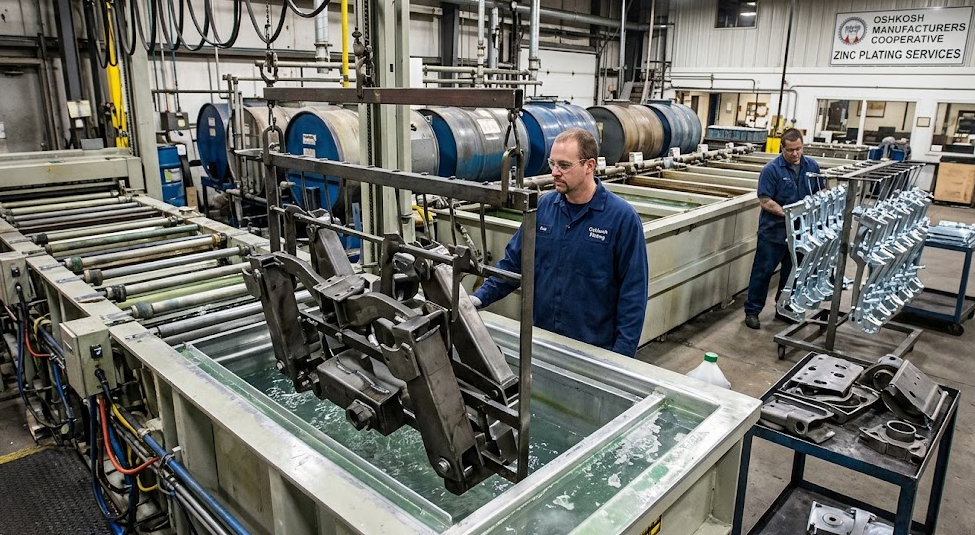
Zinc plating is an electrochemical process that deposits a thin, uniform layer of zinc onto steel or iron components. The part is cleaned, activated and immersed in a plating solution, and an electric current drives zinc onto its surface. A passivate or conversion coating is then applied over the zinc to extend its life, and a sealer or topcoat can be added when the environment demands more.
The key to why zinc works so well is that it is sacrificial. Zinc is more electrochemically active than steel, so when moisture reaches the surface, the zinc corrodes first and the steel underneath is protected. Most barrier coatings, such as paint, protect only as long as the film stays intact. If a barrier coating is scratched through to the steel, rust can begin at the scratch and creep beneath the film. Zinc continues to protect steel at small scratches and cut edges because it keeps working galvanically even when the surface is slightly damaged.
That matters on real production parts. Brackets get handled, bins get stacked, fasteners get driven with impact tools and assemblies get scuffed during installation. A coating that tolerates minor damage and still protects the base metal is a more forgiving choice than one that relies entirely on perfect film integrity.
Zinc plating also offers a combination of advantages that Oshkosh manufacturers consistently tell us they value:
- Cost-effective corrosion protection compared with many alternative systems
- Increased lifespan of steel components in humid, wet and salt-exposed environments
- Protection against moisture, humidity and road salts
- Uniform coating thickness that supports consistent performance and predictable fit
- Suitability for both small runs and high-volume production
No single finish is perfect for every part, but few deliver this mix of benefits at a price that fits production budgets. That is the core of why zinc plating has become the default finish for industrial steel parts across the region.
What Wisconsin Weather Does to Unprotected Metal
A finish that works in a dry climate can fail quickly in Wisconsin. Understanding the environment is half of choosing the right coating, and Oshkosh sits squarely in the kind of weather that punishes steel.
Road Salt and Deicing Chemicals
Deicing salt is one of the fastest accelerants of corrosion in any coating system. It is applied heavily to Wisconsin roads, parking lots and loading areas every winter, and it travels as spray, slush and dust. Vehicle components, trailer hardware, fasteners near roadways and equipment that operates outdoors all pick up salt exposure whether the designer planned for it or not. Zinc’s sacrificial behavior is especially valuable here, because the zinc layer is consumed in place of the steel while the salt does its work.
Freeze-Thaw Cycling
Northeast Wisconsin winters bring dozens of freeze-thaw cycles. Moisture works into joints, threads and microscopic surface imperfections, then freezes and expands. Over a season, that cycling can break down coatings that are thin, porous or poorly adhered. Components that will see this cycling for years need a coating thickness with real margin above the minimum, not just the bare minimum for the exposure category.
Humidity and Condensation
Humid summers and damp spring and fall weather create long periods of condensation on metal surfaces. That exposure is easy to underestimate because parts under a cover or inside a ventilated but unheated building are not in direct rain. Sustained condensation is nonetheless one of the most persistent sources of corrosion on semi-protected hardware.
Mud, Moisture and Mechanical Abuse
Parts built in Oshkosh for agricultural and off-road applications face a different kind of stress. Mud packs into crevices and holds moisture against the surface, while vibration, abrasion and impact wear at the coating. A zinc system paired with a quality passivate and sealer gives these parts a tough sacrificial barrier that stands up to wear as well as weather.
Together these conditions explain why Oshkosh manufacturers rarely accept an unprotected or lightly protected steel part. The environment simply does not leave much room for error.
Three Zinc Processes, One Goal: Matching the Process to the Part
One of the biggest advantages of working with a dedicated zinc specialist is that you do not have to force every part through a single process. Different parts call for different methods, and choosing correctly improves quality and lowers cost. Plateco runs zinc barrel electroplating, zinc rack electroplating and zinc mechanical galvanizing, so each part can be routed to the process that fits it.
Zinc Barrel Electroplating
Barrel plating is ideal for high-volume, small to medium-sized steel components. Parts are loaded into a rotating barrel and submerged in the plating solution. As the barrel turns, parts tumble against each other, which exposes every surface to the bath and produces consistent, uniform coverage.
Advantages: efficient processing of large quantities, economical bulk production, uniform zinc on threaded and recessed surfaces, reliable sacrificial protection and fast turnaround for production schedules.
Typical applications: bolts, screws and nuts small brackets and clips stampings and connectors and agricultural and industrial fasteners.
For Oshkosh manufacturers focused on production efficiency and cost control, barrel plating is usually the preferred route for small parts that move in large quantities.
Zinc Rack Electroplating
Rack plating is designed for larger, more delicate or cosmetically critical components. Each part is individually mounted on a rack, which allows precise control of coating thickness and surface finish and avoids the part-to-part contact that tumbling involves.
Advantages: accurate thickness control, smooth and uniform surface finish, reduced risk of part damage, suitability for complex shapes and engineered tolerances, and consistent batch-to-batch quality.
Typical applications: automotive mounting hardware structural brackets and frames industrial machinery components and construction hardware that requires a precision finish.
When a part is too large to tumble, too delicate to risk damage or too visible to accept contact marks, rack plating is the right answer.
Zinc Mechanical Galvanizing
Mechanical galvanizing applies a thick, heavy-duty zinc coating to steel parts exposed to harsh outdoor or industrial conditions. Instead of using an electric current, the process mechanically bonds zinc powder to the steel surface through tumbling and impact, creating a durable and well-adhered coating.
Because it does not use electroplating chemistry, mechanical galvanizing eliminates the risk of hydrogen embrittlement, which makes it an excellent option for high-strength fasteners.
Advantages: thicker zinc coatings for extended corrosion resistance, excellent adhesion, uniform thread coverage, suitability for high-strength steel and long-term durability in demanding environments.
Typical applications: anchor bolts, structural fasteners, agricultural machinery hardware, outdoor construction components and heavy-duty industrial assemblies.
Quick Process Comparison
|
Process |
Best For | Key Strength |
Typical Oshkosh Parts |
|---|---|---|---|
| Barrel Electroplating | High-volume small and medium parts | Efficient, uniform coverage on threads and recesses | Bolts, screws, nuts, clips, stampings, connectors |
| Rack Electroplating | Larger, delicate or cosmetically critical parts | Precise thickness control and smooth finish | Mounting hardware, brackets, frames, machinery components |
| Mechanical Galvanizing | High-strength steel and harsh outdoor exposure | Thick coating with no hydrogen embrittlement risk | Anchor bolts, structural fasteners, ag hardware |
Why Process Selection Matters
Sending a high-strength fastener through the wrong process, or tumbling a delicate part that should have been racked, creates defects that no amount of inspection can fix afterward. Choosing the process at the quoting stage, with the part’s geometry, strength class, volume and exposure in mind, is the cheapest quality control you will ever buy.
Finish Options: Choosing the Right Passivate for the Job
The zinc layer does the sacrificial work, but the passivate on top of it largely determines how long that zinc lasts and how the part looks. Oshkosh manufacturers can choose from a range of finishes depending on the corrosion requirement, the appearance requirement and the customer’s specification.
Clear passivation gives a bright, clean look with good basic protection. It suits interior parts and applications where appearance is neutral and corrosion exposure is moderate.
Yellow chromate provides a noticeably higher level of corrosion resistance than a clear finish and is the standard choice for many exterior and industrial parts. Its gold tone also makes it easy to identify at a glance on an assembly line.
Black finish is chosen when appearance, glare reduction or a specific aesthetic matters. It is common on visible hardware, though it usually offers somewhat less corrosion resistance than a comparable yellow system at the same zinc thickness unless a sealer is added.
Olive drab is associated with military and tactical applications and is widely used where a durable, low-visibility finish with strong corrosion performance is required.
Custom corrosion-resistant coatings are available for jobs with unusual requirements, including systems paired with high-performance trivalent passivations and sealers for the most demanding exposure.
The practical rule is simple match the finish to the environment the part will actually see, not the one it sees on the dock. A fastener that spends its life under a vehicle in winter needs a very different system than a bracket inside a dry enclosure, even if the two parts look similar on a drawing.
Serving Oshkosh’s Core Industries
Zinc plating is not a one-size solution, but it fits an unusually wide range of what Oshkosh makes. Here is how it applies to the industries that define the local economy.
Defense and Specialty Vehicle Suppliers
Oshkosh is recognized as a global leader in heavy defense and tactical vehicle manufacturing, and the Tier 1 and Tier 2 suppliers that feed those programs work to demanding standards. Brackets, fasteners and stampings on these vehicles live in extreme terrain, so the finish has to deliver heavy-duty corrosion protection and survive mechanical wear, mud and continuous outdoor abuse. Zinc plating combined with high-performance trivalent passivations and sealers creates a tough sacrificial barrier that fits this duty cycle. Documentation and process control matter as much as the coating itself in this sector, which is why a plater with ISO 9001 certification and disciplined records is an advantage.
Aerospace and Aviation Hardware
Oshkosh is also a major aviation hub, and local precision machine shops operate under strict finishing standards. On dense hardware and custom components, thickness uniformity is critical. Too little zinc compromises protection, while too much can jam threads or push a part out of tolerance. Fully automated lines with tight thickness control help hardware meet exact engineering blueprints without thread interference.
Agricultural Machinery
Northeast Wisconsin’s farm economy depends on equipment that works outdoors in mud, moisture, manure and fertilizer residue. Fasteners, linkage hardware, brackets and implement components all benefit from zinc’s sacrificial protection. Barrel plating covers the high-volume small parts, while mechanical galvanizing gives thicker protection on heavier hardware that will sit in the weather for years.
Automotive and Truck Components
Fasteners, brackets, mounting hardware and stampings for automotive and truck programs need protection from road salt and spray together with consistent fit during assembly. Zinc plating delivers both, and its uniform thickness helps parts mate cleanly on the line.
Construction Anchors and Structural Hardware
Anchor bolts, tie plates, connectors and structural fasteners face some of the least forgiving corrosion demands in metal finishing, because the cost of failure is structural rather than cosmetic. We cover those specification requirements in depth in our guide to construction hardware and zinc plating for Wisconsin projects.
General Industrial Equipment and OEM Assemblies
From machinery frames to conveyor hardware to the small parts inside OEM assemblies, zinc plating is a dependable default. Many OEMs choose it precisely because it is predictable. The process is well understood, the specifications are standardized, and the results are repeatable from lot to lot.
Precision That Protects Fit and Function
Corrosion protection is only useful if the part still works after it is coated. This is where zinc electroplating holds a real advantage over thicker coating methods for many industrial parts.
Electroplated zinc is deposited in thin, controlled layers, typically measured in micrometers under ASTM B633, the standard for electrodeposited zinc coatings. That level of control preserves thread fit, tight tolerances and the dimensional precision that mating components require. A heavy coating on a fine-threaded fastener can bind a nut or push a part out of tolerance. A properly controlled zinc layer protects the part without changing how it assembles.
That precision is why zinc plating is so common on fasteners, connectors, precision brackets and any component that must fit another component after finishing. It is also why thickness verification matters. Consistent measurement of the coating confirms that parts meet both the corrosion requirement and the dimensional one, so engineers do not have to choose between them.
When parts need very thick protection or involve high-strength steel that is sensitive to hydrogen, mechanical galvanizing provides an alternative path without giving up thread coverage. The ability to choose among processes, rather than being locked into one, is what lets a specialized plater serve such different parts equally well.
The Real Economics of Zinc Plating
Cost is always part of the conversation, and zinc plating earns its place on the bill of materials for straightforward reasons.
Low cost per part. Zinc electroplating, especially in barrel processing, is highly efficient at volume. Spread across thousands of fasteners or stampings, the finishing cost per part is typically a small fraction of the part’s value.
Long service life. The point of a finish is to extend the life of the component. A well-specified zinc system keeps steel parts functional for years in environments that would corrode bare steel in a single season, which reduces replacements, returns and downtime.
Lower total cost of ownership. The sticker price of the finish is rarely the real cost. The real cost is the rejected lot, the warranty claim, the line stoppage and the damaged reputation that follow a coating failure. A plater with strong quality control and reliable delivery lowers all of those hidden costs.
Scalability. The same finish works for a prototype run, a seasonal production surge or a long-term high-volume program. That flexibility means a manufacturer does not need to requalify a different coating every time volume changes.
For Oshkosh manufacturers, zinc plating provides a balance of affordability, durability and dependable protection. That balance, more than any single technical feature, explains why it keeps winning the specification.
Why Quality Systems and Delivery Matter as Much as the Coating
Any plater can run parts through a tank. What separates a reliable partner from a risky one is everything around the tank process control, inspection, documentation, communication and on-time delivery.
Many manufacturers have lived the alternative. They have dealt with excessive defect rates, inconsistent thickness, missing paperwork and delivery dates that slip without warning. Each of those problems lands on the customer’s production schedule, not the plater’s.
We built Plateco around a different standard. Here is what we commit to every customer:
- On spec. If we deliver a plated part that you reject for a quality problem that is our fault, you will not be charged for that part.
- On time. We are 95% on time, all of the time.
- Honest. Every piece of information you receive from us is 100% accurate based on what we know.
- A partner. We work cooperatively with you, because your success is our number one priority.
The numbers behind that commitment are not marketing language. Plateco’s return rate for the first quarter of 2026 was 0.1%, and our long-term customer return rate has remained among the lowest in the industry. We are ISO 9001 certified, and we have been named to Products Finishing magazine’s Top Shops list for seven straight years. Those results come from process discipline, automation, trained people and an obsessive attitude toward quality.
“We treat zinc plating as an extremely complex process demanding state-of-the-art technology, painstaking planning, obsessive quality control, and a tremendous amount of talent. Because our customers don’t come to us for excuses they come to us for perfection. And we’ll do whatever it takes to give them nothing less.”
Jim Schweich, Chief Executive Perfectionist, Plateco, Inc.
For a deeper look at our certifications and the specifications we plate to, visit our Certifications & Specifications page.
A Regional Partner That Understands Northeast Wisconsin
Geography matters in manufacturing. Shipping parts across state lines or overseas for finishing adds transit time, complicates rush orders and makes it harder to resolve questions quickly. A Wisconsin-based plater keeps the loop short.
Plateco operates from Reedsburg, Wisconsin, and serves manufacturers across the state, including Oshkosh and the wider Northeast Wisconsin region, along with Appleton, Green Bay, Milwaukee and other Wisconsin communities. That proximity gives Oshkosh buyers several practical benefits:
- Reliable turnaround times that fit production schedules rather than disrupt them
- Flexible capacity for both small and large runs, including rush work when a schedule shifts
- Direct access to our quality team when a drawing or specification needs clarification before parts hit the line
- Familiarity with local conditions, including the salt, humidity and freeze-thaw cycles your parts will face in service
Because we focus exclusively on zinc plating and related processes, our expertise is concentrated rather than spread across a dozen unrelated finishes. That focus is what lets us deliver durable, consistent and high-performance corrosion protection tailored to the manufacturers we serve.
How to Specify Zinc Plating So It Passes the First Time
The fastest way to avoid a rejected lot is to write a clear specification. Vague callouts such as “zinc plate” or “plated” leave the actual coating decision to whoever processes the order last, and that ambiguity is the root of many quality disputes.
A complete zinc plating specification should include the following elements:
- The governing standard. For electrodeposited zinc, this is typically ASTM B633. Customer or program specifications may add requirements.
- The service condition or thickness. ASTM B633 defines four service conditions based on exposure severity. Parts that see road salt or permanent weather exposure belong at the higher end of the range.
- The passivate or finish type. Specify clear, yellow, black or olive drab, and note any RoHS or trivalent chromium requirement.
- Any sealer or topcoat. For severe exposure, a sealer can substantially extend time before white or red corrosion appears.
- The process requirement, if one exists. Note when a part must be rack plated, barrel plated or mechanically galvanized, particularly for high-strength steel where hydrogen embrittlement is a concern.
- Dimensional and thread notes. If thread fit or tolerance must be maintained after plating, say so on the drawing.
- Testing and documentation. Call out thickness verification, salt spray requirements and certification paperwork needed with the shipment.
Specification Example: Exterior Bracket
Zinc electroplate per ASTM B633, SC3 or higher, trivalent passivate. Minimum thickness on significant surfaces. Rack plate to avoid contact marks. Sealer required. Certification of conformance with each lot.
Specification Example: High-Strength Fastener
Zinc mechanical galvanize. Thread coverage required. No electroplating process permitted due to hydrogen embrittlement risk. Verify nut fit after coating.
When in doubt about exposure, specify for the more demanding environment. The cost difference between one service level and the next is usually a small percentage of part cost, while the cost of a premature corrosion failure is dramatically higher.
A Practical Checklist for Choosing a Zinc Plating Partner
If you are evaluating platers for Oshkosh production work, these are the questions worth asking:
- Do they offer barrel, rack and mechanical galvanizing, so each part is processed the right way?
- Are they ISO 9001 certified, with documented process control?
- How do they verify coating thickness, and how often?
- What is their actual return rate, and will they put a quality guarantee in writing?
- What is their on-time delivery performance, and how do they communicate when schedules change?
- Can they handle both small and large runs without a quality drop?
- Will someone on their team talk through your drawing before parts are processed?
A plater that answers these confidently, with numbers, is a plater that expects to be held accountable. That accountability is worth more than a slightly lower quote from a shop that cannot.
Frequently Asked Questions
Why do Oshkosh manufacturers choose zinc plating over paint or powder coat?
Paint and powder coat are barrier coatings, so their protection depends on the film staying intact. Zinc is sacrificial, which means it continues to protect steel even when the surface is scratched or at cut edges. Zinc plating also adds only a thin layer, which preserves thread fit and tolerances that painted finishes can disturb. Many manufacturers use zinc as the base corrosion layer and add sealers or topcoats when extra performance is needed.
What is the difference between barrel plating and rack plating?
Barrel plating tumbles many small parts together in a rotating barrel and is ideal for high-volume work such as bolts, nuts, screws and small stampings. Rack plating mounts each part individually, giving better thickness control and a smoother finish on larger, delicate or cosmetically critical components. The right choice depends on part size, geometry, volume and appearance requirements.
When should I choose mechanical galvanizing instead of electroplating?
Mechanical galvanizing is the better choice for high-strength steel fasteners where hydrogen embrittlement is a concern, and for parts that need a thicker coating for harsh outdoor or industrial exposure. It is commonly used on anchor bolts, structural fasteners and agricultural hardware.
Are Plateco’s zinc finishes tough enough for harsh off-road and military applications?
Yes. Heavy-duty vehicles engineered in Oshkosh operate in rugged terrain. Zinc plating paired with high-performance trivalent passivations and sealers creates a tough sacrificial barrier that withstands mechanical wear, mud and continuous outdoor exposure.
Will zinc plating cause thread jamming on precision hardware?
Not when it is controlled properly. Fully automated plating lines with tight thickness control deliver uniform coatings on dense hardware and custom components so parts meet exact engineering blueprints without binding. If thread fit is critical, note it on your drawing so it can be verified.
How do I know which finish and thickness my part needs?
Start with the environment. Consider road salt, humidity, mechanical wear, appearance requirements and any customer or industry specification. If you are unsure, send us your drawing and describe how the part will be used. We will recommend the process, finish and thickness that fit, and flag any specification gaps before parts go on the line.
Does Plateco handle both small runs and high-volume production?
Yes. Our flexible production capacity supports small runs, prototype work, seasonal surges and long-term high-volume programs without sacrificing quality or delivery performance.
What is your return rate, and what happens if a part is rejected?
Our return rate for the first quarter of 2026 was 0.1%. If you reject a plated part for a quality problem that is our fault, you will not be charged for that part.
Ready to Protect Your Industrial Metal Parts?
Tell Us About Your Project
Plateco has been delivering zinc plating for Wisconsin manufacturers since 1974, with the process controls, certifications and documentation to support demanding engineering specifications. Send us your drawings, volumes and corrosion requirements, and we will confirm the right process, finish and thickness before your parts go on the line. Call 608-524-8241 or visit us at 1375 Industrial Street, Reedsburg, WI 53959.