

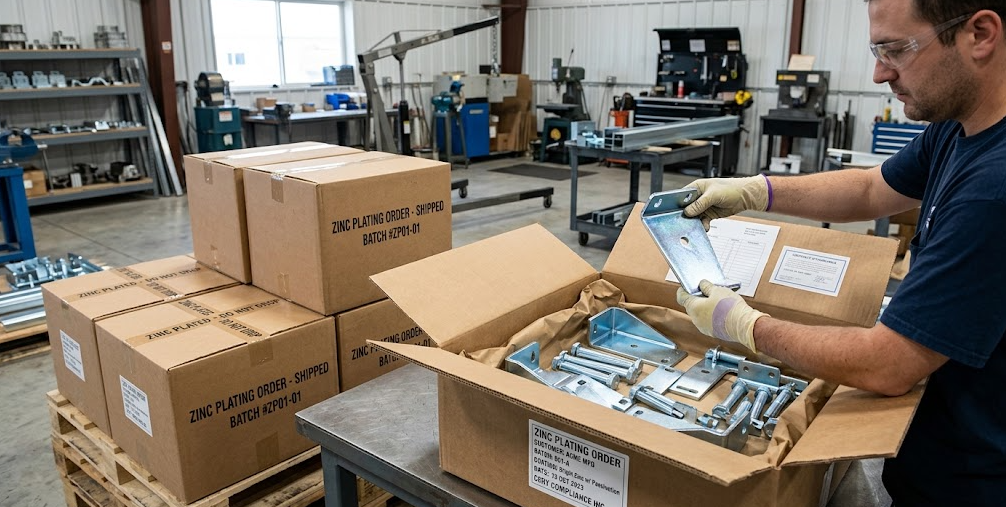
A purchasing manager has just been told that the current plater is, once again, a week behind. The parts are sitting in a tote, the assembly line is waiting, and the only thing on the calendar is the conversation that starts with “we need to find someone else.” She opens a browser, finds a plater that looks promising, and then stops. Not because of price or capability, but because of a quieter question what actually happens when you hand your parts to a company you have never worked with before? Who do you talk to? What do they need from you? How will you know it went well? That uncertainty is the real cost of switching platers, and it is exactly what this guide is meant to remove.
Changing suppliers is rarely a decision people make casually. Most buyers and quality engineers who reach out to us have been through a stretch of late deliveries, inconsistent coating, or rejected lots, and they have a reasonable fear that a new plater will simply introduce a different set of problems. The good news is that a first zinc plating order follows a predictable path, and when you know the path, you can make it smooth.
At Plateco, we have been zinc plating for manufacturers, fabricators and OEMs from our facility in Reedsburg, Wisconsin, since 1974. We hold ISO 9001 2015 certification, and we have been named a Products Finishing Top Shop for seven straight years. Our commitment to new customers is the same one we make to every customer on spec, on time, or it’s on us. This guide walks through what a first order with us looks like, step by step, and what you can do on your side to make it go well.
0.1% Plateco return rate, first quarter 202695% On-time delivery, all of the time
Before You Send Anything: Gathering What We Need
Every first order starts with information, and the quality of that information shapes everything that follows. The fastest way to start is our request for quote form, or a call to (608) 524-8241. Before you do either, it helps to collect a handful of details. You do not need a perfect package, but the more complete it is, the faster and more accurate your quote will be.
The part itself
We need to know what we are plating. That means a description or print of the part, the base material (low-carbon steel, hardened steel, cast iron, and so on), and the approximate size and weight. Geometry matters more than most people expect. A flat stamped bracket, a threaded fastener, a part with deep blind holes and a part that nests together in a bin all behave differently in a plating tank, and they influence whether barrel, rack or mechanical galvanizing is the right method.
The specification
If your drawing or purchase order calls out a specification, we need it. Common examples include an ASTM or industry standard, a minimum coating thickness, a passivate type and color, and sometimes a corrosion-resistance requirement such as a salt spray rating. If you are not sure what your part needs, tell us how it will be used. Will it sit indoors in a dry enclosure, or outside on a piece of agricultural equipment? Will it be painted afterward? Good plating decisions start from the service environment, and our team can help you work backward from there.
Quantities and timing
Give us the quantity for the first order, the expected annual volume if you know it, and the date you actually need parts back. Be honest about the date. A real need-by date lets us tell you right away whether it fits our schedule, and it is much better to hear “we can do it” or “here is what we can do” on day one than on day ten.
Special requirements
Mention anything unusual hydrogen embrittlement relief baking for hardened fasteners, masking of threads or surfaces, part marking or lot traceability requirements, specific packaging, or required documentation such as a certificate of conformance. Surprises at this stage are cheap. Surprises after plating are not.
Have Questions About Your Parts? – (608) 524-8241
Choosing the Right Process: Barrel, Rack or Mechanical Galvanizing
One of the first things we will work out with you is which plating method suits your parts. We run three, and each exists for good reasons.
Zinc barrel electroplating
Barrel plating is the workhorse for small parts produced in volume screws, nuts, washers, clips, small stampings and similar hardware. Parts tumble together in a rotating barrel while current deposits zinc, which gives efficient, uniform coverage across large quantities. It is usually the most economical choice for small, durable parts that can tolerate tumbling.
Zinc rack electroplating
Rack plating is for parts that are too large, too delicate, or too geometry-sensitive to tumble. Each part is mounted on a fixture and held in a controlled position during plating. Brackets, formed assemblies, long parts, and anything with cosmetic surfaces or tight dimensional features often belong on a rack. The trade-off is that racking takes skilled handwork, which is one reason rack design is such a focus for our team.
Zinc mechanical galvanizing
Mechanical galvanizing applies zinc without an electric current, by tumbling parts with zinc powder and glass media in a chemical solution. Because there is no electrolysis involved, it is well suited to parts where hydrogen embrittlement is a concern, such as hardened fasteners, and it can build thick, durable coatings on certain hardware.
You do not have to decide this alone. Part of a first-order conversation is our team looking at your parts and telling you which method we would recommend and why. If there are two workable options, we will explain the trade-offs in cost, appearance and performance so the decision is yours and is an informed one.
Understanding Specs, Thickness and Finish Options
Many first-time customers find the vocabulary of plating the most intimidating part of the process. It does not have to be. Three decisions define most zinc plating orders.
Coating thickness. Thickness is the main driver of corrosion protection. More zinc generally means longer protection, but it also affects fit on threaded parts and other tight-tolerance features. If your part has a thread or a press-fit surface, tell us, because thickness and dimensional fit need to be considered together. Industry standards such as ASTM B633 define thickness classes by service condition, and we can help you match your environment to the right one.
Passivate (chromate conversion coating). After zinc is deposited, a passivate is applied to boost corrosion resistance and give the part its finish. Common options produce clear/blue, yellow or black finishes. They differ in appearance and in how much additional protection they provide. Appearance may matter to you, or only performance may matter. Tell us which.
Topcoats and sealers. For applications that need more corrosion resistance than zinc plus passivate alone can deliver, a sealer or topcoat can be added. It can also adjust friction characteristics for fasteners that have to be driven or torqued consistently.
If you already have a specification from your customer or engineering team, send it and we will work to it. If you do not, we will ask a few questions about the part’s environment and function and propose a reasonable starting point. Our certifications and specifications page lists the standards we work to, and it is a good place to check that the spec you have in mind is one we routinely handle.
The Quote: What It Includes and What It Doesn’t
Once we have your part details, spec and quantities, we put together a quote. A clear quote should tell you what process we plan to use, the price per piece or per hundredweight as applicable, any minimum charges, the expected turnaround, and the assumptions the pricing is built on.
Read those assumptions. A quote is based on the information you gave us, so if the parts arrive with a different base material, heavier oil or scale, different quantities or an unexpected requirement, the quote may have to change. We would rather tell you that up front than surprise you afterward. We are committed to being honest, and that means when you get information from us it is accurate to the best of the information we have.
A quote is also a good moment to ask questions. What is the turnaround, and is there a faster option? What does the price include, and does it cover inspection, packaging or documentation? How are special requirements charged? A plater who welcomes these questions is usually a plater you will enjoy working with.
Placing the Order and Sending Your Parts
When you accept the quote, you send us a purchase order. This is where details get locked in, so check that it matches the quote part number, revision level, quantity, plating specification, passivate, and any special instructions. Clean, complete paperwork is the single easiest way to prevent confusion later.
Packaging and labeling
Send parts in containers that can be handled safely, and label every container with your part number and quantity. Mixed parts in one unlabeled box are the most common cause of avoidable delay. If you have multiple part numbers in one shipment, a packing list that matches the purchase order makes receiving quick and accurate.
Condition of parts on arrival
Plating adheres to clean metal. Parts that arrive heavily oiled, scaled, rusted or with heat-treat residue can still be plated, but they need more preparation, and in some cases it affects price or turnaround. If your parts have unusual soils or surface conditions, tell us in advance. We cover this in more detail in our post on how surface prep affects zinc adhesion, because cleaning matters more than most buyers realize.
Materials that need a heads-up
Some base materials behave differently in plating. Leaded steels, for example, carry risks that are worth knowing about, which we discuss in our post on zinc plating leaded steel. Hardened steels need attention to hydrogen embrittlement. If you are unsure what your material is, send the material certification or a sample and we will help figure it out.
Shipping to Reedsburg, Wisconsin
Our plant is at 1375 Industrial Street in Reedsburg. Many customers across Wisconsin, Illinois, Iowa, Minnesota, Michigan and Indiana ship to us by freight or drop parts off themselves. If you are not sure how to arrange logistics, ask. We can talk through options with you, and our Plateco Transfer service exists to make moving parts to and from our facility easier.
What Happens Inside the Plant
Most customers never see their parts while they are being plated, so it helps to understand the journey. Here is what happens after your parts arrive.
Receiving and verification
Parts are logged in, counted and checked against the purchase order. We confirm the part number, quantity and condition, and we note any discrepancy immediately so you hear about it early rather than late.
Cleaning and surface preparation
This step is unglamorous, and it is where much of plating quality is decided. Oils, scale and oxides are removed through a sequence of cleaning and rinsing stages so zinc can bond properly to the base metal. Skipping or shortening this stage is one of the most common reasons plated coatings blister or peel later.
Plating
Depending on the process, your parts are barrel plated, rack plated or mechanically galvanized. Bath chemistry, current, and timing are controlled carefully, because thickness and adhesion depend on holding them consistently. For a closer look at how automation helps with that, see our post on how automation changed our zinc plating lines.
Passivate and finishing
After plating, parts receive the specified passivate and any topcoat, and are then dried. Parts that require baking for hydrogen embrittlement relief are handled according to the requirement on your order.
Inspection
Before a lot ships, it is inspected against your specification. That includes checking coating thickness and examining parts for appearance and finish defects. Automated measurement is useful, but a trained person still looks at your parts, because some defects only show up to a human eye. Our approach to quality is described in our post on how we achieved a 0.1% defect rate.
Packing and shipping
Plated parts are counted, packed to protect the finish, and labeled with your part number and quantity, then staged for shipment or pickup.
“We treat zinc plating as an extremely complex process demanding state-of-the-art technology, painstaking planning, obsessive quality control, and a tremendous amount of talent. Because our customers don’t come to us for excuses they come to us for perfection.”Jim Schweich, Chief Executive Perfectionist, Plateco, Inc.
Turnaround and Communication: What to Expect Day to Day
Turnaround is the subject most new customers ask about first, and with good reason. A plater’s turnaround is only useful if it is a number you can rely on. Our goal is to be 95% on time, all of the time, and to be upfront about timing from the start. The date on your quote is based on current schedule, part type, process and any special requirements such as baking or masking.
Several things affect lead time, and knowing them helps you plan:
- Process and part complexity. Standard barrel work moves differently from custom racked assemblies.
- Special requirements. Baking, masking, sorting, specific packaging and documentation all add steps.
- Incoming condition. Parts that need extra cleaning take longer.
- Information completeness. An order that is missing a spec detail waits for an answer, and waiting is the most avoidable delay of all.
- Volume and schedule. If you anticipate a big release, tell us early so we can plan capacity.
If you need parts faster than the standard timeline, say so. We will tell you honestly whether it is possible and what it would take. If something changes on our side, you will hear it from us before you have to ask. That is part of what we mean by being honest and being your partner we would rather give you a difficult answer early than a comfortable one late.
When Your Parts Arrive: Documentation, Inspection and Sign-Off
The day your first order arrives is the real moment of truth, so it is worth having a plan for it.
Check the paperwork first. Confirm that the packing list and certification match your purchase order part number, quantity, specification and any lot or traceability information. If you asked for a certificate of conformance or other documentation, it should be there.
Inspect on receipt. Follow your normal incoming inspection procedure. Check appearance, finish and color consistency, verify coating thickness if you have the equipment, and confirm that threads, holes and fit features behave as expected. For a first order, it is worth testing a few parts in the actual assembly or application, not only measuring them.
Tell us what you find. If everything is right, we would love to hear that. If something is not, tell us quickly and specifically, with part numbers, quantities and photos if possible. Fast, clear feedback lets us find the cause and fix it. It also protects you, because our guarantee is straightforward if we deliver a plated part that you reject for a quality problem that is our fault, you won’t be charged for that part.
That guarantee is not a slogan we keep in a drawer. Customers are sometimes surprised that we invite scrutiny of our first shipment. We welcome it. A first order is a chance to show what consistent plating looks like, and if we fell short, the faster we know the faster we make it right.
Your First-Order Checklist
Here is a summary of what to gather and what to expect at each stage, so your first order goes smoothly from the start.
| Stage | What You Provide | What You Can Expect From Us |
|---|---|---|
| Request a quote | Part description or print, material, size, quantity, spec, need-by date | Questions if details are missing a recommended process |
| Review the quote | Confirmation of spec, finish and special requirements | Clear pricing, assumptions and turnaround |
| Place the order | Purchase order matching the quote revision level | Order confirmation and a realistic schedule |
| Ship parts | Labeled containers and a matching packing list notes on soils or special material | Receiving check against the PO early flag on any discrepancy |
| Processing | Availability for questions | Cleaning, plating, passivate, inspection, honest updates |
| Delivery | Incoming inspection feedback on the lot | Correct paperwork, packed parts, and a partner for any follow-up |
Common First-Order Mistakes (and How to Avoid Them)
After decades of plating parts for new customers, we see the same small issues again and again. All of them are easy to avoid once you know about them.
Assuming the spec is obvious. If thickness, passivate or corrosion requirements live only in someone’s head, they will not end up on the parts. Write them down on the purchase order.
Forgetting about thread fit. Plating adds thickness. If a part has tight threads or press-fit features, say so at the quote stage so we can plan for it.
Not mentioning hardened or unusual material. Material type changes process requirements. Hardened steel, cast iron and leaded steel all have specific considerations.
Sending mixed, unlabeled parts. Clear labeling is the cheapest form of quality control there is.
Understating urgency, or overstating it. A realistic need-by date is more useful than an artificially early one. If there really is a hard deadline, tell us why and we will work with you on it.
Waiting to give feedback. If something on the first lot looks wrong, tell us right away. The sooner we see it, the sooner we can resolve it, and the better the second order will be.
Choosing on price alone. A low per-piece price is meaningless if lots are rejected or late. The real cost of plating includes rework, delays and incoming inspection time. As we say to anyone comparing suppliers all zinc plating companies are not the same.
What Happens After the First Order
A good first order is the start of a working relationship. After the first lot, it is worth reviewing how the parts performed and whether anything should be adjusted, such as thickness, packaging, documentation or lead time. If you plan repeat orders, we can talk through scheduling so that recurring volume flows predictably. If your parts are going into demanding applications, ask us about additional services too many customers are surprised by what we offer beyond plating, which you can see on our other exceptional services page.
Above all, we want to be a partner, not just a vendor. That means communicating clearly, telling you the truth when it is inconvenient, and treating your success as our number-one priority. The first order is where that either proves itself or does not, and we plan to prove it.
Frequently Asked Questions
How do I start my first order with Plateco?
Submit the request for quote form on our website or call (608) 524-8241. Include a description or print of the part, the material, quantity, any specification, and the date you need parts back. We will follow up with questions if anything is missing.
What if I don’t know which plating process I need?
That is a normal starting point. Tell us what the part is and how it is used, and we will recommend barrel plating, rack plating or mechanical galvanizing, and explain why.
Do I need a formal specification to place an order?
No, but a specification makes the result easier to define and verify. If you do not have one, we will ask about the part’s environment and function and suggest a sensible starting point.
What if my parts are oily, rusty or scaled?
Tell us when you request the quote. Many soils can be handled in our cleaning sequence, but the condition of incoming parts can affect preparation, price and turnaround, so it is better to address it up front.
What if I am not happy with the first shipment?
Contact us right away with specific details. If you reject a plated part for a quality problem that is our fault, you won’t be charged for that part, and we will work with you to find and correct the cause.
Can you handle customers outside Wisconsin?
Yes. We serve manufacturers across the Midwest, including Wisconsin, Illinois, Iowa, Minnesota, Michigan and Indiana. See our location pages for more information.
Will you keep me updated during the order?
Yes. Honesty and partnership are part of our commitment. If anything affects your schedule or your parts, you will hear it from us directly.