

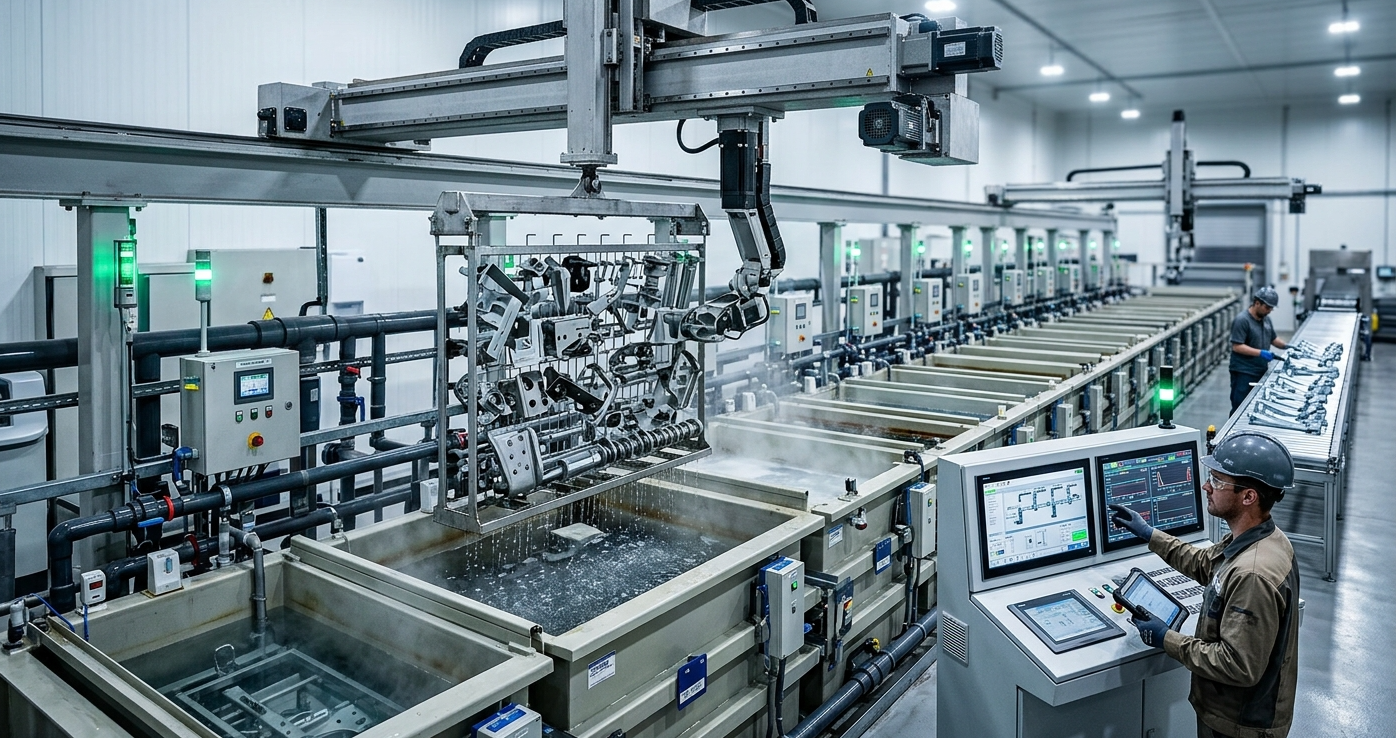
A quality manager pulls a lot report from a rack of brackets plated eighteen months ago and lays it next to a lot report from last week. The parts look identical on the shop floor. The paperwork tells a different story. The 2024 lot shows a thickness range that drifts nearly four microns from the front of the rack to the back. The current lot holds within a single micron, rack position to rack position, part to part, week to week. Nothing about the steel changed. Nothing about the zinc chemistry changed. What changed was who or what was controlling the process in between. That gap is automation, and it is the single biggest shift in how zinc plating actually gets done in the last decade.
Zinc plating has a reputation, deserved in a lot of shops, for being a process that lives and dies on operator feel. How long a rack dwells in the bath, how it’s angled, how quickly it moves from station to station, how closely someone is watching the ammeter all of it used to depend on a person making a judgment call, over and over, shift after shift. That approach can produce excellent parts. It can also produce a lot report that looks nothing like the one from three weeks ago, even though the purchase order didn’t change and the part didn’t change.
At Plateco, we’ve been zinc plating for Wisconsin manufacturers, fabricators and OEMs since 1974, and we’ve watched the industry move unevenly, and not all at once from that operator-feel model toward a line where the repeatable parts of the process are automated and the operator’s judgment is aimed at the parts that actually need it. This isn’t a story about robots replacing people. It’s a story about where variability comes from in a plating line, what automation actually removes, and what it means in practical terms for the thickness, consistency and documentation you get on your next purchase order.
1.2 µm
Typical thickness variance we now hold across a rack lot, down from a much wider range under manual timing controls
24/7
Continuous bath chemistry monitoring made practical by automated dosing and titration systems
0.1%
Current defect rate across Plateco’s automated production lines
Why Automation Became Necessary, Not Just Convenient
It’s worth being direct about why this shift happened, because it wasn’t primarily about cutting labor costs, and framing it that way undersells what’s actually going on. Automation became necessary because the tolerances customers are asking for have tightened, the industries buying plated parts have gotten less forgiving of variability, and the paperwork requirements attached to a lot of that work automotive, aerospace-adjacent, medical device, defense-adjacent assume a level of process control that a purely manual line struggles to document consistently.
A manual zinc plating line can absolutely hit an ASTM B633 thickness spec on a good day, with a good operator, on a rack that doesn’t have unusual geometry. The problem was never that manual plating couldn’t produce a good part. The problem was that it couldn’t reliably produce the same good part, rack after rack, shift after shift, without meaningful drift and it couldn’t always prove, after the fact, exactly what happened during the run if a customer asked.
That last point matters more than people outside the industry usually realize. A quality engineer reviewing an incoming lot of plated fasteners doesn’t just want parts that pass a thickness check. They want a process that they can trust to produce the same result on the next lot, and increasingly, they want data that documents it happened that way not a plater’s word for it.
The Misconception We Hear Most Often
That automation in plating means the process runs itself and nobody’s watching it. In practice, automation on a well-run line does the opposite it frees the people running the line from babysitting timing and dosing so they can spend their attention on the things that actually require a trained eye rack design, part loading, visual inspection and catching the kind of anomaly a sensor won’t flag on its own.
Have Questions About Your Parts? – (608) 524-8241
What “Automation” Actually Means on a Plating Line
“Automated plating line” gets used loosely enough in the industry that it’s worth breaking down what’s actually being automated on a modern line, because the term covers several distinct systems that each solve a different variability problem.
Automated Hoist and Transfer Systems
On a rack line, one of the largest historical sources of thickness variance was simple timing inconsistency how long a rack sat in the plating tank, how long it dwelled in each rinse stage, and how quickly it moved between stations. A person managing a dozen racks at once, on a schedule, across an eight-hour shift, is going to introduce small timing variations even when they’re doing everything right. Automated hoist and transfer systems move racks and barrels through the sequence clean, rinse, plate, rinse, passivate, rinse, dry on a fixed, programmed timeline that doesn’t drift based on how busy the floor is at 2:15 in the afternoon.
PLC-Controlled Bath Chemistry
Zinc plating baths are chemically alive systems. Metal concentration, brightener levels, pH and temperature all shift as parts move through the tank, and a bath that’s chemically “off” produces thickness variance and adhesion problems even with perfect timing. Programmable logic controllers now continuously monitor and adjust these parameters dosing brighteners and replenishing chemistry automatically rather than on a manual titration schedule that might only catch drift once or twice a shift. This is arguably the single biggest quality lever automation has added, because bath chemistry drift is invisible to the eye until it’s already affecting parts.
Automated Rectifiers and Current Control
Electroplating deposits zinc using an electric current, and the relationship between current density, time and coating thickness is precise enough that small fluctuations in current compound into real thickness variance across a run. Automated rectifiers hold current density within a tight programmed range and adjust automatically as rack load changes, rather than relying on an operator to notice and correct a drifting ammeter reading.
Robotic and Fixed-Sequence Racking Assistance
Full robotic racking is still uncommon on complex, mixed-geometry rack work a skilled rack builder’s judgment about part orientation, contact points and shielding is genuinely hard to automate for parts that vary in shape from lot to lot. Where automation has made real inroads is in barrel loading and unloading for bulk fastener work, and in fixed-sequence handling systems that move fully-built racks through the line without a person repositioning them by hand at each stage.
Real-Time Thickness and Coating Verification
X-ray fluorescence (XRF) thickness measurement has moved from a spot-check tool used at the end of a run to a station that can be integrated into in-process quality checks, catching a thickness problem within a run rather than after an entire lot has already been through passivate and dried. This is the difference between finding a problem on a sample at the end of the day and finding it while there’s still time to correct the bath or the timing before more parts are affected.
Automated Data Logging and Traceability
Every automated system above also produces something manual lines historically couldn’t a continuous, time-stamped record of bath temperature, current, dwell time and chemistry readings for a given lot. That data trail is what turns “we plated it correctly” into a documented, auditable record a customer’s quality team can actually review.
Quick Reference: What Automation Controls vs. What It Doesn’t
Automated systems now reliably control dwell time, transfer sequencing, bath chemistry dosing, current density and in-process thickness verification. They do not replace rack design judgment, visual defect inspection, part-specific process decisions for unusual geometry, or the final quality sign-off on a lot before it ships.
The Measurable Difference: Manual Timing vs. Automated Process Control
Numbers make this easier to see than a general description does. The table below reflects the kind of shift we’ve tracked moving core process steps from manual, operator-timed control to automated, PLC-managed control on comparable rack work.
| Process Variable | Manual Timing Control | Automated Process Control |
|---|---|---|
| Thickness variance across a rack lot | Can range 3–6 µm depending on operator load and shift | Typically held within 1–1.5 µm |
| Bath chemistry drift detection | Checked periodically, often once or twice per shift | Continuously monitored and auto-corrected |
| Rack-to-rack cycle time consistency | Varies with operator workload and floor traffic | Fixed, programmed sequencing |
| Defect rate on standard rack work | Higher, especially during shift changes or high-volume periods | Significantly reduced, closer to Plateco’s current 0.1% average |
| Lot traceability and documentation | Manual logs, dependent on record-keeping discipline | Automated, time-stamped process data by lot |
| Recovery time from a chemistry deviation | Hours, if caught before affecting a full run | Minutes, caught and corrected in real time |
The pattern across every row is the same automation doesn’t change what a good manual process is capable of on its best day. It changes how consistently that best-day performance shows up, lot after lot, without depending on which shift ran the job or how busy the floor was that afternoon.
Get a Free Quote For Your Project
How This Actually Changes What You Get as a Customer
This is the part that matters most if you’re the one specifying, buying or receiving plated parts, because the process changes above translate into concrete, practical differences in what shows up on your dock.
Tighter, More Predictable Thickness Tolerances
If your spec calls for ASTM B633 SC3 at 12 µm minimum, an automated line gives you a much narrower band above that minimum rather than a wide swing that sometimes runs close to spec and sometimes runs well past it, wasting zinc and adding unnecessary cost. Predictable thickness also means predictable fit for threaded or dimensionally sensitive hardware, where a coating that runs thicker than expected on one lot and thinner on the next can quietly turn into an assembly problem on your line.
Faster, More Reliable Turnaround
Automated transfer and chemistry management reduce the number of manual interventions and corrections needed mid-run, which shortens the practical cycle time for a given lot and makes quoted turnaround times something we can hold to consistently rather than treating as a best guess. When a rush order comes in on a tight construction or production schedule, an automated line has more real capacity to absorb it without sacrificing quality on the rest of the floor.
Lower Defect Rates and Less Rework
Fewer manual timing errors and faster detection of chemistry drift both mean fewer parts that come out of the tank with adhesion problems, thin spots or inconsistent passivate coverage. For you, that means fewer rejected lots, less time spent on incoming inspection flagging problems, and fewer awkward conversations about whether a marginal lot is close enough to spec to accept.
Documentation You Can Actually Hand to a Customer or Auditor
Automated data logging means a lot doesn’t just get plated correctly it gets plated with a record showing exactly how. If your own customer or an auditor asks for evidence that a component met its corrosion protection spec, a time-stamped process record tied to that specific lot number is a fundamentally stronger answer than a plater’s general assurance that “we always run it that way.”
More Consistent Passivate and Topcoat Application
Passivate and topcoat performance depends heavily on dwell time and bath concentration consistency, the same variables automation controls most directly. That consistency shows up later, in the field, as coating that performs the way the salt spray rating on the spec sheet actually predicted rather than a lot that tests fine on the sample piece but underperforms once it’s out in real exposure.
“We treat zinc plating as an extremely complex process demanding state-of-the-art technology, painstaking planning, obsessive quality control and a tremendous amount of talent. Automation didn’t change that standard it gave us a more reliable way to hold ourselves to it, lot after lot, instead of hoping a good shift repeats itself.”
Jim Schweich, Chief Executive Perfectionist, Plateco, Inc.
What Automation Doesn’t Replace
It’s worth being honest about the limits here, because overselling automation is its own kind of misinformation, and it’s not how we’d want a customer to make a decision about a plating partner.
Rack Design Still Requires a Trained Eye. Every part geometry presents a different challenge for contact points, current distribution and shielding. A rack built wrong will produce thin or missed spots no matter how well-controlled the bath chemistry is downstream, because the current never reached that surface consistently in the first place. This is still a skill a person builds over years, not a parameter a PLC manages.
Visual and Functional Inspection Still Needs a Person. Automated thickness verification tells you a coating meets a numeric spec. It doesn’t catch a cosmetic defect, a contamination spot, a part that got loaded incorrectly, or a thread that’s binding after coating. Final inspection before a lot ships still depends on a trained inspector looking at and, where relevant, function-testing actual parts.
Judgment on Unusual or Mixed-Lot Work Doesn’t Automate Away. A run of standard fasteners in a consistent geometry is exactly where automation delivers the most value. A mixed lot of unusual custom brackets, low-volume prototype parts or components with unconventional geometry still benefits enormously from an experienced operator making real-time decisions about how that specific rack needs to run automation supports that decision, it doesn’t replace it.
Root-Cause Problem Solving Is Still Human Work. When a lot does come back out of spec, automated data logs make it dramatically easier to find out why but interpreting that data, tracing it back to a cause, and adjusting the process correctly is still a job for an experienced quality team, not something a dashboard resolves on its own.
The honest way to describe where we’ve landed automation took over the parts of the process where consistency matters more than judgment, and freed up the people on our floor to spend more of their attention on the parts where judgment is exactly what a good part needs.
What This Means for How You Should Evaluate a Plating Partner
If you’re sourcing zinc plating for parts where consistency, documentation or tight tolerances matter and for most industrial, structural or precision hardware, they do it’s reasonable to ask a plater directly how much of their process is automated and where. A few questions tend to surface the real answer quickly.
Ask how bath chemistry is monitored. A shop running periodic manual titration is going to have more variability between lots than one running continuous automated monitoring, even if both shops are competent and well-run. This single answer tells you more about consistency than almost anything else you can ask.
Ask what documentation comes with a lot. If the answer is a general certificate of conformance with no lot-specific process data, that’s a meaningfully different level of traceability than a time-stamped record of bath conditions, current density and thickness verification tied to your specific purchase order.
Ask how thickness is verified, and when. End-of-run spot checks on a sample are the historical standard. In-process verification that can catch a drifting run before the whole lot is affected is a meaningfully stronger quality control position, particularly for larger or higher-value lots.
Ask about defect rate and how it’s tracked. A shop that can quote you an actual, tracked defect rate rather than a general assurance that quality is good is telling you something real about how closely they’re measuring their own process, automated or not.
None of this means the lowest-automation shop on your bidder list is automatically the wrong choice, particularly for low-volume or highly custom work where hands-on judgment matters more than throughput consistency. But for standard rack and barrel work at any real volume, the gap in consistency and documentation between an automated and a purely manual line is large enough that it’s worth asking about directly rather than assuming every plater’s process looks roughly the same behind the tank.
Frequently Asked Questions
Does automation make zinc plating more expensive?
Not typically, and often the opposite. Automated bath chemistry management and current control reduce rework, reduce wasted zinc from over-plating and reduce the labor cost of manually monitoring and correcting a line throughout a shift. The upfront investment in automated systems is significant, but it shows up in pricing as more consistent, competitive turnaround rather than a premium passed on to the customer for standard work.
Will automation change the appearance or performance of my parts?
Automation changes consistency, not the fundamental coating chemistry or appearance your specification calls for. A part plated on an automated line with a trivalent yellow passivate at SC3 should look and perform the same as one plated correctly on a well-run manual line the difference shows up in how reliably that same result repeats across every lot, not in what any single good part looks like.
Can automated lines still handle low-volume or custom prototype work?
Yes, though the benefit is smaller for very low-volume or highly irregular parts, where a single rack’s build and an experienced operator’s judgment matter more than programmed timing consistency. Most shops running automated lines, including ours, still apply operator judgment to rack design and loading regardless of volume automation manages the repeatable downstream steps once a rack is built correctly.
How do I know if my current plater’s process is actually automated or just says it is on their website?
Ask specifically how bath chemistry is monitored, whether current density is automatically controlled or manually adjusted, and what lot-specific data not just a general certificate comes with your shipment. A shop with genuinely automated process control will be able to answer these specifically and usually welcomes the question, because the answer is a real point of differentiation for them.
Does automated plating meet the same ASTM and industry standards as manual plating?
Automation is a process control method, not a different coating standard parts plated on an automated line still need to meet the same ASTM B633 service condition, thickness and passivate requirements as parts plated manually. What automation changes is how reliably a lot lands within that spec, and how well the plater can document that it did.
Is automation the reason defect rates and thickness consistency have improved industry-wide, or is it something else?
Automation is the largest single factor, particularly for bath chemistry control and current density management, which were historically the two biggest sources of lot-to-lot variability. Improvements in zinc chemistry formulations and better rack design practices have also played a role, but process control automation is what allowed those improvements to actually show up consistently in finished parts rather than depending on how well a given shift executed them.
Ready to See What a Consistently Controlled Plating Process Looks Like on Your Parts?
Tell Us About Your Project
Plateco has been zinc plating for Wisconsin manufacturers, fabricators and OEMs since 1974, and our automated process controls exist for one reason to make sure the part we plate for you today performs exactly like the part we plate for you next year. Send us your prints and specs, and we’ll show you exactly how our process holds to them.