
Zinc electroplating is one of the most widely used metal finishing processes in manufacturing. When done correctly, it delivers reliable corrosion protection, a clean metallic appearance, and meets demanding OEM specifications. When done incorrectly, a range of surface and structural defects can appear some visible, some invisible that compromise corrosion performance, dimensional accuracy, or even structural integrity.
At Plateco, we have been processing zinc-plated parts since 1974 for automotive, agricultural, construction, and industrial customers across Wisconsin and the Midwest. Understanding zinc plating defects what causes them, how to identify them, and how to correct or prevent them is fundamental to getting parts right the first time.
This guide covers the most common defects encountered in zinc electroplating, organized by category: appearance defects, adhesion defects, dimensional defects, and corrosion performance defects. Each entry explains the root cause, the correct corrective action, and the process control that prevents it from happening again.
KEY POINT
Not all defects are equally serious. A minor appearance variation may be cosmetically undesirable but have no effect on corrosion protection. A hydrogen embrittlement failure, by contrast, may show no visible signs at all and still result in sudden fracture under service load. Understanding the severity classification of each defect type is as important as identifying the defect itself.
SECTION 1: APPEARANCE DEFECTS
Appearance defects are the most frequently identified category in incoming inspection and customer complaints. While some appearance defects are purely cosmetic and do not compromise function, others signal underlying process problems that can affect corrosion performance. Each must be evaluated in context.
DEFECT #1 WHITE RUST (WHITE STAINING) [High Risk]
CAUSE: Zinc oxide and zinc hydroxide forming on the zinc surface, typically caused by exposure to moisture before or after plating without adequate passivation. Also occurs when parts are improperly stored or shipped in damp conditions after plating.
FIX: Affected parts can sometimes be re-passivated if white rust is light and superficial. Heavily rusted parts typically require stripping, re-plating, and re-passivation. Evaluate against the customer’s acceptance criteria before attempting rework.
PREVENTION: Apply passivation immediately after zinc plating with no delay. Ensure passivate bath chemistry is within specification. Dry parts thoroughly before packaging. Use moisture-absorbing packaging materials for shipment. Store plated parts in a dry, climate-controlled environment.
DEFECT #2 RED RUST (BASE METAL CORROSION) [High Risk]
CAUSE: Premature red rust on the steel substrate indicates that the zinc deposit has been fully consumed by corrosion or that inadequate zinc thickness was deposited in the first place. Can also result from skip plating in recessed areas.
FIX: Strip and re-plate to correct service condition (thickness). Investigate whether the specified zinc thickness was achieved on all significant surfaces, including recesses. Review process parameters and passivation effectiveness before re-running the job.
PREVENTION: Specify correct ASTM B633 service condition for the application environment. Use alkaline zinc bath chemistry for threaded and recessed parts to ensure uniform coverage. Add topcoat sealer over passivate for outdoor or harsh-exposure applications.
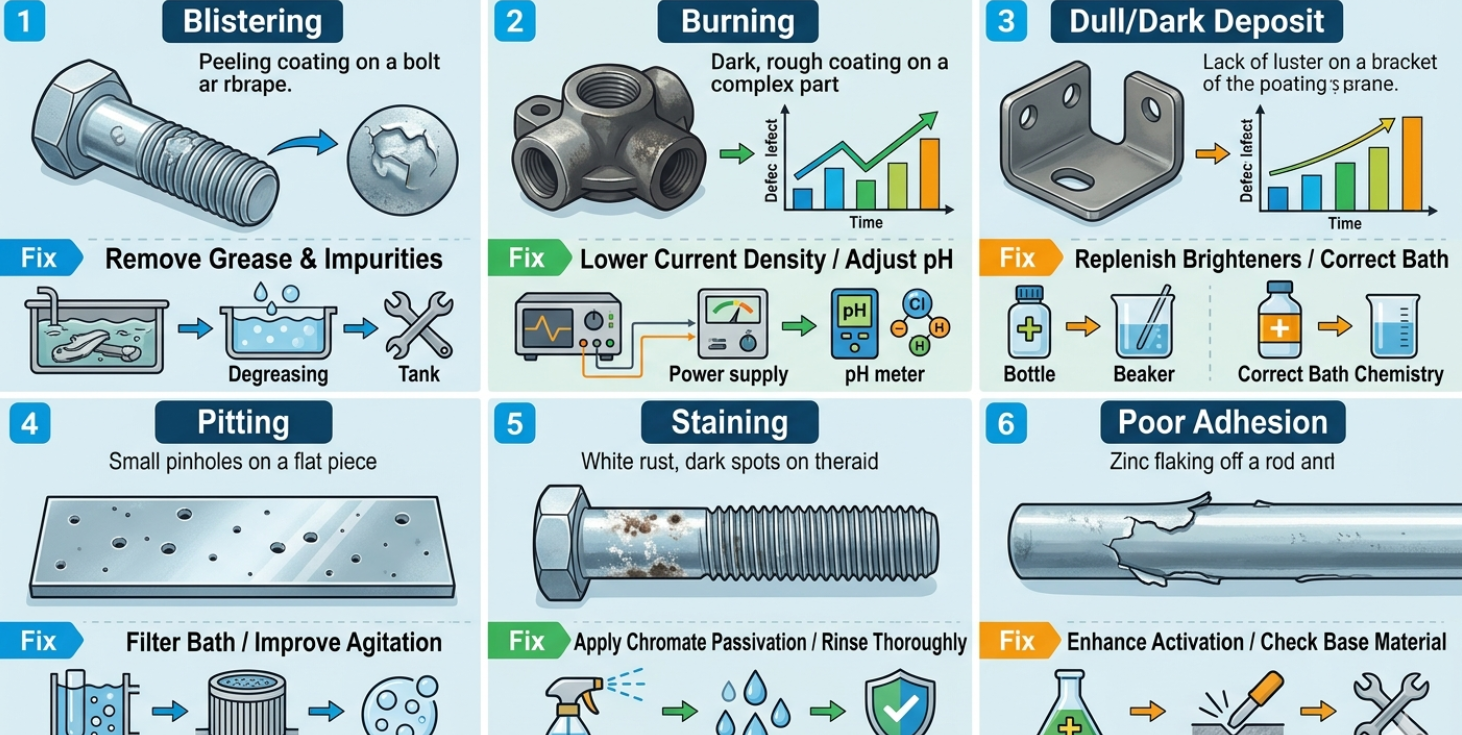
DEFECT #3 PITTING AND CRATERING [Medium Risk]
CAUSE: Small pits or crater-like depressions in the zinc deposit surface. Caused by gas bubble adhesion (hydrogen bubbles from the cathodic reaction) during plating, or by contamination in the plating bath typically organic contamination from oils, grease, or bath breakdown products.
FIX: Mild pitting may be acceptable depending on customer specification. Severe pitting indicates bath contamination or agitation problems. Carbon treatment (activated carbon filtration) of the plating bath can remove organic contamination. Parts with unacceptable pitting must be stripped and re-plated after bath correction.
PREVENTION: Maintain rigorous pre-treatment cleaning to remove all oils and soils before plating. Monitor and control plating bath chemistry, organic contaminant levels, and brightener concentrations. Ensure adequate bath agitation and air agitation to release hydrogen bubbles before they cause pits.
DEFECT #4 BURNT DEPOSITS (DARK, ROUGH, OR POWDERY ZINC) [High Risk]
CAUSE: A dark gray, rough, or powdery zinc deposit indicates an overloaded deposit from excessive current density in high-current-density areas. The burned deposit has poor adhesion, inferior corrosion resistance, and a characteristic dull, rough appearance.
FIX: Burned areas have poor adhesion and will not provide adequate corrosion protection. Parts with burned deposits must be stripped and re-plated. Reduce current density on re-run and review anode placement and rack geometry.
PREVENTION: Use correct current density for the bath chemistry and part geometry. Avoid placing anodes too close to protruding features. Use robber anodes or shielding to redistribute current on complex rack geometries. Monitor rectifier output continuously.
DEFECT #5 DULL OR NON-BRIGHT DEPOSIT (ACID ZINC) [Low Risk]
CAUSE: In acid zinc (chloride) baths, a dull or milky deposit typically indicates brightener depletion, bath contamination, or operation outside the specified temperature and pH range. The zinc is depositing but not with the expected brightness.
FIX: Analyze bath chemistry: pH, zinc concentration, chloride concentration, brightener levels, and temperature. Correct any parameters out of range. Add brighteners per bath supplier recommendation. Hull cell testing can confirm the corrective action before full production restart.
PREVENTION: Maintain bath parameters within specification using regular Hull cell testing and chemical analysis. Replenish brighteners on a documented schedule based on amp-hour consumption rather than visual inspection alone.
DEFECT #6 PASSIVATE COLOR VARIATION [Low Risk]
CAUSE: Uneven or unexpected passivate color patchy yellow, inconsistent clear, or mottled appearance indicates inconsistent passivation processing. Causes include uneven zinc deposit thickness, non-uniform immersion/drain, bath temperature variation, or incompatible zinc deposit morphology.
FIX: If corrosion performance meets specification on salt spray testing, minor color variation may be acceptable per customer agreement. Severe variation indicates a process problem. Review passivate bath temperature, pH, concentration, and immersion time. Ensure parts are fully submerged with no air pockets during passivation.
PREVENTION: Maintain passivate bath chemistry within tight control limits. Ensure consistent rinsing before passivation. For rack plating, ensure part orientation allows complete submersion. Document passivate bath parameter ranges and verify at shift start.
DEFECT #7 SKIP PLATING (NO DEPOSIT IN RECESSED AREAS) [High Risk]
CAUSE: Absence of zinc deposit in recessed areas, blind holes, thread roots, or interior surfaces. Common in acid zinc barrel and rack plating where throwing power is insufficient to plate low-current-density geometry. The bare steel in the recesses is directly exposed to corrosion.
FIX: Strip and re-plate using alkaline zinc bath chemistry, which has superior throwing power. Review part loading/racking geometry and anode placement. Increasing plating time can help deposit zinc in recesses but is less effective than switching bath chemistry.
PREVENTION: Specify alkaline zinc bath chemistry for all threaded fasteners, complex stampings, and parts with recesses or blind holes. Confirm coverage in low-current-density areas during process qualification. Do not use acid zinc for parts where complete zinc coverage of all surfaces is required.
SECTION 2: ADHESION DEFECTS
Adhesion defects occur when the zinc deposit fails to bond properly to the steel substrate, or when a subsequent coating (paint, powder coat, adhesive) fails to bond to the zinc surface. Adhesion failures can be immediate visible as peeling or flaking before the part leaves the plating line or delayed, appearing only after thermal cycling or exposure in service.
DEFECT #8 PEELING AND FLAKING ZINC [High Risk]
CAUSE: The zinc deposit separates from the steel substrate in sheets or flakes. Root cause is almost always inadequate pre-treatment: insufficient degreasing leaves an oil or oxide film between the steel and the zinc deposit, preventing proper metallurgical bonding.
FIX: Peeling zinc has zero corrosion protection. All affected parts must be stripped, thoroughly cleaned, and re-plated. Conduct a root cause analysis on the pre-treatment line. Check alkaline cleaner concentration, temperature, and immersion time. Verify acid pickling is removing all oxides.
PREVENTION: Maintain pre-treatment chemistry within specification. Verify cleaner and acid bath concentrations at shift start. Implement rinse water quality monitoring. Test adhesion of plated parts by scribing and tape testing as a process control check before releasing production lots.
DEFECT #9 PAINT OR POWDER COAT DELAMINATION OVER ZINC [High Risk]
CAUSE: Paint or powder coat separating from the zinc surface after application or in service. May be caused by contamination of the zinc surface before painting (oils, fingerprints, passivate residue), incompatibility between passivate chemistry and primer type, or improper drying after passivation before painting.
FIX: Delaminated parts must be stripped to bare metal and reprocessed. Review surface preparation protocol before painting. Confirm passivate chemistry compatibility with the specific primer and powder coat system being used. Test adhesion per cross-hatch tape test (ASTM D3359) before releasing a revised process.
PREVENTION: Specify clear (not yellow) passivate if parts are to be painted, unless the paint supplier confirms yellow passivate compatibility. Ensure parts are fully dried before primer application. Avoid handling zinc-plated parts with bare hands after cleaning. Confirm adhesion performance during initial process qualification with each new paint/powder coat system.
DEFECT #10 BLISTERING [High Risk]
CAUSE: Raised bubbles or blisters under the zinc deposit or under a coating applied over zinc. Typically caused by hydrogen entrapment under the deposit surface. In high-strength steel parts, this is associated with hydrogen embrittlement processes; in mild steel, it may indicate substrate contamination or improper pre-treatment.
FIX: Blistered parts cannot be reworked the deposit integrity is compromised. Strip, clean, and re-plate. For high-strength steel substrates, ensure hydrogen embrittlement relief bake is performed promptly after plating. Investigate pre-treatment line for contamination sources.
PREVENTION: For high-strength steel, follow ASTM B633 bake relief requirements. Ensure thorough pre-treatment cleaning. Monitor plating bath for contamination. For parts that will be painted, ensure zinc surface is chemically clean and free of residues before coating application.
SECTION 3: DIMENSIONAL DEFECTS
Zinc electroplating adds material to the part surface. The deposit thickness typically 5 to 25 micrometers (0.0002 to 0.001 inches) must be accounted for in the design of precision parts, particularly threaded components, press fits, and tight-tolerance assemblies. Dimensional defects arise from unexpected or non-uniform deposit thickness.
DEFECT #11 OVER-PLATING (EXCESSIVE ZINC THICKNESS) [Medium Risk]
CAUSE: Zinc deposit significantly exceeding the specified thickness, particularly on high-current-density areas (corners, edges, outer threads). Causes include excessive current density, too-long plating time, or incorrect bath zinc concentration. Over-plating on threaded parts can cause thread interference and galling.
FIX: Over-plated parts may need to be stripped and re-plated at the correct thickness, or depending on the tolerance stack and customer acceptance may be acceptable if thread gauge passes. Evaluate against the drawing tolerance before disposition.
PREVENTION: Set plating time and current density to achieve specified thickness range, not maximum thickness. Monitor deposit thickness during production using XRF (X-ray fluorescence) or magnetic thickness gauging. Account for the deposit on both sides of a feature when designing clearances.
DEFECT #12 UNDER-PLATING (INSUFFICIENT ZINC THICKNESS) [High Risk]
CAUSE: Zinc deposit below the specified minimum thickness. Results in reduced corrosion protection life and potential specification non-compliance. Common causes include depleted bath zinc concentration, insufficient plating time, low current density, or measurement on a non-significant surface.
FIX: Evaluate part against specification: if thickness on significant surfaces is below minimum, the part must be stripped and re-plated. Do not pass under-plated parts based on measurement at non-critical locations.
PREVENTION: Calibrate and use XRF thickness gauging on significant surfaces defined in the applicable specification. Monitor bath zinc concentration and plating parameters continuously. Include a final thickness verification step in the quality plan for each job.
DEFECT #13 NON-UNIFORM DEPOSIT DISTRIBUTION [Medium Risk]
CAUSE: Significant variation in zinc thickness between high-current-density areas (edges, corners) and low-current-density areas (recesses, thread roots). Can result in over-plating on exposed areas while recesses receive inadequate coverage, or vice versa depending on bath chemistry.
FIX: If significant surfaces fail minimum thickness, re-plate. If variation is within tolerance, document and pass. Review bath chemistry selection (alkaline vs. acid) relative to part geometry. Consider anode arrangement changes in rack plating to improve distribution.
PREVENTION: Match bath chemistry to part geometry: alkaline zinc for complex parts requiring uniform distribution, acid zinc for simple flat geometry. Use auxiliary anodes or conforming anodes for complex rack geometries. Verify thickness distribution during process qualification on new part numbers.
SECTION 4: STRUCTURAL AND PERFORMANCE DEFECTS
The most serious defects in zinc plating are those that affect structural integrity or corrosion performance without visible surface indication. These defects particularly hydrogen embrittlement require process controls and documentation practices rather than inspection to manage, because they cannot be reliably detected after the fact.
DEFECT #14 HYDROGEN EMBRITTLEMENT (DELAYED FRACTURE) [High Risk]
CAUSE: Atomic hydrogen absorbed into high-strength steel during acid pickling or electroplating reduces ductility and fracture toughness. The part can fracture suddenly under normal service loads, days or weeks after plating, with no visible warning. Risk is significant above 150 ksi tensile strength (approximately HRC 36).
FIX: If hydrogen embrittlement failure is suspected, conduct fracture surface analysis to confirm intergranular or transgranular brittle fracture morphology. Review plating records to confirm whether bake relief was performed within 4 hours. For remaining parts from the same lot, perform sustained load testing per ASTM F606 before approving release.
PREVENTION: For steel above HRC 36: bake at 375 degrees F plus or minus 25 degrees F for minimum 8 hours within 4 hours of plating completion. Use alkaline zinc bath chemistry to reduce hydrogen absorption. Specify inhibited acid pickling. Document bake relief on job traveler with time-temperature records.
DEFECT #15 PREMATURE CORROSION FAILURE (BELOW SALT SPRAY REQUIREMENT) [High Risk]
CAUSE: Zinc-plated parts failing salt spray testing below the specified minimum hours. Can result from insufficient zinc thickness, inadequate passivation, passivate bath out of specification, missing topcoat sealer, or damage to the coating during handling.
FIX: Perform failure analysis: measure zinc thickness at failure initiation site, inspect passivate chemistry records, test passivate bath from the production day of the failing lot. Identify the root cause before re-running. Correct the deficient parameter and re-qualify on salt spray before releasing production.
PREVENTION: Verify complete process control on every production run: zinc thickness on significant surfaces, passivate bath chemistry, topcoat sealer application (if specified), and handling care after plating. Include in-process salt spray witness specimens with each lot for high-specification jobs.
DEFECT #16 HEXAVALENT CHROMIUM CONTAMINATION (ROHS NON-COMPLIANCE) [High Risk]
CAUSE: Presence of hexavalent chromium (Cr(VI)) in the passivate layer, indicating use of hexavalent chromate chemistry instead of required trivalent. This is a regulatory non-compliance (RoHS, ELV, REACH) as well as a supply chain failure. Parts cannot be shipped to RoHS-controlled customers.
FIX: All affected parts must be stripped, re-passivated with verified trivalent chemistry, and re-certified. Issue corrective action report. Verify plater’s chemistry certificates and process records. Never assume chemistry without documentation.
PREVENTION: Source zinc plating exclusively from platers who operate trivalent-only passivation systems. Require RoHS Compliance Certificates (CoC) confirming Cr(III) chemistry with every shipment. Plateco operates exclusively trivalent chemistry as our commercial standard.
SECTION 5: ROOT CAUSE FRAMEWORK — WHERE DEFECTS ORIGINATE
The majority of zinc plating defects trace to one of five process stages. Understanding which stage is responsible for a given defect type accelerates corrective action and prevents recurrence. Here is a structured root cause framework organized by process stage:
ZINC PLATING DEFECT ROOT CAUSE BY PROCESS STAGE
| PROCESS STAGE | COMMON DEFECTS | KEY CONTROL PARAMETERS |
| Substrate / Incoming Material | Hydrogen embrittlement susceptibility, adhesion failures related to steel chemistry, blistering | Confirm substrate hardness and tensile strength. Verify heat treat condition against drawing. Use material test reports. |
| Pre-Treatment (Cleaning & Pickling) | Peeling, flaking, blistering, pitting, hydrogen embrittlement | Alkaline cleaner: concentration, temperature, time. Acid pickling: concentration, inhibitor level, time. Rinse water quality and conductivity. |
| Plating Bath Chemistry | Burnt deposits, dull finish, pitting, skip plating, thickness variation | Zinc concentration, pH, brightener levels, temperature, current density, bath contamination (TOC), anode condition. |
| Post-Treatment (Passivation & Sealing) | Color variation, premature white rust, RoHS non-compliance, poor paint adhesion | Passivate bath concentration, pH, temperature, immersion time, rinse quality, drying temperature and time, sealer application. |
| Handling, Packaging & Storage | White rust after shipping, mechanical damage to deposit, fingerprint contamination | Part drying before packaging, moisture control in packaging, avoid bare-hand contact, storage environment temperature and humidity. |
SECTION 6: HOW TO WORK WITH YOUR PLATER TO PREVENT DEFECTS
The most effective defect prevention happens before the first production run, not during it. How you communicate your requirements to your plating partner and what information you provide on the drawing and purchase order directly determines whether your plater has what they need to get it right.
Put the Complete Specification on the Drawing
An incomplete drawing is the single most common upstream cause of plating defects. A drawing that says only ‘zinc plate’ gives the plater almost no information. A complete specification should include: the process standard (ASTM B633), the service condition (SC1 through SC4, which determines minimum thickness), the passivate type and chemistry (trivalent clear, yellow, or black), any topcoat sealer requirement, the substrate hardness class (if above HRC 36, to trigger bake relief), and any OEM or customer-specific specification call-out.
SPECIFICATION EXAMPLE
Zinc electroplate per ASTM B633, SC3 (12 micrometer minimum on significant surfaces), trivalent yellow passivate (Type II). Substrate: SAE 4140, HRC 34-38. Hydrogen embrittlement relief bake required: 375 F plus or minus 25 F, 8 hours minimum, within 4 hours of plating. RoHS compliant per EU Directive 2011/65/EU. Certificate of compliance required with shipment.
Share Part Geometry and Application Context
Your plater cannot see what you can see on the drawing. Share the part geometry description are there blind holes? Deep recesses? Tight threads? so the plater can select the correct bath chemistry (alkaline zinc for complex geometry, acid zinc for simple flat stampings). Share the application context: outdoor exposure, chemical environment, painted or unpainted. This information lets the plater recommend the right passivation and sealing system.
Request Process Documentation
For any part above HRC 36, any part with a RoHS or OEM compliance requirement, and any safety-critical application, request process documentation with shipment. This should include zinc thickness measurement records on significant surfaces, passivate bath chemistry records for the production run, bake relief time-temperature records (if applicable), and the RoHS Certificate of Compliance. A qualified plater operating under ISO 9001 will maintain these records as standard practice.
Establish an Incoming Inspection Protocol
Define your incoming inspection acceptance criteria before the first delivery, not after the first rejection. What appearance variation is acceptable? What is the minimum thickness that triggers rejection? Will you conduct salt spray witness testing? Establishing these criteria in advance and communicating them to the plater prevents disputes and ensures consistent lot acceptance.
PLATECO QUALITY COMMITMENT
Plateco is ISO 9001:2015 certified. Our quality management system maintains process records, bath chemistry documentation, thickness measurement data, bake relief records, and RoHS compliance certification for every production run. We provide these records on request and welcome customer audits. If something goes wrong, we investigate root cause, implement corrective action, and provide a formal 8D report to affected customers.
SECTION 7: DEFECT SEVERITY AND DISPOSITION QUICK REFERENCE
ZINC PLATING DEFECT — SEVERITY AND DISPOSITION GUIDE
| DEFECT | SEVERITY | TYPICAL DISPOSITION | PROCESS STAGE |
| White Rust (Light) | Medium | Re-passivate if surface is clean. Evaluate vs. spec. | Post-Treatment |
| White Rust (Heavy) | High | Strip, re-plate, and re-passivate | Post-Treatment |
| Red Rust (Base Metal) | High | Strip and re-plate to correct SC | Plating / Post-Treatment |
| Pitting / Cratering | Medium | Bath correction + re-plate if severe | Plating Bath |
| Burnt Deposits | High | Strip and re-plate after current correction | Plating Bath |
| Skip Plating | High | Re-plate with alkaline zinc | Plating Bath / Chemistry |
| Peeling / Flaking | High | Strip and re-plate after pre-treatment fix | Pre-Treatment |
| Paint Delamination | High | Strip to bare metal and reprocess | Post-Treatment / Paint |
| Over-Plating | Medium | Evaluate thread gauge; re-plate if interference | Plating Bath |
| Under-Plating | High | Strip and re-plate to specification thickness | Plating Bath |
| Hydrogen Embrittlement | Critical | Lot hold, sustained load testing, root cause report | Pre-Treat / Plating / Bake |
| Corrosion Below Spec | High | Failure analysis, root cause, re-qualify | Multiple |
| RoHS Non-Compliance | Critical | Strip, re-passivate with trivalent, re-certify | Post-Treatment |
FREQUENTLY ASKED QUESTIONS
Q: Can I visually inspect for hydrogen embrittlement?
No. This is the most dangerous aspect of hydrogen embrittlement: it produces no visible surface indication. A hydrogen-embrittled part looks identical to a sound part. The only reliable detection method is mechanical testing sustained load testing or notch tensile testing which is why process control (correct bake relief, proper timing, inhibited acid) is the primary defense. Inspection alone cannot detect or prevent hydrogen embrittlement failures.
Q: My customer rejected parts for color variation in the passivate. Is that a valid rejection?
It depends on the specification. If the drawing specifies a particular passivate appearance or references an approved color standard, variation outside that range is a valid rejection. However, variation in trivalent yellow passivate color lighter or darker iridescent gold-amber is inherent to trivalent chemistry and normal. If your customer is accustomed to the appearance of legacy hexavalent yellow and is rejecting trivalent parts based on appearance alone, that is a specification and communication problem, not a plating defect. Establish an approved sample appearance standard with your customer before production begins.
Q: How do I know if my plater is actually hitting the specified zinc thickness?
Ask for thickness measurement records. A qualified plater will measure zinc thickness on significant surfaces using calibrated XRF or magnetic thickness gauging equipment and record those measurements as part of the job documentation. For critical applications, you can also conduct incoming thickness verification using your own calibrated gauge. XRF gauging is non-destructive and can measure zinc thickness quickly and accurately without damaging the part or its coating.
Q: What is the difference between white rust and red rust and does it matter?
Yes, it matters significantly. White rust is zinc oxide and zinc hydroxide forming on the zinc surface it means the zinc is corroding, not the steel. The base metal (steel) is still protected. Red rust means the zinc has been fully consumed and the steel substrate is now corroding directly. A part with white rust has degraded appearance and reduced remaining zinc protection but may still function. A part with red rust has lost its corrosion protection entirely and, depending on the application, may be structurally compromised. ASTM B633 salt spray tests measure hours to both white rust and red rust, treating each as a distinct threshold.
Q: Can defective zinc plating always be stripped and re-plated?
Usually, but not always. Mild steel parts at standard service conditions can typically be stripped in appropriate chemistry and re-plated with no significant effect on base metal dimensions or properties. However, stripping adds a processing cycle and time, and for some defects particularly hydrogen embrittlement failures the damage is done and rework cannot undo it. For high-strength steel parts, each additional acid exposure during stripping adds hydrogen embrittlement risk, and the bake relief cycle must be repeated after re-plating. For some precision parts with very tight tolerances, stripping and re-plating may introduce dimensional variation. Always consult with your plater before authorizing rework.
Q: Does Plateco offer corrective action reports for defective shipments?
Yes. For any confirmed plating defect traced to a process failure on our end, Plateco provides a formal corrective action report (8D format) documenting the root cause, immediate containment action, corrective action taken, and verification method. We take quality failures seriously and invest in root cause resolution rather than simply replacing affected parts. Our ISO 9001:2015 system requires documented corrective actions and trend monitoring to prevent recurrence.
WORK WITH A PLATER WHO GETS IT RIGHT
Zinc plating defects from white rust to hydrogen embrittlement are almost always preventable with the right combination of process control, correctly specified chemistry, complete drawing information, and a plating partner who understands the engineering behind the finish.
At Plateco, we have spent over five decades refining the processes, chemistry controls, and quality systems that prevent defects from reaching our customers. Our ISO 9001:2015 certification is not a wall decoration it is a living quality management system that governs how every job is set up, processed, measured, documented, and released.
REQUEST A QUOTE
Send us your print and application details. We will confirm the correct process, flag any specification concerns before the first run, and provide the documentation you need for your quality system. plateco.net | (608) 524-8241 | Reedsburg, Wisconsin