

If you are reading this, you have probably already decided that zinc barrel electroplating is the right process for your parts. You have fasteners, clips, stampings, or small machined components that need corrosion protection, the volume is real, and now you need a supplier who can quote it accurately and run it reliably. The only question left is what happens once you click “Request a Quote.”
That question matters more than most buyers admit. A quote is not just a price. It is the first test of how a plating partner thinks, communicates, and handles detail. A vague quote that comes back fast often turns into a revised quote, a surprise surcharge, or a part held on the dock while someone chases a missing callout. A precise quote, built on complete information, tends to turn into an order that moves smoothly from receiving to shipping.
This guide walks through exactly what to expect when you request a zinc barrel electroplating quote from Plateco, Inc. We will cover what to send, how we review it, what drives cost, how we confirm that barrel plating is the right fit, what happens after you approve, and how to compare our quote with others on your desk. Our goal is simple: no guesswork, no surprises, and a clear path from your prints to plated parts that are on spec and on time.
Complete Information
Is the fastest route to an accurate quote, because every open question about a part, a spec, or a volume is a question that delays your answer.
Process Fit First
Matters more than price per pound, since a part that does not belong in a barrel costs far more in scrap and rework than any quote can save.
A Quote Is a Plan
The best ones spell out the coating, the process, the paperwork, and the schedule, so your purchase order and our production line start from the same page.
Have Questions About Your Parts? - (608) 524-8241
Why the Quoting Stage Deserves More Attention Than It Gets
Many purchasing teams treat quoting as a formality. They send a drawing, collect numbers, and pick the lowest one. That approach works for commodity purchases. It does not work well for finishing, because plating is a process service performed on your parts, to your specification, and the final cost depends on details that only show up when someone reads the print carefully.
Consider what a quote has to answer. Which standard governs the coating? What thickness class is required? Which chromate color? Are the parts hardened, and if so, does hydrogen embrittlement relief baking apply? How are the parts packaged coming in and going out? What lot documentation do you need? Each answer affects labor, chemistry, cycle time, or inspection, and therefore price and lead time.
A supplier who skips these questions to hand you a fast number has not removed the work. They have postponed it to the point where it is more expensive to resolve: after your parts are on our dock or, worse, already in the barrel. We would rather ask the questions up front, which is why the process below is built around getting the details right before a single part is processed.
Before You Request: Is Zinc Barrel Electroplating the Right Fit?
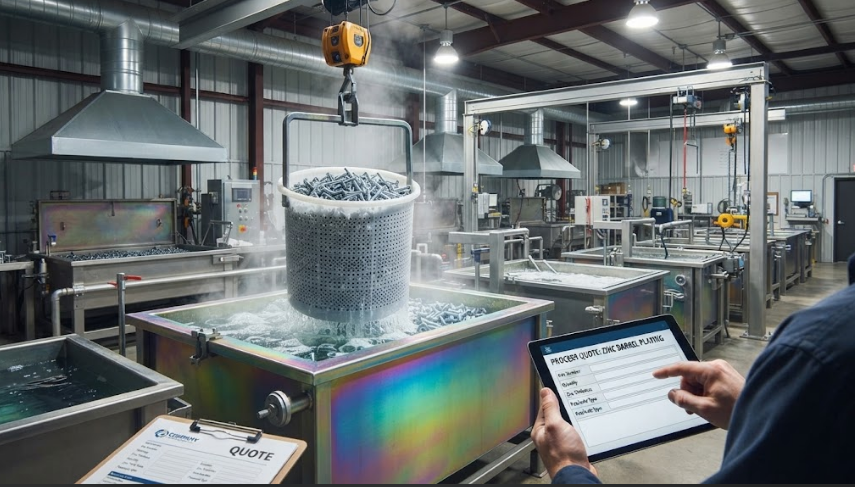
Because you are asking for a barrel quote specifically, it is worth a quick gut-check against what barrel plating does well. Zinc barrel electroplating deposits a protective zinc coating on small steel parts in bulk. Instead of mounting each part individually, hundreds or thousands of components are loaded into a perforated, rotating barrel. The barrel tumbles inside the zinc electrolyte while current flows, so zinc ions deposit across every exposed surface.
Barrel plating is usually a strong match when:
- Parts are small to medium in size, such as fasteners, washers, clips, stampings, and machine screws
- Volumes are high or recurring, so bulk processing improves efficiency
- Parts are durable enough to tumble without damage or nesting
- Protection and cost efficiency matter more than showroom-level cosmetic perfection
- Threads, blind holes, and recesses need reliable solution coverage
Another process may fit better when:
- Parts are large, delicate, or easily dented, scratched, or tangled
- Cosmetic appearance is critical on every surface
- Parts are high-strength and embrittlement risk calls for a different approach
In those cases, zinc rack electroplating or zinc mechanical galvanizing may be the better path. If you are unsure, say so in your request. Part of our review is confirming the process, and we would rather recommend the right one than quote the one you guessed.
Step One: Gather What We Need to Quote Accurately
The quality of a quote tracks the quality of the information behind it. You do not need a perfect package to start, but the more of the following you provide, the less back-and-forth is needed.
Part Information
- Part number and description for every item you want quoted
- Prints or drawings showing dimensions, threads, and any critical surfaces or features
- Part size and weight, since piece weight drives how parts load into a barrel
- Base material and any heat treatment, including hardness where relevant
- Photos or samples if the geometry is unusual, such as parts that could nest, tangle, or trap solution
Coating Requirements
- Governing specification, such as ASTM B633 or a customer-specific OEM standard
- Thickness or class required
- Finish color: clear (blue), yellow, black, olive drab, or a custom finish
- Sealers or other post-treatments and any corrosion performance target, such as salt spray hours
Volume and Schedule
- Quantity per order and expected annual volume
- Release pattern: one-time, blanket order, or scheduled releases
- Target delivery dates and any hard deadlines
Quality, Paperwork, and Logistics
- Inspection, sampling, or testing requirements
- Certificates of conformance, lot traceability, or audit documentation
- Packaging, labeling, and return-container expectations
- Shipping method, and whether you will deliver or want pickup
Missing something? Send what you have. A partial request is better than a delayed one, and we will tell you exactly what is outstanding rather than leaving you to guess.
Share your part specifications, annual volume, and corrosion requirements.
You can start through our request-a-quote page, through the contact form, or by calling (608) 524-8241. If you already have drawings and a forecast, the written route is efficient because the information stays attached to your request. If you are still figuring out specifications, a phone call can save time, because a conversation often resolves in five minutes what an email thread takes days to untangle.
Plateco is located at 1375 Industrial Street in Reedsburg, Wisconsin, and we serve manufacturers across Wisconsin, Illinois, Indiana, Michigan, Minnesota, and Iowa. You do not need to be local to request a quote. Many of our customers ship parts to us from other states.
Step Three: What Happens After You Submit
Here is the sequence you can expect once your request reaches us. We describe the stages instead of promising a fixed clock, because turnaround depends on how complete your package is and how much review your parts require. We will give you a realistic answer for your situation, not a generic number.
1. Intake and Completeness Check
Your request is reviewed for the essentials: part, spec, volume, and schedule. If something is missing or contradictory, such as a print that calls out a thickness the specification does not support, we flag it now. This is the cheapest moment to resolve a question.
2. Technical Review of Your Parts
This is the step that separates a plating quote from a price list. We look at geometry, size, weight, and material to judge how the parts will behave in a barrel. We consider whether threads and recesses will plate evenly, whether parts will tumble without damage, and whether any feature raises a quality risk. If the parts are hardened, we confirm whether hydrogen embrittlement relief baking is required and build it into the plan.
3. Process Confirmation
We confirm that barrel is the right process for what you sent. If it is, we move forward. If a different process serves your parts better, we explain why and quote accordingly. Because zinc is all we do, this is a conversation grounded in daily experience with zinc coatings, not a sales pitch for whatever equipment happens to be open.
4. Specification and Finish Alignment
We match your coating requirements to our capabilities: the governing standard, thickness, chromate system, color, and any sealers. We are equipped to plate to widely recognized specifications including ASTM B633 and customer-specific OEM standards. If your print references an outdated or unclear callout, we raise it so the order is not built on a misunderstanding.
5. Pricing and Scheduling Review
With the technical picture settled, we price the work and look at where it fits on our schedule. Volume pattern matters here. A steady, predictable release schedule is easier to plan than a sudden spike, and we will tell you if timing needs to be adjusted to protect your delivery date.
6. Quote Delivery and Walkthrough
You receive a written quote that states what is included: process, coating, finish, post-plate steps, documentation, and assumptions. If anything is unclear, we walk you through it. A quote you do not fully understand is not a good quote, however low the number.
What Drives the Price of a Zinc Barrel Electroplating Quote
Buyers sometimes expect a single per-pound or per-piece price that applies everywhere. In practice, several variables move the number. Understanding them helps you compare quotes honestly and, in some cases, reduce cost without sacrificing performance.
| Cost Factor | Why It Matters |
|---|---|
| Part size and weight | Determines how many pieces load into a barrel and how efficiently they process |
| Volume and release pattern | Larger, steady volume spreads setup and handling across more parts |
| Thickness and class | Heavier deposits take longer and use more zinc |
| Chromate system and color | Different finishes carry different processing steps and performance levels |
| Sealers and post-treatments | Add steps, handling, and sometimes curing time |
| Hydrogen embrittlement baking | Required for many high-strength parts and adds time and handling |
| Inspection and testing | Sampling plans, thickness checks, and extended testing take labor and time |
| Packaging and labeling | Custom packaging, part separation, and labeling add handling |
| Documentation | Certificates, traceability, and audit paperwork require effort to assemble |
| Schedule urgency | Expedited work competes with other customers’ jobs and costs more to accommodate |
Where you can save without cutting corners
Specify what you actually need. Requiring a heavier class or a premium finish “just in case” raises cost. Match the coating to the real service environment. Wisconsin winters, road salt, and agricultural exposure are demanding, but not every part sees the same conditions.
Share your forecast. Recurring parts quoted with a realistic annual volume let us plan labor and chemistry around a known pattern.
Release steadily. Even flow beats last-minute surges, and it keeps lead times predictable.
Keep paperwork requirements purposeful. Ask for the documentation your quality system genuinely needs. It is available, but it is not free.
Coatings, Colors, and Post-Plate Steps You Will See in Your Quote
Your quote will describe the complete finishing sequence, not just “zinc plating.” Here is what each element means.
Zinc deposition. The core of the process. Zinc provides sacrificial protection, meaning that even if the coating is scratched, the zinc corrodes before the underlying steel. Thickness and class determine how long that protection lasts.
Chromate conversion coating. Applied after plating to boost corrosion resistance and produce a specified color: clear (blue), yellow, black, olive drab, or a custom finish. These treatments meaningfully improve salt spray performance and extend service life.
Sealers. Used where a performance target calls for extra protection beyond the chromate layer. Your quote will state whether one is included.
Hydrogen embrittlement relief baking. For hardened, high-strength steel, baking after plating is a time-sensitive requirement governed by the applicable specification. It is not optional and cannot be rushed. If your parts are hardened, tell us at the start so the quote and schedule both reflect it. You can read more in our guide to hydrogen embrittlement in zinc plating.
Inspection and testing. Thickness measurement and any verification your specification requires. Clarify what applies to every lot and what applies on a sample basis.
What Our Barrel Process Looks Like Once You Say Yes
After you approve the quote and send a purchase order, your parts enter a controlled process. Understanding it helps you see why preparation up front pays off.
Receiving and Verification
Parts arrive and are checked against your order: part number, quantity, and paperwork. This is also where a revision mismatch is caught, which is why we ask you to confirm the print revision in your request.
Loading
Parts are loaded into a perforated rotating barrel. The perforations let solution flow freely while maintaining electrical contact between parts. Load size and part geometry are planned based on the technical review, and our lines can process up to 800 pounds per barrel.
Cleaning and Surface Preparation
Before any zinc is deposited, parts are degreased to remove oils, acid pickled to remove oxides, and rinsed to control contamination. Proper preparation is critical, because contamination can compromise adhesion or cause defects that only show up after plating.
Zinc Deposition
In the electrolyte bath, current flows, zinc ions are drawn to the negatively charged steel surfaces, and a controlled zinc layer forms on every exposed surface. Continuous tumbling gives each part even exposure and helps solution reach blind holes and recesses. Our fully automated barrel lines monitor chemistry and regulate conditions such as current density and temperature to keep deposition consistent from lot to lot. Rotation speeds can be controlled for delicate components.
Post-Plating Treatment
Chromate conversion, sealers, and baking are applied as specified in your quote.
Inspection, Packaging, and Shipping
Thickness is verified, packaging and labeling follow your instructions, and documentation is prepared. Parts ship or are staged for pickup as agreed.
Every stage ties back to your quote. If it was in the quote, it is in the process. If it was not, that is a conversation to have before production, not after.
“We treat zinc plating as an extremely complex process demanding state-of-the-art technology, painstaking planning, obsessive quality control, and a tremendous amount of talent. Because our customers don’t come to us for excuses they come to us for perfection. And we’ll do whatever it takes to give them nothing less.”Jim Schweich, Chief Executive Perfectionist, Plateco, Inc.
How to Compare Our Quote With Others
If you are collecting several quotes, resist the temptation to compare only the bottom line. Two quotes that look different may be pricing different scopes. Line them up on the following points.
- Is the specification identical? Same standard, class, thickness, and finish across all quotes.
- Are post-plate steps included? Baking, sealers, and inspection can quietly appear as add-ons later.
- What documentation is included? Certificates and traceability are sometimes extra.
- What are the assumptions? Look for conditions about volume, packaging, or part condition that could change the price.
- What is the lead-time basis? Ask whether it reflects current workload and your specific parts.
- What happens if parts are rejected? This reveals how a vendor stands behind its work.
- Does the supplier specialize? A shop spread across many finishes may not have the same depth in zinc as one that does only zinc.
On that last point, Plateco focuses exclusively on zinc plating, which means deeper technical knowledge, refined operating systems, continuous process optimization, and consistent coating performance. Our philosophy is simple: On Spec. On Time. Or It’s On Us.
We stand behind that with numbers. Our on-time commitment is 95%, and our customer return rate for the first quarter of 2026 was just 0.1%. And if you reject a part for a quality problem that is our fault, you will not be charged for it. We encourage you to ask every vendor on your list for comparable figures.
Certifications and Traceability: What We Can Support
If your customers audit you, you need a plating partner who can support that. Plateco holds ISO 9001 certification, and documentation and traceability are available to support quality audits and compliance reviews. Our certifications and specifications page lists what we work to. When you request your quote, tell us which records you need: certificates of conformance, lot traceability, or specific OEM requirements. Stating them at the quoting stage means they are priced, planned, and ready when the parts ship, rather than assembled in a scramble afterward.
Planning Your First Order and Setting Up for Repeat Business
A quote is the start of a relationship, and a few habits make that relationship smoother.
Confirm print revisions. Plating to a superseded print is the most avoidable form of rework. Verify that the revision on your purchase order is the one engineering intends.
Name two contacts. One primary and one backup who can make decisions. A question that waits three days for an answer is a delay.
Start with a clear first order. For new parts, a well-documented first lot establishes the baseline for everything that follows. Notes about what you expect, and what you see, make future lots easier.
Share your forecast. If a part will repeat, tell us. Predictable volume helps us schedule labor, barrels, and chemistry.
Plan the calendar. Seasonal peaks and holidays compress capacity for everyone. Our guide to avoiding year-end zinc plating delays covers how to build margin into a tight quarter.
Communicate changes immediately. If a quantity, deadline, or revision changes, tell us right away. Early notice lets us reallocate capacity and protect your delivery.
Your Zinc Barrel Quote Readiness Checklist
Parts and Specification
- Part numbers, descriptions, and current-revision prints
- Part size, weight, and base material
- Heat treatment or hardness, including embrittlement baking needs
- Governing standard, thickness class, finish color, and sealer
Volume and Schedule
- Quantity per order and annual volume estimate
- Release pattern and target delivery dates
- Hard deadlines flagged clearly
Quality and Logistics
- Inspection, testing, and documentation requirements
- Packaging and labeling instructions
- Shipping or pickup preferences
- Primary and backup contacts
Questions to Ask Before You Choose a Plating Partner
- Do you review my parts before quoting, or just price by weight? Technical review is what prevents surprises.
- Will you tell me if another process is a better fit? An honest answer matters more than a quick yes.
- What exactly is included in the price? Ask about baking, sealers, inspection, and documentation.
- What lead time should I expect for my parts and volume right now? Insist on a specific answer.
- How do you handle quality problems? Look for clear accountability.
- How will I get status updates? A defined process beats a promise to “keep you posted.”
Frequently Asked Questions
How do I request a zinc barrel electroplating quote?
Use our request-a-quote page, our contact form, or call (608) 524-8241. Include part numbers, prints, quantities, coating requirements, and your target schedule.
What information do you need to quote accurately?
At minimum: part details and drawings, base material, governing specification, thickness or class, finish color, volume, and timing. Add documentation, packaging, and testing needs for the most precise quote.
Can you quote if I am not sure barrel plating is right?
Yes. Send your drawings or samples and tell us what you are trying to achieve. We will confirm the best process, whether that is barrel, rack, or mechanical galvanizing.
Do you quote threaded and very small parts?
Yes. The tumbling action allows solution access to threads and recesses, and specialized barrel configurations allow plating of extremely small components. Send samples if the geometry is unusual.
How does hardened steel affect my quote?
High-strength steel may require hydrogen embrittlement relief baking after plating, which adds a time-sensitive step. Tell us about hardness upfront so it is included in both price and schedule.
Do you offer blanket orders or scheduled releases?
Recurring parts benefit from a shared forecast and planned releases. Tell us your pattern when you request your quote and we will discuss what works.
What if a part is rejected for a quality problem?
If you reject a part for a quality problem that is our fault, you will not be charged for it.
Do you serve customers outside Wisconsin?
Yes. We are based in Reedsburg, Wisconsin, and serve manufacturers in Indiana, Minnesota, Michigan, Iowa, Illinois, and Wisconsin. See our location pages for details.
Ready for a Zinc Barrel Electroplating Quote You Can Plan Around?
Plateco has been zinc plating for Midwest manufacturers, fabricators, and OEMs since 1974. Send us your prints, volumes, and deadlines, and we will tell you plainly what we recommend, what it includes, and what to expect.