

If you buy, stock, or specify steel hardware for outdoor, buried, marine-adjacent, agricultural, or road-exposed service, you already know the pattern. A shipment of anchor bolts, structural fasteners, or heavy connectors arrives looking fine. Eighteen months later, someone is calling to ask why the coating is gone and the threads are rusting solid. The steel was never the problem. The corrosion protection was either too thin for the environment, uneven where it mattered most, or specified against a standard nobody on the purchasing side had actually read.
Mechanical galvanizing exists to solve that exact problem. It puts a thick, dense, well-bonded zinc coating on small and medium steel parts without electroplating current and without the high heat of a hot-dip kettle. For industrial supply buyers, OEMs, fabricators, and distributors, that combination makes it one of the most practical ways to buy long-life corrosion protection for hardware.
This guide is written for people who are ready to buy, or close to it. We explain how the process works, where it outperforms the alternatives, how to write a specification that gets you what you actually need, what drives cost and lead time, and exactly what to send us when you request a quote. Everything here is grounded in what we do at our Reedsburg, Wisconsin facility, and where a decision depends on your specific part or spec, we say so rather than guess.
- Since 1974 – Plateco has served Wisconsin and Midwest manufacturers, fabricators, and OEMs with zinc coating.
- 1% – Plateco return rate, 1st Quarter 2026. On spec, on time, or it’s on us.
- 95% – On-time delivery commitment.
Why Steel Hardware Fails in the Field, and Why Coating Choice Is a Purchasing Decision
Bare or thinly coated steel hardware does not fail randomly. It fails predictably, according to the environment it is installed in and the protection it was given. In the Upper Midwest, that environment is unusually harsh. Winter brings road salt and deicing chemicals, then thaws, then freezes again, driving moisture and chlorides into every thread and crevice. Summer adds humidity. Agricultural settings add fertilizer, manure, and constant washdown. Industrial plants add chemical exposure and cleaning cycles. Hardware that is buried, set in concrete, or in contact with the ground faces moisture around the clock.
Zinc protects steel in two ways. First, it acts as a barrier, keeping moisture and oxygen away from the steel surface. Second, it is sacrificial if the coating is scratched or nicked, the zinc corrodes in preference to the steel next to it, which is why a galvanized bolt with a scuffed thread often keeps performing long after a painted bolt with the same scuff would have started to rust. How long that protection lasts depends heavily on how much zinc is on the part and how well it is bonded.
That is why coating selection belongs in the purchasing conversation and not just the engineering one. A fastener that is 20 percent cheaper but lasts half as long in service is not a bargain. It is deferred cost replacement parts, labor to re-access the joint, downtime, and in structural or safety-related applications, a liability conversation nobody wants to have. Buyers who treat the coating as a line item to be minimized often end up paying for it later. Buyers who treat it as a performance requirement, with a measurable specification attached, get predictable service life.
The question then becomes which coating process delivers the right protection for the right part at a sensible total cost. For a large share of industrial hardware, the answer is mechanical galvanizing.
What Is Mechanical Galvanizing?
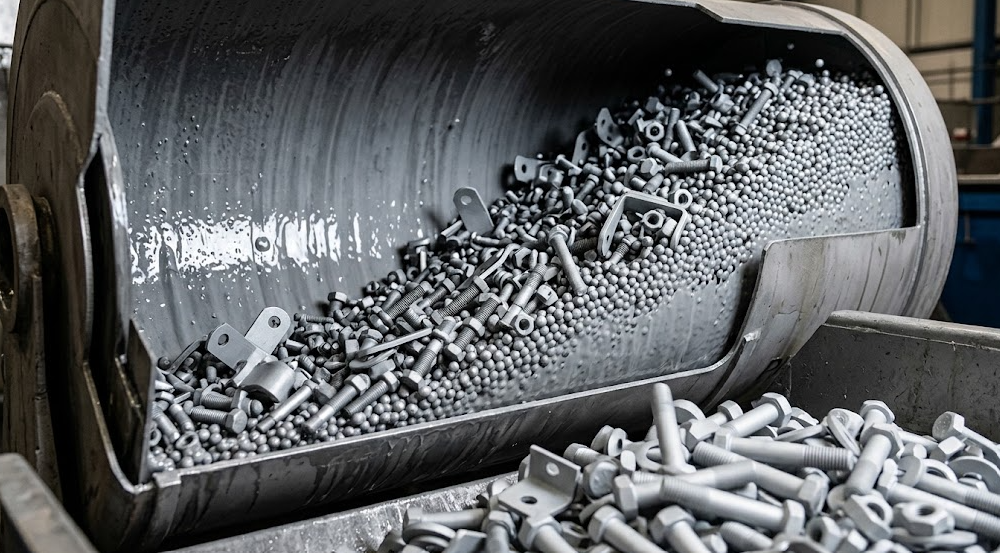
Mechanical galvanizing is a cold-application process. Instead of dipping parts in molten zinc, or passing electrical current through a plating bath, it bonds zinc powder to the steel surface mechanically, through a combination of tumbling, centrifugal force, and controlled heat. The zinc is embedded and built up on the surface rather than deposited from a solution.
The result is a thicker and more uniform zinc coating than typical electroplating produces, with strong adhesion to the base steel. Because the zinc is delivered by tumbling action, it reaches threads, blind holes, recesses, and other awkward features that can be difficult for other processes to cover consistently.
How the process works at Plateco
- Surface preparation. Parts are rigorously cleaned to remove oils, rust, and contaminants. A clean surface is the single biggest factor in whether the zinc bonds properly to the steel, and skipping or rushing this step is the most common cause of coating problems across the industry.
- Loading and tumbling. Prepared parts go into a rotating drum containing zinc powder. As the drum turns, parts tumble and collide, embedding zinc particles into the surface of the steel. The same action carries zinc into threads, blind holes, recesses, and complex shapes.
- Heat activation and particle bonding. Controlled heat can be used to help the zinc particles adhere more uniformly and securely. This does not melt the steel or the zinc. It simply improves bonding, producing a dense zinc layer that is thicker and more protective than typical electroplated coatings.
- Finishing and protection. After galvanizing, parts can be sealed or passivated to further improve corrosion resistance and to achieve a specific visual finish.
Our process controls cover each of these stages surface preparation protocols, drum rotation speed and duration, controlled heat application, inspection checkpoints, and thickness verification. Those are the variables that make coating performance consistent and measurable from one lot to the next, which matters far more to a repeat buyer than any single impressive test result.
Have Questions About Your Parts? – (608) 524-8241
Where Mechanical Galvanizing Outperforms the Alternatives
Mechanical galvanizing is not the right answer for every part, and we would rather tell you that up front. But for the heavy-duty hardware most industrial supply buyers purchase in volume, it fills a gap that the other common processes leave open. Here is how it compares in practical terms.
| Factor | Mechanical Galvanizing | Standard Zinc Electroplating | Hot-Dip Galvanizing |
| Coating thickness | High, specified to your requirement | Moderate | Very high |
| Corrosion protection | Excellent | Good | Excellent |
| Adhesion | Very strong | Moderate | Strong |
| Coverage on threads, holes, recesses | Very good | Good | Can build up in threads |
| Hydrogen embrittlement risk | None from the coating process | Possible | None from plating |
| Heat distortion risk | No high-heat exposure | No | Yes, kettle temperatures |
| Best suited for | Heavy-duty, small to medium hardware | Small to medium parts, lighter exposure | Large structural steel |
Hot-dip comparison reflects general industry characteristics the electroplating and mechanical galvanizing columns reflect Plateco’s published process comparison. Always confirm against the specification your part requires.
Versus standard zinc electroplating
Electroplated zinc is an excellent, economical choice for a huge range of small and medium parts, and we run zinc barrel and rack electroplating lines for exactly that reason. But electroplated coatings are thinner by nature. For hardware that will sit in road salt, constant moisture, or ground contact, a thicker mechanically bonded layer simply gives you more zinc to lose before the steel is exposed. That extra margin is what translates into longer service life and fewer replacements.
Versus hot-dip galvanizing
Hot-dip galvanizing is the long-standing choice for large structural steel, and it delivers very heavy coatings. The trade-offs show up on hardware. Molten zinc exposes parts to high temperatures that can distort or weaken some steels, and the heavy, sometimes uneven coating can build up in threads and tight features, which can create fit problems that require re-tapping or oversize tapping to resolve. Mechanical galvanizing offers heavier protection than electroplating without the heat distortion associated with hot-dip processing, which is why it sits between the two and is so often the right fit for fasteners and similar components.
The hydrogen embrittlement question
For high-strength fasteners, hydrogen embrittlement is a serious concern. Hydrogen introduced into hardened steel during some electroplating processes can lead to delayed cracking under load. Mechanical galvanizing does not use electrical current to deposit the coating, so it does not introduce hydrogen into the steel surface through the plating step. If you buy high-strength bolts, structural fasteners, or any component where brittle fracture is a real risk, this alone can justify choosing mechanical galvanizing. Where your specification calls for particular treatment of high-strength parts, confirm those requirements with us at quote stage.
Not sure which coating your hardware needs?
Send us the part, the environment, and the spec. We’ll recommend the right process.
Steel Hardware That Benefits Most From Mechanical Galvanizing
The process earns its place wherever hardware faces one or more of these conditions heavy moisture exposure, road salt and deicing chemicals, buried or ground contact, industrial washdown environments, or agricultural wear. If your customers install what you sell in any of those conditions, a heavier zinc coating is worth discussing.
Typical applications we see include:
- Large fasteners – Bolts, studs, and threaded rod where thread coverage and coating thickness both matter.
- Structural hardware – Brackets, connectors, and fittings used in construction and infrastructure.
- Anchor bolts – Parts that spend their service life in or against concrete and soil, where moisture is constant and replacement is expensive.
- Heavy-duty connectors – Hardware that carries load, sees vibration, and cannot afford a failed joint.
- Mining and construction components – Parts exposed to abrasion, moisture, and rough handling.
- Agricultural equipment parts – Hardware facing fertilizer, wash cycles, and constant outdoor exposure.
For distributors and industrial supply houses, there is a commercial angle as well. Hardware that holds up in the field generates fewer complaints, fewer returns, and fewer warranty conversations with your own customers. If you stock fasteners and connectors for contractors, farm equipment dealers, or municipal and utility buyers, offering mechanically galvanized options gives you a premium, specification-ready product in categories where buyers have been burned by coatings that did not last.
Specifications and Coating Thickness: What to Put on the Purchase Order
The most expensive mistake in buying coated hardware is a vague specification. “Galvanized” on a purchase order means very different things to different suppliers. Mechanical galvanizing can be tailored to meet a range of performance targets, which is a strength only if your order says clearly what target you need.
When you request a quote, be ready to define:
- The governing specification. Many mechanically galvanized coatings are specified to a published standard such as ASTM B695, which defines coating classes by minimum thickness. If your drawing, customer, or industry calls out a specific standard and class, tell us. If it does not, tell us the environment and service life you need and we will help you identify an appropriate requirement.
- Minimum coating thickness. Thickness is the single most important number for corrosion life. State it explicitly rather than relying on a general description.
- Post-treatment. Sealing or passivation can further improve corrosion resistance and set the final appearance. Specify what you need, including any color or appearance requirement.
- Corrosion resistance target. If you have a salt-spray or environmental performance requirement, include it. The right coating weight and finishing system depend on it.
- Thread and fit requirements. If the hardware must mate with nuts or tapped holes, tell us your fit requirements so coating thickness can be planned around them.
You will find more detail on the standards we work to on our Certifications & Specifications page, and Plateco’s quality system is ISO 9001 certified. If your application involves a specialized requirement beyond standard zinc coatings, such as aerospace or defense certifications, confirm that directly with us before placing volume. We would rather answer that question at the start than have you discover a gap after parts ship.
The Misconception We Hear Most Often
That “thicker is always better.” Thicker coatings give more corrosion life, but hardware still has to fit. On threaded parts, coating thickness has to be planned against thread tolerances, and an over-specified coating can cause assembly problems. The right answer is the thickness your environment demands, specified deliberately, not the heaviest number on a chart. That is the conversation we have with you during quoting.
Process Control and Documentation: Proof, Not Promises
Buyers comparing coating vendors usually start with price per piece or per pound. The better starting point is how a vendor proves what they delivered. A coating that cannot be verified is a coating you are taking on faith.
Our mechanical galvanizing lines operate under defined, repeatable controls. Surface preparation follows set protocols so every lot starts clean. Drum rotation speed and duration are controlled, because they directly affect how the zinc builds and bonds. Heat application is controlled. Inspection checkpoints are built into the process, and thickness verification systems confirm that the coating meets the requirement before parts leave the building.
These controls are the reason Plateco’s return rate was 0.1% in the first quarter of 2026, and the reason we stand behind a simple commitment on spec, on time, or it’s on us. If we deliver a plated part that you reject for a quality problem that is our fault, you are not charged for that part. We have been named a Products Finishing Top Shop for seven straight years, and our quality system carries ISO 9001 certification through the Performance Review Institute.
For industrial supply buyers, the practical takeaway is to ask every coating vendor the same questions: How is thickness verified? What documentation ships with each lot? What happens if a lot is rejected? A vendor with genuine process control answers specifically and without hesitation. You can read how we approach this across the board in our guide, Plateco vs Competitors: Why Wisconsin Manufacturers Choose Plateco.
“We treat zinc plating as an extremely complex process demanding state-of-the-art technology, painstaking planning, obsessive quality control, and a tremendous amount of talent. Because our customers don’t come to us for excuses they come to us for perfection.”
— Jim Schweich, Chief Executive Perfectionist, Plateco, Inc.
What Drives the Cost and Lead Time of Mechanically Galvanized Hardware
We do not publish a flat price list, because the honest answer to “what does it cost?” depends on the part and the specification. What we can do is explain exactly which factors move the number, so you can compare quotes sensibly and plan orders to get the best value.
Factors that influence price
- Part size and weight. Heavier and larger parts use more zinc and more drum capacity per lot.
- Required coating thickness. A heavier class means more zinc and more processing time, and it is priced accordingly.
- Lot size and repeat volume. Mechanical galvanizing is a batch process, so volume and repeat business matter. Standing orders and blanket releases often allow more efficient scheduling.
- Part condition on arrival. Heavy scale, rust, or oil requires additional surface preparation. Clean, well-packaged parts are faster and more economical to process.
- Post-treatment and finish. Sealing or passivation adds a step and should be specified up front.
- Documentation requirements. Any special certification or reporting beyond standard should be named in the RFQ.
Compare total landed cost, not just quoted price
A low quoted rate can hide expensive surprises rejected lots, expedited freight to recover a missed date, and internal labor spent chasing a vendor. When you factor in what a failed coating costs in the field, the cheapest quote is rarely the cheapest outcome. A vendor with a 0.1% return rate and a 95% on-time commitment protects your schedule and your own customer relationships in ways a per-pound price never captures.
Lead time
Our on-time commitment is 95%, and we hold ourselves to it. Actual turnaround on your order depends on lot size, thickness requirement, current scheduling, and how quickly parts reach us, so we quote lead time specifically rather than offering a generic number. If you have a hard deadline, say so in your request and we will tell you honestly whether we can meet it. We would rather decline an unrealistic date than promise one and miss it.
How to Order: What to Send With Your Request for Quote
Getting an accurate quote quickly comes down to sending complete information the first time. Here is the checklist we recommend, and the shortest path from request to coated hardware.
- Send prints and specifications. Include part drawings, material and hardness information, and the coating specification and class if you have one. If your hardware is high-strength, say so.
- Describe the environment. Tell us where the parts will be used: road salt, buried, washdown, agricultural, marine-adjacent. This lets us confirm the specified thickness actually matches the exposure.
- Give us volume and delivery expectations. Share your first-order quantity, expected annual volume, and when you need parts back. Repeat volume often changes how we schedule.
- Name any special requirements. Post-treatment, appearance, documentation, thread fit, or packaging needs should be in the RFQ, not discovered at shipment.
- Request a trial on your hardest part. If you are evaluating us against a current supplier, run your most demanding part first, not your easiest. That is the clearest way to verify our results.
- Review the quote and approve. We respond with a quote and any recommendations, such as an adjusted thickness or finish, based on what you told us.
New to us? See What to Expect on Your First Zinc Plating Order and our shipping and packaging guide.
Where Mechanical Galvanizing Is the Right Fit, and Where to Ask More Questions
It is an especially strong fit when your hardware is heavy-duty or structural, faces road salt, moisture, ground contact, or agricultural conditions, is threaded or has complex geometry that needs consistent coverage, or is heat-sensitive or high-strength so that avoiding hot-dip temperatures and plating-process hydrogen both matter.
Consider a different process when parts are very large structural members better suited to hot-dip kettles, or when your application is light-duty, indoor, or low-corrosion, where economical zinc electroplating can fully meet the requirement at lower cost. We offer both zinc barrel electroplating and zinc rack electroplating, so we can steer you toward whichever coating fits your part and budget, even if that is not mechanical galvanizing. Read more in our guides on zinc barrel coating for steel hardware and zinc rack coatings for steel hardware.
Confirm directly before ordering if you have specialized certification requirements, an unusual part geometry, or a coating requirement outside standard zinc systems. A direct conversation up front is always better than an assumption.
Frequently Asked Questions
Is mechanical galvanizing suitable for large parts?
Yes. It is well suited to medium and large components that need thick protective coatings and durable corrosion resistance, and we handle a wide range of part sizes. For very large structural steel, hot-dip galvanizing may be the more appropriate process, and we will tell you if that is the case for your part.
How does mechanical galvanizing compare to hot-dip galvanizing?
Mechanical galvanizing provides thicker coatings than electroplating, with greater consistency than some hot-dip processes and without the distortion risk that comes from high temperatures. It is often the better choice for fasteners and hardware where thread fit and heat sensitivity matter.
Can mechanically galvanized hardware withstand road salt?
Yes. The dense zinc layer provides excellent protection in corrosive environments, including freeze-thaw cycles and deicing chemicals. Exact service life depends on the coating thickness you specify, any sealing or passivation, and the severity of exposure.
Is there a risk of the coating flaking?
With proper surface preparation and process control, mechanical galvanizing delivers strong adhesion and reduces the risk of coating separation under normal use. This is exactly why we treat cleaning and in-process controls as the foundation of the process, not an afterthought.
Does mechanical galvanizing cause hydrogen embrittlement?
The coating process does not use electrical current, so it does not introduce hydrogen into the steel surface through plating. That eliminates plating-related hydrogen embrittlement risk for high-strength components. If your specification includes requirements for hardened parts, include them in your RFQ so we can confirm handling.
What do I need to send to get a quote?
Send prints, specifications, material details, expected volume, delivery date, and the environment the hardware will see. Tell us your required thickness or standard if you have one. The more complete your request, the faster and more accurate our quote.
What if a lot doesn’t meet my requirements?
Our commitment is on spec, on time, or it’s on us. If you reject a plated part for a quality problem that is our fault, you are not charged for it. We would also rather hear about a concern immediately so we can make it right quickly.
Ready to Protect Your Hardware With Coatings Built to Last?
Tell us your part specifications, corrosion challenges, and performance goals, and we will recommend the optimal mechanical galvanizing solution for your needs. Reject excuses. Demand perfection. Better yet, demand Plateco.