

A new quality engineer’s first vendor call with a plating supplier tends to go one of two ways. Either the conversation moves fluently between terms like dwell time, hull cell, and throwing power, and the engineer nods along while quietly making a mental list of things to look up afterward, or the plater slows down, translates everything into plain language, and the conversation takes twice as long as it needed to. Neither outcome is ideal. The first leaves genuine specification questions unasked because the vocabulary itself was the barrier. The second works, but it means a purchasing manager or design engineer is never quite operating with full command of a process they’re specifying parts against, order after order.
This glossary exists to close that gap directly. It’s built for the buyers, quality engineers, and design engineers who specify zinc-plated parts regularly but didn’t come up through a plating shop floor, and who want a genuine working vocabulary rather than a superficial one. We’ve organized fifty terms into six practical categories, moving from the core process itself through chemistry, specification and testing, finish types, defects, and the documentation language that shows up on every quote and lot report. Read straight through for a real foundation, or use it as a reference to look up a specific term the next time a supplier conversation or a print callout uses language that isn’t quite familiar yet.
At Plateco, we’ve been zinc plating for Wisconsin manufacturers, fabricators, and OEMs since 1974, and one pattern we’ve seen consistently across five decades is that the buyers and engineers who get the most reliable results from a plating relationship are the ones who understand the process well enough to ask precise, specific questions, not just general ones. This glossary is meant to help build exactly that kind of fluency.
50 Terms
Covering the core plating process, chemistry, specification and testing standards, finish types, common defects, and documentation language
6 Categories
Organized for genuine reference use, not just an alphabetical list to scroll past
Since 1974
Plateco has specified, explained, and documented these exact terms for Wisconsin manufacturers across five decades of production
Have Questions About Your Parts? – (608) 524-8241
Part One: The Core Process
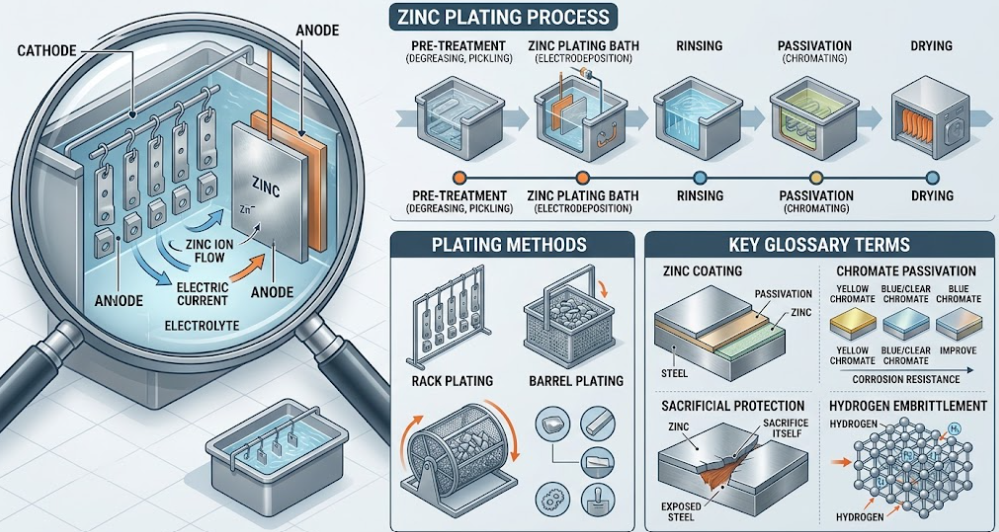
Zinc Plating (Electroplating) — The general process of depositing a layer of zinc onto a steel or iron part using an electrical current, primarily to provide sacrificial corrosion protection to the base metal.
Electrodeposition — The broader technical term for the electrochemical process by which metal ions in solution are deposited onto a conductive surface, of which zinc plating is one specific application.
Substrate — The base material, typically steel or iron, onto which the zinc coating is deposited. The substrate’s own surface condition and alloy composition directly affect how well the zinc coating adheres and performs.
Anode — The positively charged electrode in the plating bath, typically made of zinc, which dissolves into the solution during the process to replenish the zinc ions being deposited onto the parts.
Cathode — The part being plated, which functions as the negatively charged electrode in the bath, attracting the positively charged zinc ions that form the coating.
Rack Plating — A plating method where individual parts are mounted on a fixture, or rack, that holds them in position and conducts electrical current to them throughout the process. Rack plating is generally used for larger, more geometrically complex, or more delicate parts than barrel plating.
Barrel Plating — A plating method where a large volume of smaller parts, such as fasteners, is tumbled loosely inside a rotating barrel submerged in the plating bath, allowing high-volume processing without the labor of individually racking each part.
Current Density — The amount of electrical current applied per unit of surface area during plating, typically measured in amps per square foot. Current density directly affects deposition rate and coating thickness, and needs to be carefully controlled and matched to a part’s specific geometry.
Dwell Time — The length of time a part remains submerged in the plating bath, which, combined with current density, determines the final coating thickness. Under-timed dwell periods are a common, preventable cause of thin, out-of-spec coatings.
Throwing Power — A bath’s ability to deposit a reasonably uniform coating thickness across a part’s entire surface, including recessed areas, internal corners, and other geometry that’s harder for current to reach evenly. Good throwing power is particularly important for complex part shapes.
Hull Cell — A small test cell used to evaluate a plating bath’s performance, current distribution, and throwing power under controlled laboratory conditions, allowing a plater to diagnose bath chemistry issues before they affect full production.
Rectifier — The electrical equipment that converts alternating current into the direct current required for the electroplating process, and precisely controls the current delivered to the plating bath.
Part Two: Chemistry and Coatings
Zinc Chloride Plating (Acid Zinc) — A type of zinc plating bath chemistry using zinc chloride as the primary zinc source, generally offering faster deposition rates and good throwing power, commonly used for rack-plated parts with more complex geometry.
Alkaline Zinc Plating — A type of zinc plating bath chemistry operating at a high pH, generally offering excellent throwing power and ductility, and frequently preferred for parts where hydrogen embrittlement risk needs to be minimized.
Cyanide Zinc Plating — An older category of alkaline zinc plating chemistry using cyanide compounds, largely phased out across the industry in favor of cyanide-free alkaline and acid zinc alternatives due to environmental and safety considerations.
Chromate Conversion Coating — A chemical treatment applied over the zinc layer after plating, which reacts with the zinc surface to form a protective conversion layer, significantly enhancing corrosion resistance beyond what the zinc coating alone provides.
Trivalent Chromium (Tri-Chrome) — A category of chromate conversion coating using trivalent chromium compounds, now the industry-standard choice across most applications due to its more favorable environmental and regulatory profile compared to hexavalent chromium.
Hexavalent Chromium — An older category of chromate conversion coating chemistry, largely phased out of most modern zinc plating operations due to significant environmental and regulatory restrictions, including RoHS compliance requirements in many industries.
Passivation — The general process of applying a chromate or similar conversion coating to a plated surface to reduce its reactivity and improve corrosion resistance, another term commonly used interchangeably with chromate conversion coating.
Topcoat / Sealer — An additional protective layer sometimes applied over a chromate conversion coating for further corrosion resistance or a specific appearance, used selectively depending on the application’s requirements.
Hydrogen Embrittlement — A condition where hydrogen atoms absorbed into a steel part during the plating process become trapped within the metal’s structure, potentially causing brittleness and, in high-strength steel applications, a real risk of delayed cracking under load.
Baking (Hydrogen Embrittlement Relief) — A post-plating heat treatment process that drives absorbed hydrogen out of the plated part, mitigating hydrogen embrittlement risk. Baking is standard practice for high-strength steel fasteners and other parts susceptible to this failure mode, and is typically required within a specific time window after plating.
pH — A measure of a plating bath’s acidity or alkalinity, which directly affects deposition rate, coating quality, and overall bath performance, and requires regular monitoring and adjustment to stay within the process’s controlled operating range.
Brightener — An additive included in some plating bath chemistries specifically to produce a brighter, more reflective zinc deposit, used primarily for cosmetic or decorative applications rather than purely functional corrosion protection.
Part Three: Specification and Testing
ASTM B633 — The governing industry specification for electrodeposited zinc coatings on iron and steel, defining coating thickness classes based on the severity of the part’s intended service environment. This is the specification referenced on the overwhelming majority of zinc plating prints and purchase orders.
Service Condition (SC) — A classification within ASTM B633 describing the severity of a part’s expected exposure environment, ranging from mild indoor use to severe outdoor or corrosive exposure, which determines the required coating thickness class for that application.
Coating Thickness Class — The specific minimum coating thickness required under ASTM B633, expressed in micrometers, and directly tied to the part’s designated service condition. Correct classification at the design stage is essential to ensuring a plated part performs as intended.
Micrometer (Micron, µm) — The standard unit of measurement for zinc coating thickness, equal to one-millionth of a meter, used throughout plating specifications and inspection reports.
Salt Spray Test (ASTM B117) — A standardized accelerated corrosion test in which plated parts are exposed to a controlled salt fog environment for a specified duration, used to evaluate and compare corrosion resistance performance against a specification requirement.
Adhesion Test — A test method used to verify that the zinc coating is properly bonded to the substrate, typically involving a controlled bend, tape pull, or similar mechanical stress applied to a sample part to check for any coating separation or flaking.
XRF (X-Ray Fluorescence) Testing — A non-destructive testing method used to measure actual coating thickness on a finished part by analyzing X-ray fluorescence response, widely used for in-process and final inspection without damaging the part.
Certificate of Conformance (CoC) — A document provided by a plating vendor confirming that a completed lot meets the specified requirements, ranging from a general statement of compliance to, with a more rigorous vendor, detailed lot-specific process data.
First Article Inspection (FAI) — A comprehensive inspection of an initial sample part or lot, conducted before full production begins, to verify that a vendor’s process can consistently meet a customer’s specification requirements.
PPAP (Production Part Approval Process) — A formal, documentation-intensive qualification process, common in automotive and other demanding supply chains, used to verify that a supplier’s production process can reliably and repeatedly produce parts meeting all specified requirements.
RoHS Compliance — Confirmation that a coating or plating process meets the Restriction of Hazardous Substances directive’s requirements, relevant primarily to the type of chromate conversion coating chemistry used and increasingly required across a wide range of industries beyond its original electronics-industry scope.
Part Four: Finish Types and Appearance
Clear Zinc (Blue-White Zinc) — A zinc coating with a clear or very light chromate conversion coating, giving the part a bright, silvery appearance close to the natural color of plain zinc. Offers a baseline level of corrosion resistance among the common finish options.
Yellow Zinc (Gold Zinc) — A zinc coating with a yellow or gold-toned chromate conversion coating, generally offering improved corrosion resistance compared to clear zinc, and widely used across general industrial and automotive fastener applications.
Black Zinc — A zinc coating with a black chromate or black passivate conversion coating, chosen both for its corrosion resistance properties and its dark, cosmetic appearance, common on hardware and fasteners where visual appearance matters alongside function.
Olive Drab Zinc — A zinc coating with an olive drab colored conversion coating, commonly specified for military and defense applications, offering strong corrosion resistance along with the specific low-visibility appearance required by many defense specifications.
Iridescent Finish — A descriptive term for the rainbow-like sheen sometimes visible on a chromate-conversion-coated zinc surface, particularly with certain clear or yellow chromate chemistries, generally considered a normal cosmetic characteristic rather than a defect.
Barrel Finish vs. Rack Finish — A general distinction in surface appearance between barrel-plated and rack-plated parts, with barrel-plated parts sometimes showing minor contact marks from tumbling against other parts during processing, an inherent characteristic of the barrel plating method rather than a defect.
Part Five: Common Defects and Quality Terms
White Rust (White Corrosion) — A white, powdery corrosion product that can form on a zinc surface, particularly under humid storage conditions or when parts are stacked in contact with each other before the chromate conversion coating has fully cured. White rust is a cosmetic and early-stage corrosion concern, distinct from red rust.
Red Rust — Corrosion of the underlying steel substrate itself, indicating that the zinc coating has been fully consumed or breached in that area, a considerably more serious condition than white rust since it reflects damage to the base metal the coating was meant to protect.
Blistering — A defect where the zinc coating separates from the substrate in localized raised areas, generally caused by inadequate surface cleaning before plating, contamination, or improperly controlled bath chemistry.
Pitting — Small, localized depressions or holes in the plated surface, often caused by gas bubbles adhering to the part during plating, or by surface contamination that wasn’t fully removed during the cleaning stage.
Burning — A defect characterized by a dark, rough, or powdery deposit, typically caused by excessive current density relative to the bath’s actual throwing power and plating capacity for a given part geometry.
Dull Deposit — A zinc coating lacking the expected brightness or luster, which can result from a variety of causes including bath chemistry imbalance, contamination, or insufficient brightener concentration in chemistries that rely on one.
Coverage — The extent to which a zinc coating is present across a part’s entire surface, including recessed or hard-to-reach areas. Incomplete coverage, sometimes called “skip plating,” typically results from inadequate rack design or poor bath throwing power for a specific part geometry.
Nodulation — A defect involving rough, bump-like growths on the plated surface, generally caused by particulate contamination in the bath or excessive current density in localized areas of a part.
Part Six: Documentation and Supply Chain Terms
Lot Traceability — The ability to trace a specific batch of plated parts back to the exact bath chemistry readings, current density, dwell time, and production conditions used to process that lot, an increasingly important requirement across regulated and quality-sensitive supply chains.
Bath Chemistry Log — A record of a plating bath’s chemical composition and key parameters over time, maintained to demonstrate consistent process control and to support lot traceability requirements.
Rack Design — The engineering and fabrication of the fixture used to hold parts during rack plating, which needs to account for a part’s specific geometry to ensure proper current distribution, complete coverage, and consistent thickness across the entire part.
Minimum Order Quantity (MOQ) — The smallest order volume a plating vendor is willing to process economically, a relevant consideration for smaller job shops or lower-volume manufacturers evaluating potential vendors.
Turnaround Time (Lead Time) — The time between when a plating vendor receives parts and when the completed, inspected lot is ready for shipment back to the customer, a key operational factor in production scheduling and vendor evaluation.
The Misconception We Hear Most Often From Buyers New to Plating Specifications
That “zinc plating” is a single, interchangeable product, and that a print callout of “zinc plate per ASTM B633” is specific enough to guarantee a consistent result from any vendor. In practice, chemistry type, service condition classification, chromate finish, and post-plating treatments like hydrogen embrittlement baking all need to be specified deliberately, and a vendor’s actual process control determines whether that specification is genuinely met, lot after lot, not just claimed on a certificate. Understanding the vocabulary in this glossary is what allows a buyer or engineer to specify precisely enough, and ask precisely enough, to actually get that consistency.
“The buyers and engineers who get the best results from any plating relationship aren’t necessarily the ones who’ve been doing this the longest. They’re the ones who ask specific questions, because they understand specifically what they’re asking about. That’s exactly why we spend time walking new customers through this vocabulary directly, not just handing them a spec sheet and hoping it makes sense.”
Jim Schweich, Chief Executive Perfectionist, Plateco, Inc.
How to Actually Use This Glossary in a Vendor Conversation
Understanding these terms is most valuable when it changes the actual questions you ask a plating vendor, not just when it helps you follow along with a conversation after the fact. A few practical applications worth highlighting directly.
Use service condition and coating thickness class language precisely when specifying a new part. Rather than simply noting “zinc plate” on a print, specify the exact ASTM B633 service condition and thickness class appropriate to the part’s actual application, and confirm directly with your vendor that they’re prepared to meet and document that specific class, not just a general zinc plating capability.
Ask specifically about bath chemistry type when evaluating a vendor for a complex part. If your part has demanding geometry, tight internal corners, recessed features, ask directly whether the vendor’s chemistry and rack design approach are suited to achieving good coverage and throwing power for that specific shape, rather than accepting a general assurance of capability.
Confirm hydrogen embrittlement relief explicitly for high-strength steel parts. If your application involves high-strength steel fasteners or components, don’t assume baking is automatically included, confirm it directly, and ask about the vendor’s process for meeting the required post-plating time window.
Request lot traceability documentation that actually matches the vocabulary in this glossary. Ask a prospective vendor whether their documentation includes bath chemistry readings, current density, and dwell time tied to your specific lot number, rather than accepting a general certificate of conformance that doesn’t reflect that level of detail.
Frequently Asked Questions
What’s the difference between zinc plating and galvanizing?
Zinc plating, or electroplating, deposits a thin, precisely controlled zinc layer using an electrical current, typically in the range of a few to several dozen micrometers. Hot-dip galvanizing involves immersing a part in molten zinc, producing a considerably thicker coating better suited to heavy structural steel and large outdoor applications, but less suited to precision parts with tight tolerances.
Why does my print need to specify a service condition, not just “zinc plate”?
The service condition, defined under ASTM B633, determines the required coating thickness for your part’s specific exposure environment. A part specified with no service condition leaves the required thickness ambiguous, which can result in a coating that technically meets a general zinc plating description but doesn’t actually provide adequate corrosion protection for how the part will actually be used.
Is yellow zinc always more corrosion-resistant than clear zinc?
Generally, yes, yellow zinc’s thicker chromate conversion coating typically provides improved corrosion resistance compared to a clear or blue-white chromate finish, though the specific performance difference depends on the exact chemistry used and should be confirmed against your specific service condition requirement rather than assumed.
Do all zinc-plated parts need hydrogen embrittlement baking?
No. Baking is specifically relevant to high-strength steel parts susceptible to hydrogen embrittlement, and lower-strength steel applications generally don’t carry the same risk. Your engineering team or plating vendor can confirm whether your specific part’s steel grade and strength level warrant this treatment.
What should I ask a vendor if a certificate of conformance seems too general?
Ask directly whether they can provide lot-specific process data, bath chemistry readings, current density, and dwell time, tied to your purchase order, rather than a general statement of compliance. A vendor with genuine process control should be able to provide this without hesitation.
Ready to Put This Vocabulary to Work on Your Next Project?
Tell Us About Your Project
Plateco has been zinc plating for Wisconsin manufacturers, fabricators, and OEMs since 1974. Whether you’re specifying your first plated part or refining a specification you’ve worked with for years, we’re glad to walk through exactly what your project needs, in language that actually makes the decision clear. Send us your prints and specs, and let’s talk through it.