

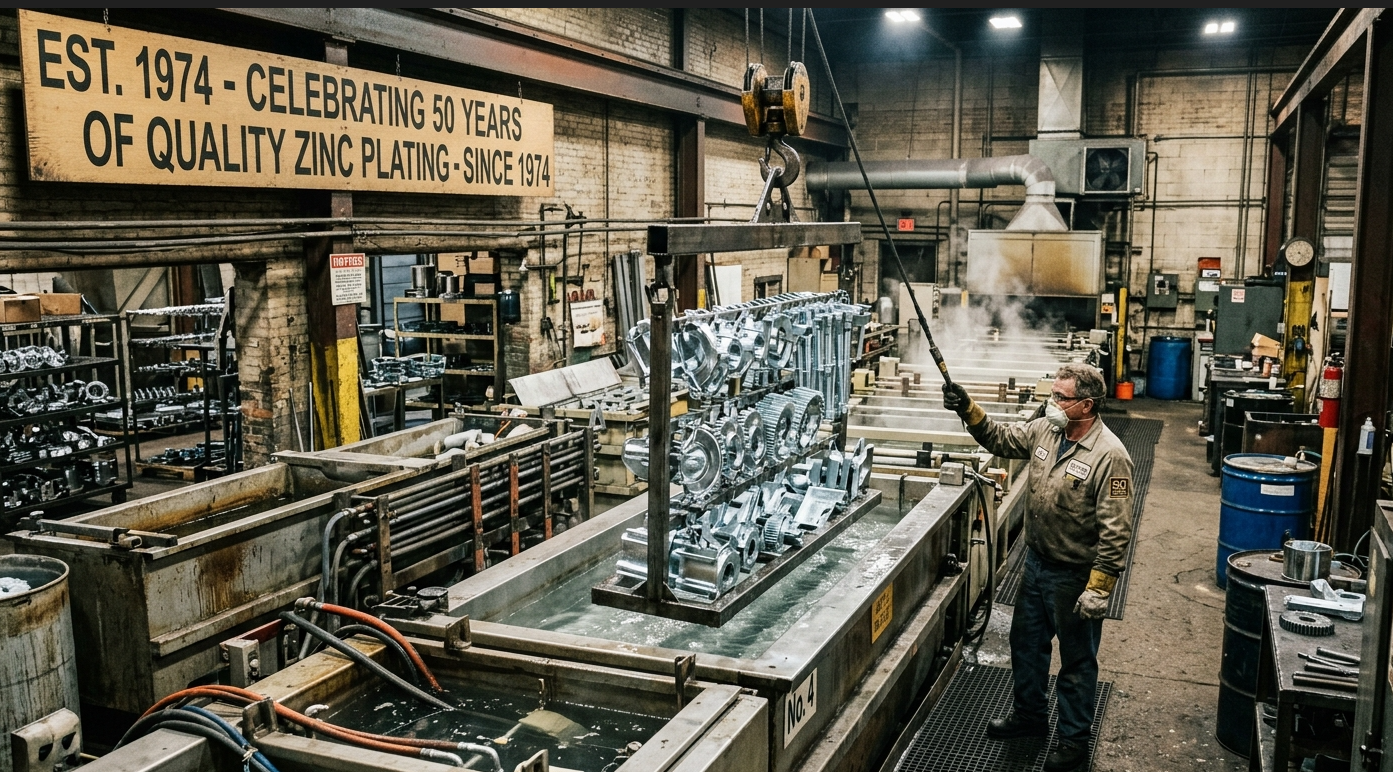
A father stands at the edge of a rack line in 1974, watching a hoist lower a load of freshly cleaned steel brackets into a zinc bath he mixed himself that morning. There’s no PLC humming in the background, no XRF gun waiting on the bench, no lot report generating itself in a database. There’s a tank, a timer he trusts more than he trusts most people, and a promise to the fabricator down the road that the parts will be ready Friday. Fifty years later, his family is still running that promise through three recessions, a handful of regulatory overhauls, two generational handoffs, and enough technological change to make that first rack line look like a museum piece. The tanks are different. The chemistry is different. The paperwork is different. What hasn’t changed is the reason the business is still standing somebody in the family decided, five decades ago, that the parts had to be right, on time, every time and never stopped enforcing that standard.
That’s not a hypothetical. It’s the plain arithmetic of what it takes to run a family-owned zinc plating shop for half a century. Plating businesses don’t survive fifty years by accident, and they don’t survive them by staying exactly the same the whole way through. They survive by learning sometimes the easy way, often the hard way what actually matters to a customer standing in a plant with a purchase order and a deadline, and by building a culture disciplined enough to hold that standard even as owners, equipment, regulations, and entire industries change underneath them.
At Plateco, we’ve been zinc plating for Wisconsin manufacturers, fabricators, and OEMs since 1974. Half a century in one industry, one family, one set of tanks that have been rebuilt more times than anyone still working here can count. This piece isn’t a sales pitch dressed up as history. It’s an honest look back at what fifty years in a business as unglamorous and unforgiving as zinc plating actually teaches you about the work, about running a company, and about what it means to put a family name on every rack that leaves the building.
50 Years
In continuous operation as a family-owned zinc plating business, serving manufacturers across Wisconsin, Illinois, Michigan, and Iowa
3 Generations
Of family involvement in day-to-day operations, from the founding owner to the team running the floor today
0.1%
Current defect rate across Plateco’s production lines the direct result of decades of process discipline, not a recent invention
Why Fifty Years in Plating Is Rarer Than It Sounds
Plating is not a forgiving industry to build a long-term business in, and it’s worth explaining why, because it puts the “fifty years” number in context most people outside manufacturing don’t have.
The chemistry is unforgiving. A zinc bath that’s slightly out of balance doesn’t announce itself it just quietly produces parts that fail adhesion testing or come in under thickness spec, and by the time anyone notices, an entire lot may already be compromised. The regulatory environment is unforgiving. Environmental compliance requirements for plating operations have tightened repeatedly over five decades, and shops that didn’t invest early in wastewater treatment, air quality controls, and proper chemical handling didn’t get a grace period they got shut down or priced out. The capital requirements are unforgiving. Tanks, rectifiers, ventilation systems, and now automation and process-control equipment all wear out and all need reinvestment, on a cycle that doesn’t pause just because business is slow that quarter.
And the customer relationships are unforgiving in their own way. A manufacturer sourcing plated fasteners or brackets isn’t shopping on nostalgia. They’re comparing turnaround, thickness consistency, and documentation against every other shop that wants their business, every single time a purchase order comes up for renewal. A family name over the door buys goodwill, but it doesn’t buy a pass on performance.
Put those four pressures together unforgiving chemistry, unforgiving regulation, unforgiving capital demands, and unforgiving customers and it becomes clear why so many plating shops that opened in the 1970s aren’t around anymore, while a handful of family operations quietly are. Surviving that combination for fifty years isn’t a marketing claim. It’s a track record that has to be re-earned essentially every week.
The Misconception We Hear Most Often
That a fifty-year-old family business must be running on legacy equipment and legacy thinking coasting on reputation instead of keeping pace with the industry. In practice, the shops that actually make it to fifty years are usually the opposite of coasting. Longevity in plating comes from being willing to tear out and rebuild the parts of the operation that stopped working, generation after generation, while holding onto the parts of the culture that never should change.
Have Questions About Your Parts? – (608) 524-8241
Lesson One: The Chemistry Never Forgives Shortcuts
The first and hardest lesson a family plating business learns usually in its earliest years, when the stakes of a bad decision are highest is that zinc plating has no tolerance for shortcuts. A bath that’s under-titrated to save time. A rinse stage that’s skipped because the line is behind schedule. A rack that’s overloaded because there’s a rush order and not enough floor space. Every one of those shortcuts produces the same outcome eventually parts that don’t hold spec, a customer who finds out, and a reputation that takes far longer to repair than the shortcut saved in time.
Family businesses tend to learn this lesson more permanently than businesses with rotating management, for a simple reason the person who cut the corner and the person who has to answer for it at the next family dinner are often the same person, or someone who has to look that person in the eye. That’s not a romantic notion. It’s a structural accountability that outside investors and quarterly-earnings pressure don’t naturally create. When your name is on the building and your kids might inherit the customer relationships you’re managing today, the incentive to do the job right the first time compounds instead of decaying.
Over fifty years, that discipline shows up less as a single dramatic decision and more as thousands of small ones: replacing a bath a day earlier than strictly necessary because the readings looked borderline, re-running a rack that came out of the tank looking almost right, turning down volume during a busy stretch rather than compromising dwell time to hit a deadline. None of those decisions make headlines. All of them, repeated for five decades, are the actual explanation for a defect rate that customers can rely on.
Lesson Two: Equipment Ages Standards Can’t
Every piece of physical equipment in a plating shop has a lifespan. Tanks corrode. Rectifiers fail. Hoist systems wear out. A business that’s been operating for fifty years has replaced essentially everything at least once, and in most cases several times over. That’s not a footnote to the story it’s one of the central lessons a multi-generational plating business has to internalize the equipment is disposable, but the standard the equipment is supposed to meet is not.
This distinction matters because it’s exactly where a lot of aging businesses in any industry, not just plating quietly fail. They get attached to equipment that’s familiar and paid off, and they let the standard slip to match what the old equipment can still deliver, rather than replacing the equipment to keep meeting the standard the business was built on. A family plating shop that survives fifty years has usually made the opposite call, more than once, at real financial cost retiring manual titration in favor of continuous automated bath monitoring, replacing hand-timed transfer sequences with programmed hoist systems, adding in-process thickness verification instead of relying solely on end-of-run spot checks.
That kind of reinvestment is genuinely hard for a family-owned operation, because the capital comes out of the same balance sheet that funds payroll, not out of a venture round or a public offering. Every major equipment decision in a fifty-year family business has been a real trade-off, made by people with a personal financial stake in getting it right. The businesses that made those trade-offs in the customer’s favor, again and again across decades, are the ones still standing.
Quick Reference What Changed Over Five Decades and What Didn’t
What changed bath chemistry monitoring, current control, rack and transfer automation, thickness verification methods, environmental compliance systems, and the documentation that comes with every lot. What didn’t change the standard that a part has to meet the spec on the print, the commitment to tell a customer the truth about a lot that didn’t pass, and the expectation that the person building the rack actually understands the part going on it.
Lesson Three: Growth Has to Be Earned, Not Chased
A family business with fifty years behind it has almost always turned down growth at some point a large order that would have required compromising quality control to fulfill, a new market that looked appealing on paper but didn’t match the shop’s actual capabilities, an acquisition offer that would have meant handing decisions to people without a personal stake in the outcome. That kind of restraint is easy to praise in hindsight and genuinely difficult to practice at the time, especially during the periods and there are always periods when growth looks like the obvious right answer and turning it down looks like leaving money on the table.
The lesson a multi-generational plating business learns, usually more than once, is that capacity has to be built before volume is chased, not the other way around. Adding a large new customer before the bath chemistry monitoring, the rack-building expertise, or the floor space to handle the added volume is actually in place doesn’t produce growth it produces a stretch of inconsistent lots, frustrated customers, and a reputation hit that takes years to undo. The shops that are still family-owned after five decades tend to be the ones that grew in a sequence invest in capability, prove it can hold the standard at the new volume, then take on the volume rather than the reverse.
This shows up geographically, too. A regional plating business doesn’t typically expand its service area by chasing every inquiry that comes in from outside its footprint. It expands when the operational capacity to serve a new region reliably turnaround time, logistics, the ability to actually hold to a quoted delivery schedule already exists. That’s a slower, less exciting way to grow than an aggressive expansion push, and it’s also a large part of why a business built that way is still around to look back on fifty years instead of being a cautionary tale about overextension.
Get a Free Quote For Your Project
Lesson Four: Documentation Went From an Afterthought to the Whole Relationship
Fifty years ago, a lot report at most plating shops was a handwritten note and a plater’s word that the bath had been run correctly. That was normal, it was generally trusted, and for a long time it was more or less sufficient for the industries buying plated parts. That world is gone, and a family business that’s still operating today has had to relearn, more than once, what documentation actually means to a customer.
The shift has been gradual but total. Automotive and aerospace-adjacent supply chains started requiring traceable process data, not just a passing thickness reading. Quality engineers started asking not just “does this lot meet ASTM B633,” but “show me the bath temperature, current density, and dwell time for this specific lot number.” Auditors started showing up expecting a paper trail, not a plant manager’s assurance. A family business that survived that transition did it by treating documentation as a core part of the product, not paperwork bolted on at the end which meant investing in automated data logging systems well before every customer was demanding them, because the ones who were already asking for that level of detail were often the best customers to have.
The businesses that treated documentation as optional overhead for as long as they could get away with it tended to lose exactly the customers worth keeping the ones in regulated, quality-sensitive industries who could take their volume elsewhere the moment a competitor could actually prove their process instead of just describing it.
| What Changed Over 50 Years | 1970s–1980s Standard | Standard Today |
|---|---|---|
| Bath chemistry monitoring | Manual titration, checked periodically | Continuous automated monitoring and dosing |
| Thickness verification | End-of-run spot checks on a sample | In-process verification integrated into the line |
| Lot documentation | Handwritten logs, general certificates of conformance | Automated, time-stamped, lot-specific process records |
| Environmental compliance | Minimal formal wastewater and air quality controls | Comprehensive treatment systems and regulatory reporting |
| Customer relationship basis | Reputation and relationship, largely undocumented trust | Reputation plus verifiable, auditable process data |
| Family role on the floor | Hands-on at every station, every shift | Hands-on where judgment matters most automation manages repeatability |
The pattern in that table is the same one that shows up across every lesson in this piece nothing about the underlying commitment to a good part changed in fifty years. Nearly everything about how that commitment gets proven, monitored, and delivered has changed completely usually more than once.
Lesson Five: The Family Name Is a Liability Before It’s an Asset
There’s a version of this story that treats a family name on the door as an unambiguous strength instant trust, built-in goodwill, a shorthand for reliability. That’s true, but it’s only half true, and the family businesses that actually make it to fifty years are usually the ones that understood the other half early: a family name is also a liability, because there’s nowhere to hide from a bad lot.
A large, anonymous plating operation that ships a bad batch can absorb that mistake into a bigger system a different shift takes the call, a different manager handles the fallout, the company’s identity isn’t wrapped up in any single person’s judgment. A family business doesn’t have that buffer. When a lot goes out wrong, it’s not “the company” that made the mistake in the customer’s mind it’s the family whose name is on the sign, and often a specific person the customer has spoken to directly for years. That kind of exposure is uncomfortable, and it’s also exactly the pressure that keeps a family operation honest in a way that’s hard to manufacture artificially.
Over five decades, that pressure becomes a genuine advantage, but only because it was treated as a liability to guard against for most of those years, not as a marketing line to lean on. The confidence a longtime customer has in a family plating business isn’t really confidence in the name it’s confidence built from watching that family absorb responsibility for problems, generation after generation, instead of deflecting it.
“Fifty years doesn’t happen because a business avoided problems. It happens because every generation of this family decided the problems were ours to fix, not the customer’s to absorb. That’s the only part of this business that was never allowed to change, no matter how much the chemistry, the equipment, or the paperwork changed around it.”
Jim Schweich, Chief Executive Perfectionist, Plateco, Inc.
Lesson Six: Passing the Business Down Is Harder Than Building It
Founding a plating business and building it into something durable is genuinely difficult. Handing it to the next generation without losing what made it work is, in a lot of ways, harder and it’s the lesson that determines whether a family business gets to celebrate a fiftieth anniversary at all.
The failure mode is well known across family-owned manufacturing a founding generation builds a standard through hard-won experience, the next generation inherits the business without necessarily inheriting the same firsthand understanding of why the standard exists, and the discipline erodes not through one bad decision, but through a slow drift where “that’s how we’ve always done it” replaces an actual understanding of why doing it that way matters.
The family plating businesses that avoid that drift tend to do one thing consistently the next generation doesn’t inherit a management title, they inherit time on the floor first building racks, running bath chemistry, handling the calls where a lot didn’t meet spec and someone has to explain why. That apprenticeship is what turns “the owner’s kid” into someone the floor actually trusts to make the same calls the founding generation made, for the same reasons.
What Fifty Years Actually Buys a Customer Today
None of this history matters to a customer evaluating a plating partner unless it translates into something concrete about the parts they receive today. It does, in a few specific ways worth naming directly.
A process that’s been stress-tested by real volume, real deadlines, and real mistakes, for decades not a process built on a whiteboard. Every control point in a mature plating operation exists because something taught the business it needed to be there, usually the hard way, at some point over five decades. That’s a different kind of reliability than a newer operation’s process, which may look identical on paper but hasn’t been through the same number of real-world stress tests.
Institutional memory that shows up in rack design and problem-solving. A rack builder or quality manager with years sometimes decades of firsthand experience with a wide range of part geometries brings judgment to unusual jobs that a newer team, however well-trained, simply hasn’t had the repetitions to develop yet. This matters most exactly where automation matters least on custom, low-volume, or unusually shaped work.
A demonstrated pattern of investing ahead of requirements rather than behind them. A business that’s made it fifty years has, by necessity, reinvested in equipment, automation, environmental compliance, and documentation systems repeatedly not once, as a single modernization project, but continuously, because standing still for too long in this industry is how a plating business stops being around in ten years, let alone fifty.
Accountability that doesn’t disappear behind a corporate structure. When something needs to be made right, a family-owned operation with a name on the door and a real stake in the next fifty years has a different relationship to that responsibility than an anonymous vendor does.
How to Evaluate Whether a Business’s Longevity Is a Real Signal
Not every business that’s been around a long time has actually earned the trust that longevity implies, and it’s fair for a customer to ask questions that separate genuine track record from simple survival.
Ask what’s actually changed in their process over the years. A shop that describes real investment in automation, documentation, environmental systems over its history is telling you something different than a shop that describes doing things “the same way we always have.”
Ask who’s actually on the floor and how long they’ve been there. Institutional knowledge lives in people, not a founding date on a website. A business with genuine longevity usually has team members, family or not, who’ve seen a wide range of problems and solved them.
Ask how the business has handled a bad lot in the past. How a plater talks about mistakes described honestly or glossed over tells you more about whether their track record is real than years in business alone.
Ask what’s driving their current investment priorities. A business still reinvesting after decades in operation is behaving like a company planning for another fifty years.
Frequently Asked Questions
Does a family-owned plating business have different quality standards than a larger corporate operation?
Not by definition plenty of large, corporately owned plating operations run excellent, well-controlled processes, and plenty of small family shops cut corners. What a genuinely long-running family business tends to offer is direct, personal accountability for outcomes, since the people making process decisions usually have a lasting personal stake in the company’s reputation, not just a quarterly performance target.
Is a fifty-year-old plating company more likely to be using outdated equipment?
It can go either way, which is exactly why it’s worth asking directly rather than assuming. A business that’s survived fifty years in an industry this capital- and compliance-intensive has almost certainly replaced its major equipment multiple times, because operating on outdated systems for too long is one of the more common ways a plating business doesn’t make it that long in the first place.
Why does family ownership matter for something as technical as zinc plating?
Family ownership doesn’t change the chemistry, but it changes the incentive structure around decisions corner-cutting, reinvestment, and how a problem gets handled when a lot doesn’t meet spec. Over decades, that incentive structure tends to produce more consistent behavior than a purely transactional management relationship, though it’s not a guarantee on its own.
How has automation changed a longtime family plating business without changing who runs it?
Automation has taken over the repeatable, timing- and chemistry-dependent parts of the process the parts where consistency matters more than judgment while leaving rack design, part-specific decisions, and final inspection in the hands of experienced people. A fifty-year family business has typically absorbed that shift by investing in the technology while keeping the judgment calls with the team members, family or not, who have the deepest understanding of the process.
What’s the biggest risk to a family plating business’s next fifty years?
Based on how these businesses tend to fail, the biggest risk isn’t usually a single bad decision it’s a slow erosion of the standard across a generational handoff, where the next generation inherits authority without inheriting the firsthand understanding of why the standard exists. Businesses that treat that handoff deliberately, with real time on the floor before real authority, tend to avoid it.
Ready to Work With a Team That’s Been Holding This Standard for Fifty Years?
Tell Us About Your Project
Plateco has been zinc plating for Wisconsin manufacturers, fabricators, and OEMs since 1974. Three generations, one standard the part we plate for you today has to perform exactly like the part we plated for your predecessor a decade ago, and exactly like the part we’ll plate for your successor a decade from now. Send us your prints and specs, and let’s start the next chapter.