

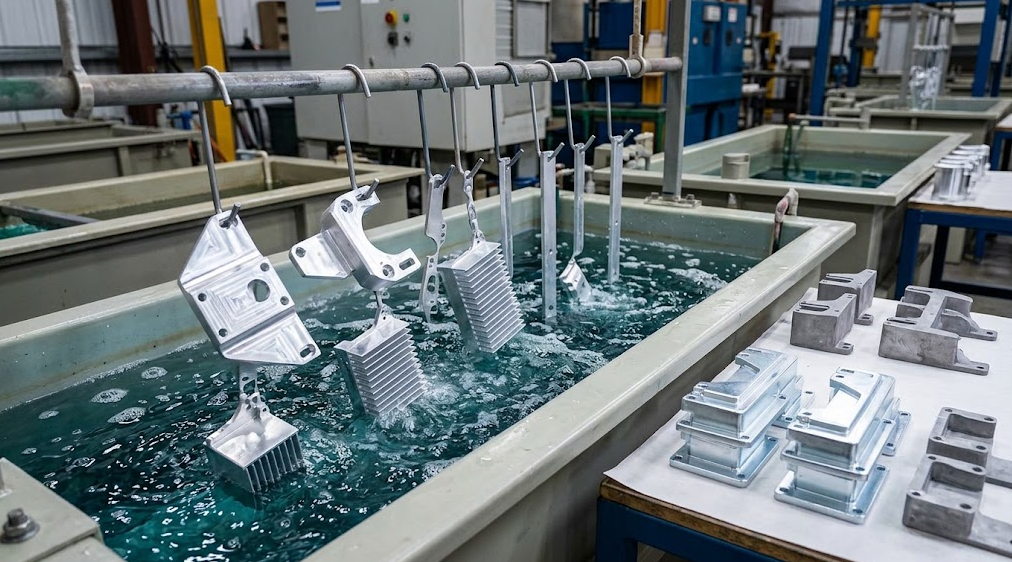
An engineer sends over a print for a bracket that’s about to switch from mild steel to 6061 aluminum. Weight savings, same fastener pattern, same assembly line an easy swap on paper. Then the note at the bottom of the print says “zinc plate per ASTM B633, SC3.” That single line turns an easy material substitution into a conversation that needs to happen before the part ever goes near a tank, because zinc does not plate onto aluminum the way it plates onto steel, and treating the two processes as interchangeable is one of the more common and more expensive mistakes we see when a design moves from ferrous to non-ferrous metal.
The short answer to the question in the headline is yes, zinc can be applied to aluminum. The honest answer is that it can’t be applied the way most people picture zinc plating happening, and the difference between those two answers is exactly the kind of thing a manufacturer needs to understand before specs, timelines and budgets get locked in around an assumption that doesn’t hold up in the tank.
Aluminum’s own chemistry is the reason. Steel plates by simple electrodeposition because a clean steel surface gives zinc ions a metal-to-metal surface to bond to. Aluminum doesn’t offer that surface not because the metal underneath is unsuitable, but because of what sits on top of it before a part ever reaches a plating line.
Instant
How quickly a fresh oxide layer reforms on bare aluminum after it’s mechanically or chemically removed
2 Steps
Minimum zincate immersions typically required before aluminum parts are ready for zinc electroplating
1927
The year the first zinc immersion process for plating on aluminum was patented this is not a new problem
Why Zinc Won’t Bond Directly to Aluminum
Every piece of aluminum, the moment it’s exposed to air, grows a thin layer of aluminum oxide on its surface. This isn’t contamination and it isn’t something that happens because a part sat around too long in storage it’s a near-instantaneous chemical reaction between aluminum and oxygen that starts the second bare metal is exposed, and it keeps reforming as fast as it’s removed. That oxide layer is actually a large part of why aluminum resists corrosion so well on its own. It’s also exactly what stands between the base metal and a usable zinc coating.
Electroplating works by using an electric current to draw metal ions out of a plating bath and deposit them onto a conductive surface. For that bond to hold, the current needs a clean path to metal, and the plated layer needs metal-to-metal contact to grip. A layer of aluminum oxide sitting on top of the base metal breaks that contact. Zinc ions deposited directly over an oxidized aluminum surface don’t form a real metallurgical bond they sit loosely on top of the oxide film, and a coating that isn’t actually bonded to the substrate flakes, blisters or peels under the kind of handling, assembly stress or thermal cycling that a properly bonded coating shrugs off without issue.
This isn’t a defect in aluminum or a sign that a shop did something wrong. It’s a basic property of the metal, and it’s been a known, documented problem in the finishing industry since at least the late 1920s, when the first patented process for getting a metal coating to adhere to aluminum was filed. Manufacturers who assume a zinc plater can treat an aluminum part exactly like a steel part are working from a misunderstanding that the industry solved for nearly a century ago but solved with an extra step, not by skipping the problem altogether.
The Misconception We Hear Most Often
That “zinc plating aluminum” means running an aluminum part through the same tank sequence used for steel and getting the same result. It doesn’t. Steel goes straight from cleaning into the zinc bath. Aluminum needs its oxide layer chemically stripped and replaced with a thin, temporary zinc layer first a step called zincating before it can accept a real electroplated zinc coating at all. Skip that step, or do it poorly, and you get a coating that looks fine on the day it ships and fails within weeks.
Have Questions About Your Aluminum Parts? – (608) 524-8241
The Zincate Process: How Aluminum Actually Gets Plated
The way the industry solved the oxide problem is a pretreatment step called zincating, sometimes referred to as the zincate process or zinc immersion. It’s not a variation on standard zinc electroplating it’s a separate chemical step that happens before electroplating can start, and understanding what it does is the key to understanding why aluminum plating takes longer, costs more and requires a different level of process control than plating steel.
Stripping the Oxide Layer
The aluminum part goes through an alkaline cleaning and etching stage that dissolves the existing oxide film. This step has to remove the oxide completely and evenly across the whole part, because any spot where oxide survives becomes a spot where the next step and everything after it fails to bond.
Immersion in a Zincate Bath
Immediately after the oxide is stripped, and before a new oxide layer has time to reform in open air, the part goes into an alkaline zincate solution. This is a displacement reaction, not electroplating no current is applied. The aluminum surface reacts directly with zinc ions in the solution, and a thin layer of metallic zinc deposits itself onto the aluminum surface in exchange. That zinc layer does two things at once it gives the part a genuine metal surface for electroplating to bond to, and it protects the aluminum from re-oxidizing in the time between pretreatment and plating.
Double Zincating for Critical Work
A single pass through the zincate bath produces a layer that’s often uneven in thickness and grain structure, because the reaction happens quickly and somewhat unevenly across the surface. For parts where coating adhesion really matters anything with tight corrosion performance requirements, anything that will see thermal cycling, or anything going into an assembly where flaking plating is genuinely a problem rather than a cosmetic one the standard practice is to strip that first zincate layer back off in a nitric acid dip, then run the part through the zincate bath a second time. The second layer comes out finer-grained, more uniform and more tightly adherent than the first, which is why double zincating is the industry standard for anything beyond decorative or low-consequence work, not an upcharge for extra caution.
Electroplating Zinc Over the Zincate Layer
Only after the zincate layer is in place does the part go into a standard zinc electroplating bath, where the process looks much more like plating a steel part current draws zinc ions out of the bath and deposits them onto the now-conductive surface. The zincate layer is what makes that deposition possible at all without it, the part is back to the same oxide-blocked, non-bonding surface it started with.
Passivate and Topcoat as Normal
Once the zinc layer is electroplated to the specified thickness, passivation proceeds the same way it would on a steel part a chromate or trivalent conversion coating goes on to add corrosion resistance and, depending on spec, color. This is one of the few parts of the aluminum plating sequence that isn’t fundamentally different from plating steel.
Quick Reference: Steel vs. Aluminum Plating Sequence
Steel clean → zinc electroplate → rinse → passivate → rinse → dry. Aluminum clean → alkaline etch to strip oxide → zincate immersion → (strip and re-zincate for critical work) → zinc electroplate → rinse → passivate → rinse → dry. The extra steps aren’t optional add-ons they’re the difference between a coating that bonds and one that doesn’t.
What This Means in Practice Manual Sequence vs. Aluminum-Specific Process Control
The table below lays out the practical differences a manufacturer should expect between specifying zinc plating on a steel part and specifying it on an equivalent aluminum part, assuming both are run correctly.
| Process Factor | Steel (Standard Zinc Plating) | Aluminum (Zincate + Zinc Plating) |
|---|---|---|
| Pretreatment steps before electroplating | Alkaline clean and acid activation | Alkaline clean, oxide strip, zincate immersion (often double zincate) |
| Sensitivity to timing between steps | Low some tolerance for delay between cleaning stages | High bare, zincated surface must move into the next bath promptly |
| Coating adhesion risk if skipped/rushed | Low, if basic cleaning is done correctly | High a rushed or single zincate pass is the leading cause of flaking |
| Typical cycle time | Standard rack or barrel cycle | Longer, due to added pretreatment stages |
| Alloy sensitivity | Minimal most carbon and low-alloy steels behave similarly | Significant high-silicon and some high-copper aluminum alloys plate less predictably |
| Skill/process control required | Standard plating line controls | Tighter control over bath chemistry, immersion time and rinse staging |
The pattern that matters most for a manufacturer reading this table isn’t that aluminum plating is harder in some vague sense it’s that the extra steps are specifically about adhesion, and adhesion is exactly the property that’s invisible on the day a part ships and very visible six months later if it wasn’t done right.
Get a Free Quote For Your Aluminum Parts
Not Every Aluminum Alloy Plates the Same Way
This is a detail that gets missed on prints more often than it should, and it’s worth being direct about it the aluminum alloy a part is made from has a real effect on how well zinc plating performs, and it’s worth knowing before a design locks in a specific alloy for a part that’s also going to be plated.
Wrought alloys in the 5000 and 6000 series common choices like 5052 and 6061 for brackets, housings and structural hardware generally zincate and plate predictably, and most of what a manufacturer would expect from a “normal” aluminum plating job applies to these alloys without much extra caveat.
High-silicon cast alloys, common in die-cast aluminum components, are more difficult. Silicon doesn’t zincate the way aluminum does, so a cast part with a high silicon content can end up with an uneven zincate layer thinner or patchier over areas where silicon is concentrated at the surface which shows up later as spotty adhesion or localized plating failure. This doesn’t mean high-silicon castings can’t be plated, but it does mean the process needs more attention, and it’s worth flagging to a plater before quoting rather than after a first article comes back with adhesion problems.
High-copper alloys in the 2000 series can also complicate the zincate reaction, since copper affects how the displacement reaction proceeds on the surface. These alloys are plateable, but they’re not a drop-in substitution for the more common structural alloys without some process adjustment.
The practical takeaway is simple if a part is being designed for zinc plating, the alloy selection and the plating spec should be decided together, not sequentially. A design engineer who picks an alloy purely for machinability or casting behavior, without checking whether it’s a good zincate candidate, can end up handing a plater a part that’s technically platable but meaningfully harder to plate well.
When Zinc Plating Isn’t the Right Call for Aluminum
Part of giving a straight answer to “can this be done” is being honest about when it’s not the best answer to the underlying problem, even though it’s technically achievable.
If the goal is corrosion resistance and nothing else is driving the spec, anodizing is worth considering before defaulting to zinc plating. Anodizing works with aluminum’s natural oxide behavior instead of against it it thickens and controls that oxide layer electrochemically rather than stripping it away and for a lot of aluminum corrosion-resistance applications, it’s a simpler, often less expensive process that doesn’t carry the adhesion risk that comes with plating over a zincate layer.
If the part needs to mate or bond electrically with a zinc-plated steel component, zinc-on-aluminum can actually be the right call specifically because it gives both parts a matching surface metal, which matters for uniform appearance and for avoiding a galvanic mismatch at the joint. Aluminum and steel in direct contact, especially in a damp or outdoor environment, set up galvanic corrosion risk on their own plating both surfaces with zinc, a metal that’s anodic to both and sacrifices itself preferentially, is a legitimate engineering reason to plate aluminum rather than an aesthetic preference.
If cost and turnaround are the primary drivers and the corrosion or appearance requirement is modest, it’s worth asking whether a conversion coating alone, without the added zinc electroplate, meets the actual spec. Not every aluminum part that shows up with “zinc plate” on the print actually needs the full zincate-and-electroplate sequence to satisfy the underlying performance requirement, and that conversation is worth having with a plater before tooling and specs are finalized rather than after.
“The question we’d rather get before a job is quoted than after it’s rejected is simple does this part actually need zinc plating, or does it need a corrosion-resistant aluminum finish, and are those the same thing for what you’re building? Half the time they are. Half the time a shorter conversation up front saves a customer money and gets them a better-performing part.”
Jim Schweich, Chief Executive Perfectionist, Plateco, Inc.
What Manufacturers Should Ask Before Specifying Zinc Plating on Aluminum
If a part is moving from steel to aluminum, or an aluminum part is being designed from scratch with a zinc plating callout, a few questions up front save real time and money later.
Ask whether the plater runs a double zincate process, and under what conditions. A single zincate pass is faster and cheaper, but it’s the wrong choice for anything beyond low-consequence, cosmetic-only applications. A plater who defaults to double zincate for structural or corrosion-critical aluminum work, and can explain why, is telling you they understand the failure mode that matters most on this kind of job.
Confirm the alloy is disclosed, not just the part geometry. A print that specifies 6061-T6 gives a plater real information to work with. A print that just says “aluminum” leaves room for a die-cast substitution somewhere upstream in the supply chain that changes how the part behaves in the zincate bath and that’s a conversation worth having before parts show up at the dock.
Ask how adhesion is verified, not just thickness. A thickness reading tells you the coating is the right thickness. It doesn’t tell you the coating is actually bonded to the part. Tape testing, bend testing or other adhesion verification methods matter more on aluminum than on steel, precisely because the failure mode on aluminum is adhesion loss rather than simple under-thickness.
Ask if anodizing was considered as an alternative and why zinc plating is still the right call. This isn’t a trick question, and a good plater won’t treat it like one. If zinc plating is genuinely the right process for the application matching a plated steel assembly, meeting a spec that calls for it specifically, or a corrosion profile anodizing doesn’t cover as well a plater should be able to say so clearly rather than just taking the job as specified without comment.
Frequently Asked Questions
Can you zinc plate aluminum the same way you zinc plate steel?
No. Aluminum forms a natural oxide layer that blocks zinc from bonding directly to the base metal, so aluminum parts need a zincate pretreatment step a chemical displacement process that puts a thin zinc layer directly on the aluminum surface before standard zinc electroplating can be applied on top of it.
Does zinc plating on aluminum look different from zinc plating on steel?
Once the process is done correctly, a zinc-plated aluminum part and a zinc-plated steel part look essentially the same the same bright or yellow passivate finish, depending on spec. The difference is entirely in what happens underneath the coating during pretreatment, not in the finished appearance.
Is zinc plating on aluminum less durable than on steel?
Not inherently, but it’s more sensitive to process quality. A properly double-zincated and plated aluminum part holds up as well as a steel equivalent for most applications. A poorly zincated part rushed, single-pass, or run on a difficult alloy without adjustment is where adhesion failures show up, usually as flaking or blistering rather than corrosion breakthrough.
Why do some aluminum parts fail zinc plating adhesion tests?
The most common causes are an incomplete oxide strip before zincating, a single zincate pass on a part that needed double zincating, too much delay between the zincate step and electroplating (allowing oxide to reform), or an alloy with high silicon or copper content that wasn’t accounted for in the process.
Should I use anodizing instead of zinc plating on an aluminum part?
It depends on why the part needs a coating at all. If pure corrosion resistance on an aluminum-only application is the goal, anodizing is often simpler and less expensive. If the aluminum part needs to match, mate with, or provide galvanic protection alongside zinc-plated steel components, zinc plating is usually the better technical choice.
Do all aluminum alloys plate equally well?
No. Common wrought alloys like 6061 and 5052 generally zincate and plate predictably. High-silicon die-cast alloys and high-copper 2000-series alloys are more difficult and often need process adjustments to get consistent, well-bonded results.
Is zinc plating on aluminum more expensive than on steel?
Usually, yes, because of the added pretreatment steps, longer cycle time and tighter process control the zincate stage requires. The difference is generally modest relative to overall part cost, but it’s worth budgeting for rather than assuming aluminum and steel plating are priced the same.
Ready to Get a Straight Answer on Your Aluminum Part?
Tell Us About Your Project
Plateco has been zinc plating for Wisconsin manufacturers, fabricators and OEMs since 1974, and that includes aluminum work that gets the zincate step right the first time. Send us your prints, your alloy call-outs and your spec, and we’ll tell you plainly whether zinc plating is the right process for your part and exactly how we’ll get it to bond.