
Metal finishing has always operated under environmental scrutiny, and for good reason the chemistry that makes zinc plating possible, acids, alkaline cleaners, heavy metal-bearing rinse water, chromate passivates, carries real environmental responsibility if it isn’t managed correctly. What’s different in 2026 is the pace and specificity of what’s changing. Federal effluent guidelines are being revised for the first time in decades. PFAS compounds once considered a minor footnote in some finishing processes are now a defined compliance category. And the legacy hexavalent-to-trivalent chromium transition, already years in the making, still isn’t fully resolved across every specification in the field. This piece is a direct look at what’s actually shifting in environmental regulation for zinc plating, and what responsible adaptation to that shift genuinely requires, not just for compliance’s sake, but because it’s the right way to run this kind of operation.
Environmental compliance in metal finishing has never been static, but it has historically moved slowly, with major regulatory frameworks staying largely stable for long stretches between updates. That pattern is breaking. Between federal effluent guideline revisions specifically targeting electroplating and metal finishing, the ongoing PFAS regulatory buildout, and continued state-level tightening of discharge and air quality permitting, the compliance landscape for this industry is genuinely more dynamic right now than it’s been in a long time.
This piece is written as a direct, substantive look at what’s actually changing, not a generic list of buzzwords, and an honest account of what genuine adaptation looks like for a plating operation trying to stay ahead of these shifts rather than reacting to them after the fact. It’s written for manufacturers sourcing plating who want to understand what to expect from a responsible supplier, and for anyone in the industry trying to make sense of where this regulatory environment is actually heading.
Metal Finishing Category
Electroplating operations fall under EPA’s Metal Finishing effluent guidelines, among the categories under active federal review
PFAS
A newly defined compliance category for the industry, moving from voluntary disclosure toward binding discharge limits
1974
Year Plateco began operating under, and adapting to, this industry’s environmental compliance framework
The Regulatory Landscape Reshaping Metal Finishing
Understanding where zinc plating’s environmental compliance obligations are actually headed requires separating a few distinct, overlapping regulatory threads, since they’re moving at different speeds and require genuinely different responses from an operating facility.
Federal effluent limitation guidelines are undergoing their most significant review in years. The EPA’s Effluent Limitations Guidelines (ELGs) establish technology-based wastewater discharge standards for specific industrial categories, and electroplating and metal finishing operations fall under a defined ELG category subject to ongoing federal review. This matters because ELGs set the technical floor for what a facility’s wastewater treatment system needs to achieve before discharge, whether to a municipal sewer system under a pretreatment permit or, less commonly for smaller job shops, direct discharge to surface water under its own permit. A revised ELG can meaningfully change what wastewater treatment infrastructure a facility needs to operate and maintain.
PFAS regulation has moved from a background concern to an active, defined compliance category. Per- and polyfluoroalkyl substances, historically used in some metal finishing processes, most notably as mist suppressants in certain chrome plating operations, are now squarely within the EPA’s regulatory crosshairs, with electroplating and metal finishing identified among the industrial categories facing PFAS-specific effluent guideline development. This is a genuinely new compliance frontier for the industry, distinct from the heavy-metal and pH-focused wastewater regulation the sector has operated under for decades.
State-level environmental permitting continues tightening independently of federal action. Beyond federal ELG revision, state environmental agencies, including Wisconsin’s Department of Natural Resources for facilities operating here, continue to refine discharge, air quality, and hazardous waste handling requirements at the state level, sometimes moving ahead of or beyond federal minimums. A facility’s compliance obligations are genuinely the product of both federal and state requirements simultaneously, not federal rules alone.
The hexavalent-to-trivalent chromium transition remains an active, if largely resolved, compliance thread. Driven originally by REACH restrictions in the European Union and reinforced by domestic environmental and worker safety pressure, the shift away from hexavalent chromium passivates toward trivalent chromate chemistry has been underway for well over a decade and is essentially the default for new work. But as covered in more depth in our companion piece on the state of zinc plating in 2026, a meaningful number of legacy engineering specifications still technically reference hexavalent-era standards, creating an ongoing administrative compliance gap even where the underlying process chemistry has largely moved on.
Why These Four Threads Need to Be Understood Separately
Federal ELG revision, PFAS regulation, state permitting, and the hexavalent-to-trivalent transition are frequently discussed together as “environmental regulation” in a general sense, but they involve different regulatory bodies, different timelines, and require different specific responses from a plating operation. A facility that’s fully current on trivalent chromium chemistry but hasn’t addressed PFAS in its process chemistry, for example, is only partially prepared for where this regulatory environment is actually headed.
The Hexavalent-to-Trivalent Transition: Where It Actually Stands in 2026
Because this transition has been underway for so long, it’s worth being precise about exactly where it stands today rather than treating it as either fully complete or still an open question, since the honest answer is genuinely in between.
On the process chemistry side, the transition is essentially complete for any facility doing current, compliant work. Trivalent chromate passivates, RoHS-compliant and free of the health and environmental concerns associated with hexavalent chromium, are the standard default chemistry across the industry for new specifications, and any plating operation still relying primarily on hexavalent chromium passivate for general commercial work in 2026 should be treated as a significant red flag during supplier evaluation.
On the specification and documentation side, meaningful gaps remain. A substantial number of engineering drawings, particularly for legacy OEM programs and older component designs that haven’t been recently revised, still technically reference chromate finish standards written during the hexavalent era, sometimes by part number or standard designation that predates the industry-wide chemistry shift. This creates a real, practical ambiguity does the print’s reference to a legacy standard mean the customer specifically wants hexavalent chemistry replicated as closely as possible under a compliant trivalent alternative, or is the reference simply outdated and due for an update? This is exactly the kind of gap that benefits from a direct conversation between supplier and customer rather than an assumption in either direction.
Appearance expectations from the hexavalent era sometimes create confusion during this transition, as covered in more depth in our piece on why zinc plating looks dull or discolored. Trivalent chromate passivates commonly produce a degree of iridescent sheen that legacy hexavalent finishes didn’t typically exhibit, and buyers whose quality expectations were calibrated against older hexavalent appearance standards sometimes flag normal, compliant trivalent characteristics as a defect, an avoidable friction point that proactive supplier communication can prevent.
A Practical Takeaway for Manufacturers
If your engineering drawings haven’t been reviewed against current, trivalent-era chromate finish standards, this is a genuinely worthwhile administrative project to prioritize, not because your current supplier is necessarily doing anything wrong, but because an outdated print creates ambiguity that benefits neither party and can complicate a future audit or supplier transition.
Not Sure Whether Your Specifications Reflect Current Chemistry Standards?
Send us a sample of your current engineering drawings and we’ll help you identify any that reference legacy hexavalent-era standards worth updating.
PFAS: The Compliance Wave the Industry Is Just Beginning to Navigate
PFAS regulation represents a genuinely new category of environmental compliance for metal finishing, distinct from the heavy-metal and pH-focused wastewater rules the industry has operated under for decades, and it deserves specific, detailed attention precisely because it’s less familiar and less fully mapped out than the hexavalent transition covered above.
PFAS compounds have historically been used in certain metal finishing processes as mist suppressants and wetting agents, most notably in hard chrome plating operations, where they help control the hazardous airborne mist generated by the high current densities that process requires. Their use in standard zinc electroplating has generally been more limited, but the regulatory framework being developed applies at the level of the broader electroplating and metal finishing industrial category, meaning facilities need to evaluate their own specific process chemistry against emerging requirements rather than assuming zinc-specific processes are automatically exempt.
The EPA’s regulatory approach is moving from voluntary disclosure and monitoring toward binding discharge limitations. This progression, first identifying and monitoring PFAS presence in industrial wastewater, then establishing specific discharge limits, follows a pattern common to how new contaminant categories typically move through the federal regulatory process, and metal finishing has been identified as an early-priority industrial category for this specific regulatory buildout given documented historical PFAS use in some finishing chemistries.
Responsible adaptation means proactive chemistry auditing now, not waiting for final rules to be published. A facility that waits until final PFAS discharge limits are formally published before evaluating its own process chemistry is accepting meaningfully more compliance risk and potential remediation cost than one that proactively audits its current chemical inventory against known PFAS-containing formulations now, while there’s still runway to reformulate or substitute process chemistry ahead of binding requirements.
Why This Matters Even for Facilities Confident They Don’t Use PFAS Directly
PFAS compounds can be present as minor components or byproducts within broader chemical formulations without being the primary, obviously labeled active ingredient, meaning a facility can’t fully evaluate its PFAS exposure risk through a surface-level review of its major process chemistries alone. Genuine due diligence requires working directly with chemical suppliers to confirm formulation-level PFAS content across the full range of products used in a facility’s process, not just the most prominent ones.
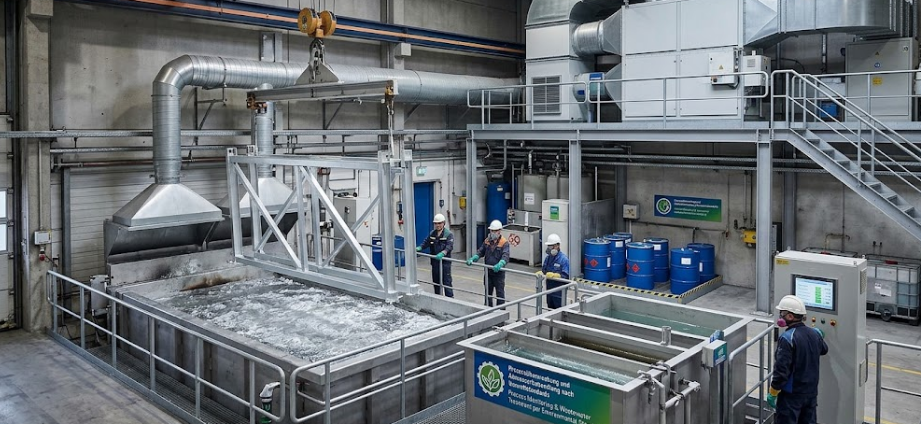
Wastewater Treatment and Discharge Permitting: The Operational Core of Compliance
Beyond specific contaminant categories like PFAS or chromium chemistry, the foundational environmental compliance obligation for any plating operation is wastewater treatment and discharge permitting, and this is where day-to-day regulatory adaptation actually happens on the shop floor.
Pretreatment standards govern facilities discharging to municipal sewer systems, which describes the majority of plating operations, including ours. Under the Clean Water Act’s pretreatment program, facilities must treat wastewater to meet specific standards before it enters the municipal system, preventing heavy metals, acids, and other process contaminants from overwhelming municipal treatment capacity or passing through untreated into receiving waters. These standards are enforced both at the federal ELG level and through local municipal pretreatment permits, which can include requirements more stringent than the federal floor.
Wisconsin’s Department of Natural Resources administers state-level environmental permitting that operates alongside, and in some respects independently of, federal requirements. Facilities operating in Wisconsin need to maintain compliance with both federal Clean Water Act pretreatment obligations and state-level DNR permitting requirements, which cover wastewater discharge, air quality, and hazardous waste handling and disposal specific to Wisconsin’s own regulatory framework.
Hazardous waste generation and disposal from plating operations is itself a distinct, ongoing compliance obligation. Spent process chemistry, treatment sludge containing concentrated heavy metals, and other process byproducts are subject to hazardous waste handling, storage, and disposal requirements under RCRA (the Resource Conservation and Recovery Act) at the federal level, layered with state-specific hazardous waste program requirements. Proper waste characterization, documented chain-of-custody through licensed hazardous waste disposal, and accurate recordkeeping are foundational, if unglamorous, parts of genuine environmental compliance in this industry.
What Genuine Wastewater Compliance Looks Like in Practice
Beyond simply having a wastewater treatment system installed, genuine compliance requires ongoing monitoring and sampling against permit limits, documented treatment system maintenance, accurate discharge monitoring reports submitted on schedule, and a facility culture where wastewater compliance is treated as a continuous operational responsibility rather than a periodic audit-preparation exercise.
The Sustainability Pressure Flowing Down From OEM Customers
Beyond direct regulatory compliance, a related and increasingly significant pressure on plating operations comes from OEM customers’ own sustainability and ESG (environmental, social, and governance) reporting obligations, which increasingly flow down through their supply chains to suppliers like plating operations.
Scope 3 emissions and supply chain sustainability reporting increasingly require suppliers to provide environmental performance data. As larger OEMs and public companies face growing pressure, from investors, regulators, and their own customers, to report on their full supply chain environmental footprint, this reporting obligation increasingly extends down to their direct suppliers, who are asked to provide data on energy use, waste generation, water usage, and broader environmental performance that feeds into the OEM’s own sustainability reporting.
This is becoming a genuine supplier qualification factor, not just a compliance afterthought. A plating supplier’s ability to provide accurate, credible environmental performance data increasingly matters to OEM customers not just from a pure regulatory compliance standpoint, but as part of a broader supplier qualification and ongoing relationship management process tied to the OEM’s own sustainability commitments and reporting requirements.
This pressure is likely to intensify rather than plateau over the coming years, as sustainability reporting requirements continue expanding across more industries and jurisdictions, and manufacturers with recurring plating relationships should expect this to become an increasingly standard part of supplier qualification and ongoing account management conversations, even beyond the direct regulatory compliance obligations covered earlier in this piece.
Need Environmental or Compliance Data for Your Own Supplier Reporting?
If your organization’s sustainability or supply chain reporting requires environmental performance information from your plating supplier, let’s talk about what we can provide.
Get a Free Quote For Your Project
How We’re Adapting: What Genuine Responsiveness to This Environment Requires
It’s worth being direct about what responsible adaptation to this regulatory environment actually involves, rather than offering vague reassurance that a facility is “committed to sustainability” without substance behind the claim.
Proactive chemistry auditing against emerging PFAS requirements, ahead of finalized rules. Rather than waiting for binding PFAS discharge limits to be published, responsible operations are working with chemical suppliers now to confirm formulation-level PFAS content across their process chemistry and identify substitution pathways ahead of compliance deadlines, treating this as an active project rather than a future problem to address once rules are finalized.
Ongoing wastewater treatment system investment and maintenance, not a one-time installation. Genuine compliance requires treating wastewater treatment infrastructure as an ongoing operational and capital investment, periodic system upgrades, consistent maintenance, and monitoring calibrated to actual permit requirements, rather than a system installed once and left unexamined until a compliance issue forces attention to it.
Specification review support for customers navigating the hexavalent-to-trivalent documentation gap. As covered earlier in this piece, a meaningful part of adapting to this transition isn’t just process chemistry, it’s proactively helping customers identify and resolve outdated specification references on their own engineering drawings, rather than silently defaulting to whatever chemistry seems most convenient without flagging the discrepancy.
Transparent environmental performance reporting for customers with their own sustainability obligations. As OEM sustainability reporting requirements increasingly flow down through the supply chain, being prepared to provide accurate, credible environmental performance data to customers who need it for their own reporting is becoming a genuine part of responsible supplier relationship management, not an unusual or burdensome request.
Direct, honest communication about compliance status, rather than assuming customers won’t ask. A responsible plating partner should be willing and able to discuss its current environmental permitting status, wastewater treatment approach, and PFAS chemistry review process directly and specifically with any customer who asks, rather than offering only general reassurance without substance.
A Standard Worth Holding Any Plating Supplier To
Ask any current or prospective plating partner directly what is your PFAS chemistry review status, how do you handle the hexavalent-to-trivalent documentation gap on legacy specifications, and can you provide environmental performance data if our organization needs it for our own reporting? A supplier prepared for where this regulatory environment is actually headed will answer these specifically. One who can’t is a genuine risk factor worth weighing in your supplier evaluation.
Environmental Regulation as a Legitimate Supply Chain Risk Factor
For manufacturers sourcing plating, it’s worth stating directly why everything covered in this piece should factor into supplier evaluation, not just be treated as background industry context that doesn’t affect your own sourcing decisions.
A supplier facing a compliance enforcement action, a discharge permit violation, an unresolved PFAS exposure, or a hazardous waste handling issue, represents genuine supply chain continuity risk, not just an abstract environmental concern. Enforcement actions can result in production shutdowns, remediation costs that get passed through to customers, or in serious cases, facility closure, any of which directly disrupts a customer’s own supply chain regardless of how well-run the rest of that supplier’s operation is.
A supplier’s environmental compliance posture increasingly affects your own organization’s supply chain sustainability reporting, as covered above, meaning a supplier’s environmental performance is no longer purely their own internal matter if your organization has its own sustainability reporting obligations that depend on accurate supplier data.
Proactive suppliers reduce your own compliance risk exposure, since a supplier actively managing emerging requirements like PFAS ahead of finalized rules reduces the likelihood of a sudden, disruptive compliance issue affecting your supply chain later, compared to a supplier taking a purely reactive approach to regulatory change.
Where This Is Headed
The regulatory threads covered throughout this piece, federal ELG revision, PFAS regulatory buildout, state-level permitting evolution, and the ongoing hexavalent-to-trivalent documentation gap, are likely to continue developing rather than settling into a stable, static compliance framework over the near term. Manufacturers sourcing plating should expect continued communication from responsible suppliers about how these shifts are being addressed, and should treat a supplier’s environmental compliance posture and forward-looking adaptation, not just their current pricing and capacity, as a genuine, ongoing factor in supply chain risk management.
Plateco has operated under, and adapted to, this industry’s evolving environmental compliance framework since 1974, and we believe genuine adaptation means treating these changes as an active, ongoing responsibility rather than a compliance checkbox to address only when required. If you’re evaluating your plating supply chain’s environmental compliance posture, or need environmental performance data for your own sustainability reporting, we’re glad to have that conversation directly.
Frequently Asked Questions
How significant is PFAS regulation for standard zinc electroplating specifically, versus other metal finishing processes?
PFAS use has historically been more concentrated in certain processes, particularly hard chrome plating, where these compounds served as mist suppressants, compared to standard zinc electroplating. That said, the regulatory framework under development applies at the level of the broader electroplating and metal finishing industrial category, so facilities performing zinc plating should still evaluate their own specific process chemistry rather than assuming automatic exemption based on process type alone.
Is the hexavalent-to-trivalent chromium transition something I need to worry about if my current supplier already uses trivalent passivate?
If your supplier is already using compliant trivalent chromate chemistry, the process side of this transition is handled. The remaining consideration worth checking is whether your own engineering drawings and specifications have been updated to reflect current, trivalent-era standards, since outdated references to legacy hexavalent-era standards can create documentation ambiguity even when the actual process chemistry being used is fully compliant.
What’s the difference between federal EPA effluent guidelines and state-level environmental permitting requirements?
Federal Effluent Limitation Guidelines establish technology-based wastewater discharge standards at a national level for specific industrial categories, including electroplating and metal finishing. State environmental agencies, like Wisconsin’s DNR, administer their own permitting programs that operate alongside federal requirements and can include additional or more stringent obligations specific to that state. Facilities need to maintain compliance with both simultaneously, not just federal requirements alone.
Why would a plating supplier’s environmental compliance matter to my own company’s sustainability reporting?
As Scope 3 emissions and broader supply chain sustainability reporting requirements expand, particularly for larger OEMs and public companies facing investor and regulatory pressure, these reporting obligations increasingly flow down to direct suppliers, who are asked to provide environmental performance data feeding into the OEM’s own reporting. If your organization has these obligations, a plating supplier’s ability to provide credible environmental data becomes a genuine, practical factor in your own compliance and reporting capability, not just an abstract concern about their operations.
How can I tell if a plating supplier is genuinely proactive about emerging environmental regulation versus just compliant with current minimum requirements?
Ask directly about their PFAS chemistry review status ahead of finalized federal rules, how they’re addressing the hexavalent-to-trivalent specification documentation gap with customers, and whether they can provide environmental performance data for supply chain sustainability reporting if needed. A supplier with specific, substantive answers to these questions is demonstrating proactive posture one offering only general reassurance about being “environmentally responsible” without specifics is likely operating at, or potentially behind, current minimum compliance requirements.
Does environmental regulation compliance affect the cost or price of zinc plating services?
It can, to some degree, since wastewater treatment infrastructure, chemistry reformulation ahead of emerging requirements, and ongoing compliance monitoring and reporting all represent genuine operational and capital costs for a plating operation. That said, the cost of working with a supplier facing a compliance enforcement action, production disruption, or environmental remediation, disruption to your own supply chain, potential reputational exposure if your sustainability reporting depended on inaccurate supplier data, is typically far greater than any modest cost difference associated with sourcing from a genuinely proactive, compliant supplier.
Where can I learn more about how this connects to broader industry trends beyond environmental regulation specifically?
Our companion piece on the state of zinc plating in 2026 covers the broader regulatory, workforce, pricing, and technology trends shaping the industry this year, of which environmental regulation is one significant but not sole component.
Want to Talk Through Your Plating Supply Chain’s Environmental Compliance Posture?
Call Us Directly
Whether you’re evaluating a supplier’s compliance readiness or need environmental data for your own reporting, give us a call and we’ll have a direct, substantive conversation about it.
📞 Call Us Now: 608-524-8241