

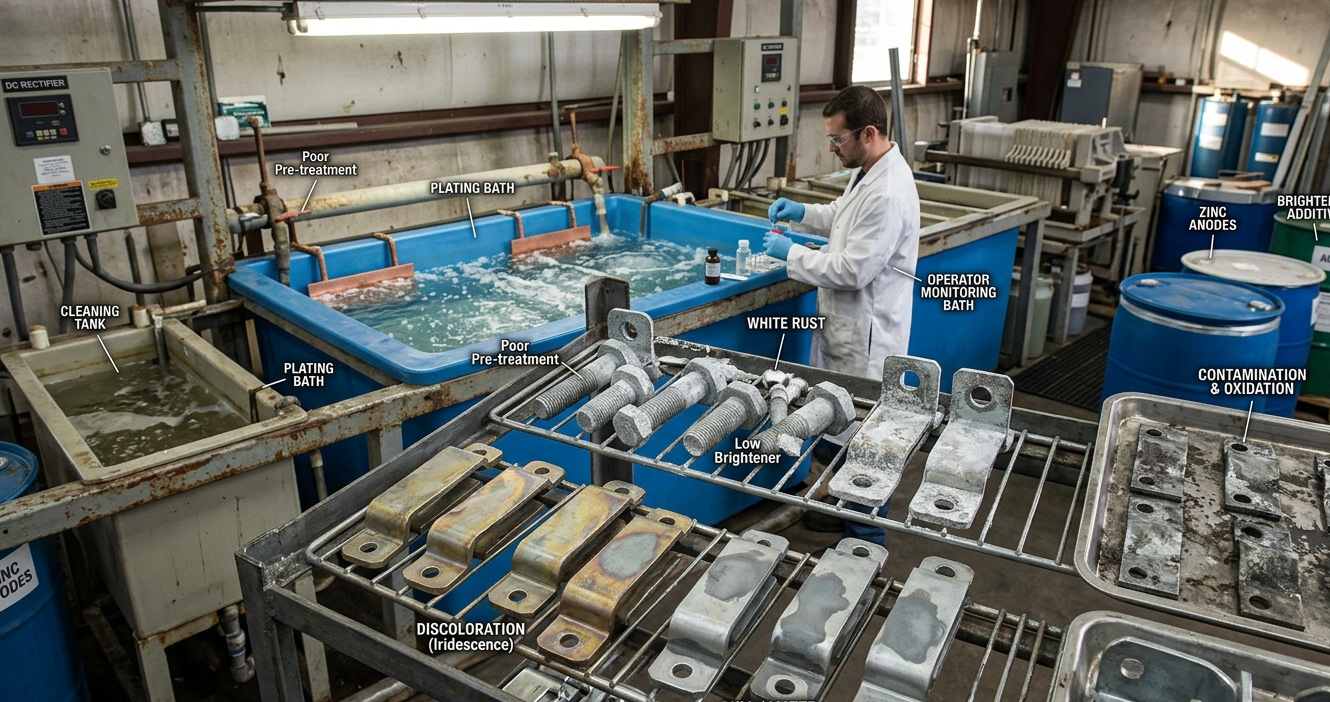
A box of zinc plated parts arrives, and something looks off. Maybe it’s a dull, chalky patch instead of the bright, uniform finish you expected. Maybe there’s a yellowish or grayish tint that wasn’t there on the last shipment. Maybe some parts look perfect and others from the same batch look noticeably different. The instinct is usually to assume something is structurally wrong, that the corrosion protection itself has failed. Sometimes that’s true. Often, it isn’t, and the actual cause is a specific, identifiable issue somewhere between the plating bath and the moment the part reached your hands. This guide walks through what actually causes dull or discolored zinc plating, how to tell a cosmetic issue from a genuine coating failure, and what to do about each one.
Discoloration and dullness on zinc plated parts are among the most common quality questions we field, and also among the most frequently misunderstood. A visual defect on plated hardware triggers an understandable reaction reject the lot, question the supplier, assume the corrosion protection is compromised. Sometimes that reaction is exactly right. But a meaningful share of the dull or discolored parts that get flagged as defective are actually functioning coatings with a cosmetic issue, caused by something as simple as storage humidity or handling residue, that has nothing to do with whether the zinc underneath is still protecting the steel.
The reverse mistake is just as costly assuming discoloration is “just cosmetic” when it’s actually an early visible sign that the passivate layer has broken down and the underlying zinc, or worse, the base steel itself, has started to corrode. Telling these two situations apart requires understanding what’s actually happening at a material level when zinc plating changes appearance, not just noticing that it looks different than expected.
This guide breaks down the specific, identifiable causes of dull and discolored zinc plating, organized by where in the process each cause typically originates, so you can diagnose what you’re actually looking at rather than guessing.
72 Hours
Time within which white rust can begin appearing on unprotected zinc under high humidity storage
3 Categories
Process, post-plating storage, and normal variation, the three sources of most appearance issues
1974
Year Plateco began solving zinc plating quality questions for Wisconsin manufacturers
Start Here: Is This Actually a Coating Failure, or Just an Appearance Issue?
Before diagnosing a specific cause, it’s worth establishing the most important distinction in this entire guide discoloration and dullness are not, by themselves, evidence that the zinc coating has stopped protecting the underlying steel. Zinc plating protects steel through a combination of barrier protection and, critically, galvanic (sacrificial) protection, meaning the zinc corrodes preferentially to protect the steel beneath it even after some surface change has occurred. A part can develop visible white corrosion products on its surface and still have zinc actively protecting the base metal underneath, functioning exactly as designed, just not looking as pristine as it did on day one.
That said, this is not a blanket reassurance that discoloration never matters. Advanced white rust that has consumed a significant portion of the zinc layer, red rust (indicating the zinc has been fully consumed and the base steel itself is now corroding), and certain process-related discoloration issues do represent genuine coating problems that warrant rejection or further investigation. The goal of this guide is to help you tell these situations apart rather than treating every instance of “doesn’t look right” as either an automatic reject or an automatic non-issue.
The First Question to Ask
Is the discoloration uniform and consistent with normal passivate appearance variation, or does it look like distinct spotting, white powdery deposits, or reddish-brown staining? Uniform color variation within a normal range is usually cosmetic. Spotting, powdery white deposits, or any reddish-brown coloration are specific, identifiable defect patterns worth investigating further, covered in detail below.
Ready to Get a Clear Answer on Your Zinc Plating? – (608) 524-8241
Cause Category 1: Normal Appearance Variation (Not a Defect)
A meaningful share of “why does this look different” questions trace back to genuine, acceptable variation in zinc plating appearance that doesn’t indicate any defect at all. Understanding what’s normal prevents unnecessary rejections and wasted investigation time.
Iridescence in trivalent chromate passivates. Since the industry-wide shift away from hexavalent chromium passivates toward RoHS-compliant trivalent chromate systems, a degree of iridescent, rainbow-like sheen has become a normal, expected characteristic of many yellow passivate finishes, rather than a defect. Trivalent chromate chemistry simply produces a different visual character than the legacy hexavalent processes many buyers may still associate with “correct” zinc plating appearance, and this iridescence, while sometimes surprising to buyers used to older hexavalent finishes, is not itself a sign of a problem.
Slight color variation between production lots. Minor differences in shade or tone between one production run and another, particularly for yellow and black passivate finishes, can occur due to normal, acceptable variation in bath age, chemistry concentration within specified tolerances, and ambient processing conditions. This is analogous to slight variation between paint batches, an acceptable reality of a chemical process rather than evidence of inconsistent quality.
Slightly different appearance on different part geometries within the same lot. Complex parts with recesses, threads, or varying surface angles relative to the anode during plating can show subtle differences in brightness or thickness buildup across a single part’s own surface, simply due to how electroplating current distributes across complex geometry. This is a normal characteristic of the electroplating process itself, not necessarily an indication of inadequate process control, though it’s worth discussing with your supplier if it affects a functionally critical surface.
Why This Matters for Your Own Quality Process
If your incoming inspection criteria were established based on older hexavalent chromate appearance expectations, and your current supplier (correctly) uses RoHS-compliant trivalent chemistry, you may be flagging normal, expected trivalent passivate characteristics as defects. Confirm with your plating supplier what normal appearance range to expect for your specific specification before assuming a color or sheen difference indicates a process problem.
Cause Category 2: Process-Related Discoloration (Genuine Supplier-Side Issues)
Some discoloration and dullness genuinely does originate in the plating process itself, reflecting an issue with bath chemistry, process control, or handling before the part ever leaves the plater’s facility.
Passivate solution contamination or depletion. Passivate baths, like plating baths themselves, require ongoing chemistry maintenance and periodic replacement as they age and accumulate contamination from repeated use. A depleted or contaminated passivate solution can produce a dull, uneven, or off-color finish compared to a properly maintained bath, and this is a legitimate process control issue worth raising directly with a supplier if it’s a consistent, repeated pattern rather than a one-off.
Inadequate rinsing between process steps. Zinc plating involves multiple sequential process steps, plating, activation, passivating, and each requires thorough rinsing before the part moves to the next stage. Inadequate rinsing can leave residual process chemistry on the part’s surface, which can react with the subsequent step’s chemistry or simply dry into a visible film, producing a hazy, streaked, or unevenly colored appearance rather than the clean, uniform finish proper rinsing produces.
Drying issues immediately after passivating. How a part is dried immediately after the final passivate rinse affects final appearance meaningfully. Water spots, streaking, or an uneven, blotchy appearance can result from improper drying technique, air drying with poor air circulation, water quality issues in the final rinse, or parts sitting too long in a wet state before drying is completed.
Rack or barrel contact marks. The physical points where a part contacts a plating rack, or where parts contact each other inside a barrel during barrel plating, can show as small unplated or thinly plated spots once the part is removed from the fixture. On smaller barrel-plated hardware, faint contact marks are a normal and generally acceptable characteristic given the nature of the process, but excessive marking, particularly on functionally critical surfaces, is worth raising with your supplier.
Bath temperature or current density outside optimal range. Zinc electroplating baths operate within specific temperature and current density ranges for optimal deposit quality. Operating outside these ranges, even while still producing a coating that meets minimum thickness requirements, can result in a duller, less bright, or less uniform finish than a properly controlled process would produce.
What to Ask Your Supplier If You Suspect a Process Issue
“Has anything changed in your passivate bath chemistry or maintenance schedule recently?” “Can you confirm your rinse water quality and drying process for this order?” “Is this appearance consistent across your other current production, or specific to my lot?” A supplier with genuine process discipline will engage with these questions specifically rather than dismissing the concern.
Seeing Inconsistent Results From Your Current Supplier?
If discoloration is showing up repeatedly across multiple lots and you’re not getting specific answers about what’s changed, that’s worth a second opinion. Send us a sample and your specification and we’ll tell you honestly whether it’s a process issue.
Cause Category 3: Post-Plating Storage and Handling Issues (The Most Common Cause)
In our experience, the single most common source of dull or discolored zinc plating that customers notice is not a plating process defect at all, it’s something that happened after the parts left the plating line, during storage, shipping, or handling. This is genuinely useful to understand, because it means the fix often has nothing to do with switching suppliers.
White rust (wet storage stain). This is by far the most common cause of unexpected discoloration on zinc plated parts, and it deserves detailed explanation because it’s so frequently misunderstood. White rust, technically zinc oxide and zinc hydroxide corrosion products, forms when freshly plated zinc parts are stored in conditions with high humidity, condensation, or direct moisture contact, particularly when parts are stacked tightly together, trapping moisture between surfaces with limited air circulation. It appears as a white, sometimes powdery or crusty deposit, and can develop within as little as 72 hours under sufficiently poor storage conditions, well before a part is even installed.
White rust is a genuine corrosion product, but critically, it typically represents the zinc sacrificing itself exactly as designed, protecting the underlying steel by corroding preferentially. Mild white rust is often a cosmetic and early-warning issue rather than a functional failure, though extensive white rust that has consumed a significant portion of the zinc layer does reduce the remaining service life of the coating and warrants closer inspection.
Fingerprint and handling residue. Oils, salts, and moisture from bare-hand handling can leave visible marks on freshly plated parts that show up as dull spots, faint discoloration, or in more humid conditions, can actually accelerate localized white rust formation at the contact point. This is why proper handling procedures, gloves, clean racking, careful packaging, matter for maintaining appearance even when the underlying plating quality is fully sound.
Improper packaging for transit. Parts shipped without adequate protection from moisture, temperature swings, or condensation risk during transit, particularly across regions or seasons with significant humidity or temperature differential, can arrive with discoloration that developed entirely during shipping rather than reflecting anything about the original plating quality.
Extended storage before use. Even well-packaged parts stored for extended periods, particularly in uncontrolled warehouse environments with seasonal humidity swings, can develop some degree of surface change over time. This is a normal characteristic of any reactive metal coating and doesn’t necessarily indicate the coating has failed, but it does mean “how long has this been sitting in inventory” is a relevant question when investigating unexpected discoloration.
Chemical exposure during storage. Storage near cleaning chemicals, certain woods (some contain natural acids that can react with zinc), or in environments with airborne industrial contaminants can cause localized discoloration or accelerated corrosion that has nothing to do with the original plating process.
The Most Important Distinction in This Section
Discoloration that developed during storage or shipping is not evidence that your plating supplier did anything wrong, and rejecting a lot or switching suppliers based on storage-related white rust addresses the wrong problem. If discoloration consistently appears after your own receiving and storage process, the fix is in your storage and handling conditions, not your plating specification.
How to Tell White Rust From a Genuine Coating Failure
Given how common white rust confusion is, it’s worth a direct, practical comparison to help distinguish a cosmetic storage issue from something that actually warrants rejection or further investigation.
Distinguishing White Rust From Red Rust and Genuine Coating Failure
| Characteristic | White Rust (Zinc Corrosion) | Red Rust (Base Steel Corrosion) |
|---|---|---|
| Color | White, gray, or dull chalky appearance | Reddish-brown, orange |
| What’s corroding | The zinc coating itself (sacrificial, by design) | The underlying base steel, meaning zinc protection has been exhausted |
| Severity implication | Often mild and cosmetic in early stages extensive white rust reduces remaining service life | Always a genuine coating failure requiring investigation |
| Common cause | Storage humidity, condensation, poor ventilation, tight stacking | Zinc coating fully consumed by white rust, or coating breach exposing bare steel |
| Typical response | Usually acceptable for less critical or cosmetic applications if mild assess remaining zinc thickness if extensive | Warrants rejection and root-cause investigation regardless of application |
If you’re looking at reddish-brown corrosion on a part that was supposed to be zinc plated, that is a genuine problem, not a storage cosmetic issue, and it means the zinc protecting that specific area has already been fully consumed, whether from a coating gap, physical damage, or extended white rust progression that went unaddressed. This distinction, white versus red, is the fastest practical way to sort a call-your-supplier-immediately situation from a check-your-storage-conditions situation.
Practical Storage and Handling Recommendations to Prevent Discoloration
Since post-plating storage and handling account for such a large share of discoloration issues, a few specific practices meaningfully reduce the risk of parts developing unwanted appearance changes before they’re ever installed.
Store in a climate-controlled, low-humidity environment when possible. Avoiding significant humidity swings and condensation-prone storage conditions is the single most effective preventive measure against white rust formation.
Avoid tight stacking that traps moisture between parts. Allowing air circulation between stored parts, rather than stacking tightly in sealed containers without any ventilation, reduces the trapped-moisture conditions that accelerate white rust formation.
Use appropriate packaging for the storage duration and environment. VCI (vapor corrosion inhibitor) paper or packaging is specifically designed to reduce corrosion risk during storage and transit and is worth considering for parts that will sit in inventory for extended periods or ship through variable climate conditions.
Handle with clean gloves rather than bare hands. This is a simple, low-cost practice that meaningfully reduces fingerprint-related discoloration and localized corrosion risk, particularly for parts that will remain visible in a finished assembly.
Rotate inventory to avoid extended storage of plated parts before use. Where practical, a first-in-first-out inventory approach reduces the amount of time any given batch of plated parts spends in storage before installation, directly reducing the window during which storage-related discoloration can develop.
Want a Second Opinion on a Discolored Shipment?
If you’re not sure whether what you’re seeing is a cosmetic storage issue or a genuine coating problem, send us photos and we’ll help you figure out which one it is, no charge, no obligation.
When Discoloration Genuinely Warrants Rejecting a Lot
Not every appearance issue should be waved off as cosmetic, and it’s worth being direct about when discoloration or dullness genuinely indicates a problem worth escalating with your supplier.
Any red rust presence, regardless of how minor, since it indicates the zinc coating has been fully consumed in that location and the base steel is now actively corroding, a genuine functional failure of the corrosion protection system.
White rust covering a substantial portion of the part’s surface, particularly on parts intended for outdoor or high-corrosion service, since extensive white rust indicates meaningful consumption of the zinc layer and correspondingly reduced remaining service life, even if the underlying steel hasn’t yet been reached.
Discoloration that appears immediately upon receiving, before any storage on your end, since this points toward a process or shipping issue on the supplier’s side rather than something within your own storage control, and is worth raising directly and specifically with the supplier.
Inconsistent appearance across a single lot that doesn’t correspond to any storage or handling difference you can identify, which can indicate inconsistent process control, bath chemistry problems, or rack loading issues on the supplier’s end worth investigating.
Discoloration on functionally critical surfaces, such as sealing surfaces, electrical contact points, or precision-fit areas, where even cosmetic-level surface change could affect actual part function, regardless of whether the same discoloration would be acceptable on a purely structural or non-critical surface.
A Reasonable Standard to Apply
Ask whether the discoloration you’re looking at affects the part’s actual function, corrosion protection, dimensional fit, electrical performance, sealing integrity, or is purely a matter of visual appearance on a surface where cosmetics genuinely don’t matter for the application. This distinction, more than the discoloration itself, should generally drive whether a lot warrants rejection.
A Practical Diagnostic Approach
When you encounter dull or discolored zinc plating and aren’t sure what’s causing it, working through a simple sequence of questions gets you to an answer faster than guessing.
First, check the color. White or gray discoloration points toward zinc corrosion (white rust), likely storage-related. Reddish-brown indicates base steel corrosion, a genuine coating failure requiring immediate attention regardless of cause.
Second, check when it appeared. Discoloration visible immediately upon receiving points toward a process or shipping issue. Discoloration that developed after weeks or months in your own storage points toward storage conditions on your end.
Third, check consistency. Uniform discoloration across an entire lot, especially if it matches known trivalent passivate characteristics, may simply be normal appearance variation. Spotty, inconsistent discoloration that doesn’t correspond to any storage pattern you can identify is more likely a process-related issue worth raising with your supplier.
Fourth, check function. Regardless of cause, assess whether the discoloration affects the part’s actual required performance, corrosion protection remaining, dimensional fit, electrical or sealing function, rather than treating any visual deviation as automatically disqualifying.
Getting Ahead of Discoloration Questions
The best way to avoid repeated confusion and back-and-forth over discoloration issues is establishing clear expectations upfront, both with your plating supplier and within your own receiving and storage processes. Confirm with your supplier what normal appearance variation looks like for your specific passivate specification, particularly if you’re newly transitioning to trivalent chromate finishes. Review your own storage and handling practices for any patterns that might be introducing white rust or handling marks before parts are even installed. And when something genuinely looks wrong, use the color-timing-consistency-function framework above to figure out where in the process the issue actually originated, rather than defaulting to an assumption in either direction.
Plateco has been answering exactly these kinds of quality questions for Wisconsin manufacturers since 1974, and we’d rather walk you through what you’re actually looking at than have you guess. If you’re dealing with a shipment that doesn’t look right, send us photos and your specification and we’ll help you figure out what’s actually going on.
Frequently Asked Questions
Is white rust on zinc plated parts dangerous or does it mean the parts need to be scrapped?
Not necessarily. Mild white rust often represents the zinc coating doing exactly what it’s designed to do, corroding sacrificially to protect the underlying steel, and doesn’t automatically mean the part has failed or needs to be scrapped. Extensive white rust that has consumed a significant portion of the zinc layer does reduce remaining service life and warrants a closer look, particularly for parts headed into demanding outdoor or high-corrosion applications, but the presence of some white rust alone isn’t automatically disqualifying for every application.
Why does my zinc plating look different, more rainbow or iridescent, than it used to?
This is very likely related to the industry-wide shift from hexavalent to trivalent chromium passivate chemistry, required under RoHS and similar environmental regulations. Trivalent chromate passivates commonly produce a degree of iridescent sheen that wasn’t characteristic of the older hexavalent processes many buyers associate with “normal” zinc plating appearance. This iridescence is typically a normal characteristic of the current, compliant chemistry rather than a defect.
Can I prevent white rust just by using a better passivate, or is storage the real fix?
Passivate type does affect corrosion resistance, and a yellow trivalent passivate generally offers better protection than a clear passivate at comparable zinc thickness. But even a well-chosen passivate has limits, and poor storage conditions, high humidity, tight stacking, extended uncontrolled storage, can overwhelm that protection and produce white rust regardless of passivate quality. Addressing storage and handling conditions is usually the more direct and effective fix for recurring white rust issues rather than assuming a different passivate alone will solve it.
How can I tell if discoloration happened during shipping versus during my own storage?
The clearest signal is timing discoloration visible immediately upon receiving, before the parts have spent any time in your own storage, points toward something that happened during production or transit. Discoloration that develops gradually over weeks or months while parts sit in your own inventory points toward your storage conditions. Keeping basic records of receiving-inspection appearance versus later appearance for parts held in inventory can help establish this pattern over time if discoloration issues recur.
Does discoloration ever indicate the wrong plating process was used entirely, rather than a quality issue with the correct process?
Occasionally, yes. If a part’s appearance is dramatically different from what a specified coating and passivate combination should produce, unusual color entirely inconsistent with the specified passivate type, for example, it’s worth confirming directly with your supplier that the correct process was actually applied to your order, rather than assuming a subtle quality variation. This is a reasonable, direct question to ask rather than an accusation, and a transparent supplier will confirm or investigate promptly.
If a supplier tells me discoloration is “just cosmetic,” should I always accept that explanation?
Not without understanding why. A transparent supplier should be able to explain specifically what’s causing the appearance issue, normal passivate variation, storage-related white rust, a rinse or drying issue, rather than offering a vague reassurance without explanation. Use the color-timing-consistency-function framework in this guide to form your own assessment, and treat a supplier’s explanation as a starting point for discussion rather than an automatic final answer, particularly for parts headed into functionally critical or long-service applications.
Ready to Get a Clear Answer on Your Zinc Plating?
Tell Us About Your Project
Plateco has been helping Wisconsin manufacturers diagnose and prevent zinc plating appearance issues since 1974, with the process controls and documentation to tell you exactly what you’re looking at. Send us photos and your specification and we’ll give you a straight answer.