

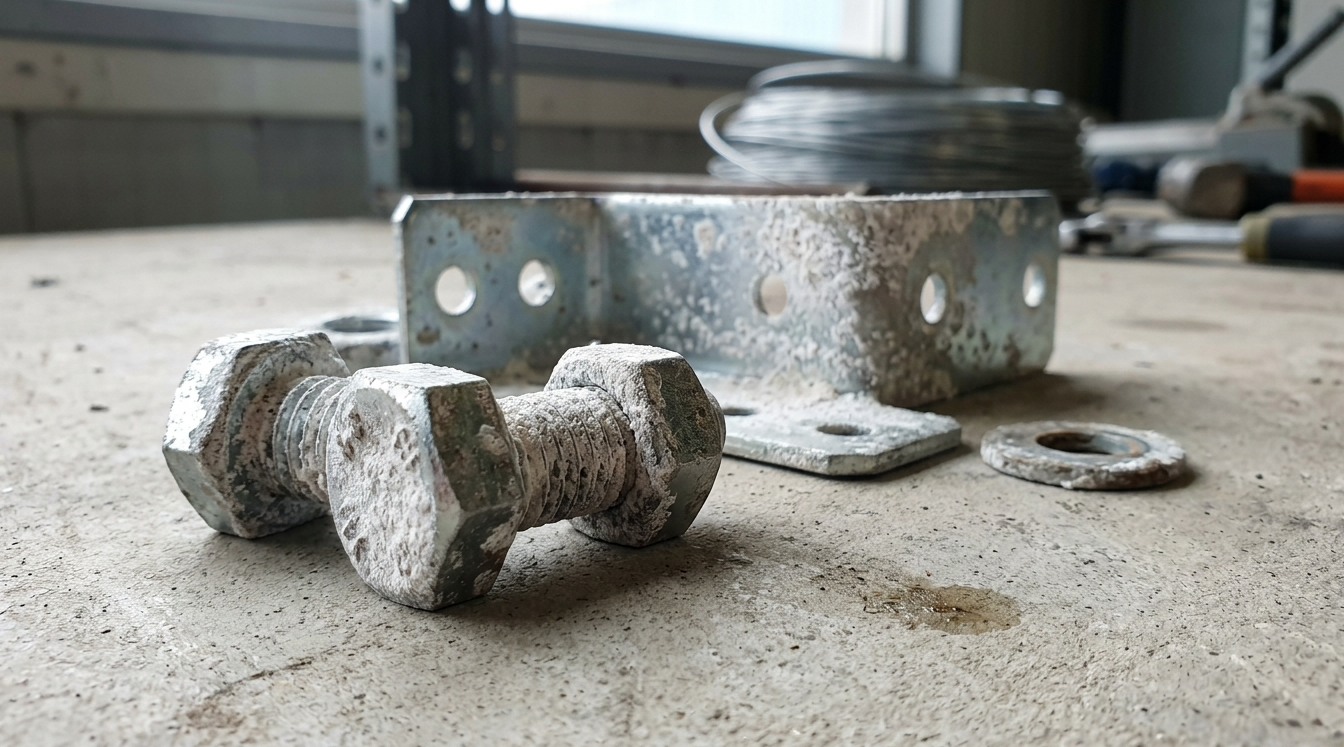
A pallet of freshly zinc plated parts sits in a warehouse for two weeks, and when it’s opened, a chalky white film has appeared across a portion of the load. The immediate reaction is almost always the same something went wrong with the plating. In the overwhelming majority of cases, that reaction is misdirected. White rust is one of the most common, most misunderstood, and most preventable issues in zinc plating, and it has far more to do with what happened after the parts left the plating line than what happened during plating itself. This guide explains exactly what white rust is at a chemical level, why it forms, how to tell it apart from a genuine coating failure, and the specific storage and handling practices that prevent it before it starts.
White rust is, by a wide margin, the most common quality complaint we hear about zinc plated parts that has nothing to do with the plating process itself. It’s also one of the most consistently misunderstood, because it looks alarming, a dull white or gray film or powder on a surface that’s supposed to be bright and clean, and because the instinct when something looks wrong is to assume the coating has failed. Understanding what’s actually happening chemically when white rust forms changes how you think about it entirely, from a defect to investigate to a storage condition to manage.
This guide is built to give manufacturers, distributors, and anyone receiving or storing zinc plated parts a complete, practical understanding of white rust what it is, why zinc is specifically vulnerable to it in ways other metals aren’t, what conditions cause it to form, how to distinguish it from a genuine coating problem, and the concrete steps that prevent it from happening in the first place.
72 Hours
Time in which white rust can begin forming under high-humidity, poorly ventilated storage
60-80%
Relative humidity threshold above which zinc corrosion rates accelerate significantly
1974
Year Plateco began helping Wisconsin manufacturers manage zinc plating storage and handling
What White Rust Actually Is, Chemically
White rust is the common name for zinc corrosion products, primarily zinc oxide and zinc hydroxide, that form on the surface of zinc or zinc plated parts when the metal reacts with moisture and oxygen under specific conditions. It typically appears as a white, gray, or sometimes slightly chalky or powdery deposit, occasionally with a somewhat waxy or crystalline texture depending on how it formed and how long it’s been developing.
The chemistry behind it is straightforward. Zinc is a reactive metal that readily forms a protective oxide layer when exposed to normal atmospheric conditions, and under typical, moderate humidity conditions, this thin oxide layer is actually beneficial, it’s part of what gives zinc plating its corrosion resistance in the first place, forming a stable, adherent film that slows further corrosion. White rust forms when this process happens too quickly, under conditions of high humidity, condensation, or standing moisture, particularly in poorly ventilated spaces where moisture can’t evaporate and the corrosion reaction products build up faster than they can stabilize into that thin, protective oxide film. The result is a looser, more voluminous, visually obvious white deposit rather than the thin, stable oxide layer that forms under normal conditions.
This distinction matters enormously for how you should think about white rust. It isn’t some foreign contamination or a sign that the wrong process was used, it’s an accelerated version of the same basic chemical reaction that gives zinc its corrosion resistance in the first place, just occurring too fast and under the wrong conditions to form the stable, protective film it normally would.
The Core Concept to Understand
Zinc protects steel specifically because it’s more chemically reactive than steel, corroding preferentially in what’s called galvanic or sacrificial protection. White rust is visible evidence that this sacrificial protection mechanism is active, the zinc corroding instead of the steel underneath it. In many cases, that’s the coating doing exactly what it’s designed to do, just under storage conditions that made the reaction happen faster and more visibly than ideal.
Why Zinc Is Specifically Vulnerable to This, When Other Metals Aren’t
It’s worth explaining why this is such a well-known, named phenomenon specifically for zinc, rather than something that happens comparably across all plated or coated metals. Zinc’s electrochemical reactivity, the same property that makes it useful as a sacrificial coating for steel, also makes it considerably more reactive with atmospheric moisture than more noble metals like nickel or chromium, which corrode far more slowly under comparable conditions.
Freshly plated zinc is at its most reactive immediately after plating, before it’s had time to develop a stabilized surface oxide layer through normal, gradual atmospheric exposure. This is precisely why white rust so often shows up specifically on newly plated parts during their first days or weeks after production, rather than being an ongoing, steady-state risk throughout a part’s entire service life. Once a stable oxide layer has formed under reasonable conditions, zinc becomes considerably more resistant to further rapid white rust formation, though it never becomes fully immune, particularly if it’s later exposed to standing water or persistently high humidity.
This early vulnerability window is exactly why storage and handling practices in the days and weeks immediately following plating matter so disproportionately for preventing white rust, a detail covered in depth in the prevention section below.
The Specific Conditions That Cause White Rust to Form
Understanding the precise conditions that trigger white rust formation is the foundation for actually preventing it, since prevention is almost entirely about controlling these conditions rather than changing anything about the plating process itself.
High relative humidity. White rust risk increases significantly once ambient relative humidity climbs into the 60 to 80 percent range and above, and becomes acute at higher humidity levels combined with limited air circulation. This is why humid climates, and humid seasons even in more moderate climates, see a meaningful uptick in white rust complaints compared to drier conditions.
Condensation from temperature cycling. Even in a space with moderate average humidity, temperature swings, cold parts moved into a warmer space, or a warehouse experiencing day-to-night temperature cycling, can cause condensation to form directly on metal surfaces as they pass through their dew point, creating a direct moisture source on the part surface regardless of the room’s average humidity reading.
Tight stacking and poor air circulation. This is one of the most common and most preventable contributing factors. Parts stacked tightly together, nested inside one another, or packed into sealed containers without any air circulation trap whatever moisture is present between surfaces, preventing it from evaporating and concentrating the corrosive reaction at the points of contact between parts. This is why white rust so frequently appears specifically at contact points between stacked or bundled parts rather than uniformly across an entire surface.
Sealed packaging without adequate moisture control. Counterintuitively, sealing parts in plastic or other airtight packaging without proper desiccant or vapor corrosion inhibitor protection can actually worsen white rust risk rather than preventing it, since any moisture present at the time of sealing has nowhere to go and remains in direct, prolonged contact with the part surface.
Direct water contact during transit or storage. Parts exposed to actual liquid water, rain during outdoor transit staging, condensation dripping from overhead pipes or roof leaks in a storage facility, or contact with wet packaging materials, face the most severe and rapid white rust risk of any condition covered here.
Extended time before the zinc surface stabilizes. As covered above, freshly plated parts are most vulnerable during the days immediately following plating, before a stable surface oxide has developed through normal exposure. Parts shipped or stored under marginal conditions during this early window face meaningfully higher risk than the same parts would face later in their service life under identical conditions.
A Pattern Worth Recognizing
If white rust consistently appears at the specific points where parts contact each other in a stacked or bundled configuration, rather than uniformly across exposed surfaces, that’s a strong signal pointing toward trapped moisture from tight stacking as the primary cause, rather than a general environmental or process issue. This pattern recognition can save significant time in diagnosing recurring white rust complaints.
Is White Rust Always a Problem? Understanding Severity
Not all white rust represents the same level of concern, and understanding the range from cosmetic to genuinely functional is important for deciding how to respond when you encounter it.
Light, surface-level white rust appears as a faint, hazy, or slightly dulled surface, sometimes barely visible without close inspection or a specific angle of light. This level typically represents very early-stage, limited zinc consumption and is often acceptable for many applications, particularly where appearance isn’t critical and remaining zinc thickness is more than sufficient for the part’s required service life.
Moderate white rust shows as a clearly visible white or gray deposit, sometimes powdery or slightly raised from the surface, covering a noticeable but still limited portion of the part. This level warrants closer attention, particularly for parts headed into demanding outdoor or long-service applications, since it represents more meaningful zinc consumption than the light stage above.
Heavy or advanced white rust presents as thick, crusty, or extensively powdery deposits covering a significant portion of the part’s surface, sometimes with visible pitting or texture change to the surface beneath the deposit once it’s removed. This level represents substantial zinc consumption and genuinely reduces the coating’s remaining service life, warranting a real assessment of whether the part still meets its required corrosion protection specification.
Any red-brown coloration indicates the zinc has been fully consumed at that specific location and the underlying base steel has begun corroding directly, a categorically different and more serious situation than white rust at any severity, since it means sacrificial protection has already failed at that point rather than simply being visibly active.
A Practical Severity Assessment
For parts where appearance matters less than function, light to moderate white rust on a small portion of the surface is often acceptable, particularly if the part still has adequate remaining service life for its application. For parts with tight cosmetic requirements, or extensive white rust covering a large surface area, closer inspection, including remaining thickness verification if the application warrants it, is the more appropriate response than assuming it’s automatically fine or automatically a reject.
Not Sure How Serious Your White Rust Issue Is?
Send us photos of what you’re seeing and we’ll help you assess whether it’s light surface staining or something that warrants a closer look at remaining coating thickness.
How Passivate Choice Affects White Rust Resistance
The passivate or chromate conversion coating applied over zinc during plating plays a direct, measurable role in how resistant a part is to white rust formation, which makes passivate selection a genuine prevention lever worth understanding, not just a cosmetic or corrosion-resistance afterthought.
Clear (blue) passivate provides the least additional protection against white rust among common passivate options, offering a bright appearance but comparatively limited additional corrosion resistance beyond the base zinc layer itself.
Yellow (trivalent) passivate provides meaningfully better resistance to white rust formation than clear passivate at a comparable zinc thickness, which is why it’s frequently the right default choice for parts that will face any meaningful storage duration, shipping distance, or humidity exposure before installation.
Black passivate generally falls between clear and yellow in terms of white rust resistance, offering improved protection over clear passivate while providing a different aesthetic option for applications where a darker finish is preferred.
Topcoat sealers applied over a passivate layer provide an additional barrier against moisture contact and can meaningfully extend the time before white rust begins forming under marginal storage conditions, making them worth considering for parts with known extended storage or difficult shipping conditions ahead of them.
It’s worth being clear about what passivate choice can and can’t do here a better passivate reduces white rust risk and extends the time before it becomes visible under a given set of conditions, but it doesn’t eliminate the underlying chemistry, and sufficiently poor storage conditions, standing water, extended high humidity without ventilation, can overwhelm even a well-chosen passivate’s protection. Passivate selection and proper storage practice work together neither fully substitutes for the other.
Prevention: Storage and Handling Practices That Actually Work
Given that the overwhelming majority of white rust cases originate in post-plating storage and handling rather than the plating process itself, prevention is almost entirely about controlling the storage environment and handling practices parts encounter between plating and installation.
Store in a climate-controlled, low-humidity environment. Where practical, storing zinc plated parts in a space with controlled humidity, ideally maintained below the 60 percent relative humidity threshold where corrosion rates begin accelerating meaningfully, is the single most effective preventive measure available. This doesn’t require an elaborate climate control system for every facility, but avoiding damp basements, uninsulated outdoor storage, or spaces with known humidity problems makes a measurable difference.
Ensure adequate air circulation around stored parts. Avoid tight stacking or sealed, unventilated containers wherever possible, since trapped moisture between closely packed parts is one of the most common specific triggers for white rust formation. Where parts must be stored in bulk, allowing for some air gap or circulation between layers reduces this risk considerably.
Use vapor corrosion inhibitor (VCI) packaging for extended storage or shipping. VCI paper, bags, and other packaging materials are specifically engineered to release a protective vapor that inhibits corrosion on enclosed metal parts, and they’re a genuinely effective, relatively low-cost tool for parts that will spend meaningful time in storage or transit, particularly across variable climate conditions or extended shipping routes.
Avoid handling with bare hands where practical. Skin oils and moisture from bare-hand contact can leave residue that creates localized conditions favorable to accelerated corrosion at the contact point, and using clean gloves during handling, particularly for parts that will remain visible or functionally critical, reduces this risk.
Minimize the time between plating and installation where feasible. Since freshly plated zinc is at its most vulnerable during the initial period before a stable surface oxide develops, reducing unnecessary storage time between receiving plated parts and installing them reduces the overall window during which white rust risk is elevated.
Inspect incoming shipments promptly rather than leaving pallets sealed and unexamined for extended periods. Catching early-stage white rust shortly after receiving allows for a quick assessment and, if needed, a conversation with your supplier about storage or shipping conditions, rather than discovering extensive white rust only after parts have sat unexamined in your own storage for weeks or months, at which point it becomes much harder to determine where in the process the moisture exposure actually occurred.
Coordinate passivate selection with expected storage and shipping conditions at the specification stage. If you know a given order will face extended storage, long-distance shipping, or a humid destination climate, specifying yellow passivate or a topcoat sealer upfront, rather than defaulting to clear passivate purely for appearance, is a proactive step that reduces downstream risk.
A Simple Prioritization for Limited Resources
If you can only implement a few of these practices, prioritize climate-controlled storage and adequate air circulation first, since these address the two most common root causes (humidity and trapped moisture) directly. VCI packaging is the next highest-value addition, particularly for parts facing extended storage or shipping, followed by handling practices and passivate coordination for ongoing risk reduction.
Diagnosing Where White Rust Actually Originated
When white rust does show up, a few diagnostic questions help identify whether it originated during production, shipping, or your own storage, which matters for determining the right corrective action rather than assuming any single cause by default.
Was it present immediately upon receiving, before any storage on your end? This points toward either a shipping condition issue or, less commonly, a passivate or drying process issue at the plating facility itself, worth raising directly with your supplier.
Did it develop gradually while parts sat in your own inventory? This points toward your own storage conditions as the primary factor, and reviewing humidity levels, stacking practices, and packaging in your specific storage location is the appropriate next step.
Is it concentrated at specific contact points between stacked or bundled parts? This is a strong indicator of trapped moisture from tight stacking specifically, rather than a general environmental humidity issue affecting the whole storage space uniformly.
Does it correlate with a specific weather event, humidity spike, or temperature swing you can identify? Checking whether white rust onset correlates with a known period of unusually high humidity, a heat wave, a facility HVAC issue, or a specific shipping route through a humid region can often pinpoint the specific triggering condition rather than leaving the cause as a mystery.
Dealing With a White Rust Issue Right Now?
Whether it’s a shipment that just arrived or parts that have been sitting in your own storage, give us a call and walk us through what you’re seeing. We’ll help you figure out where it started and what to do next.
What White Rust Means for Remaining Service Life
For parts headed into demanding, long-service applications, outdoor equipment, structural hardware, components with a multi-decade expected service life, it’s worth understanding how white rust formation before installation affects the coating’s remaining protective capacity once the part is actually put into service.
Every bit of zinc consumed by white rust formation before installation is zinc that’s no longer available to provide sacrificial protection once the part is actually in service. For light, surface-level white rust representing minimal zinc consumption, this effect on remaining service life is generally negligible relative to the coating’s overall thickness and expected performance. For moderate to heavy white rust, the practical service life reduction becomes more meaningful and worth actually quantifying, particularly for parts specified at the minimum acceptable coating thickness for their service condition to begin with, where less margin exists to absorb pre-installation zinc loss.
This is one of the more practical reasons prevention matters beyond simple appearance concerns white rust that forms before a part is ever installed represents a real, if often modest, reduction in the corrosion protection that part will actually deliver over its intended service life, which is a different and more concrete concern than pure cosmetics, even when the visible severity looks similar in either case.
When to Involve Your Plating Supplier
If white rust issues are recurring, severe, or appearing in a pattern that doesn’t match your own storage conditions, it’s worth having a direct, specific conversation with your plating supplier rather than assuming the issue is purely on your end by default. A supplier with genuine process discipline should be willing and able to discuss their drying process, passivate type and thickness for your specification, and packaging practices for shipment, and should engage constructively with the diagnostic questions covered above rather than offering a generic reassurance without investigation.
Conversely, if the pattern clearly points toward your own storage conditions, extended storage duration, known humidity issues in your facility, tight stacking practices, that’s genuinely useful information for adjusting your own processes rather than a reason to question your supplier’s plating quality. Getting this diagnosis right, rather than defaulting to blame in either direction, is what actually solves the recurring problem rather than just addressing a single instance of it.
Plateco has helped Wisconsin manufacturers diagnose and prevent white rust issues since 1974, with both the process discipline to get plating and passivate right the first time, and the practical storage and handling guidance to help you protect that investment after the parts leave our facility. If white rust is showing up in your supply chain, we’re glad to help you figure out exactly why.
Frequently Asked Questions
Does white rust mean my zinc plated parts have failed and need to be replaced?
Not necessarily. Light to moderate white rust often represents the zinc coating performing its intended sacrificial protection function, corroding preferentially to protect the underlying steel, and doesn’t automatically mean the part has failed or needs replacement. Heavy, extensive white rust does reduce remaining zinc thickness and warrants a closer assessment, particularly for parts headed into demanding or long-service applications, but the presence of some white rust alone isn’t automatically disqualifying.
How quickly can white rust form on newly plated parts?
Under high-humidity, poorly ventilated storage conditions, white rust can begin forming within as little as 72 hours, and sometimes faster under especially severe conditions like direct standing water contact. This is why storage and handling practices in the immediate days following plating matter disproportionately, since freshly plated zinc is at its most reactive before a stable surface oxide has developed through normal exposure.
Can white rust be removed, and does removing it restore the part’s original appearance and protection?
Light white rust can often be removed through gentle mechanical cleaning or specific chemical treatments, which can restore much of the original appearance. However, removal doesn’t restore the zinc that was consumed in forming the white rust in the first place, meaning the part will have somewhat less remaining zinc thickness than it did before the white rust formed, even after cleaning. For parts where remaining coating thickness is critical to the application, this should be factored into any decision about whether cleaning and continued use is appropriate versus replacement.
Is white rust more common with certain passivate types than others?
Yes. Clear passivate generally offers less protection against white rust formation than yellow (trivalent) passivate at a comparable zinc thickness, which is why yellow passivate is often the better default choice for parts facing meaningful storage duration or humidity exposure before installation. That said, even yellow passivate doesn’t eliminate white rust risk entirely under sufficiently poor storage conditions, proper storage and handling practices remain important regardless of passivate choice.
Should I reject an entire shipment if I find white rust on some of the parts?
Not automatically. Assess the severity (light, moderate, or heavy), check whether it’s isolated to specific contact points suggesting a stacking or packaging issue rather than a widespread problem, and consider whether the affected parts still meet their required corrosion protection specification for their intended application. A blanket rejection may be appropriate for heavy white rust on parts with tight specifications, but light, isolated white rust on parts with adequate remaining service margin often doesn’t warrant rejecting an entire shipment.
Does VCI packaging really make a meaningful difference, or is it primarily a precautionary measure with limited actual effect?
VCI packaging has a genuine, measurable protective effect by releasing vapor-phase corrosion inhibitors that form a protective molecular layer on enclosed metal surfaces, meaningfully slowing corrosion reactions compared to unprotected storage under otherwise identical conditions. It’s a legitimate and often cost-effective prevention tool, particularly valuable for parts facing extended storage duration, long-distance shipping, or transit through humid or variable climate conditions, rather than a purely precautionary formality.
Or Tell Us About Your Project Online
Plateco has helped Wisconsin manufacturers diagnose and prevent white rust since 1974, with the process discipline and storage guidance to protect your parts from plating line to installation. Send us your details and we’ll help you build a prevention plan that actually works.