

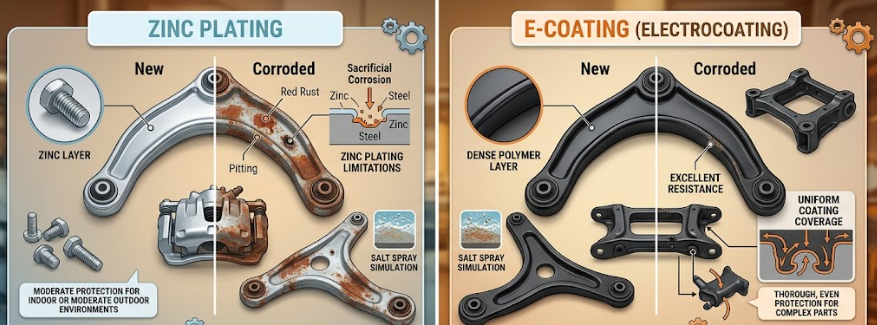
Two coatings dominate automotive corrosion protection, and they don’t work the same way. Zinc plating sacrifices itself to protect steel underneath. E-coating seals the part behind a tough, uniform paint barrier. Specify the wrong one and you’ll either overpay for protection a part doesn’t need, or watch it rust out before its warranty period ends. This guide breaks down exactly how each process works, where each one wins, and how OEMs actually combine them on the same vehicle.
1,000+ hrs
Typical salt-spray life of e-coated + topcoat body panels
5–25 µm
Typical zinc plating thickness range (ASTM B633)
15–35 µm
Typical cathodic e-coat film build
Walk into any automotive supplier’s quality office and ask which corrosion coating is “better,” and you’ll get a shrug instead of an answer. That’s because zinc plating and e-coating aren’t really competing for the same job. They’re built on different physics, they show up on different parts of the vehicle, and mixing them up on a print is one of the fastest ways to end up with a part that fails a salt-spray test or a bracket that binds when a bolt is torqued down.
Automotive engineers, purchasing managers, and Tier 1 suppliers run into this decision constantly: does this bracket, fastener, or panel get zinc plated, e-coated, or both? The right answer depends on the part’s geometry, its exposure environment, its dimensional tolerances, and how it fits into the vehicle’s overall corrosion protection strategy. This guide compares the two processes side by side so you can make that call with confidence instead of guesswring it from habit.
Why This Comparison Comes Up So Often in Automotive Manufacturing
Corrosion is the single largest warranty and durability risk facing any vehicle component that touches moisture, road salt, or humidity. Automakers design against a 10 to 15 year corrosion-free expectation on structural components, and even smaller hardware like clips, brackets, and fasteners are expected to survive years of underbody exposure without visible red rust.
Both zinc plating and e-coating exist to meet that expectation, but they were developed for different geometries and different failure modes. Zinc plating grew out of the fastener and hardware world, where parts are small, numerous, and need uniform coverage on threads and recesses. E-coating grew out of the need to protect large, complex sheet-metal assemblies like body-in-white structures, frames, and stampings with an even, edge-covering film that traditional spray paint could never achieve consistently.
When engineers ask “which one protects better,” they’re often really asking a more specific question without realizing it: better for what part, in what environment, for how long, and at what cost. This guide answers all four.
What Is Zinc Plating? The Sacrificial Protection Method
Zinc electroplating (sometimes called zinc electrodeposition) is an electrochemical process. Parts are submerged in a zinc-ion electrolyte bath and connected to an electrical current. Zinc ions in solution migrate to the part’s surface and deposit as a thin, adherent metallic layer, typically somewhere between 5 and 25 micrometers thick depending on the required service condition.
The protective mechanism is what metallurgists call sacrificial (galvanic) corrosion protection. Zinc is more electrochemically active than steel, meaning that when moisture reaches the coated surface, the zinc corrodes preferentially and the steel underneath is left untouched, even at small scratches or exposed edges. The zinc essentially takes the corrosion hit on the steel’s behalf. Once the zinc layer is fully consumed, corrosion of the base steel begins, so thickness directly determines service life.
Most automotive zinc plating follows ASTM B633, which defines four service condition (SC) categories based on the severity of the exposure environment, and is almost always paired with a chromate conversion coating (passivate) that slows the rate zinc is consumed even further.
Where Zinc Plating Shows Up on a Vehicle
- Fasteners: bolts, nuts, screws, and clips throughout the chassis and body
- Small brackets and stampings with threaded features
- Suspension hardware and brake components
- Underbody clips, retainers, and wiring harness hardware
Why Zinc Wins on Small, Threaded PartsBarrel plating tumbles small parts continuously through the bath, which coats threads, recesses, and internal features that a sprayed or dipped coating would struggle to reach evenly. This is exactly why fasteners are almost universally zinc plated rather than e-coated.
Have Questions About Your Parts? – (608) 524-8241
What Is E-Coating? The Barrier Protection Method
Electrocoating (e-coating, or electrodeposition coating) is also an electrically driven process, but it deposits an organic paint resin instead of a metal. Parts are submerged in a water-based paint emulsion, and an electrical charge causes charged paint particles to migrate to the part and deposit as a uniform film across every reachable surface, including internal cavities, seams, and edges.
Almost all automotive e-coating today is cathodic electrocoating (CED), where the part is the cathode. Cathodic e-coat resins (typically epoxy-based) offer significantly better corrosion resistance and edge coverage than the older anodic e-coat systems used decades ago, which is why cathodic e-coat has been the industry default on structural automotive components since the 1980s.
The protective mechanism here is fundamentally different from zinc plating. E-coat doesn’t sacrifice itself; it works as a continuous barrier that physically blocks moisture, oxygen, and salt from ever reaching the metal surface. Because the film is applied electrically rather than sprayed, it achieves a uniformity of coverage, including into box sections and weld seams, that conventional liquid painting cannot match.
Where E-Coating Shows Up on a Vehicle
- Body-in-white structures and unibody frames
- Large stamped panels: doors, hoods, fenders, quarter panels
- Frame rails and structural cross-members on body-on-frame vehicles
- Larger brackets and assemblies without critical threaded tolerances
Why E-Coat Wins on Large, Complex Assemblies
The electrical deposition process follows the electric field into recesses and seams that a spray gun physically cannot reach. On a welded body structure with hundreds of overlapping panels, that’s the difference between full corrosion protection and hidden rust starting inside a seam within a year or two.
Head-to-Head: Zinc Plating vs. E-Coating
| Factor | Zinc Plating | E-Coating |
|---|---|---|
| Protection mechanism | Sacrificial (galvanic) | Barrier (physical seal) |
| Coating material | Metallic zinc | Organic epoxy/acrylic resin |
| Typical thickness | 5–25 µm | 15–35 µm |
| Behavior at a scratch or edge | Continues protecting steel around the scratch | Steel exposed at the scratch can corrode locally |
| Coverage on complex geometry | Excellent on threads, holes, small recesses | Excellent on box sections, seams, large cavities |
| Best part size | Small to medium hardware | Large stampings and welded assemblies |
| Dimensional impact | Can affect thread fit at higher thickness | Minimal dimensional impact |
| Typical color/appearance | Silver, gold, or black depending on passivate | Black or gray (usually top-coated with color paint) |
| Governing standard (common) | ASTM B633 | Various OEM CED specifications |
| Usually followed by | Chromate passivate; sometimes a sealer | Primer-surfacer, basecoat, clearcoat |
Corrosion Resistance Compared: Salt Spray and Real-World Life
Salt spray testing (per ASTM B117) is the industry’s standard accelerated corrosion benchmark, even though it doesn’t perfectly mirror real-world exposure. It’s still the most useful apples-to-apples comparison available, and the numbers tell an important story about how differently these two coatings age.
| Coating System | Hours to First Red Rust (approx.) | Failure Mode |
|---|---|---|
| Zinc plating, clear passivate (SC1, 5µm) | 96–120 hrs | Zinc fully consumed, base steel exposed |
| Zinc plating, yellow passivate (SC3, 12µm) | 200–240 hrs | Zinc fully consumed, base steel exposed |
| Zinc plating, yellow passivate + sealer (SC4, 25µm) | 480+ hrs | Zinc fully consumed, base steel exposed |
| Cathodic e-coat only (no topcoat) | 500–750 hrs | Film undercutting from an edge or scratch |
| Cathodic e-coat + primer + basecoat + clearcoat | 1,000+ hrs | Film undercutting from a stone chip or deep scratch |
The Scratch Test Nobody Runs, But Should
Salt spray hours only tell half the story. Scratch an e-coated panel down to bare metal and the exposed steel corrodes locally, with rust creeping outward from that point (called “creepage” or “undercutting”). Scratch a zinc-plated part and the surrounding zinc continues to sacrificially protect the exposed steel. For parts that are likely to get stone-chipped or scratched in service, that self-healing behavior matters more than the raw salt spray number.
This distinction explains why raw salt spray hours can be misleading if read in isolation. E-coat systems often post higher total hours in a lab because the intact film is an excellent barrier, but a single breach in that film creates a localized failure point. Zinc’s sacrificial behavior means minor damage doesn’t create a runaway failure the same way, which is one reason threaded fasteners exposed to installation scratches and torque marks are almost never e-coated alone.
Cost and Production Comparison
Cost comparisons between the two processes are only meaningful when you compare like-for-like part types, because the processes were never really built to serve the same production volumes or part geometries.
Zinc Plating Cost Drivers
- Barrel plating is highly cost-efficient at high volumes for small parts (fasteners, clips, stampings)
- Cost scales with required thickness; SC4 (25µm) typically costs 20–40% more per part than SC1 (5µm)
- Passivate type (clear, yellow, black) adds modest incremental cost
- Minimum order quantities and rack space matter more than they do for e-coat lines, since barrel lots are batch-processed
E-Coating Cost Drivers
- Requires substantial capital infrastructure (dip tanks, rectifiers, ovens), typically only economical at OEM or large Tier 1 scale
- Cost is driven more by part surface area and tank dwell time than by part count
- Film build (thickness) and bake cycle time affect throughput more than material cost
- Almost never economical as a standalone process for small hardware; it’s built around large-batch immersion of bigger assemblies
Rule of Thumb on Cost
If you’re pricing a bag of fasteners, zinc plating will almost always be dramatically cheaper and more practical than e-coating the same parts. If you’re pricing a welded body structure or a large stamped panel, e-coating is usually the only process that can economically and reliably protect every internal surface.
Matching the Coating to the Part: A Practical Framework
Instead of asking which coating is “better” in the abstract, automotive engineers get further by asking these four questions about the specific part in front of them.
1. Does the part have threaded features or tight tolerances?
If yes, zinc plating is almost always the right call. E-coat film build, while thinner in absolute terms than some zinc specifications, is applied over primer and topcoat layers in production, and the combined stack is difficult to control precisely enough for thread engagement. Zinc plating thickness can be tuned and verified specifically to protect thread function.
2. Is the part a large, welded, multi-panel assembly?
If yes, e-coating is the only process that reliably reaches internal seams, box sections, and hem flanges. Zinc plating a fully welded body structure isn’t practical; the geometry and size are outside what a plating tank and rack setup are designed to handle economically.
3. Will the part need a painted, color-matched finish?
E-coat is specifically designed as a paint system foundation; it’s the first layer beneath primer-surfacer, basecoat, and clearcoat on every visible body panel. Zinc plating is not typically painted over in the same way, though it can be, and is usually left in its natural silver, gold, or black passivate finish for functional hardware.
4. Is the part small enough for barrel or rack plating, and how exposed will it be?
Small brackets and clips exposed to road spray and salt but without complex internal cavities are strong zinc plating candidates. If the same part is welded into a larger assembly that will be e-coated as a unit anyway, it may not need separate zinc plating at all.
Can Zinc Plating and E-Coating Be Combined?
Yes, and in high-corrosion-demand automotive applications, they frequently are. This is sometimes called a duplex or hybrid coating system, and it’s common on structural fasteners and brackets that are both mechanically critical and heavily exposed.
A typical duplex approach zinc plates a fastener or bracket first for sacrificial protection at the thread and edge level, and then the assembled unit passes through the e-coat line along with the rest of the body structure for an additional barrier layer. The two mechanisms complement each other: if the e-coat film is chipped or scratched during assembly or service, the zinc underneath continues providing sacrificial protection at that exact point, buying additional years of service life before base steel is ever exposed.
A Common Specification Mistake
Specifying “e-coat only” on a fastener or small bracket without considering whether it also needs zinc plating underneath is one of the most common oversights in automotive hardware specs. If that part will see direct road spray, salt exposure, or repeated mechanical handling, e-coat alone may not be enough protection once the film is inevitably nicked during installation.
OEM-Specific Duplex Requirements
Many OEM corrosion specifications (GM, Ford, and Stellantis among them) call for zinc-plated fasteners with trivalent passivate specifically because those fasteners will later pass through an e-coat bath along with the rest of the body-in-white. The zinc layer is not redundant protection in that scenario; it’s the first line of defense that keeps working after the e-coat film is inevitably compromised somewhere in the vehicle’s service life.
“Neither coating is the universal answer, and any plater or paint shop that tells you otherwise is selling you the process they happen to run, not the process your part actually needs. The right question isn’t ‘zinc or e-coat’ it’s what does this specific part need to survive, and does its geometry even allow for both.”