

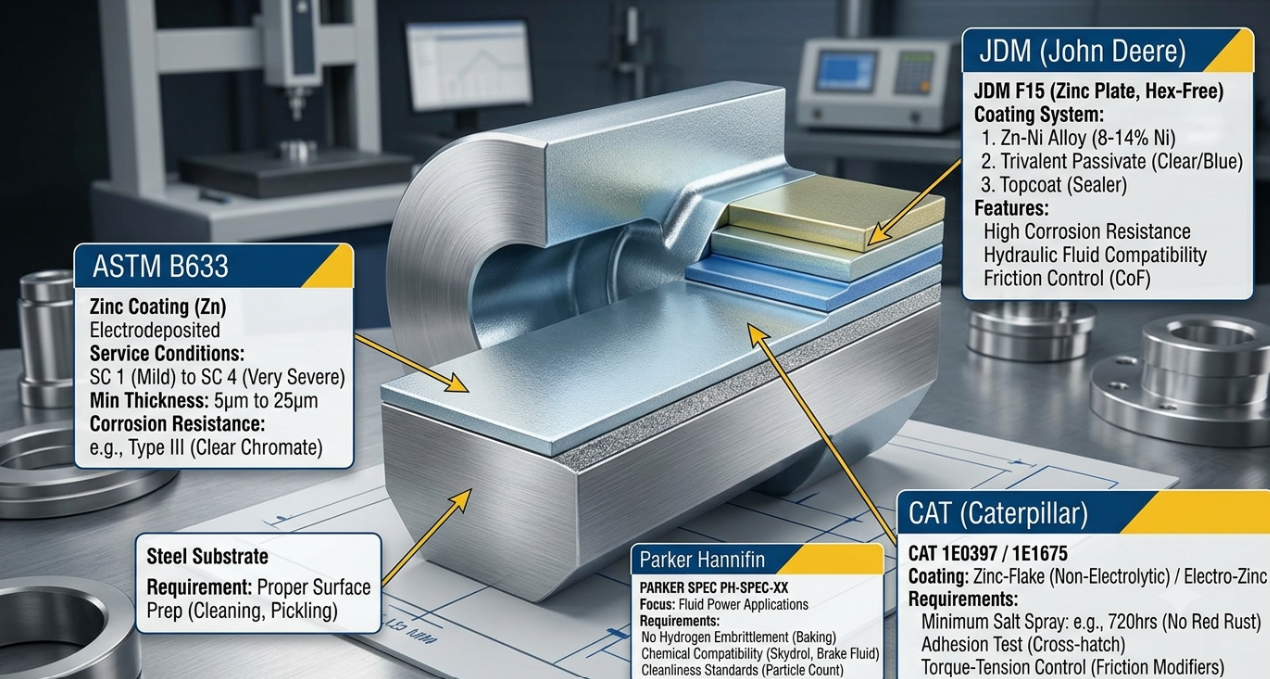
Every plating purchase order has a spec line on it somewhere “per ASTM B633,” “per JDM,” “per CAT Material Spec,” or a Parker Hannifin part-print callout buried three pages deep in a PDF. Most buyers treat that line as boilerplate. It isn’t. It’s the single line that determines whether your plater can legally ship your parts, whether your OEM customer will accept the lot, and whether you’ll be fielding a rejection notice six weeks from now. This guide breaks down the specs that actually govern zinc plating work, what each one really requires, and the questions you need answered before you hand a job to a plater.
If you buy zinc-plated parts for a living as a purchasing manager, a quality engineer, or a manufacturing buyer sourcing for an OEM supply chain you’ve probably had this experience: a plater quotes the job, the parts come back zinc plated, and then your customer’s incoming inspection rejects the lot because the coating doesn’t match the spec on the print. Nobody lied to you. The plater plated the parts. They just didn’t plate them to the right standard, because the standard was never clearly identified in the first place.
This happens more often than it should, and it’s almost never about plating quality in the abstract. It’s about specification literacy knowing which standard governs your part, what that standard actually requires, and whether the shop you’re sending work to can document compliance with it. At Plateco, we’ve been plating to ASTM B633, John Deere JDM, Caterpillar CAT, Parker Hannifin, and dozens of other customer-specific standards since 1974, and the conversations that derail jobs are almost always the same: a buyer assumes “zinc plate” means one thing, and their OEM customer’s spec means something more specific.
This guide is built to close that gap before it costs you a rejected lot. We’ll walk through the major specifications you’re likely to encounter, what distinguishes them, and how to evaluate whether a plater can actually hit the spec your part requires not just claim to.
Why “Zinc Plate It” Is Never a Complete Instruction
A bare instruction to “zinc plate” a part tells a plater almost nothing. It doesn’t specify how thick the coating needs to be, what passivate chemistry should sit on top of it, what salt spray performance is required, whether the part needs to meet a specific OEM’s internal material standard, or what dimensional tolerances apply after plating. Left to fill in those blanks, a plater will default to the minimum that satisfies general industry practice which may be nowhere near what your customer’s print actually demands.
This matters because plating specifications aren’t interchangeable. ASTM B633 SC3 and a Caterpillar internal coating spec might both call for roughly 12 microns of zinc, but the Caterpillar spec may also require a specific salt spray hour minimum, a particular passivate chemistry, hydrogen embrittlement relief baking within a defined window, and documented lot traceability that ASTM B633 alone doesn’t mandate. A plater who reads “zinc plate” and runs a generic ASTM job may produce parts that are technically zinc plated and still fail Caterpillar’s incoming inspection.
The fix is straightforward in concept and frequently skipped in practice: identify the exact standard your part requires, pass that standard to your plater in writing, and confirm the plater has documented experience and process control for that specific standard not just zinc plating in general.
ASTM B633: The Foundation Most Other Specs Build On
ASTM B633 is the baseline American standard for electrodeposited zinc coatings on iron and steel, and it’s worth understanding even if your part ultimately calls out an OEM-specific standard, because most OEM specs reference B633 as their starting point and then add requirements on top of it.
B633 organizes zinc plating into four service condition (SC) categories, each tied to a minimum coating thickness and an intended exposure environment:
- SC1 (5 µm minimum) — mild, dry indoor environments with no meaningful moisture exposure.
- SC2 (8 µm minimum) — indoor environments with occasional condensation or humidity.
- SC3 (12 µm minimum) — outdoor exposure to weather and atmospheric corrosion.
- SC4 (25 µm minimum) — harsh outdoor exposure including road salt, coastal air, and industrial or agricultural chemicals.
The standard also specifies passivate types most commonly Type II (trivalent, for general corrosion resistance) and Type III (thin film, primarily for appearance and minimal added thickness) and ties dimensional expectations to thread class on fastener applications.
The critical point for buyers: a print that says “zinc plate per ASTM B633” with nothing else is an incomplete specification. It doesn’t tell the plater which service condition applies. Most shops will default to SC1, the lightest deposit allowed under the standard. If your part is going to live outdoors or anywhere near moisture, road salt, or industrial chemicals, an SC1 default is very likely to produce premature corrosion failure in the field and it will have technically met the print as written.
If you want the full mechanics of how thickness maps to environment, we’ve covered that in detail in our zinc plating thickness guide. For this article, the takeaway is simpler: ASTM B633 is the vocabulary that OEM specs are written in. Understanding it is the prerequisite to understanding everything that follows.
John Deere JDM: What Agricultural Equipment Specs Actually Require
John Deere’s internal material specifications commonly referred to as JDM standards govern plating requirements for parts that go into Deere-branded agricultural, construction, and forestry equipment. If you’re a supplier in the ag equipment supply chain, you’ve almost certainly seen a print reference a JDM spec number rather than ASTM B633 directly.
JDM zinc plating specifications typically build on ASTM B633’s service condition framework but add requirements specific to the conditions farm and construction equipment actually face: soil contact, fertilizer and chemical exposure, seasonal storage with humidity cycling, and extended outdoor service life without scheduled maintenance. In practice, this usually means:
- A minimum service condition of SC3, and frequently SC4, depending on the part’s location on the equipment.
- A specified passivate system trivalent chromate chemistries are standard for current JDM specs, replacing the legacy hexavalent systems that older specs once called for.
- Salt spray performance minimums measured in hours to white corrosion and hours to red rust, which go beyond what ASTM B633 alone requires.
- Documentation and lot traceability requirements, since Deere’s quality systems expect a paper trail back to the plating lot for any part installed on production equipment.
The practical risk for buyers is treating a JDM callout as functionally identical to a generic ASTM B633 spec. It isn’t. A plater unfamiliar with JDM requirements may hit the thickness number and still miss the passivate chemistry, the salt spray performance threshold, or the documentation package Deere’s incoming inspection expects. If your part print references a JDM specification, you need a plater who can name that specification back to you, explain what it requires beyond ASTM B633, and produce the test data and traceability records to prove compliance not one who treats “JDM” as a synonym for “zinc plate, but for tractors.”
Caterpillar CAT Material Specifications: Built for Severe-Duty Equipment
Caterpillar maintains its own family of material and coating specifications for components used across its construction, mining, and heavy equipment lines, generally referenced on prints by a CAT specification number. Like JDM, CAT specs are built on the same general principles as ASTM B633 but tend to be more exacting in a few specific areas, reflecting the severe-duty environments Caterpillar equipment operates in.
What distinguishes a CAT zinc plating spec in practice:
- Tighter thickness control bands. Where ASTM B633 gives you a minimum thickness with no defined ceiling, CAT specifications often define both a minimum and a practical maximum, particularly on fastener and threaded components, to protect dimensional fit and assembly torque values.
- Hydrogen embrittlement relief requirements. High-strength steel fasteners are especially vulnerable to hydrogen embrittlement introduced during the plating process. CAT specifications typically mandate a post-plating baking step within a defined time window after plating, at a specified temperature and duration, to relieve absorbed hydrogen before the part is put into service. This isn’t optional process color it’s a structural integrity requirement, and a plater who skips it or runs it inconsistently is putting load-bearing fasteners at risk of delayed cracking failure.
- Specific passivate and supplementary coating combinations. CAT specs frequently call for a defined passivate plus a sealant or topcoat combination calibrated to the equipment’s expected service environment, which can include mining sites, coastal infrastructure projects, and agricultural or industrial settings with aggressive chemical exposure.
- Salt spray and corrosion test documentation tied to the specific CAT spec number, not a generic ASTM B633 reference.
If your part calls out a CAT material spec, the questions to ask your plater are direct: do they have documented process control for that exact specification, do they run hydrogen embrittlement relief baking as a standard step (not an upcharge afterthought), and can they produce salt spray and thickness data referencing the CAT spec number specifically, not just “ASTM B633 equivalent.” Heavy equipment components carry real consequences when this is missed fastener failure on load-bearing hardware isn’t a cosmetic problem.
Parker Hannifin Specifications: Precision Hydraulics Demand Precision Plating
Parker Hannifin manufactures hydraulic, pneumatic, and motion control components where dimensional precision is often more operationally critical than it is in general industrial hardware. A hydraulic fitting, valve body, or cylinder component with even modest dimensional drift from over-thick plating can fail to seal, bind during assembly, or compromise system pressure ratings. Parker’s internal plating specifications are written with this precision requirement front and center.
What sets a Parker Hannifin zinc plating spec apart:
- Strict dimensional tolerance control. Parker components frequently mate with seals, O-rings, and other precision-fit hardware where the plating thickness itself is a dimensional variable, not just a corrosion-resistance variable. Specs commonly define a narrow thickness window rather than a simple minimum, because both under- and over-plating can compromise fit and function.
- Process traceability and lot control, consistent with Parker’s broader quality system requirements across its supplier base.
- Specific passivate chemistry requirements, generally trivalent systems for RoHS compliance, paired with defined salt spray performance targets appropriate to the hydraulic or pneumatic system’s operating environment.
- Preference for rack plating over barrel plating on dimensionally sensitive parts. Because rack plating allows tighter, more controllable thickness distribution than barrel plating, Parker specifications on precision components often implicitly or explicitly favor a rack process to hold the tighter thickness window the part requires.
The buyer-side risk here is subtle but real: a shop that’s excellent at high-volume barrel plating to a simple ASTM B633 minimum may not have the rack plating process control, gauge calibration, or dimensional verification discipline that a Parker Hannifin precision component demands. Asking a plater whether they run rack plating in-house, how they verify post-plating dimensional compliance, and whether they’ve plated to Parker specifications before are reasonable, necessary questions not red tape.
A Side-by-Side Look at What Changes Between These Specs
It’s worth seeing these standards next to each other, because the differences are exactly where supply chain risk hides.
| Specification | Built On | Typical Minimum SC | Distinguishing Requirement | Common Failure Point |
|---|---|---|---|---|
| ASTM B633 | Itself (foundational) | Varies by SC1–SC4 callout | Defines the SC framework everyone else builds on | No SC number specified on the print |
| John Deere JDM | ASTM B633 | SC3–SC4 | Salt spray hour minimums, ag-specific passivate, full lot traceability | Treated as equivalent to generic ASTM spec |
| Caterpillar CAT | ASTM B633 | SC3–SC4 | Hydrogen embrittlement relief baking, defined thickness ceiling | Baking step skipped or run outside required window |
| Parker Hannifin | ASTM B633 | Application-dependent, often narrow window | Tight dimensional tolerance band, rack process preference | Barrel-plated parts drift outside fit tolerance |
This table is a starting point, not a substitute for the actual document. Specification revisions change over time, and the exact numeric requirements on any given JDM, CAT, or Parker spec depend on the specific document number referenced on your print. The principle that doesn’t change: identify the exact spec number, get the actual document or relevant excerpt from your customer, and pass it to your plater verbatim.
How to Know If Your Plater Can Actually Hit the Spec
Anyone can print “ASTM B633” or “JDM compliant” on a website. Whether a shop can actually deliver consistent, documented compliance is a different question, and it’s the one that determines whether your parts pass incoming inspection. Here’s what to verify before you commit a job.
Ask for the specific specification document, not the standard family. “We plate to JDM standards” is not the same as “we plate to JDM J17 with trivalent yellow passivate.” Ask your plater to confirm the exact specification number on your print and explain, in their own words, what it requires. If they can’t, they likely haven’t run it before.
Ask how thickness is measured and documented. A credible plater should be able to describe their measurement method typically X-ray fluorescence (XRF) for production lots how frequently they sample, and whether results are recorded and available for your review. If a shop can’t produce thickness documentation tied to your specific lot, you have no way to prove compliance to your own customer if a dispute arises later.
Ask about hydrogen embrittlement relief, if your parts are high-strength steel fasteners. This is non-negotiable on CAT and many automotive and agricultural specs, and it’s also the step most likely to be skipped by a shop unfamiliar with the requirement. Ask when baking occurs relative to plating, at what temperature, for how long, and whether it’s documented per lot.
Ask whether the job runs on barrel or rack equipment, and whether that matches what your part’s dimensional tolerances require. A shop with only barrel capacity may not be the right fit for a Parker Hannifin precision component, regardless of how good their general zinc plating quality is.
Ask for references or documented history with the specific OEM spec. A plater who has run JDM, CAT, or Parker Hannifin work before will have salt spray data, customer audit history, and process documentation specific to that work. This is the difference between a shop that’s plated parts that happen to look similar and a shop that has actually qualified for and sustained compliance with the standard your part requires.
Confirm passivate chemistry compliance. Trivalent chromate systems are now standard across nearly all current OEM specifications for RoHS compliance. If a plater defaults to hexavalent chemistry, or doesn’t clearly state which passivate system they’re running, treat that as a flag worth resolving before the job starts.
None of these questions are unreasonable to ask, and a plater with real experience in OEM-spec work will answer them readily, often before you ask. A vague or defensive answer to any of these is the clearest early signal that a shop may not be equipped to hit the specification your part actually requires.
What Happens When the Spec Is Missed
It’s worth being concrete about the cost of getting this wrong, because the consequences compound quickly. A lot of parts plated to the wrong service condition, the wrong passivate chemistry, or without required hydrogen embrittlement relief doesn’t just risk an incoming inspection rejection though that alone means lost time, re-plating costs, and a delayed delivery to your customer. It can mean field failures months or years later: corroded hardware on equipment that was supposed to last a decade, or worse, a cracked high-strength fastener on load-bearing equipment because hydrogen relief baking was skipped or mistimed.
These are not hypothetical risks. They’re the recurring root causes behind plating-related warranty claims and supplier corrective action requests across the agricultural, construction, and industrial equipment sectors. The cost of verifying a plater’s specification capability up front is measured in a few phone calls and a documentation review. The cost of discovering a gap after parts have shipped is measured in recalls, supplier scorecards, and damaged customer relationships.
Putting This Into Practice on Your Next Purchase Order
If you take one thing away from this guide, make it this: never send a plating job out with a vague specification and hope the plater fills in the right blanks. Before you issue the purchase order:
Identify the exact specification referenced on your part print the full document number, not just the standard family. Confirm with your own customer if the print is ambiguous; this is a normal and expected question, and any professional OEM contact will have the answer readily available. Pass the complete specification to your plater in writing, including service condition, passivate type, salt spray requirements, and any embrittlement relief or dimensional tolerance notes. Ask your plater directly whether they have documented experience and current process qualification for that exact specification, and request the supporting thickness, salt spray, and traceability documentation as part of the quote.
This isn’t extra diligence for its own sake it’s the standard practice that separates suppliers who pass OEM audits consistently from suppliers who are perpetually fighting rejection notices and corrective action requests. The specification line on your print is doing more work than it looks like it’s doing. Treat it accordingly.
Frequently Asked Questions
Is ASTM B633 the same thing as a JDM, CAT, or Parker Hannifin specification?
No, but it’s the foundation they’re built on. ASTM B633 defines the service condition framework for zinc thickness, passivate types, and general testing methodology that most OEM-specific specs reference. JDM, CAT, and Parker Hannifin standards layer additional requirements on top of B633 salt spray performance minimums, hydrogen embrittlement relief, tighter dimensional control, or specific passivate chemistries tailored to their own equipment and applications. Treating an OEM spec as fully interchangeable with generic ASTM B633 is a common and costly mistake.
My print just says “JDM” with a document number I don’t recognize. What should I do?
Contact your customer and ask for the actual specification document or a relevant excerpt. JDM document numbers are revised periodically, and the exact requirements depend on the specific revision referenced. Don’t assume; confirm, then pass the complete document to your plater.
Does my plater need to be certified to a specific OEM standard, or just capable of meeting it?
Most OEM zinc plating specifications don’t require third-party certification in the way ISO 9001 does, but they do require documented process qualification and consistent compliance, verified through testing and traceability records your plater should be able to produce on request. What matters is whether your plater can demonstrate, with data, that they’re hitting the spec not just claiming familiarity with it.
Why would a CAT or Parker Hannifin spec require a tighter thickness range than ASTM B633?
ASTM B633 sets a minimum thickness with no upper bound because its primary concern is corrosion resistance. CAT and Parker Hannifin specs often add a maximum thickness because their parts have dimensional and assembly requirements thread fit, hydraulic seal compatibility, torque specifications that a coating applied too thick can compromise. The tighter range exists to balance corrosion protection against functional fit.
Can one plater realistically handle ASTM B633, JDM, CAT, and Parker Hannifin work, or should I expect to use different suppliers for each?
A single plater can absolutely handle all of these, provided they maintain the process control, equipment range (both barrel and rack), and documentation systems each specification requires. What you should look for isn’t separate suppliers per standard, but a plater who can clearly demonstrate qualification and current production experience across the specific specs your parts require, rather than treating every job as a generic zinc plating run.
What’s the fastest way to find out exactly what spec my part needs?
Send your part print or purchase order specification directly to your plater before the job is quoted. A plater experienced in OEM-spec work will read the print, identify the governing specification, and tell you precisely what it requires including any details your own documentation may be missing. This single step resolves more specification ambiguity than any amount of guesswork.
Ready to Confirm Your Plater Can Hit the Spec?
Tell Us About Your Parts
Plateco has been plating to ASTM B633, John Deere JDM, Caterpillar CAT, Parker Hannifin, and dozens of other OEM specifications since 1974. Send us your print and we’ll confirm exactly what standard governs it, what it requires, and how we’ll document compliance before the job ever hits the line.