

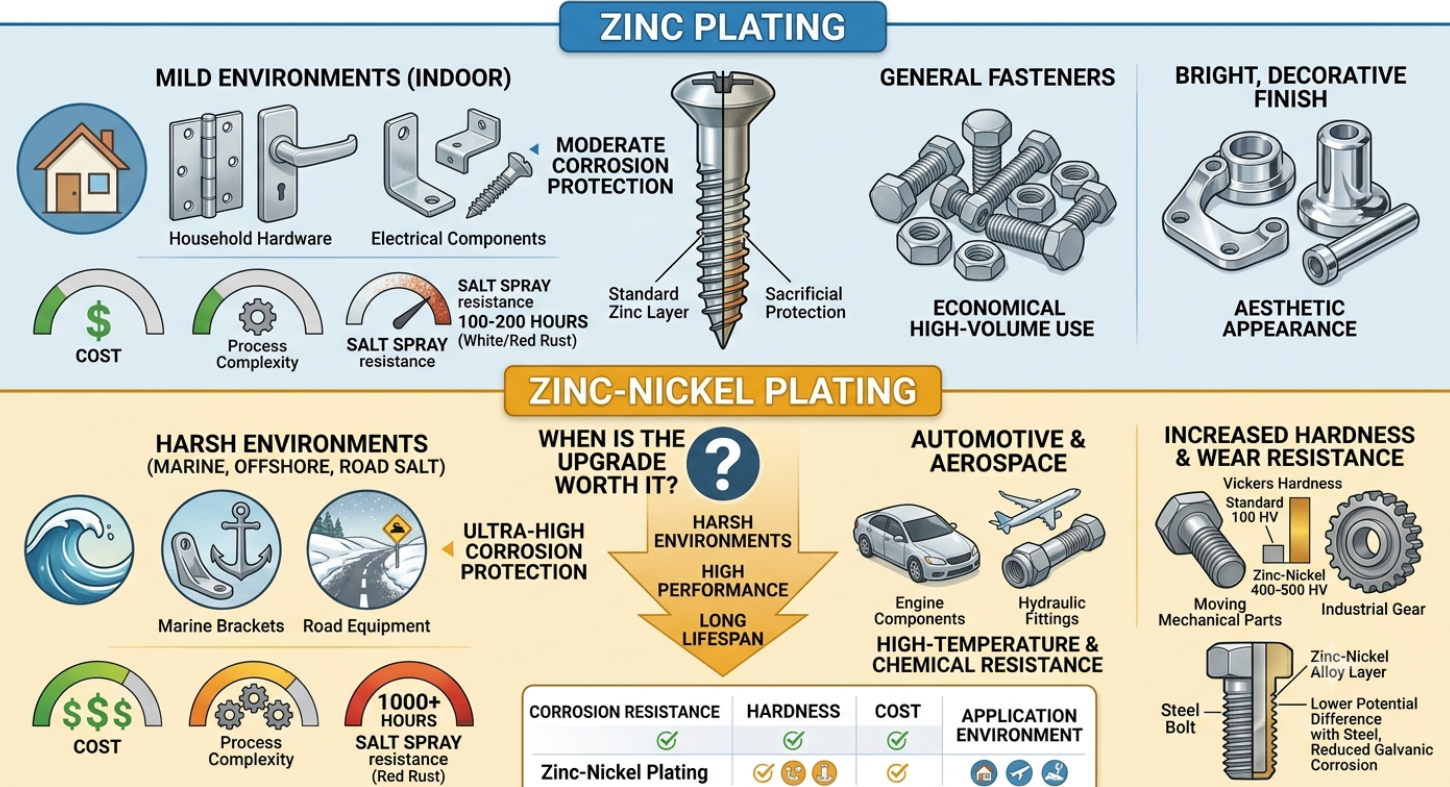
Two coatings, two very different price tags, and one question every buyer eventually asks: do I really need zinc-nickel, or is standard zinc plating good enough? Choosing wrong in either direction is expensive under-protect a part and it fails in the field; over-specify it and you’re paying a 3-4x premium for corrosion resistance you’ll never use. This guide breaks down exactly how the two coatings compare, what performance gap you actually get for the extra cost, and how to decide which one belongs on your print.
If you plate steel parts for a living, you’ve had this conversation before: an engineer specifies zinc-nickel “to be safe,” purchasing pushes back on the cost, and nobody on the call can say exactly how much extra corrosion protection the upgrade buys. That gap between the two coatings gets treated like a mystery when it isn’t. It’s measurable, it’s well documented, and it comes down to a small number of decision factors.
This comparison walks through what each coating actually is, how they perform side by side on corrosion resistance, hardness, temperature tolerance, and cost, and most importantly gives you a practical framework for deciding which one your part actually needs. By the end, you’ll be able to look at an application and know within a few minutes whether standard zinc plating is the right call or whether the zinc-nickel upgrade will pay for itself.
3-6x
Longer salt-spray life for zinc-nickel vs. standard zinc
2-4x
Typical cost premium for zinc-nickel plating
300°C+
Continuous service temperature zinc-nickel can withstand
What Is Zinc Plating?
Zinc electroplating deposits a layer of pure zinc onto a steel or iron substrate through an electrochemical process. The part is submerged in a zinc-bearing electrolyte and an electrical current drives zinc ions onto the surface, building a coating typically between 5 and 25 micrometers thick depending on the ASTM B633 service condition specified.
Zinc protects steel two ways. First, it acts as a physical barrier that keeps moisture and oxygen away from the base metal. Second, and more importantly, it protects galvanically: zinc is more anodic (chemically more reactive) than steel, so when both are exposed to a corrosive environment, the zinc corrodes first and sacrifices itself to protect the steel underneath. This is why zinc plating is often called a “sacrificial coating.”
A passivate or chromate conversion coating is almost always applied over the zinc after plating to slow the rate at which the zinc itself corrodes, multiplying the effective service life of the coating. Standard zinc plating has been the default corrosion protection for fasteners, brackets, and general hardware for decades because it is fast, inexpensive, and well understood by nearly every plater in the country.
What Is Zinc-Nickel Plating?
Zinc-nickel plating is an alloy coating typically 12 to 15 percent nickel co-deposited with zinc applied through a similar electroplating process but using a more tightly controlled bath chemistry and process window. The nickel content fundamentally changes how the coating behaves.
Pure zinc corrodes relatively quickly once exposed to a harsh environment because it has only one line of defense: sacrificial protection. Zinc-nickel corrodes far more slowly because the nickel alloy is more chemically stable and forms a denser, more adherent corrosion product layer. The coating still protects galvanically, but it depletes at a fraction of the rate of pure zinc under the same conditions. This is the core reason zinc-nickel consistently outperforms standard zinc in accelerated corrosion testing and real-world service life.
Zinc-nickel also holds up better under heat, resists abrasion better than pure zinc, and is compatible with aluminum and dissimilar-metal assemblies in ways that standard zinc is not (pure zinc in contact with aluminum can accelerate galvanic corrosion of the aluminum; zinc-nickel’s slower corrosion rate reduces that risk). These properties are why zinc-nickel has become the default specification for many automotive, aerospace, and defense components over the last two decades.
Have Questions About Your Parts? – (608) 524-8241
Zinc Plating vs. Zinc-Nickel: Head-to-Head Comparison
Here’s how the two coatings stack up across the properties that matter most when specifying a coating for a real part.
| Property | Standard Zinc Plating | Zinc-Nickel Plating |
| Composition | 99%+ pure zinc | Zinc alloy with 12-15% nickel |
| Typical thickness | 5-25 µm (SC1-SC4) | 5-15 µm (thinner coating, similar or better protection) |
| Corrosion resistance | Good; consumed relatively quickly in harsh exposure | Excellent; 3-6x longer salt spray life at equal thickness |
| Hardness | 50-80 HV (softer, more prone to wear) | 250-500 HV (significantly harder, better wear resistance) |
| Max service temperature | Degrades above ~150°C (250°F) | Stable to 300°C+ (570°F) in many applications |
| Galvanic compatibility | Riskier against aluminum assemblies | Lower galvanic corrosion risk near aluminum |
| Relative cost per part | Baseline (1x) | Typically 2-4x baseline |
| Typical service life gain | Baseline | Often 3-10 years longer in harsh environments |
| Common passivates | Clear, yellow, black trivalent chromate | Black or clear trivalent chromate, often with sealer |
| Best suited for | General indoor/outdoor hardware, moderate exposure | Extreme exposure, high-reliability, high-heat, or long-life critical parts |
Corrosion Performance: What the Salt Spray Data Actually Shows
Salt spray testing per ASTM B117 is the industry’s standard method for comparing coating systems, and it’s where the performance gap between zinc and zinc-nickel becomes concrete rather than theoretical. The table below compares approximate salt spray performance at comparable thickness, both with a trivalent passivate system.
| Coating System | Thickness | Hours to White Rust | Hours to Red Rust |
| Zinc + clear passivate | 8-12 µm | 24-48 hrs | 96-120 hrs |
| Zinc + yellow passivate | 12 µm | 72-120 hrs | 200-240 hrs |
| Zinc + yellow + sealer | 12-25 µm | 200+ hrs | 480+ hrs |
| Zinc-nickel + black passivate | 8-12 µm | 300-500 hrs | 700-1,000 hrs |
| Zinc-nickel + passivate + sealer | 8-15 µm | 500-1,000+ hrs | 1,200+ hrs |
The Practical Takeaway
At roughly the same coating thickness, zinc-nickel delivers three to six times the corrosion life of standard zinc. That means a part that would show red rust in a Midwest winter under standard zinc plating can go several winters sometimes a decade or more without visible corrosion under a properly sealed zinc-nickel system. The gap isn’t marginal; it’s the difference between an annual maintenance item and a part you install once and forget about.
How Zinc-Nickel Plating Is Applied: Process Differences
Part of what makes zinc-nickel more expensive is baked into the process itself. Understanding those differences helps explain why the cost premium exists and why not every plating shop offers zinc-nickel as a service.
Standard zinc plating baths are relatively forgiving. Zinc concentration, pH, and current density can drift within a fairly wide window and still produce a coating that meets ASTM B633. Zinc-nickel alloy baths are far less forgiving. The nickel-to-zinc ratio in the deposit has to land within a narrow band, typically 12 to 15 percent nickel by weight, because straying outside that range changes the coating’s corrosion behavior, appearance, and hardness. Hitting that ratio consistently requires tighter control of bath composition, temperature, and current density than standard zinc plating demands, along with more frequent lab analysis of the bath itself.
Deposition rate is also slower. Where a standard zinc line might cycle parts through in a matter of minutes, zinc-nickel typically requires longer dwell time in the tank to build an equivalent effective thickness, since the coating is thinner but has to be more uniform to perform as specified. Rack plating rather than barrel plating is also more common for zinc-nickel work on parts where alloy uniformity across the surface is critical, which adds labor cost compared to high-volume barrel processing.
Finally, not every plating shop runs zinc-nickel lines at all. The equipment, bath chemistry, and wastewater treatment infrastructure represent a real capital investment, and fewer shops have made it compared to the near-universal availability of standard zinc plating. That’s worth factoring into lead time expectations: sourcing zinc-nickel plating may mean working with a more specialized supplier or building in additional lead time compared to a commodity zinc job.
Environmental and Regulatory Considerations
Both coatings are applied with RoHS-compliant trivalent chromate passivate systems in modern plating operations, so neither one presents a compliance obstacle on that front. Where the two diverge is in how they’re treated in specific regulated industries.
Zinc-nickel has become the preferred replacement for cadmium plating in aerospace, defense, and some automotive applications. Cadmium offers excellent corrosion protection and lubricity but is a recognized environmental and worker-safety hazard, and its use is increasingly restricted or banned outright under REACH in the European Union and by internal policy at many U.S. manufacturers and defense contractors. Zinc-nickel with a trivalent passivate matches or exceeds cadmium’s corrosion performance in most applications without the regulatory and health liabilities, which is a major reason its adoption has accelerated over the past fifteen years.
On the wastewater side, nickel-bearing effluent from zinc-nickel plating operations is subject to additional discharge limits under EPA pretreatment standards compared to standard zinc plating wastewater. Reputable platers maintain permitted treatment systems for this, but it’s part of why zinc-nickel capacity is more concentrated among specialized shops rather than distributed across every job shop that runs a zinc line.
Total Cost of Ownership: Looking Past the Per-Part Price
The per-part plating cost is only one side of the ledger. The other side is what happens when a coating fails in the field, and that’s where the zinc-nickel upgrade often earns back its premium even on parts where the plating quote looks steep on paper.
Consider a fastener buried inside a sealed automotive subassembly that requires disassembly labor, a service bay, and a replacement part to fix if it corrodes and seizes. The cost of that single field failure labor, part, downtime, and potentially a warranty claim or dealer comeback will almost always exceed the incremental plating cost of specifying zinc-nickel across the full production run. The same logic applies to any part that’s expensive or difficult to access after installation: bridge hardware, buried anchors, sealed enclosures, or structural connectors on equipment that isn’t torn down for routine service.
On the other hand, a bracket that sits on an accessible shelf inside a climate-controlled building, replaceable in minutes at negligible cost, doesn’t carry that same failure-cost multiplier which is exactly why blanket-specifying zinc-nickel across an entire bill of materials is usually the wrong call. The total-cost-of-ownership question isn’t “which coating is cheaper per part,” it’s “which coating is cheaper once you include the realistic cost of a corrosion-related failure for this specific part, in this specific location, over its expected service life.”
Cost Comparison: What You’re Actually Paying For
Zinc-nickel plating costs more, and it’s worth understanding exactly why before deciding whether the premium is justified for your parts.
- Bath chemistry: zinc-nickel electrolytes are more expensive to formulate and maintain, and nickel itself is a costlier raw material than zinc.
- Process control: alloy composition has to stay within a tight window (12-15% nickel) for the coating to perform as specified, which requires closer monitoring, more frequent bath analysis, and tighter current control than standard zinc.
- Slower deposition rates: zinc-nickel typically plates more slowly than pure zinc, which means more time in process per part.
- Waste treatment: nickel-bearing wastewater has additional treatment and regulatory requirements compared to standard zinc plating effluent.
- Lower volume, less commoditized: fewer shops run zinc-nickel at scale compared to standard zinc, so it hasn’t seen the same cost compression from competition and volume.
Put together, these factors typically put zinc-nickel at two to four times the per-part cost of standard zinc plating, depending on part geometry, lot size, and the specific alloy and passivate system required. On a small fastener, that might mean a few cents more per part. On a large or complex part, the dollar difference can be significant which is exactly why the decision needs to be made deliberately rather than defaulted to “upgrade to be safe.”
Where Each Coating Is Actually Used
Real specification patterns across industries make the decision easier to benchmark against your own application.
| Industry / Application | Typical Coating | Why |
| General fasteners, brackets, indoor hardware | Standard zinc (SC1-SC2) | Low exposure risk; cost efficiency wins |
| Outdoor construction & agricultural hardware | Standard zinc (SC3-SC4) | Meets service life needs at lower cost than zinc-nickel |
| Automotive underbody & brake components | Zinc-nickel | Road salt, vibration, and long OEM warranty periods demand it |
| Engine bay & high-heat fastener assemblies | Zinc-nickel | Standard zinc degrades above ~150°C; zinc-nickel does not |
| Aerospace fasteners & structural hardware | Zinc-nickel | Extreme reliability requirements, long service life, weight-sensitive alternative to cadmium |
| Marine & coastal hardware | Zinc-nickel (often required) | Salt-air exposure consumes standard zinc too quickly |
| Defense & military components | Zinc-nickel | MIL-spec requirements often mandate it as a cadmium replacement |
| Electrical enclosures, indoor machinery | Standard zinc (SC1) | Minimal corrosive exposure; zinc-nickel adds cost with no benefit |
When Standard Zinc Plating Is the Right Call
Standard zinc plating is very often the correct engineering and economic decision. It’s the right choice when:
- The part lives indoors, or has only occasional or seasonal outdoor exposure.
- Service life expectations are measured in a few years, not decades, or the part is on a routine replacement cycle.
- The part won’t be exposed to continuous road salt, marine air, or aggressive industrial chemicals.
- Operating temperatures stay comfortably below 150°C (300°F).
- Budget and volume make the 2-4x cost premium hard to justify against the actual risk of corrosion failure.
- There’s no galvanic compatibility concern with adjacent aluminum components.
When the Zinc-Nickel Upgrade Is Worth It
The upgrade earns its cost premium when the failure of the coating carries real consequences. Consider zinc-nickel when:
- The part is safety-critical and coating failure could contribute to a field failure, recall, or warranty claim.
- The application involves constant road salt, de-icing chemicals, or coastal/marine salt-air exposure.
- Service temperatures regularly exceed 150°C, such as engine bay or exhaust-adjacent hardware.
- The part is assembled against aluminum and galvanic corrosion risk needs to be minimized.
- The OEM specification or customer contract requires it many automotive, aerospace, and defense specs mandate zinc-nickel outright.
- The cost of a field failure (warranty, recall, downtime, reputational damage) significantly exceeds the plating cost premium.
The part is difficult or expensive to access for maintenance or replacement once installed, making a longer service life valuable on its own.
The Most Common Mistake
Specifying zinc-nickel across an entire assembly “to be safe” when only a handful of parts actually face the exposure that justifies it. This inflates cost without improving reliability where it matters. The better approach is a mixed specification: zinc-nickel on the parts genuinely exposed to salt, heat, or high-consequence failure, and standard zinc on everything else. A part-by-part risk review, not a blanket policy, is what actually controls cost while protecting the parts that need it.
How to Specify the Right Coating on a Drawing
Once you’ve decided which coating your part needs, specifying it correctly avoids the ambiguity that leads to under- or over-plated parts. A complete specification includes the standard, the coating type, the thickness or service condition, and the passivate system.
Specification Examples
Standard zinc: “Zinc electroplate per ASTM B633, SC3, Type II (trivalent yellow passivate). Minimum thickness 12µm on significant surfaces.”
Zinc-nickel: “Zinc-nickel alloy plate per ASTM B841 (or applicable OEM spec), Class 2, Type II. 12-15% nickel content, minimum thickness 8µm on significant surfaces, black trivalent passivate with sealer.”
If you’re unsure which service condition or class applies, or whether your customer’s OEM specification calls for zinc-nickel specifically, the fastest way to get it right is to send your plater the part print or purchase order specification directly rather than guessing at a drawing note. Vague callouts like “zinc plate” or “corrosion resistant coating” leave the decision entirely up to the plater, and different shops will interpret that differently.
“We see the same conversation on almost every quote request that involves zinc-nickel: an engineer wants the upgrade, purchasing wants the standard zinc price. Our job is to give both sides the actual data the salt spray numbers, the temperature limits, the real cost difference so the decision is made on evidence, not on habit or worst-case assumption. Sometimes that means talking a customer out of zinc-nickel they don’t need. That’s the right call every time.”
Jim Schweich, Chief Executive Perfectionist, Plateco, Inc.
Frequently Asked Questions
Is zinc-nickel plating always better than standard zinc plating?
Better in performance terms, yes zinc-nickel outperforms standard zinc on corrosion resistance, hardness, and heat tolerance in nearly every measurable way. But “better” and “correct for the application” are different questions. For a part with low exposure and a short expected service life, standard zinc delivers everything the application needs at a fraction of the cost. The right coating is the one that matches the part’s actual operating environment and required service life, not automatically the highest-performing option available.
How much more expensive is zinc-nickel plating than standard zinc?
Typically two to four times the per-part cost of standard zinc plating, depending on part geometry, lot size, alloy specification, and passivate system. The gap narrows somewhat at high volume and widens on small, complex, or low-volume parts where the more demanding zinc-nickel process control adds proportionally more cost.
Can zinc-nickel and standard zinc be used on the same assembly?
Yes, and this is common practice. Many assemblies mix the two coatings deliberately: zinc-nickel on the fasteners or brackets exposed to road salt, heat, or high-consequence failure, and standard zinc on the lower-exposure hardware elsewhere in the same assembly. This targeted approach controls total plating cost without under-protecting the parts that actually need the upgrade.
Does zinc-nickel plating cause the same thread-binding issues as standard zinc on fasteners?
Zinc-nickel coatings are often specified thinner than standard zinc (commonly 8-12µm versus 12-25µm) while still outperforming it on corrosion resistance, which actually reduces dimensional risk on threaded fasteners compared to a heavy SC4 zinc deposit. That said, any electroplated coating adds material to thread flanks, so tight-tolerance threaded parts should still be reviewed for thread class compatibility after plating, regardless of which coating is used.
Is zinc-nickel plating RoHS compliant?
Yes, when applied with a trivalent (Cr III) passivate system, zinc-nickel plating is RoHS compliant. Zinc-nickel with a trivalent black or clear passivate is one of the most common replacements for legacy cadmium and hexavalent chromium coatings in automotive, aerospace, and defense applications precisely because it meets modern environmental compliance requirements while matching or exceeding cadmium’s corrosion performance.
Does zinc-nickel plating look different from standard zinc plating?
Yes. Standard zinc with a clear or yellow passivate typically has a bright, silvery, or gold iridescent finish. Zinc-nickel is most commonly finished with a black trivalent passivate, giving parts a deep matte-to-satin black appearance that’s become closely associated with premium automotive and aftermarket hardware. If appearance matters to your application visible fasteners, aftermarket parts, or components where a black finish is part of the product’s branding that’s a secondary factor worth weighing alongside the corrosion performance case for zinc-nickel.
How do I know if my OEM customer requires zinc-nickel specifically?
Check the part print and any referenced OEM specification document automotive, aerospace, and defense OEMs that require zinc-nickel will typically call it out explicitly (for example, referencing ASTM B841, a specific OEM alloy/thickness class, or a named cadmium-replacement program). If the print simply says “zinc plate” with no further detail, go back to your customer and confirm before running parts, since assuming the wrong coating means re-work or a rejected lot.
Not Sure Which Coating Your Parts Need?
Plateco has been specifying and applying zinc and zinc-nickel coatings to ASTM, OEM, and military specifications for decades across the Midwest. Send us your print and your application details, and we’ll tell you plainly whether standard zinc will do the job or whether the zinc-nickel upgrade is worth the investment no upselling, just the data.