

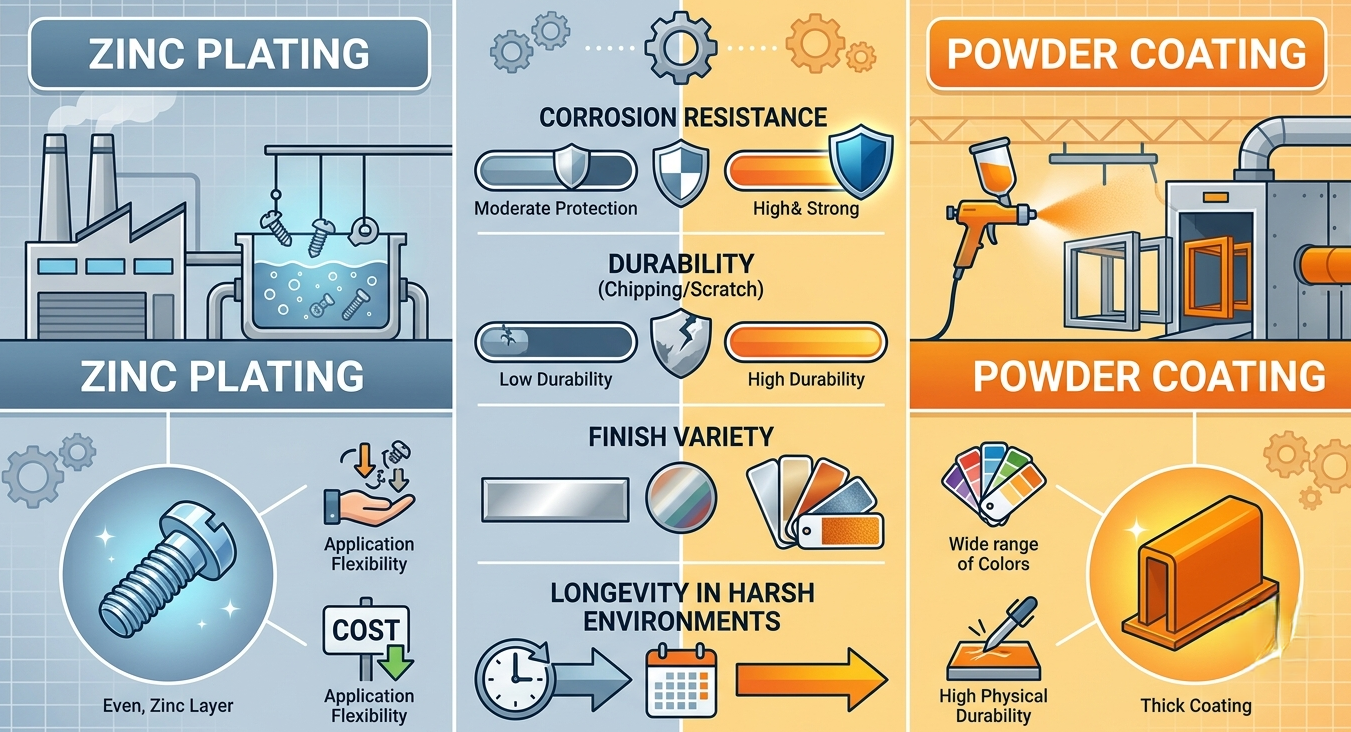
Few questions in manufacturing finishing come up more often and get answered more confidently with less actual evidence than this one: should this part be zinc plated or powder coated? Both finishes are widely used, both provide meaningful corrosion protection, and both are available at competitive prices from suppliers in almost every manufacturing region. Yet they work through completely different mechanisms, perform very differently in specific environments, and are suited to completely different applications. Choosing the wrong one is a decision that sometimes looks fine for months and only becomes obvious when parts begin corroding in the field.
This guide puts both finishes side by side across every dimension that matters to engineers and buyers: how they protect against corrosion, how they perform when scratched or damaged, what happens to threaded and complex geometry, where cost falls at different volumes, and which applications each one handles definitively better. At Plateco, we specialize in zinc electroplating so we have a perspective on this comparison. We have also been honest enough with customers for fifty years to tell them when zinc plating is not the right answer for their application, and this guide reflects that same honesty.
How to Use This Guide
This guide is organized by comparison dimension mechanism, scratch resistance, geometry, cost, and application scenarios. If you have a specific question (how they differ on threaded parts, for example), skip directly to that section. If you are making a first-time decision between the two finishes, read through in order. The application decision matrix in Section 7 provides a quick-reference summary for common part types.
Section 1: How Each Process Works — The Fundamental Difference
Understanding why zinc plating and powder coating perform differently in corrosion protection starts with understanding how each one actually protects the steel underneath. They use completely different mechanisms and that difference explains almost everything else in this comparison.
Zinc Plating: Sacrificial (Galvanic) Protection
Zinc electroplating deposits a thin layer of metallic zinc onto a steel substrate through an electrochemical process. The zinc deposit typically ranges from 5 to 25 micrometers thick (0.0002 to 0.001 inches), depending on the service condition specified under ASTM B633. This deposit is then passivated treated with a trivalent chromate conversion coating to seal the zinc surface and significantly extend its corrosion resistance.
The corrosion protection mechanism of zinc plating is fundamentally electrochemical and sacrificial. Zinc sits lower on the galvanic series than iron and steel it is more anodic which means that when zinc and steel are in electrical contact and exposed to an electrolyte (moisture), the zinc corrodes preferentially, protecting the steel underneath. Even when the zinc coating is scratched or cut, exposing bare steel at the scratch, the surrounding zinc continues to sacrifice itself to protect the exposed steel. This self-sacrificing protection at damaged areas is the defining characteristic that distinguishes zinc plating from barrier coatings.
Powder Coating: Barrier (Physical) Protection
Powder coating applies a dry thermoplastic or thermoset polymer powder to the steel surface electrostatically, then cures it in an oven at typically 350 to 400 degrees Fahrenheit to produce a hard, continuous film ranging from 60 to 100 micrometers thick (0.002 to 0.004 inches) several times thicker than a standard zinc deposit. The coating forms a dense physical barrier between the steel surface and the environment, preventing moisture and oxygen from reaching the steel as long as the coating is intact.
The corrosion protection mechanism of powder coating is purely physical it is a barrier. As long as the coating is unbroken, it is highly effective. When the coating is scratched, chipped, or damaged, the barrier is breached, moisture penetrates to the steel, and corrosion begins at and underneath the coating film. Powder coating provides no galvanic protection once the barrier is broken, there is nothing chemical or electrochemical protecting the exposed steel from the surrounding environment. Corrosion can actually undermine the coating around a damage site, causing what is known as filiform corrosion or underfilm corrosion, where rust spreads laterally under the intact coating.
| Zinc Plating |
Powder Coating |
|
Corrosion Protection Mechanism |
|
| Electrochemical and sacrificial. Zinc corrodes in place of steel. Protects even at damaged sites. Galvanic protection continues as long as zinc remains within approximately 1/8 inch of the exposed steel. | Physical barrier only. No electrochemical protection. Full protection when coating is intact and undamaged. Corrosion begins at any breach and can spread laterally under the coating. |
Have Questions About Your Parts? – (608) 524-8241
Section 2: Scratch Resistance and Post-Damage Corrosion
No coating is scratch-proof in real-world manufacturing environments. Parts are assembled, handled, installed, and operated under conditions that virtually guarantee surface damage at some point in their service life. How each finish behaves after that damage is one of the most important practical differences between zinc plating and powder coating.
Zinc Plating After Damage
When zinc-plated steel is scratched to bare metal, the galvanic mechanism continues to operate in the vicinity of the scratch. Zinc ions migrate to the exposed steel surface, providing cathodic protection. In practice, a small scratch or nick on a zinc-plated part will show white rust (zinc oxide) at the scratch site rather than red rust (iron oxide) for an extended period the zinc is still sacrificing itself to protect the steel. This is why zinc-plated fasteners installed with wrenches or screwdrivers which inevitably abrade the coating at contact points still provide corrosion protection at those abraded areas. The corrosion protection is distributed through the metal, not just through the coating surface.
Powder Coating After Damage
A scratch through the powder coat film that reaches the steel surface is a point failure that begins corroding immediately at the breach. Unlike zinc plating, there is no galvanic mechanism to arrest corrosion at the damage site. Steel rusts, and the rust products can expand under the adjacent coating film, causing delamination that spreads outward from the scratch. A small stone chip on a powder-coated agricultural implement can become a 2-inch rust patch in a single field season. High-quality powder coat with a zinc phosphate pre-treatment layer performs significantly better than standard powder coat in this regard the phosphate layer slows the corrosion spread at breach sites but still cannot replicate the self-protecting galvanic mechanism of zinc plating.
Verdict: Scratch and Damage Resistance
Winner: Zinc Plating
Zinc plating’s galvanic protection mechanism continues to protect steel at and near damaged areas. Powder coating loses its protection advantage entirely at any breach, with potential for spreading underfilm corrosion. For parts that will be mechanically handled, assembled with tools, or exposed to abrasion in service, zinc plating provides meaningfully better post-damage protection.
Section 3: Threaded Parts and Complex Geometry
The geometry of a part has a major impact on which finish is practically applicable. This section covers one of the clearest differentiators between the two processes.
Zinc Plating on Threaded Parts
Zinc electroplating is specifically designed for threaded fasteners and complex-geometry parts. The electrochemical deposition process coats all surfaces of the part that the electrolyte contacts including thread roots, inner bore surfaces, blind holes, and recessed features. Alkaline zinc bath chemistry provides throwing power that distributes the zinc deposit into low-current-density areas, providing meaningful corrosion protection in thread roots and recesses, not just on exposed surfaces. The total deposit thickness of 5 to 25 micrometers is thin enough that properly specified zinc plating on standard thread tolerances does not cause interference threaded parts plate and still pass thread gauge checks.
Powder Coating on Threaded Parts
Powder coating is largely incompatible with threaded fasteners and most complex geometry. At 60 to 100 micrometers thickness, powder coat adds enough material to a threaded surface to change the thread class a powder-coated bolt may not thread into a standard nut, and a powder-coated tapped hole may not accept a standard bolt. Masking threads before coating is possible but labor-intensive, adds cost significantly, and is impractical for high-volume fastener production. Powder coat also does not penetrate effectively into blind holes, deep recesses, or complex internal features the coating is largely a line-of-sight process applied electrostatically, and surfaces that cannot be reached by the spray gun and that cannot allow for adequate current distribution during curing will have thin or no coating.
|
Zinc Plating |
Powder Coating |
|
Threaded Parts and Complex Geometry |
|
| Directly compatible. Alkaline zinc electroplating coats all surfaces including thread roots. Standard deposit thickness (5-25 micrometers) does not cause thread interference. This is the primary application zinc plating was designed for. | Largely incompatible. At 60-100 micrometer thickness, powder coat causes thread interference. Masking is possible but costly and impractical for volume production. Poor penetration into recesses and blind holes. |
Verdict: Threaded Fasteners and Complex Geometry
Winner: Zinc Plating
Zinc plating is the definitive choice for threaded fasteners, bolts, nuts, clips, and any component with recesses or complex internal geometry. Powder coating is not a practical option for these parts at commercial production volumes.
Section 4: Appearance and Aesthetic Capability
For many applications, corrosion protection is the primary criterion and appearance is secondary. For others consumer products, visible structural components, branded equipment appearance matters as much or more than the underlying protection mechanism. These two finishes have fundamentally different aesthetic capabilities.
Zinc Plating Appearance
Standard zinc plating with trivalent yellow passivate produces an iridescent gold-amber metallic finish. Clear passivate produces a clean blue-silver metallic appearance. Black passivate produces a flat to satin black. These are essentially the three aesthetic options within standard zinc electroplating, and all three have a distinctly industrial, metallic character. Zinc plating does not come in custom colors, does not produce textured or matte polymer surfaces, and does not match the visual range available from powder coat.
Powder Coating Appearance
Powder coating is available in essentially any color (RAL, Pantone, and custom color matching), any gloss level (from flat matte to high gloss), and a wide range of textures (smooth, satin, wrinkled, hammertone, metallic flake). It produces a uniform, paint-like appearance that conceals surface imperfections and provides visual consistency across complex assemblies. For branded equipment, consumer products, architectural metalwork, and anything where the coating is the visible surface of the final product, powder coating’s aesthetic flexibility is a significant advantage.
|
Zinc Plating |
Powder Coating |
|
Appearance and Aesthetic Options |
|
| Three standard finishes: clear/blue-silver, yellow/iridescent gold, black matte. Metallic, industrial character. No custom colors, no textures. Consistent within each passivate type. | Any color, any gloss level, wide range of textures. Uniform paint-like appearance. Hides surface imperfections. Superior aesthetic flexibility for consumer and branded products. |
Verdict: Appearance and Aesthetic Flexibility
Winner: Powder Coating
Powder coating wins decisively on appearance flexibility. If the finish is the visible face of the product and color, gloss, or texture matter, powder coating is the correct choice. Zinc plating’s aesthetic range is functional and appropriate for industrial hardware but limited compared to powder coat’s full color and finish spectrum.
Section 5: Cost Comparison — Where Each Finish Is More Economical
Cost comparison between zinc plating and powder coating is only meaningful in the context of specific part types and production volumes. The per-part economics differ significantly by geometry and volume, and the lowest cost per part is not always the right decision if it comes at the expense of performance or specification compliance.
Zinc Plating Cost Characteristics
Zinc electroplating for small parts in barrel processing is typically the lowest-cost commercial corrosion protection process available. High-volume barrel plating of fasteners and small stampings at commercial rates runs in the range of $0.25 to $0.75 per pound, making the per-part cost on a small fastener a fraction of a cent. Rack plating for larger or more complex parts is higher per pound but remains competitive with powder coat for parts that can be processed in volume. Zinc plating cost scales efficiently with volume high-volume programs are significantly cheaper per pound than small spot orders.
Powder Coating Cost Characteristics
Powder coating for flat panels and structural components is competitive with or cheaper than zinc plating for large-surface parts where the cost per square foot of coated surface is the relevant metric. Powder coat’s higher film thickness means the coating material cost is higher per part, but for large flat components the labor and process time advantages can offset this. Powder coating becomes significantly more expensive for threaded or complex-geometry parts due to masking requirements, lower hanging density in the oven, and the setup costs of custom color changeovers.
| PART TYPE | ZINC PLATING COST | POWDER COATING COST | MORE ECONOMICAL |
| Small fasteners, high volume (barrel) | Very low ($0.25–0.50/lb) | Not practical (thread interference) | Zinc Plating |
| Small stampings, high volume | Low ($0.30–0.55/lb) | Moderate (requires pre-treatment) | Zinc Plating |
| Large flat brackets / structural | Moderate ($0.50–0.90/lb rack) | Competitive low per sq ft | Powder Coat or Equal |
| Large weldments / frames | Higher (complex rack setup) | Lower (single large parts/oven) | Powder Coating |
| Mixed-lot small parts, low volume | Minimum charge dominates | Setup charge dominates | Comparable (both high effective rate) |
| Precision threaded components | Low-moderate | Not applicable thread interference | Zinc Plating (only option) |
Section 6: Salt Spray Performance — What the Test Numbers Actually Mean
ASTM B117 salt spray testing is the most commonly referenced corrosion performance benchmark for both zinc plating and powder coating. Understanding what salt spray hours mean and what they do not mean is important for comparing the two finishes on this dimension.
Zinc Plating Salt Spray Hours
ASTM B633 service conditions correspond to different expected salt spray performance levels. At SC3 (12 micrometer zinc), trivalent yellow passivate typically provides 72 to 120 hours to white rust and 200 to 240 hours to red rust in continuous salt spray. With a topcoat sealer over the passivate, red rust resistance can extend to 480 hours or more. These figures represent the zinc deposit protecting steel through the galvanic mechanism and this protection continues to operate even after the test hours are accumulated at surface breach sites.
Powder Coating Salt Spray Hours
Quality powder coat applied over zinc phosphate pre-treatment on clean steel routinely achieves 500 to 1,000 hours of salt spray without red rust at the panel surface. This is superior to standard zinc plating salt spray performance in the undamaged test panel scenario. However, standard salt spray tests score panels in pristine condition. The scribing test where a scratch is made through the coating to bare metal before salt spray exposure reveals that powder coat’s advantage diminishes significantly at damage sites, where zinc plating’s galvanic mechanism continues to provide protection that powder coat cannot.
|
Zinc Plating |
Powder Coating |
|
Salt Spray Performance (ASTM B117) |
|
| SC3 zinc + trivalent yellow: 200-240 hrs to red rust (undamaged). With topcoat sealer: 480+ hrs. At scratch sites: galvanic protection continues even after breach. | Quality powder coat over zinc phosphate: 500-1,000+ hrs to red rust (undamaged panel). At scribed/scratched sites: no galvanic protection; corrosion spreads from breach. |
Key Insight on Salt Spray Comparison
Comparing salt spray hours for zinc plating and powder coating requires specifying whether you are testing an undamaged panel or a scribed (scratched) panel. On undamaged panels, quality powder coat typically outperforms standard zinc plating. On scribed panels that simulate real-world damage, zinc plating’s galvanic protection maintains much more of its performance advantage than the undamaged panel comparison suggests. For parts that will see abrasion, impact, or assembly handling which is most of them the scribed performance comparison is more relevant than the undamaged panel comparison.
One of the most important and underutilized strategies in manufacturing finishing is the combination of zinc plating and powder coating on the same part. This approach layers the galvanic protection mechanism of zinc under the aesthetic and barrier protection of powder coat, producing a system that outperforms either finish alone.
In this system, steel parts are zinc electroplated first typically to SC2 or SC3 (8 to 12 micrometers) with clear passivate, which provides the best adhesion base for subsequent organic coatings and then powder coated in the normal way. The zinc provides sacrificial protection at any point where the powder coat is scratched or damaged, arresting corrosion at the breach site. The powder coat provides the aesthetic finish, color, and additional barrier protection over the intact surface. Salt spray performance of the combined system can exceed 1,000 hours even with scribing, significantly outperforming either finish alone.
This combination is widely used in agricultural equipment (tractor frames, implement linkages, and structural components where both appearance and corrosion protection are specified), automotive underbody and under-hood components, commercial outdoor furniture, and architectural metalwork where a color finish is required alongside robust corrosion protection that survives installation damage.
When to Specify Zinc Plus Powder Coat
Consider zinc plating followed by powder coating when: (1) the application requires a specific color or appearance that zinc plating alone cannot provide, AND (2) the part will see physical handling, abrasion, or installation damage that would breach a powder coat-only finish, OR (3) the OEM or customer specification requires demonstrated salt spray performance above 480 hours on scribed test panels. The incremental cost of the combined system is typically 25 to 40 percent above powder coat alone, and usually significantly less than the alternative of a thicker, single-process corrosion protection system.
Section 8: Application Decision Matrix — Which Finish for Your Part?
Application Scenario vs. Recommended Finish
| APPLICATION / SCENARIO | RECOMMENDED FINISH | REASON |
| Hex bolts, nuts, threaded fasteners | Zinc Plating | Thread compatibility; galvanic protection at installation damage sites |
| Springs, clips, wire forms | Zinc Plating | Complex geometry; thread/spring compatibility; galvanic mechanism |
| Agricultural equipment frame (structural, visible) | Zinc + Powder Coat | Color/appearance needed; galvanic protection survives field damage |
| Large flat structural bracket, indoor use | Powder Coating | Cost effective for large flat surfaces; indoor exposure means no damage risk |
| Automotive underbody component (exposed to road salt) | Zinc Plating (or Zinc + Powder Coat) | Galvanic protection essential; road salt exposure; assembly handling damage |
| Consumer hardware (hinges, handles, visible) | Powder Coating or Zinc (black/clear) | Appearance-driven; if threaded, zinc only; if flat, powder coat for color |
| HVAC sheet metal enclosure | Powder Coating | Controlled indoor environment; flat geometry; appearance important |
| Outdoor electrical enclosure (exposed weather) | Zinc + Powder Coat | Maximum corrosion protection; appearance; UV stability |
| Precision machined component (tight tolerances) | Zinc Plating | 5-25 micrometer deposit preserves tolerances; powder coat too thick |
| Agricultural implement (ground contact, abrasion) | Zinc Plating | Galvanic protection critical at abrasion sites; powder coat alone insufficient |
Frequently Asked Questions
Q: Can powder coating be applied over zinc plating?
Yes, and this is often the optimal system for applications requiring both appearance and robust corrosion protection. Zinc plated with clear passivate (not yellow passivate, which can reduce adhesion with some primer systems) provides an excellent base for powder coat adhesion. The powder coat top layer adds color, gloss, UV stability, and barrier protection. The zinc layer underneath provides galvanic protection at any breach in the powder coat. Confirm compatibility between your specific passivate chemistry and primer or powder coat system with your coating supplier before specifying most modern powder coat systems are compatible with trivalent clear passivate.
Q: My customer spec says zinc plate AND the drawing shows a paint finish. Which do I follow?
Both in sequence. This is the zinc plus powder coat combination. The zinc plating specification governs the electroplating process (ASTM B633 service condition, trivalent passivate type, hydrogen embrittlement requirements). The paint or powder coat specification governs the subsequent coating. The two specifications are for sequential processes on the same part, not alternative options. If there is apparent conflict between the two for example, if the zinc passivate spec and the powder coat adhesion requirements seem incompatible flag this to your customer’s engineering team before processing; it may be a drawing error or an outdated specification.
Q: Powder coat is thicker doesn’t that mean better protection?
Thicker does not automatically mean better corrosion protection. The mechanism matters as much as the thickness. A 100-micrometer powder coat layer is a physical barrier that is fully effective when intact and provides zero active protection when breached. A 12-micrometer zinc deposit is an active galvanic protection system that continues to protect the steel even at breach sites. In undisturbed laboratory conditions, thicker powder coat typically outperforms thinner zinc plating in pure salt spray hours. In real-world conditions where coatings get scratched, chipped, and abraded during manufacturing, installation, and service, zinc plating’s galvanic mechanism provides a type of protection that powder coat’s additional thickness cannot replicate.
Q: Is there an environmental difference between zinc plating and powder coating?
Both processes have environmental considerations. Modern zinc electroplating with trivalent chromate chemistry is RoHS, ELV, and REACH compliant the transition from hexavalent chromate eliminated the most significant regulatory concern associated with zinc plating chemistry. Zinc itself is a naturally occurring element and the primary zinc compounds produced by corrosion (zinc oxide, zinc carbonate) are relatively benign environmentally. Powder coating is solvent-free (unlike liquid paint), produces minimal VOC emissions, and generates less hazardous waste than many liquid coating systems. Neither process is without environmental impact, but both operate within current regulatory frameworks when properly managed.
Q: My parts are currently powder coated but we’re having corrosion problems at assembly. Should we switch to zinc?
Assembly-related corrosion on powder-coated parts is a classic symptom of the barrier coating failure mode the coating is being breached during assembly by tools, wrenches, fastener installation, or press-fit operations, and there is no galvanic protection at those breach sites. Switching to zinc plating (or a zinc-plus-powder-coat combination if appearance must be maintained) addresses the root cause by providing galvanic protection at the specific damage sites that assembly operations create. Before switching, confirm that threaded interfaces are involved and that zinc plating’s thread compatibility will not introduce a different problem. Zinc plating is almost always the correct solution for assembly-damage-induced corrosion on threaded or mechanically assembled components.
Q: Does Plateco offer zinc plating as a pre-treatment for parts that will be powder coated?
Yes. Plateco regularly processes parts that are zinc plated at our facility and then powder coated by a separate finishing operation downstream. We plate to the appropriate service condition and use clear passivate (which provides the best adhesion base for organic coatings) for parts intended for subsequent powder coat, and provide the appropriate documentation. If you are considering zinc plus powder coat as a combined system, discuss the complete process sequence with both your zinc plater and your powder coat supplier to ensure chemistry compatibility and sequence timing are correct.
Final Thought
Zinc plating versus powder coating is not a competition with a universal winner. It is a decision with a correct answer for each specific application an answer that depends on the geometry of the part, the environment it will operate in, the handling and installation conditions it will face, the appearance requirements of the product, and the cost constraints of the program. The manufacturers who get this decision right consistently are not the ones who default to whichever finish their previous supplier offered or whichever their drawing has always specified they are the ones who understand the mechanism behind each finish well enough to match it to the actual protection challenge their part faces.
The practical summary: zinc plating is the right default for threaded fasteners, complex geometry parts, and anything that will be mechanically handled or installed in ways that will breach a coating. Powder coating is the right choice when appearance is the dominant requirement and the part is large, flat, and protected enough from mechanical damage that the barrier mechanism can remain intact. The combination of zinc plating under powder coating is the right choice when the application demands both and it delivers corrosion performance that neither finish achieves alone.
If you are not certain which finish is right for your specific parts and application, the conversation worth having is with a zinc plating supplier who is confident enough in their process to tell you honestly when zinc plating is not the answer and when the zinc-plus-powder-coat combination might be exactly what you need.
Talk to Plateco About Your Application
Plateco has been zinc plating parts for corrosion-demanding applications since 1974. We will tell you honestly whether zinc plating alone, zinc plus powder coat, or an alternative process better serves your specific application. Send us your drawing and application description.
plateco.net | (608) 524-8241 | 1375 Industrial Street, Reedsburg, WI 53959
On Spec. On Time. Or It’s On Us.