

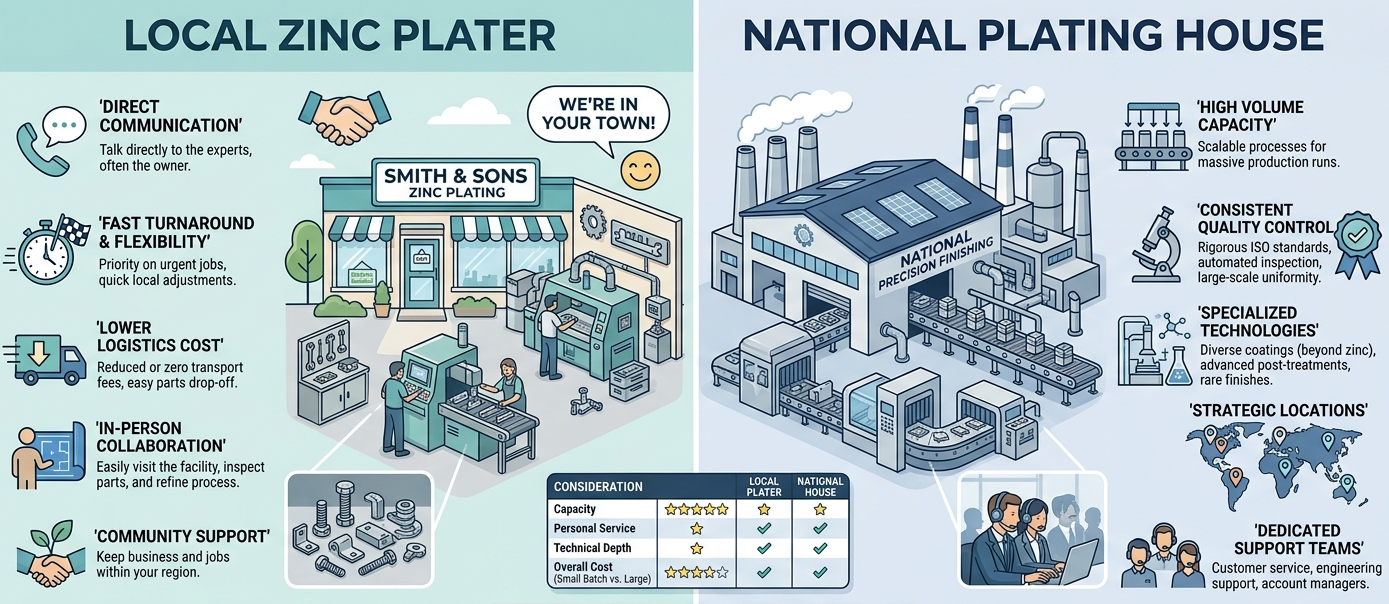
A quoting spreadsheet rarely tells the whole story. The national house comes in eight cents cheaper per part on paper, but the freight, the lead time, and the three-day wait for a callback when something goes wrong never make it into that spreadsheet. Choosing a zinc plating partner isn’t really a choice between two vendors it’s a choice between two different operating models, and each one shifts risk onto your shoulders in a different place. This guide breaks down exactly where those trade-offs live, so you can make the call with your eyes open.
Every purchasing manager who has sourced zinc plating for more than a year has faced this exact decision: stay with the plater twenty minutes down the road, or move the work to a national plating group that just bought out three regional shops and is quoting aggressively to fill capacity. The national number usually looks better on the first pass. The local number usually looks better after the first missed ship date.
Neither outcome is guaranteed. Local platers can be slow and undercapitalized. National plating houses can be responsive and excellent. The point of this guide isn’t to tell you which one wins it’s to show you exactly which variables actually move, so you’re comparing the right things instead of comparing a quote sheet to a gut feeling.
We’ll walk through turnaround time, true landed cost, quality consistency, communication when things go wrong, certifications and specialized capability, and minimum order flexibility the six factors that actually determine whether a plating relationship works for your business, not just for one job.
20–35%
Typical freight and logistics cost added when plating moves out of your region
2–3x
How much longer a national house’s average lead time often runs versus a local shop for standard lots
6
The number of factors that actually decide this comparison — not just price per part
Why This Decision Is Bigger Than a Line-Item Quote
It’s tempting to treat a plating decision like any other commodity purchase: get three quotes, take the low bid, move on. Zinc plating doesn’t behave like a commodity purchase, even though the coating itself electrodeposited zinc per ASTM B633 is a standardized, specified process. What varies enormously between suppliers isn’t the chemistry. It’s everything around the chemistry: how fast your parts move through the queue, how much variation shows up lot to lot, how a rejected batch gets handled, and whether the person who answers your call actually knows your part number.
A local plater and a national plating house are not two versions of the same service with different price tags. They’re two different business models, each with structural advantages and structural blind spots. A regional shop that’s been in the same building since the 1970s has deep, specific knowledge of a smaller customer base and a strong incentive to protect that relationship. A national platform with facilities in six states has scale, standardized processes, and often better raw pricing on chemistry and zinc anode but it also has layers of management between you and the tank, and your job is one of thousands moving through a shared queue.
Neither model is inherently better. The right answer depends on your part volume, your tolerance for lead-time variability, how often your specs change, and how much internal bandwidth you have to manage a plating relationship. Let’s get into where the real differences actually show up.
Local Zinc Plater vs. National Plating House: Full Comparison
| Factor | Local Zinc Plater | National Plating House |
|---|---|---|
| Typical turnaround | 1–3 days for standard lots; same-week rush often possible | 5–10 business days standard; rush fees common for anything faster |
| Freight / logistics cost | Often negligible; many offer local pickup and delivery | 20–35% added cost is common once shipping both directions is factored in |
| Communication | Direct line to plant floor supervisor or owner; same-day answers | Routed through account manager or regional CSR; 1–3 day response is typical |
| Quality consistency | High, but dependent on one facility’s equipment and staffing | Can be high, but may vary between plants if work shifts between locations |
| Minimum order quantities | Often flexible; will run small or prototype lots | Frequently enforces higher MOQs to justify line scheduling |
| Pricing on volume | Competitive but limited by single-facility overhead | Typically stronger unit pricing at high volume due to scale |
| Certifications available | Varies widely; smaller shops may lack ISO or specific OEM approvals | Broad certification coverage (ISO 9001, IATF 16949, OEM specs) is common |
| Capacity during demand spikes | Limited; a large surge can push out your lead time significantly | Usually more buffer capacity across multiple plants |
| Job traceability if something fails | Straightforward; one facility, one process, one point of accountability | Can be harder to trace if the job moved between plants or shifts |
| Relationship continuity | Long-tenured staff; institutional memory of your parts | Higher staff turnover and account manager changes are more common |
| Ability to handle rush/emergency orders | Frequently yes, informally, for established customers | Usually formalized rush-fee process, sometimes limited by scheduling |
✓ How to Use This Table
No supplier local or national wins every row. Weight the rows by what actually costs you money when it goes wrong. If a two-day schedule slip shuts down your assembly line, turnaround and communication matter more than a two-cent unit price difference. If you’re running high-volume, low-mix parts with a stable spec, unit cost and capacity may matter more than speed.
Have Questions About Your Parts? – (608) 524-8241
Turnaround Time: Where Distance and Queue Depth Both Matter
Turnaround time is usually the first thing that shows up as a real, felt difference between a local plater and a national house, and it’s driven by two separate factors that people often conflate: physical distance and queue depth.
Physical distance affects total cycle time even when plating time itself is identical. If your local plater is twenty minutes away, parts can go out in the morning and come back plated the same afternoon for rush work, or within one to two days for standard lots. A national plating house, even one with excellent internal scheduling, adds shipping time on both ends. Two days of freight each direction on a standard ground shipment is common, and that’s before the part ever touches a tank.
Queue depth is the less visible factor. A single-facility local shop processing work for fifty regional customers has a smaller, more predictable queue. A national plating house running work across multiple business units and geographies is often managing a larger, less predictable one and if a big account has a surge, smaller accounts can get pushed back in the schedule without much warning. This isn’t a flaw unique to national operations; it’s simply a natural consequence of scale. More customers sharing capacity means more variability in exactly when your specific job clears the queue.
The Lead-Time Trap
A quoted lead time and an actual lead time are not the same thing. Ask any prospective plater local or national for their on-time delivery percentage over the last two quarters, not just their standard quoted turnaround. A shop quoting five days with an 80% on-time rate is a bigger schedule risk than a shop quoting seven days with a 98% on-time rate.
For production schedules with tight buffer, or for prototype and first-article work where you need fast turnaround to keep a program moving, the turnaround advantage typically favors local. For high-volume, long-lead production runs planned weeks in advance, the turnaround gap matters much less, because you’re not racing the clock in the same way.
Cost: Per-Part Price vs. Total Landed Cost
This is the comparison most purchasing decisions get wrong, because it’s easy to compare quoted price per part and much harder to compare total landed cost.
What a National Quote Often Looks Like on Paper
National plating houses frequently offer more aggressive per-part pricing, particularly at volume. This comes from real structural advantages: centralized purchasing of zinc anode and chemistry at scale, more automated material handling, and standardized processes that reduce labor cost per part. If you’re comparing a printed quote sheet side by side, the national number often wins.
What the Quote Sheet Doesn’t Show
Total landed cost includes several line items that don’t appear on the plating quote itself:
- Outbound and return freight. Shipping parts to and from a plater two states away, versus a plater across town, is a real cost that’s easy to underestimate until you add up a year of invoices.
- Inventory carrying cost from longer lead times. If turnaround runs a week longer, you either carry more work-in-process inventory to buffer against that lead time, or you accept more schedule risk. Both have a cost, even if it doesn’t show up as a plating invoice line.
- Cost of communication friction. Every hour your team spends chasing a status update, re-explaining a spec to a new account manager, or escalating a quality question through multiple layers is a labor cost that rarely gets tracked back to the plating decision.
- Cost of a batch that needs to be reworked or rejected. If a lot fails inspection and needs to be stripped and replated, the freight and lead-time cost of sending it back out of region compounds quickly. A local relationship where a rework can happen same-day is worth real money here.
✓ A Better Way to Compare
Before comparing quotes, calculate cost per part landed at your dock, not cost per part leaving the plating tank. Add freight both directions, divide by lot size, and add it to the quoted unit price. For many mid-volume manufacturers, this closes most or all of the apparent gap between local and national pricing and sometimes reverses it entirely.
The volume threshold matters here. At very high volumes the kind where freight cost per part becomes a rounding error and full truckload shipping is realistic a national plating house’s scale pricing can genuinely be the lower total cost option. At small-to-mid volumes, where freight is a larger percentage of the total invoice, the gap narrows or disappears.
Quality Consistency: Single Facility vs. Multi-Plant Networks
Quality consistency is where the comparison gets more nuanced, because both models can deliver excellent, consistent quality they just get there differently, and they fail differently when something goes wrong.
A local, single-facility plater has one tank chemistry, one crew, one set of equipment, and one quality system to manage. That concentration is an advantage for consistency: there’s no risk that your job runs at a different plant with a different bath makeup or a different operator this month than last month. The flip side is that quality is entirely dependent on that one facility’s investment in equipment, testing, and staff training. A well-run single facility can be exceptional. An under-invested one has nowhere to hide.
A national plating house typically has more standardized quality systems on paper documented procedures, centralized quality management, and often broader certification coverage. But standardization across multiple plants is harder to guarantee in practice than it looks in a quality manual. If your job can be run at more than one facility depending on capacity, you introduce a variable: different equipment, different water chemistry, potentially different crews, all nominally following the same documented process but not necessarily producing identical results lot to lot.
A Question Worth Asking Directly
“Will my parts always run at the same physical facility, or could this job move between plants depending on capacity?” If the answer is that your job could move, ask what controls exist to guarantee thickness, passivate, and appearance consistency across locations. A vague answer here is a bigger red flag than a vague answer on pricing.
For parts where visual consistency matters consumer-facing hardware, for example or where a customer audits lot-to-lot thickness variation closely, this question deserves more weight than it usually gets in a sourcing decision.
Communication and Problem Resolution: The Test That Actually Matters
Every plating relationship looks fine when nothing goes wrong. The real test of a supplier local or national is what happens when a lot comes back under-thickness, a passivate color is off, or a delivery is late against a customer’s own ship date. This is where the structural difference between local and national shows up most sharply.
With a local plater, the person answering your call often has direct visibility into the tank, the schedule, and the part in question sometimes it’s the plant manager or owner themselves. Problems tend to get diagnosed and resolved in hours, not days, because there are fewer layers between your phone call and the person who can actually fix it.
With a national plating house, your point of contact is more often an account manager or regional customer service representative who may need to escalate internally to get an answer from the plant floor. This isn’t a failure of the model it’s simply how larger organizations are structured but it does add time to problem resolution, and it means the person you’re talking to may not have firsthand knowledge of your specific job.
“We answer the phone. That sounds like a low bar, but in this industry, it isn’t. When a customer calls about a lot that’s running late or a thickness reading that looks off, they’re not getting routed through three layers of customer service they’re getting someone who can walk out onto the floor and look at the part.” A perspective common among long-tenured regional plating shop owners
Neither model guarantees good or bad communication there are national operations with excellent, responsive account teams, and local shops that are genuinely hard to reach. But structurally, fewer layers between you and the tank tends to mean faster resolution when something goes wrong, and something eventually goes wrong with every plating relationship at some point. What matters is how fast it gets fixed.
Certifications, Specialized Capability, and OEM Compliance
If your parts flow into a supply chain governed by OEM-specific specifications John Deere JDM, Caterpillar CAT, Parker Hannifin, or similar certification coverage becomes a real differentiator, and this is a category where national plating houses often, though not always, have an edge.
Larger operations frequently maintain broader certification portfolios: ISO 9001, IATF 16949 for automotive supply chains, and documented approval to multiple OEM specifications simultaneously. The overhead of maintaining these certifications audits, documentation systems, dedicated quality staff is easier to absorb across a larger revenue base.
That said, this is not a universal rule. Many long-established regional platers carry ISO 9001 certification and OEM approvals built over decades of relationship with specific customers, and in some cases a regional shop’s approval to a specific OEM spec is deeper and more battle-tested than a national competitor’s broader but shallower certification list. The right question isn’t “are they certified” it’s “are they certified to the specific standard my parts require, with documentation I can hand to my own customer’s auditor.”
✓ Certification Due Diligence
Ask any prospective supplier local or national for their current ISO 9001 certificate, a list of OEM specifications they’re approved to plate against, and a sample Certificate of Conformance from a recent job similar to yours. A supplier confident in their quality system will produce these without hesitation.
Minimum Order Quantities and Scheduling Flexibility
Minimum order quantities are an underrated factor in this comparison, particularly for manufacturers running prototype work, low-volume specialty parts, or frequent small batches rather than large standing production orders.
Local platers, especially those without long queues of high-volume contract work, are often more willing to run smaller lots, prototype quantities, or one-off jobs without a minimum order penalty. This flexibility exists partly because of relationship-based scheduling a shop that knows you and expects repeat business has an incentive to accommodate a smaller job now in exchange for the larger jobs later.
National plating houses more frequently enforce formal minimum order quantities, because scheduling a production line for a small lot carries a real opportunity cost against larger, more profitable jobs already in the queue. This isn’t arbitrary it reflects genuine capacity economics at scale but it does mean smaller manufacturers or those with irregular order patterns may find themselves paying a minimum-order premium, or being turned away entirely, at a national facility that a local shop would have accommodated.
If your ordering pattern includes frequent small batches, engineering prototypes, or first-article runs ahead of a larger production order, weight this factor heavily. If your orders are consistently large and predictable, it matters far less.
When a National Plating House Is the Right Call
There are genuine scenarios where a national plating house is the better structural fit, and it’s worth naming them honestly rather than defaulting to “local is always better.”
- Very high, stable volume. When lot sizes are large and consistent, freight cost per part shrinks and scale pricing advantages grow. Full truckload logistics can offset the distance penalty entirely.
- Multi-region manufacturing footprint. If you have plants in several states, a national plating house with matching geographic coverage can simplify vendor management by consolidating plating under one contract and one quality system across all your locations.
- Broad, multi-spec certification requirements. If your parts need to satisfy several different OEM specifications simultaneously across different customer programs, a national operation’s wider certification portfolio can reduce the number of vendors you manage.
- Long, stable lead-time planning. If your production planning already runs on multi-week horizons and schedule variability isn’t a live risk, the turnaround gap between local and national matters much less.
When a Local Zinc Plater Is the Right Call
The opposite scenarios point clearly toward a regional or local partner, and these describe a large share of small and mid-size manufacturers.
- Tight production schedules with limited buffer. If a schedule slip of even a few days causes real downstream disruption, the turnaround and communication advantages of a local plater are worth more than a marginal unit-price difference.
- Frequent small or prototype lots. Manufacturers running engineering iterations, first articles, or irregular order sizes benefit from a plater willing to accommodate smaller jobs without a minimum-order penalty.
- High sensitivity to problem resolution speed. If a quality issue needs to be diagnosed and corrected same-day to keep a customer commitment, direct access to the people running the tank is a real operational advantage.
- Moderate volume where freight cost is a meaningful share of total cost. For many small-to-mid volume manufacturers, freight and logistics from an out-of-region national house erode most or all of the apparent unit-price savings.
A Practical Decision Framework
Rather than treating this as a single yes-or-no choice, it helps to score both options against the factors that actually matter to your business:
- Calculate true landed cost, not quoted unit price, including freight both directions and estimated inventory carrying cost from lead-time differences.
- Quantify your schedule risk. What does a two- or three-day delay actually cost your operation if it happens during a critical production window?
- Audit your order pattern. Are you running consistent large lots, or frequent smaller ones? This alone can eliminate one option based on minimum order quantities.
- Confirm certification requirements match exactly, not generally ask for the specific documents your own customer’s audit will require.
- Test communication before you commit. Call both suppliers with a moderately complex technical question about your specific part and see how quickly and how knowledgeably they respond. This is often the most honest signal available before you place a first order.
No framework replaces a direct conversation with both types of supplier about your specific parts, volumes, and tolerances. But going into that conversation with landed cost, schedule risk, and order pattern already quantified puts you in a position to evaluate quotes on the terms that will actually matter a year from now, not just on the number printed at the bottom of the page.
Frequently Asked Questions
Is a local zinc plater always cheaper than a national plating house?
Not always, but total landed cost including freight, inventory carrying cost from longer lead times, and the labor cost of communication friction closes much of the apparent gap for small and mid-size manufacturers. At very high, stable volumes, national scale pricing can produce a genuinely lower total cost. At moderate volumes, local total cost is frequently competitive with or lower than the national quote once freight is included.
Does a national plating house always have better certifications than a local shop?
Generally, larger operations maintain broader certification portfolios because the overhead is easier to absorb across a larger revenue base. However, many established regional platers hold ISO 9001 certification and deep, specific OEM approvals built over decades. Always ask for the specific certificate and OEM approval documentation relevant to your parts rather than assuming based on company size.
How much does turnaround time typically differ between local and national platers?
Local platers often deliver standard lots in one to three business days, with same-week rush capability for established customers. National plating houses more commonly quote five to ten business days for standard lots, with formal rush-fee processes for faster turnaround. The gap is driven by both physical shipping distance and queue depth across a larger, more variable customer base.
What should I ask a national plating house about quality consistency?
Ask directly whether your job will always run at the same physical facility or whether it could be shifted between plants depending on capacity. If multiple plants are involved, ask what specific controls shared bath chemistry standards, centralized XRF calibration, standardized passivate systems guarantee lot-to-lot consistency across locations.
Can a local plater handle OEM-specific specifications like John Deere JDM or Caterpillar CAT?
Many can, particularly established regional platers with long OEM relationships, but it varies significantly by shop. Always confirm current, active approval to the specific specification your parts require rather than assuming a smaller supplier can’t meet OEM requirements or that a larger one automatically can.
What’s the single biggest mistake manufacturers make in this comparison?
Comparing quoted unit price alone. The quote sheet never includes freight, inventory carrying cost from lead-time differences, or the labor cost of managing communication across account layers. Calculating true landed cost, and weighting schedule risk honestly, produces a very different comparison than the raw quote does and it’s the comparison that actually predicts what the relationship will cost you over a year of production.
Ready to Compare Your Options?
Tell Us About Your Parts
Whether you’re weighing a regional relationship against a national contract, or simply trying to understand what your current plater’s pricing actually includes, sending us your print or purchase order specification is the fastest way to get a straight answer on what your parts actually need and what they should actually cost, landed at your dock.