

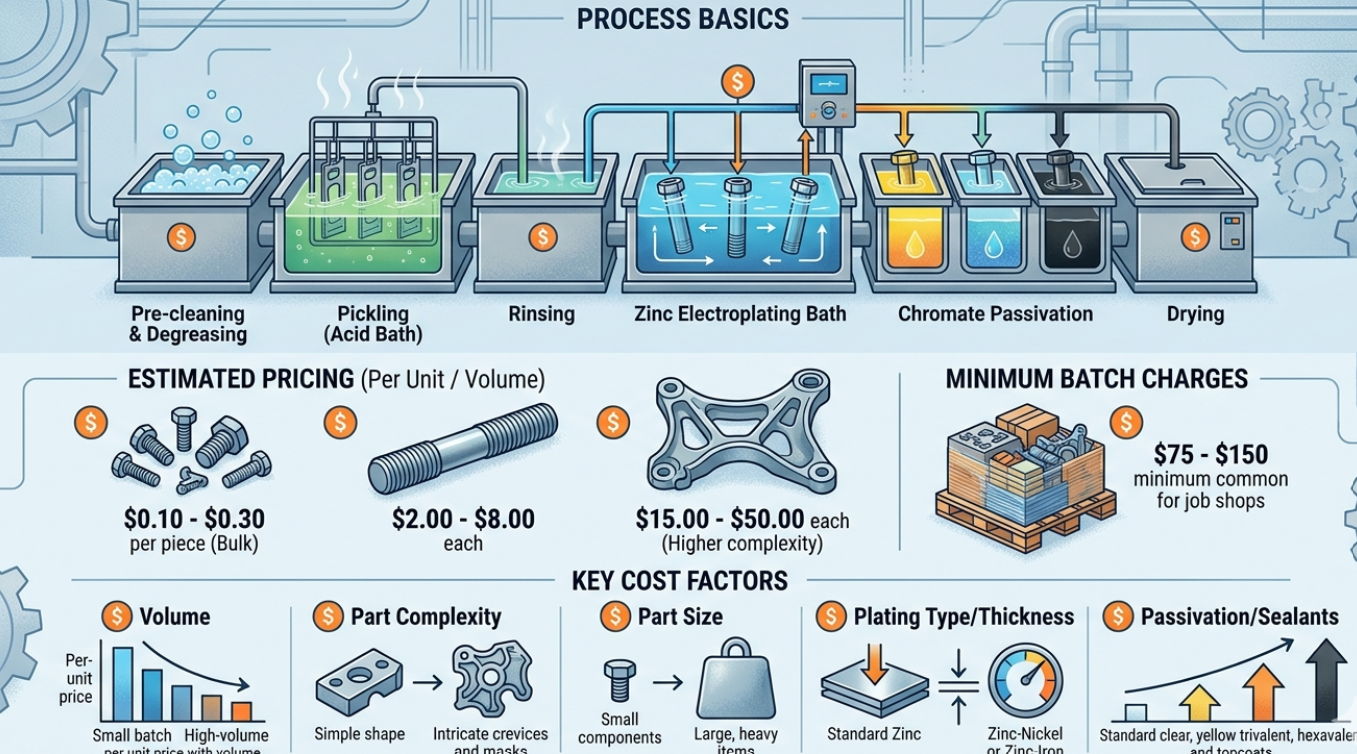
Ask five plating shops for a quote on the same print, and it’s common to get five different numbers sometimes 30% or more apart. That’s rarely because someone is overcharging. It’s because zinc plating pricing depends on a dozen variables that almost never show up clearly on a quote sheet. This guide breaks down exactly what drives the cost of zinc plating, what a fair price actually looks like for your part type and volume, and how to make sure the number you’re comparing reflects the part you’re actually buying.
If you’ve ever requested a zinc plating quote and felt like the number came out of thin air, you’re not imagining it. Unlike a finished retail product with a fixed price tag, zinc plating is a manufacturing process and the final cost per piece depends on the size of your parts, how many you’re running, how thick the coating needs to be, which passivate you specify, and several other variables that most buyers never think to ask about until the invoice arrives.
At Plateco, we’ve been quoting and producing zinc plating since 1974, working with everyone from automotive OEMs and agricultural equipment manufacturers to small machine shops ordering a single box of brackets. In that time, we’ve noticed that the buyers who get the best pricing and the best parts aren’t the ones chasing the lowest number on a quote sheet. They’re the ones who understand exactly what’s driving that number, so they can compare quotes accurately and avoid surprises when the invoice arrives.
This guide walks through every major cost driver behind a zinc plating quote, gives you realistic price ranges for different part types and order volumes, flags the hidden costs that catch buyers off guard, and shows you exactly what to include in a request for quote so every bid you receive is comparing the same thing.
Why There’s No Single “Zinc Plating Price”
Zinc plating isn’t sold the way a retail product is sold. There’s no catalog page with a single price per pound, because the cost of plating a part is built from the combination of its size, the metal it’s made from, how thick the zinc needs to be, what topcoat it needs, how many pieces you’re running, and how it has to be tested and documented. Ask “what does zinc plating cost” and a reputable plater will ask several questions back before giving you a number not because they’re stalling, but because the honest answer genuinely depends on those details.
It’s a bit like asking “how much does a paint job cost.” The answer depends entirely on the size of the vehicle, the type of paint, how many coats it needs, and whether there’s bodywork involved first. Zinc plating works the same way: two parts that look similar on a shop floor can land in very different price tiers once you factor in surface area, thickness requirements, and handling needs.
Most production-volume plating is priced per piece, calculated from the average part weight and surface area within a lot. Loose hardware sold in bulk nuts, bolts, washers, and similar commodity parts is sometimes priced per pound instead. Either pricing model is built from the same underlying cost drivers covered in the next section.
The Most Common Pricing Mistake
Comparing two quotes without confirming both vendors are pricing against the identical specification same ASTM B633 service condition, same passivate type, same lot size, and same testing requirements. A lower number on paper is meaningless if it’s quoting a thinner, unsealed, undocumented coating that won’t perform in your application. The cheapest quote today can become the most expensive part once warranty returns, field failures, or re-plating costs are factored in.
The Cost Drivers Behind Every Zinc Plating Quote
When two quotes for what looks like the same part come back noticeably different, the gap almost always traces back to one or more of the variables below. Understanding each one is the fastest way to read a quote sheet correctly and to ask the right follow-up question when something doesn’t add up.
Part Size and Surface Area
Plating cost is fundamentally a function of surface area, because that’s what determines how much zinc gets deposited and how long a part needs to spend in (or pass through) the plating line. A small fastener consumes a fraction of a cent in raw zinc; a large stamped bracket with significantly more surface area requires proportionally more material and bath time. Most shops calculate price per piece from the average weight and surface area within a given lot, which is why two parts that look similar in size can still land in different price tiers.
Base Metal and Part Geometry
Carbon steel is the most common and most cost-effective substrate for zinc plating, and it’s reflected in baseline pricing. Higher-alloy steels, parts with deep recesses or blind holes that are harder for current to reach evenly, and parts arriving with rust, oil, or mill scale that require extra pre-cleaning all add labor and processing time and that time shows up directly in the per-piece price.
Coating Thickness (ASTM B633 Service Condition)
ASTM B633 defines four service condition categories SC1 through SC4 each requiring a different minimum zinc thickness, from 5µm for mild indoor use up to 25µm for harsh outdoor or salt exposure. Thicker zinc means more material consumed and more time in the plating bath, which increases cost. As a general rule, moving from the minimum thickness (SC1) to the maximum (SC4) raises the price per piece by roughly 20–40%, depending on part geometry and lot size. If your application’s environment isn’t clear, it’s worth reviewing the thickness requirements before requesting quotes, since under-specifying thickness to save a few cents per piece is one of the most common causes of early field failures.
Passivate or Chromate Topcoat
After plating, zinc is typically sealed with a passivate (also called a chromate conversion coating) that dramatically extends corrosion resistance. Clear trivalent passivate is the most economical option; yellow trivalent the most common choice for general outdoor use costs only marginally more but adds meaningfully better protection; black, olive drab, and topcoat-sealed systems for maximum protection sit at the higher end. The passivate line item is usually small relative to the base plating cost, but skipping it to save a few cents is rarely the right tradeoff for parts that will see any real-world exposure.
Barrel vs. Rack Plating
The plating method itself affects price. Barrel plating tumbles large batches of small parts through the line together, which is highly efficient and keeps per-piece costs low for high-volume fasteners and small hardware. Rack plating hangs individual parts on fixtures and processes them with more controlled current distribution necessary for larger parts, delicate finishes, or tight dimensional tolerances, but it requires more labor per piece and has lower throughput per cycle, which raises the price.
Order Volume and Lot Size
Plating follows the same economies of scale as most manufacturing processes: setup time, racking, and line changeover costs get spread across more parts as volume increases, so the price per piece drops. On the flip side, very small orders a handful of prototype parts, for example often hit a flat minimum lot charge regardless of how few pieces are in the box, which can make the effective per-piece cost look surprisingly high.
Special Handling: Masking, Custom Racking, and Embrittlement Relief
Some parts need extra steps before or after plating. Masking protects threads or critical surfaces that shouldn’t be coated. Custom racking fixtures are sometimes required for unusually shaped parts that can’t be barrel plated. High-strength steel parts processed through acid-based pretreatment often require a baking step hydrogen embrittlement relief to prevent cracking under load. Each of these is real labor and oven time, and each typically shows up as its own line item or a built-in surcharge.
Testing, Inspection, and Documentation
Salt spray testing, XRF thickness verification reports, certificates of conformance, and OEM-specific traceability documentation all add cost usually billed as a flat fee per lot rather than folded into the per-piece price. If your purchase order or customer specification requires any of this, make sure it’s called out clearly in your RFQ so it’s reflected (or excluded) consistently across every quote you receive.
Turnaround Time
Standard zinc plating lead times commonly run three to seven business days, plus curing time for the passivate. Compressing that timeline for a rush order usually carries a premium, since it often means reshuffling a production schedule or running a smaller batch outside the normal line flow. If your timeline is flexible, saying so on your RFQ can meaningfully lower your quote.
Typical Zinc Plating Price Ranges
The ranges below are directional, drawn from common commercial pricing patterns across the industry. They’re meant to help you sanity-check a quote, not replace one the only way to get an exact number for your part is to submit a complete specification to a plater.
Table 1: Zinc Plating Cost by Order Profile
| Order Profile | Typical Volume | Price Range / Piece | Primary Cost Drivers |
| High-volume small fasteners | 5,000+ pcs | $0.03 – $0.15 | Barrel plated, SC1–SC2, minimal handling |
| Mid-size brackets & stampings | 500 – 5,000 pcs | $0.15 – $0.75 | Larger surface area, SC2–SC3, light masking |
| Large or custom parts | 50 – 500 pcs | $0.75 – $3.00+ | Rack plated, SC3–SC4, individual handling |
| Prototype / small-batch runs | Under 50 pcs | Flat lot fee, often $75 – $200+ | Minimum lot charge dominates; per-piece cost isn’t meaningful |
Loose hardware sold by weight common for generic nuts, bolts, and small stampings is frequently quoted per pound instead of per piece, with rates commonly falling between roughly $0.50 and $3.00 per pound depending on thickness, passivate, and lot size.
Table 2: Cost Impact by ASTM B633 Service Condition (Relative to SC1 Baseline)
| Service Condition | Min. Thickness | Approx. Cost vs. SC1 | Typical Use |
| SC1 — Mild | 5µm | Baseline (100%) | Dry indoor hardware, low risk |
| SC2 — Moderate | 8µm | ~105 – 115% | Light industrial, occasional humidity |
| SC3 — Severe | 12µm | ~115 – 130% | General outdoor exposure |
| SC4 — Very Severe | 25µm | ~120 – 140% | Road salt, coastal air, harsh chemicals |
How to Read These Ranges
These figures are starting points for budgeting, not quotes. The exact price for your part depends on the full combination of factors above size, metal, thickness, passivate, process, volume, handling, and documentation working together rather than in isolation. The only reliable way to get an exact number is to submit a complete specification and let a plater quote against it.
Barrel vs. Rack Plating: Which Process Costs More?
Barrel plating is almost always the lower-cost option per piece, because hundreds or thousands of small parts tumble through the line together in a single batch, spreading labor and line time across a large quantity. Rack plating costs more per piece because each part is individually loaded onto a fixture and processed with closer current control, which means more direct labor and lower throughput per cycle.
The cost difference isn’t a reason to default to the cheaper process, though. Rack plating exists because some parts need it: larger components that won’t tumble safely, parts with cosmetic surfaces that can’t tolerate part-on-part contact, or assemblies with tight dimensional tolerances that need tighter thickness control than barrel plating can reliably deliver. Choosing barrel plating for a part that genuinely needs rack processing can mean inconsistent coverage, cosmetic damage, or dimensional problems that cost far more to fix than the per-piece savings were worth.
Hidden Costs That Inflate Your Final Invoice
Many of the surprises buyers run into with plating invoices aren’t the result of unclear pricing they’re costs that exist in every quote but don’t always get spelled out up front. Here’s what to watch for.
Minimum Lot Charges
Most platers apply a flat minimum charge per job, commonly somewhere between $75 and $150, regardless of how few parts are in the order. This protects the shop’s cost of running a line for any job, but it means a 20-piece order can carry a much higher effective per-piece cost than the headline per-piece rate would suggest.
Racking and Masking Fees
Custom racking fixtures and thread or surface masking are frequently billed as a separate one-time charge or a per-lot fee rather than folded into the quoted per-piece rate. If a quote doesn’t mention these explicitly and your part needs them, expect them to appear on the invoice.
Rejects and Rework
Parts that arrive rusted, oily, or out of tolerance often require additional cleaning, blasting, or deburring before plating can even begin. This isn’t padding it’s necessary prep work but it’s frequently invoiced separately from the base plating charge, and it’s avoidable by sending clean, prepped parts whenever possible.
Freight and Lead Time Premiums
Shipping parts to and from the plating facility adds cost on both ends, and compressed turnaround requests typically carry a rush premium on top of the base price. Building a realistic lead time into your production schedule is one of the simplest ways to avoid paying for speed you didn’t actually need.
Testing and Certification Fees
Salt spray test reports, XRF thickness documentation, and certificates of conformance are usually billed as flat per-lot fees. If your customer or end application requires this documentation, confirm it’s included in the quote rather than assuming it’s bundled in.
How to Avoid Hidden Costs
Ask directly whether the quoted price includes the minimum lot charge, and what that minimum is.
Confirm whether racking, masking, and any pre-cleaning are itemized separately or built into the per-piece rate.
Send parts already cleaned and deburred where practical, to avoid additional prep charges.
Plan around standard lead times rather than paying rush premiums when your schedule allows it.
Confirm in writing what documentation (salt spray, XRF, COC) is included versus billed as an add-on.
How to Get an Apples-to-Apples Quote
The single biggest reason quotes are hard to compare is incomplete information going out in the RFQ. If two vendors are guessing at different parts of your specification, their numbers will reflect two different parts not two different prices for the same job. A complete RFQ should include the standard and service condition, the passivate type, the part’s base metal and finish requirements, the quantity, any dimensional tolerance notes, the required turnaround, and any testing or documentation requirements.
Example RFQ Specification
Zinc electroplate per ASTM B633, SC3, Type II (trivalent yellow passivate).
Quantity: 1,200 pieces. Base metal: 1018 carbon steel.
Barrel process acceptable. Standard 5–7 day turnaround.
Certificate of Conformance required with shipment.
Each line in that example removes a variable the plater would otherwise have to guess at and a guess almost always defaults to the cheapest assumption, which may not match what your application actually needs. Sending the same complete specification to every vendor you’re quoting is the fastest way to make sure the numbers you get back are actually comparable.
Zinc Plating vs. Other Finishes: A Quick Cost Comparison
Zinc plating’s pricing only makes sense in context. Here’s roughly how it stacks up against other common corrosion-protection finishes for steel parts.
| Finish | Typical Relative Cost | Best For |
| Zinc Electroplating | Baseline | General steel hardware, fasteners, brackets |
| Hot-Dip Galvanizing | ~1.5 – 3x zinc plating | Large structural steel, heavy outdoor exposure |
| Zinc-Nickel Plating | ~2 – 4x zinc plating | Severe corrosion combined with high heat |
| Powder Coating | ~1 – 2x zinc plating | Cosmetic color finish; less inherent corrosion protection alone |
| Electroless Nickel | ~3 – 6x zinc plating | Wear resistance and uniform deposit on complex geometry |
This is a major reason zinc electroplating remains the default finish across automotive, agricultural, and industrial fastener manufacturing: for most steel parts, it delivers the corrosion protection a part actually needs at a lower cost than the alternatives, without requiring a redesign of the part itself.
Plateco’s Pricing Philosophy
Every quote we issue reflects the actual specification on your print no guessing, no padding, and no surprises on the invoice. If a print is missing a thickness or passivate callout, we’ll ask before we quote, not after we plate. That’s part of our standing commitment to customers: on spec, on time, or it’s on us.
Frequently Asked Questions
What’s the average cost per piece for zinc plating?
It depends heavily on part size and order volume, but most production-scale fastener and bracket work lands somewhere between $0.05 and $0.75 per piece. Very small commodity hardware run in large volumes can fall below that range, while large or custom parts run through rack plating can exceed $3.00 per piece.
Is zinc plating cheaper than powder coating or other finishes?
For corrosion protection on steel parts, zinc plating is generally one of the most cost-effective options available, typically priced at or below powder coating and well below zinc-nickel or electroless nickel plating. Powder coating can be competitive when color and cosmetic appearance are the primary goal, but it doesn’t offer the same sacrificial corrosion protection as zinc unless it’s applied over a zinc or galvanized base.
Do small-batch or prototype orders cost more per piece?
Yes, almost always. Minimum lot charges commonly $75 to $150 apply regardless of quantity, so a 20-piece prototype order can carry a much higher effective cost per piece than a 5,000-piece production run of the identical part.
What’s a typical minimum order or setup charge?
Most shops apply a flat minimum lot charge in the $75–$150 range, though this varies by vendor and by how much custom racking or masking the job requires. It’s worth asking for this number explicitly before placing a small order.
How much does rush turnaround add to the cost?
Rush fees vary by shop and by how compressed the timeline is, but it’s common to see a noticeable premium sometimes a flat expedite fee, sometimes a percentage increase on the base price for turnarounds significantly shorter than the standard 3–7 business day window.
Does coating thickness alone explain price differences between quotes?
No. Thickness is one factor among several. Two quotes at the same service condition can still differ based on passivate type, plating process (barrel vs. rack), testing requirements, lot size, and handling needs. Always confirm what’s included before assuming a price gap is about thickness alone.
How can I get the most accurate quote?
Send a complete specification ASTM B633 service condition, passivate type, base metal, quantity, dimensional notes, required turnaround, and any testing or documentation requirements to every vendor you’re comparing. The more complete the spec, the more comparable the quotes you get back.
Ready for a Transparent Quote?
Plateco has been pricing and producing zinc plating to ASTM B633, John Deere JDM, Caterpillar CAT, Parker Hannifin, and dozens of other customer specifications since 1974. Send us your print or specification and we’ll give you a clear, itemized quote with no guesswork and no surprises on the invoice.