

If you’ve worked with zinc-plated parts for more than a few years, you’ve likely noticed a change: the deep, saturated gold of the yellow zinc fasteners from a decade ago looks different from the yellow zinc parts arriving today. The newer parts have a lighter, more variable, iridescent gold-amber tone. This isn’t a quality problem, a vendor switching to a cheaper process, or a coincidence. It’s the visible result of one of the most significant chemistry transitions in the history of metal finishing: the industry-wide shift from hexavalent chromate to trivalent chromate passivation.
At Plateco, we have lived through this transition firsthand. Understanding what changed and why helps engineers, quality managers, and procurement teams make sense of specifications, appearance variation, compliance requirements, and the questions that inevitably come up when a customer compares a new part to an old one and asks why they look different.
KEY POINT
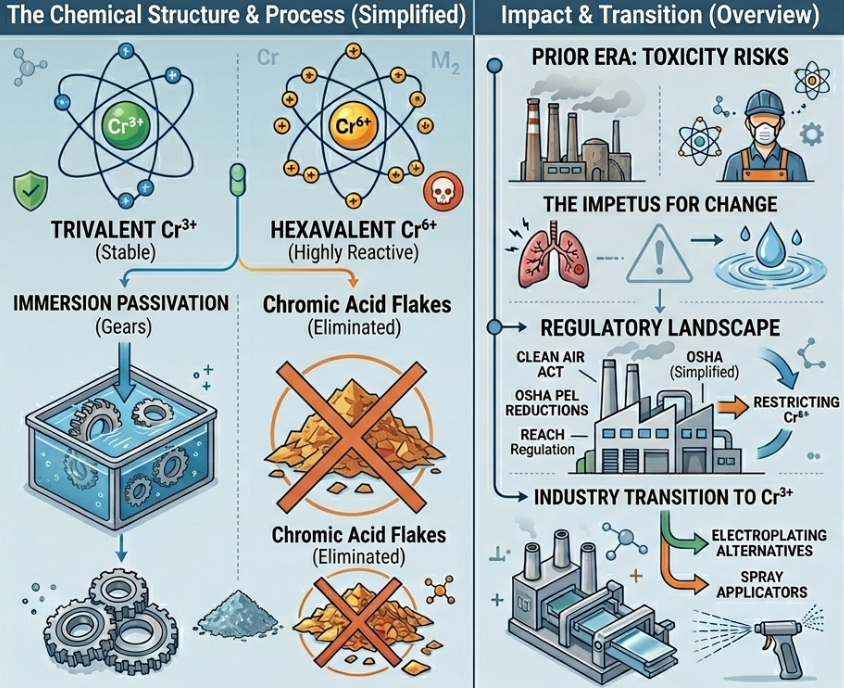
Both hexavalent chromate (Cr(VI)) and trivalent chromate (Cr(III)) are chemical conversion coatings applied over zinc plating to provide additional corrosion resistance and color. The difference between them is the oxidation state of the chromium used in the chemistry and that single difference in oxidation state is the reason one chemistry is now restricted worldwide while the other has become the universal standard.
WHAT IS CHROMATE PASSIVATION, AND WHY DOES ZINC NEED IT?
Freshly plated zinc is chemically reactive. Exposed to air and moisture, it begins forming zinc oxide and zinc hydroxide the white, powdery corrosion product known as white rust within hours to days, depending on humidity. Chromate passivation is a post-plating chemical treatment that reacts with the zinc surface to form a thin, protective conversion coating that dramatically slows this process.
During passivation, the zinc-plated part is immersed in a chromate solution. The chromium in the solution reacts with the surface zinc to form a mixed chromium-zinc oxide/hydroxide gel layer. As this layer dries, it forms a thin, glassy film that seals the zinc surface, slows the rate of oxidation, and in many formulations imparts a characteristic color clear/blue, yellow/gold, olive drab, or black, depending on the specific chemistry and process conditions.
This is true regardless of whether the chromium used is hexavalent or trivalent. Both chemistries perform the same fundamental function: sealing the zinc surface to extend corrosion protection life. The difference between them lies entirely in the chromium chemistry itself and that difference has enormous implications for health, environment, and regulatory compliance.
THE CHEMISTRY DIFFERENCE — CR(VI) VS. CR(III)
Chromium is an element that can exist in several oxidation states, but two are relevant to metal finishing: the hexavalent state (+6, written Cr(VI)) and the trivalent state (+3, written Cr(III)). These two forms of chromium behave very differently chemically, biologically, and environmentally despite being the same base element.
Hexavalent Chromium — Cr(VI)
Hexavalent chromium compounds are strong oxidizing agents. In aqueous solution, Cr(VI) exists as chromate or dichromate ions, which are highly soluble, highly mobile in the environment, and readily absorbed across biological membranes. This same reactivity is what made hexavalent chromate chemistry so effective as a passivation treatment for decades: it reacted vigorously and reliably with zinc surfaces to form a durable, corrosion-resistant film, and it had a unique self-healing property if the passivate layer was scratched, residual Cr(VI) in the film could migrate to the damaged area and re-passivate it.
That same reactivity and mobility, however, is what makes Cr(VI) dangerous. Hexavalent chromium is classified by the International Agency for Research on Cancer (IARC) as a Group 1 carcinogen the highest classification, indicating sufficient evidence of carcinogenicity in humans. Occupational exposure to Cr(VI), primarily through inhalation of mists, dusts, or fumes in plating, welding, and pigment manufacturing operations, has been linked to lung cancer, nasal and sinus cancers, and other respiratory conditions. Environmentally, Cr(VI)’s high solubility means it readily leaches into groundwater from contaminated soil or improperly disposed waste, creating long-lasting contamination that is difficult and expensive to remediate.
Trivalent Chromium — Cr(III)
Trivalent chromium is a different chemical animal entirely, despite sharing the same base element. Cr(III) compounds are far less soluble, far less mobile in biological systems and the environment, and critically, Cr(III) is actually an essential trace nutrient the human body requires small amounts of trivalent chromium for normal carbohydrate and lipid metabolism. Cr(III) is not classified as a carcinogen.
Trivalent chromate passivation chemistry uses Cr(III) compounds to form a conversion coating on zinc through a different (though related) chemical mechanism than hexavalent chemistry. Early trivalent formulations, developed in the 1990s and refined through the 2000s and 2010s, initially lagged behind hexavalent chemistry in corrosion performance and lacked the self-healing property. Modern trivalent systems have closed much of that gap through improved formulations and the use of supplemental topcoat sealers.
HEXAVALENT CR(VI)
Highly soluble and mobile. Strong self-healing capability. Excellent corrosion performance. Classified as a known human carcinogen (IARC Group 1). Restricted under RoHS, REACH, and ELV at 0.1% by weight.
TRIVALENT CR(III)
Low solubility and low mobility. No significant self-healing (topcoat sealer compensates). Very good corrosion performance, especially with sealer. Essential human trace nutrient, not classified as carcinogenic. Not restricted by RoHS, REACH, or ELV.
THE REGULATORY TIMELINE — HOW THE TRANSITION HAPPENED
The shift from hexavalent to trivalent chromate did not happen overnight, and it was not driven by a single regulation. It unfolded over roughly two decades through a series of European directives and regulations that, layer by layer, restricted hexavalent chromium across different product categories and because global supply chains are interconnected, these European rules drove chemistry changes in manufacturing operations worldwide, including in the United States.
ELV Directive (2000/53/EC) — Automotive First ( 2000 )
The End-of-Life Vehicles Directive was the first major EU regulation to restrict hexavalent chromium, alongside lead, mercury, and cadmium, in vehicles placed on the EU market starting in 2003. This gave the automotive supply chain roughly a three-year runway and made automotive the first industry to systematically adopt trivalent passivation.
RoHS Directive (2002/95/EC) — Electronics Follow ( 2003 )
The original Restriction of Hazardous Substances directive extended Cr(VI) restrictions to electrical and electronic equipment, with compliance required by July 2006. This brought the electronics and appliance supply chains into the trivalent transition, several years behind automotive.
REACH Regulation (EC 1907/2006) ( 2006 )
The Registration, Evaluation, Authorisation and Restriction of Chemicals regulation established a broader framework for chemical substances in the EU. Hexavalent chromium compounds were added to the Substances of Very High Concern (SVHC) list, subjecting continued industrial use of Cr(VI) to authorization requirements adding pressure on Cr(VI) use even in applications not directly covered by RoHS or ELV.
RoHS 2 (2011/65/EU) — Stronger Enforcement ( 2011 )
RoHS 2 replaced the original directive, broadened the scope of covered products, and critically introduced supply chain documentation obligations. Manufacturers now had to be able to demonstrate compliance with evidence from their suppliers, not just declare it. This is the point at which RoHS compliance certificates became a standard supply chain document.
Global Adoption by Major OEMs ( 2010s )
Throughout the 2010s, major OEMs across automotive, agricultural, and industrial equipment including John Deere, Caterpillar, and the major automotive manufacturers incorporated trivalent-only requirements into their global internal specifications, regardless of whether a specific product or market technically fell under EU jurisdiction. A single global standard was operationally simpler than maintaining region-specific chemistry requirements.
Trivalent as the De Facto Commercial Standard ( Today )
Trivalent chromate passivation is now the default chemistry across the vast majority of commercial zinc plating operations in North America and globally. Hexavalent chemistry has not been formally banned everywhere, but it has become commercially marginal difficult to source, increasingly costly, and excluded from nearly every major OEM specification.
WHAT ACTUALLY CHANGED APPEARANCE, PERFORMANCE, AND PROCESS
For engineers and buyers who simply want to know what’s different about the parts coming off the line today compared to a decade ago, here is the practical summary of what changed when the industry transitioned from hexavalent to trivalent chromate.
Appearance: Color and Iridescence
The most immediately visible change is in yellow passivate. Legacy hexavalent yellow (sometimes called dichromate yellow) produced a deep, saturated, consistent gold color. Modern trivalent yellow produces a lighter, more iridescent gold-to-amber tone that can vary noticeably from lot to lot, and even across a single part, depending on zinc deposit morphology, passivate bath conditions, and part geometry. This variability is normal for trivalent chemistry and does not indicate a defect but it is the single most common source of confusion when a customer compares an older part to a newer one.
Clear passivate is less visually different between hexavalent and trivalent chemistries both produce a silver-to-blue metallic appearance though subtle differences in iridescence exist for those trained to look for them.
Corrosion Performance
Early trivalent chromate systems (developed in the late 1990s and early 2000s) did underperform hexavalent chemistry in salt spray testing, sometimes significantly. This created real friction during the early transition years, as parts that had reliably passed 96-hour or 240-hour salt spray requirements under hexavalent chemistry sometimes failed to meet the same hours under early trivalent formulations.
Modern trivalent systems refined over roughly two decades have largely closed this gap for standard commercial applications. At ASTM B633 SC3 (12 micrometer zinc), trivalent yellow passivate with a quality topcoat sealer can meet or exceed 240-hour red rust requirements, performance that is competitive with legacy hexavalent benchmarks. The remaining performance difference is concentrated in the self-healing property: hexavalent chromate could partially repair minor scratches through Cr(VI) migration; trivalent chromate cannot. Topcoat sealers are the primary tool used to compensate for this difference in trivalent systems.
Process Changes for Platers
For plating operations, the transition meant qualifying new bath chemistries, re-establishing process parameters (concentration, temperature, pH, immersion time) for trivalent baths, and in many cases re-running salt spray qualification testing to confirm that trivalent passivate met the same specifications previously met with hexavalent. Many platers ran both chemistries in parallel for a period during the transition, serving customers who had migrated to trivalent-only requirements alongside customers still specifying (or not specifying) hexavalent. Today, the overwhelming majority of commercial platers, including Plateco, have transitioned to trivalent-only operations.
HEXAVALENT VS. TRIVALENT FULL COMPARISON
HEXAVALENT CR(VI) VS. TRIVALENT CR(III) CHROMATE PASSIVATION
| PROPERTY | HEXAVALENT CR(VI) | TRIVALENT CR(III) |
| Chromium Oxidation State | +6 | +3 |
| RoHS 2 Compliant | No | Yes |
| ELV Directive Compliant | No | Yes |
| REACH Status | Substance of Very High Concern | Not restricted |
| Health Classification | IARC Group 1 carcinogen | Essential trace nutrient |
| Solubility / Mobility | High | Low |
| Self-Healing Property | Yes | No (sealer compensates) |
| Yellow Passivate Appearance | Deep, saturated gold | Lighter iridescent gold-amber |
| Clear Passivate Appearance | Bright blue-silver | Blue-silver, slightly less bright |
| Salt Spray Performance (SC3, with sealer) | Excellent (historical benchmark) | Very good comparable with sealer |
| Color Consistency Lot-to-Lot | High | More variable (normal) |
| Availability Today | Limited, declining | Industry standard, widely available |
| Major OEM Acceptance | Excluded from current specs | Required / default |
| Plateco Standard Chemistry | Not used | Default for all commercial work |
WHY THIS MATTERS FOR ENGINEERS, BUYERS, AND QUALITY TEAMS
Understanding the trivalent-hexavalent transition is not just historical trivia it has direct, practical implications for specification writing, incoming inspection, supplier qualification, and customer communication.
Specification Writing
Drawings and purchase orders written years ago may reference ‘yellow chromate’ or ‘dichromate’ without specifying trivalent or hexavalent chemistry, because at the time the drawing was written, hexavalent was the assumed default. If that drawing is still in use today and a part is manufactured against it, the plater will almost certainly use trivalent chemistry because that’s what’s available and what RoHS-aligned customers expect but the drawing language is now technically ambiguous or outdated. Updating drawing language to explicitly specify ‘trivalent chromate (Cr(III)), RoHS compliant per EU Directive 2011/65/EU’ removes this ambiguity and aligns the documentation with current practice.
Incoming Inspection and Appearance Standards
If your incoming inspection criteria or visual acceptance standards were established using hexavalent-passivated sample parts (common for long-running part numbers), those samples no longer represent what a compliant, properly processed part looks like. Inspectors comparing new trivalent parts against old hexavalent reference samples may flag color variation as a defect when it is, in fact, the expected and correct appearance of modern trivalent chemistry. Updating visual reference standards with current trivalent samples prevents false rejections and the costly investigations that follow them.
Supplier Qualification and Audits
When qualifying a new plating supplier, or auditing an existing one, confirming trivalent-only chemistry should be a standard checklist item not an assumption. Request a written confirmation or RoHS Compliance Certificate referencing trivalent (Cr(III)) chemistry specifically. ‘RoHS compliant’ as a phrase is sometimes used loosely; the underlying chemistry confirmation (trivalent, no hexavalent) is the substantive requirement.
Customer Communication
If your own customers receive parts from you that look different than parts they received previously lighter yellow passivate, for example proactive communication prevents confusion and unnecessary rejections downstream. A brief explanation that the appearance change reflects a chemistry transition to RoHS-compliant trivalent passivate, with no change in corrosion performance specification compliance, resolves most concerns quickly. Keeping a one-page reference explaining this transition, which you can share with customers, is a useful tool many manufacturers have developed during this transition period.
PLATECO STANDARD
Plateco operates exclusively trivalent chromate chemistry (Cr(III)) for all commercial zinc plating passivation clear, yellow, and black. We provide RoHS Compliance Certificates on request, confirming trivalent chemistry for documentation and supply chain compliance purposes. If you’re updating drawings or specifications to reflect current chemistry standards, we’re happy to provide sample language and current process documentation.
FREQUENTLY ASKED QUESTIONS
Q: Is hexavalent chromate completely banned?
Not universally banned in an absolute sense, but functionally excluded from nearly all commercial supply chains that matter for manufacturers. RoHS 2, the ELV Directive, and REACH each restrict hexavalent chromium to a maximum of 0.1% by weight in their respective scopes a threshold that a standard hexavalent chromate passivate layer would significantly exceed. Outside these specific regulatory scopes, hexavalent chemistry isn’t technically illegal everywhere, but virtually every major OEM specification, RoHS-aligned customer requirement, and commercial plater’s standard process has moved to trivalent-only. In practice, hexavalent chromate passivation is obsolete for new commercial work.
Q: Why does my new trivalent yellow part look lighter than the part I received two years ago?
Two possibilities, and both are normal. First, if the part you received two years ago was hexavalent yellow and your new part is trivalent yellow, the lighter, more iridescent gold-amber appearance is the expected look of trivalent chemistry not a defect. Second, even within trivalent chemistry, color can vary lot-to-lot based on passivate bath conditions, zinc deposit characteristics, and part geometry. If corrosion performance (salt spray hours) meets the specification, color variation within the normal trivalent range should not be cause for rejection. If you’re uncertain, ask your plater whether the chemistry has changed and request a current sample for visual reference.
Q: Does switching to trivalent passivate require any change to the underlying zinc plating?
No. The zinc electroplating process itself bath chemistry, deposit thickness, alkaline or acid zinc selection is unaffected by the passivate chemistry choice. The passivation step is a separate, subsequent process applied after the zinc deposit is complete. Switching from hexavalent to trivalent passivate changes only that final passivation step and its resulting appearance and self-healing characteristics; it does not change the zinc deposit underneath.
Q: Can I request hexavalent chromate passivation if I specifically want it?
Most commercial platers, including Plateco, no longer offer hexavalent chromate passivation as a standard process, having transitioned entirely to trivalent chemistry. If a specific application has a documented technical requirement for hexavalent chemistry (which would be unusual today, given the maturity of trivalent systems), this would need to be discussed directly with a plater to determine whether the capability exists anywhere in their operation and whether the resulting parts could even be used, given that most downstream supply chains now reject hexavalent-passivated parts on compliance grounds regardless of the original requester’s intent.
Q: How can I verify whether a part was passivated with trivalent or hexavalent chromate?
Visual appearance alone is not a reliable verification method, especially for clear passivate where the difference is subtle. Laboratory methods such as X-ray photoelectron spectroscopy (XPS) or wet chemical extraction with colorimetric Cr(VI) determination can definitively identify the presence of hexavalent chromium in a passivate layer. In practice, most supply chains rely on documentation Certificates of Compliance from the plater confirming trivalent chemistry rather than testing individual parts. Testing is typically reserved for dispute resolution, new supplier qualification audits, or regulatory compliance investigations.
Q: Does the trivalent transition affect black passivate too?
Yes. Black passivate, like clear and yellow, was historically available in hexavalent chemistry and has transitioned to trivalent formulations using pigments or dyes incorporated into the trivalent chromate bath to achieve the black appearance. Trivalent black passivate is widely available and RoHS compliant. As with yellow, some appearance differences exist between legacy hexavalent black and modern trivalent black, though the visual difference for black passivate is generally less pronounced than for yellow.
Q: Will there be another chemistry transition in the future?
Possibly, though nothing comparable is currently mandated. Trivalent chromate remains chromium-based it simply uses a different, non-restricted oxidation state of the same element. Some research continues into chromium-free conversion coatings for zinc, driven by ongoing regulatory interest in chromium compounds generally under frameworks like REACH. However, trivalent chromate is currently compliant with all major regulations and is the established, mature industry standard, with no imminent regulatory driver for a further transition. Manufacturers should stay aware of regulatory developments, but no immediate action beyond the trivalent standard is currently required.
THE BOTTOM LINE
The shift from hexavalent to trivalent chromate passivation represents one of the most significant chemistry changes in modern metal finishing driven by health and environmental concerns about hexavalent chromium, formalized through a sequence of European directives starting with the ELV Directive in 2000 and continuing through RoHS 2 and REACH, and ultimately adopted as the global commercial standard across automotive, industrial, agricultural, and electronics supply chains.
For engineers and buyers, the practical takeaway is straightforward: trivalent chromate (Cr(III)) is the current standard, it is RoHS, ELV, and REACH compliant, it delivers corrosion performance that meets the requirements of nearly all commercial specifications (especially with topcoat sealers), and the appearance differences from legacy hexavalent chemistry particularly the lighter, more variable yellow passivate color are normal and expected, not defects.
REQUEST A QUOTE
Plateco operates exclusively trivalent chromate chemistry across all commercial zinc plating work, with RoHS Compliance Certificates available on request. If you’re updating drawings or specifications to reflect current chemistry standards, our team can help. plateco.net | (608) 524-8241 | Reedsburg, Wisconsin