

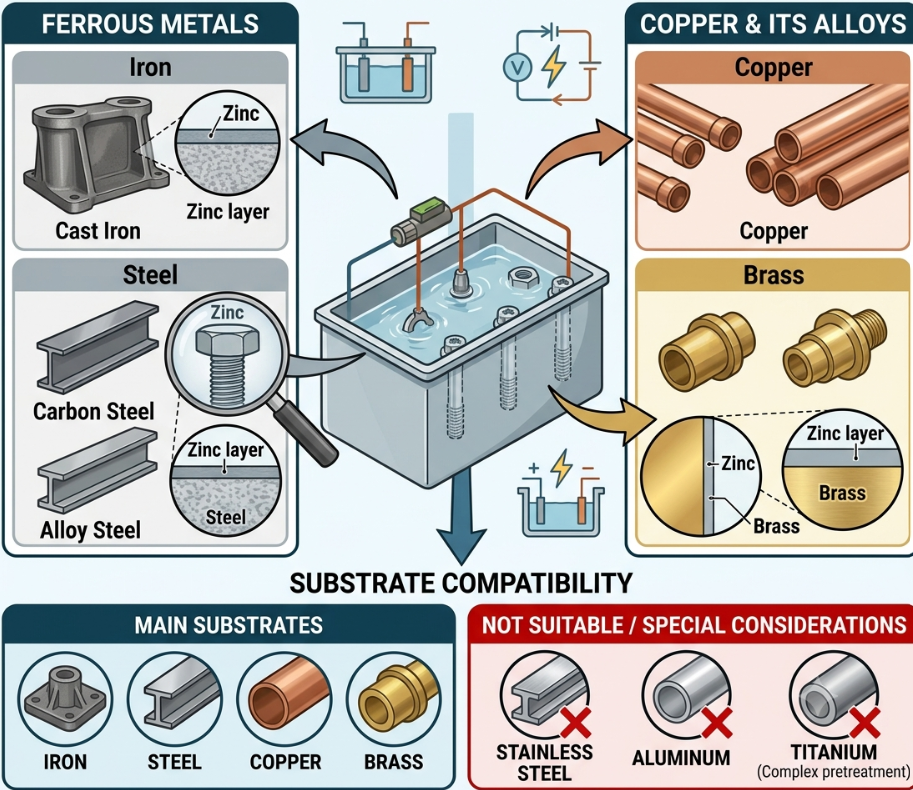
Zinc electroplating is one of the most common and cost-effective corrosion protection processes in metal finishing but it is not a universal solution. Zinc plating works through a specific electrochemical mechanism that depends on the substrate metal’s properties, and that mechanism simply does not function the same way on every metal. Some metals take zinc plating beautifully and benefit enormously from it. Others cannot be zinc plated at all without specialized processes, and a few should never be zinc plated regardless of what process is used.
At Plateco, we field this question constantly from engineers and procurement teams: “Can this part be zinc plated?” The honest answer depends entirely on what the part is made of. This guide walks through every major metal and alloy category commonly encountered in manufacturing, explains whether zinc plating is appropriate, and where it isn’t points toward the finishing process that actually makes sense.
KEY POINT
Zinc electroplating deposits metallic zinc onto a substrate through an electrochemical reaction in an aqueous bath. For the process to work properly, the substrate must conduct electricity, must not react adversely with the plating bath chemistry, and must be able to form a sound metallurgical bond with the zinc deposit. Ferrous metals (iron and steel) are the overwhelming majority of substrates zinc plating was designed for and remain its primary application.
SECTION 1: METALS THAT CAN BE ZINC PLATED
The metals in this section are routinely zinc plated in commercial operations, including at Plateco. Each has its own process considerations, but all are well-established substrates for zinc electroplating.
CARBON STEEL (MILD / LOW-CARBON) [Excellent Fit]
Carbon steel is the most common substrate for zinc electroplating and represents the vast majority of commercial zinc plating volume worldwide. Mild steel fasteners, brackets, stampings, and structural hardware take zinc plating readily, with excellent adhesion and predictable, repeatable results. This is the substrate that zinc plating as a process was fundamentally developed around.
PROCESS NOTES: No special pre-treatment beyond standard alkaline cleaning and acid pickling is required. Both alkaline and acid zinc bath chemistries work well. Hydrogen embrittlement is not generally a concern for low-carbon steel because its tensile strength is well below the 150 ksi risk threshold.
ALLOY STEEL AND HIGH-STRENGTH STEEL [Good Fit (With Conditions)]
Alloy steels and heat-treated high-strength steels including the steel used in Grade 8 fasteners, springs, and structural components can be zinc plated successfully, and frequently are, particularly in automotive, agricultural, and fastener manufacturing. However, above approximately 150 ksi tensile strength (roughly HRC 36), hydrogen embrittlement becomes a significant concern requiring specific process controls.
PROCESS NOTES: Hydrogen embrittlement relief baking (375 F, minimum 8 hours, within 4 hours of plating) is required for parts above HRC 36. Alkaline zinc bath chemistry is preferred for high-strength steel because it introduces less hydrogen than acid zinc. Inhibited acid pickling reduces hydrogen pickup during pre-treatment. Confirm substrate hardness with your plater before specifying.
CAST IRON (GRAY IRON, DUCTILE IRON) [Good Fit (With Conditions)]
Cast iron components gears, housings, brackets, and structural castings can be zinc plated, and zinc plating is a common corrosion protection for cast iron parts in agricultural and industrial equipment. The porous nature of cast iron, however, requires careful pre-treatment, because the casting process can leave embedded sand, graphite, and porosity that traps cleaning chemicals and plating solution.
PROCESS NOTES: Pre-treatment must remove embedded sand and graphite smear from the casting and machining process. Trapped acid or alkaline solution in porosity can bleed out after plating, causing localized corrosion (a defect called ‘bleed-out’). Extended rinse cycles and, in some cases, impregnation sealants are used to address porosity issues before plating.
POWDERED METAL (SINTERED STEEL COMPONENTS) [Good Fit (With Conditions)]
Powdered metal (PM) parts produced by sintering compressed metal powder into near-final shapes are common in automotive and small-mechanism applications (gears, cams, small brackets). PM parts can be zinc plated, but their inherent porosity (typically 10-25% by volume, depending on the sintering process) creates the same bleed-out risk as cast iron, often to a greater degree.
PROCESS NOTES: Sealed or impregnated PM parts (with resin or oil impregnation) plate more predictably. Unsealed PM parts may require extended rinsing and post-plate baking to drive out trapped plating solution before passivation. Discuss the PM part’s density and any impregnation treatment with your plater before the first run.
STEEL WELDMENTS AND FABRICATIONS [Good Fit (With Conditions)]
Welded steel assemblies frames, brackets, and fabricated structures can be zinc plated as complete assemblies, which is common in agricultural and construction equipment manufacturing. The primary considerations are weld spatter, slag, and the presence of multiple base metals if dissimilar steels were welded together.
PROCESS NOTES: All weld spatter and slag must be removed before plating; spatter that survives pre-treatment will plate over and create a rough, defective surface. If dissimilar metals were welded (for example, stainless steel reinforcement on a mild steel frame), discuss with your plater the dissimilar metal will plate differently and may require masking or a different process for that section.
SECTION 2: METALS THAT REQUIRE SPECIAL PROCESSES
The metals in this section can technically receive a zinc deposit, but standard zinc electroplating processes designed for steel are not directly applicable. These substrates require modified pre-treatment, specialized strike layers, or entirely different bath chemistries to achieve a sound zinc deposit.
STAINLESS STEEL [Special Process Required]
Stainless steel can be zinc plated, but it requires a specialized pre-treatment process because of the passive chromium oxide layer that gives stainless steel its corrosion resistance. This same passive layer prevents standard zinc plating pre-treatment (acid pickling) from properly activating the surface for plating without addressing it, the zinc deposit will have poor adhesion and may flake off.
PROCESS NOTES: A ‘Wood’s nickel strike’ or specialized acid activation process is typically used to break down the passive oxide layer and deposit a thin nickel strike layer before zinc plating. This adds process steps and cost. Importantly: stainless steel is corrosion-resistant on its own in most applications, so zinc plating stainless steel is unusual and typically only specified for galvanic compatibility reasons (to match the corrosion potential of adjacent zinc-plated steel parts) rather than for additional corrosion protection.
CAST ALUMINUM AND ALUMINUM ALLOYS [Special Process Required Generally Not Recommended]
Aluminum can technically be electroplated with zinc, but the process is substantially different from steel zinc plating and is rarely the right choice. Aluminum forms a natural oxide layer instantly upon exposure to air, which must be removed through a specialized ‘zincate’ immersion process (different from the zincate alkaline zinc bath used for steel) before any subsequent plating can occur.
PROCESS NOTES: If zinc plating on aluminum is required for a specific reason (typically galvanic compatibility in a mixed-metal assembly), the process requires a zincate immersion step, followed by copper or nickel strike layers, before zinc can be deposited. This is a fundamentally different and more expensive process than standard steel zinc plating. In nearly all cases, aluminum parts are better served by anodizing, which is a conversion coating native to aluminum and provides superior, more cost-effective corrosion and wear protection.
BRASS AND BRONZE (COPPER ALLOYS) [Special Process Required Uncommon]
Brass and bronze can be zinc plated using a cyanide or specialized non-cyanide alkaline process with an appropriate strike layer, but this is uncommon in commercial practice. Copper alloys are themselves corrosion-resistant in many environments (which is why they’re chosen for plumbing, electrical, and decorative applications in the first place), so the corrosion-protection rationale for zinc plating rarely applies.
PROCESS NOTES: When zinc plating on brass or bronze is specified, it is typically for appearance matching (to give a brass part the same finish as adjacent steel hardware) or for galvanic compatibility in an assembly. A strike layer is generally required to ensure adhesion. Discuss the specific alloy and application with your plater this is a low-volume specialty request for most commercial platers.
SECTION 3: METALS THAT CANNOT OR SHOULD NOT BE ZINC PLATED
The metals and materials in this section are either incompatible with the zinc electroplating process at a fundamental electrochemical level, or zinc plating would actively harm the part, create a safety issue, or provide no benefit over the metal’s native properties.
TITANIUM AND TITANIUM ALLOYS [Not Recommended]
Titanium forms an extremely stable, tenacious oxide layer that is even more resistant to chemical activation than the oxide layer on stainless steel or aluminum. Standard zinc plating pre-treatment cannot adequately activate a titanium surface for plating, and even specialized strike processes used for titanium plating (typically for other metals like gold or silver in aerospace and medical applications) are complex, expensive, and not standard commercial offerings.
PROCESS NOTES: Titanium’s own corrosion resistance is exceptional in most environments that is the primary reason titanium is selected for a part in the first place. There is essentially no application where zinc plating titanium makes engineering or economic sense. If a titanium part requires a different surface property (wear resistance, color, lubricity), other surface treatments specific to titanium (anodizing, PVD coatings, nitriding) are the appropriate solutions.
MAGNESIUM AND MAGNESIUM ALLOYS [Not Recommended Process Incompatibility]
Magnesium is the most chemically reactive common structural metal, and it is essentially incompatible with standard aqueous zinc electroplating processes. Magnesium reacts directly with both acidic and alkaline plating bath chemistries, corroding rapidly upon immersion before any controlled plating can occur. Galvanic effects between magnesium and zinc (which sit at very different positions on the galvanic series) can also accelerate corrosion of the magnesium substrate dramatically if zinc were somehow deposited.
PROCESS NOTES: Magnesium parts requiring corrosion protection use specialized processes developed specifically for magnesium: chromate or non-chromate conversion coatings, anodizing processes specific to magnesium alloys, or specialized electroless nickel processes with magnesium-specific pre-treatment. Zinc electroplating is not part of the magnesium finishing toolkit in commercial practice.
PLASTICS, COMPOSITES, AND NON-METALLIC MATERIALS [Not Applicable Different Process Entirely]
Plastics, fiber-reinforced composites, ceramics, and other non-conductive materials cannot be zinc electroplated using standard processes because electroplating requires the substrate to conduct electrical current. Without conductivity, the electrochemical deposition reaction that builds up the zinc layer cannot occur on the part’s surface.
PROCESS NOTES: Plastics that require a metallic appearance or EMI shielding use ‘electroless plating’ processes (typically electroless nickel or copper) that don’t require the substrate to be conductive, followed by conventional electroplating if a thicker metal layer is needed. This is an entirely different process family from zinc electroplating on steel and is offered by specialty platers, not standard zinc plating operations.
LEAD AND LEAD ALLOYS [Not Recommended]
Lead is rarely encountered as a substrate in modern manufacturing due to health and environmental regulations, but when it is, zinc plating is not appropriate. Lead’s low melting point, softness, and chemical reactivity with plating bath acids and alkalis make it a poor electroplating substrate generally. Galvanic compatibility between zinc and lead is also problematic.
PROCESS NOTES: If a lead-containing component requires corrosion protection or surface modification, consult with a specialty plater experienced in lead substrates this is a rare, application-specific scenario outside standard commercial zinc plating.
PREVIOUSLY CHROME-PLATED OR NICKEL-PLATED PARTS (WITHOUT STRIPPING) [Not Possible Without Stripping First]
A part that already has an existing metallic coating chrome, nickel, or another zinc deposit from a prior plating run cannot simply be zinc plated over the existing coating with good results. The existing coating changes the surface chemistry and conductivity in ways that prevent proper zinc adhesion, and any defects in the existing coating will be locked in underneath the new zinc layer.
PROCESS NOTES: Parts with existing coatings that need to be re-plated (for rework, refinishing, or correcting a defective prior plating job) must have the existing coating fully stripped down to base metal before re-plating. Stripping chemistry depends on the coating being removed chrome strippers, nickel strippers, and zinc strippers are all different processes. Discuss the existing coating with your plater before requesting re-plating.
SECTION 4: ZINC PLATING COMPATIBILITY QUICK REFERENCE
Use this table as a fast reference for whether a given substrate is suitable for standard commercial zinc electroplating, requires a special process, or should use an alternative finish entirely.
METAL SUBSTRATE COMPATIBILITY WITH STANDARD ZINC ELECTROPLATING
| METAL / ALLOY | ZINC PLATING STATUS | KEY CONSIDERATION |
| Carbon Steel (Mild) | Excellent Fit | Industry-standard substrate; no special process required |
| Alloy / High-Strength Steel | Good Fit, With Bake Relief | Hydrogen embrittlement controls required above HRC 36 |
| Cast Iron | Good Fit, With Care | Porosity requires extended rinse to avoid bleed-out |
| Powdered Metal (Sintered) | Good Fit, With Care | Inherent porosity; impregnation helps |
| Steel Weldments | Good Fit, With Care | Remove all spatter and slag before plating |
| Stainless Steel | Special Process (Nickel Strike) | Passive oxide layer requires activation; usually unnecessary |
| Cast Aluminum / Aluminum Alloys | Special Process — Not Recommended | Anodizing is the better choice in nearly all cases |
| Brass / Bronze (Copper Alloys) | Special Process — Uncommon | Copper alloys are already corrosion resistant |
| Titanium | Not Recommended | Titanium’s native oxide and corrosion resistance make zinc unnecessary |
| Magnesium Alloys | Not Compatible | Reacts with plating bath chemistry; use magnesium-specific coatings |
| Plastics / Composites | Not Applicable | Non-conductive; requires electroless plating instead |
| Lead / Lead Alloys | Not Recommended | Rare substrate; poor electroplating compatibility |
SECTION 5: WHY THE SUBSTRATE MATTERS SO MUCH
Understanding why these compatibility differences exist helps engineers make better material and finishing decisions earlier in the design process before a part is built and the finishing question becomes urgent.
Electrochemical Compatibility
Zinc electroplating works by passing electrical current through an electrolyte bath, causing zinc ions to deposit as metallic zinc onto the cathode (the part being plated). This requires the substrate to conduct electricity and to not react chemically with the bath in ways that interfere with controlled deposition. Steel is electrochemically well-matched to standard zinc plating baths. Highly reactive metals (magnesium), passive-layer metals (titanium, stainless steel, aluminum), and non-conductive materials (plastics) each break this compatibility in a different way.
Galvanic Series Position
The galvanic series ranks metals by their electrochemical potential. When two different metals are in electrical contact in the presence of an electrolyte (such as moisture), the less noble (more anodic) metal corrodes preferentially to protect the more noble (more cathodic) metal this is exactly how zinc protects steel (zinc is more anodic, so it sacrifices itself). But this same principle means that plating zinc onto a metal that is more anodic than zinc itself (such as magnesium) would create a galvanic couple that accelerates corrosion of the substrate rather than protecting it the opposite of the intended effect.
Adhesion and Metallurgical Bonding
A sound zinc deposit requires a metallurgical bond between the zinc and the substrate at the atomic level. Surface oxide layers whether the natural oxide on aluminum, the passive chromium oxide on stainless steel, or the oxide on titanium physically block this bonding unless removed or modified through specialized activation processes. On bare steel, standard acid pickling removes surface oxides effectively, enabling good adhesion. On metals with more stable oxide layers, standard pickling is insufficient, and the zinc deposit (if it forms at all) will have poor adhesion and will flake or peel.
Process Economics
Even when a special process exists to zinc plate an otherwise-incompatible substrate (such as the nickel strike process for stainless steel), the economic and practical question remains: is zinc plating the right choice for this part? In most cases, when a substrate requires a special activation process to accept zinc, that substrate already has its own native corrosion resistance or has finishing processes specifically developed for it that will outperform a forced zinc plating process at lower cost. Choosing the substrate-appropriate finishing process anodizing for aluminum, passivation for stainless steel, conversion coatings for magnesium is almost always the better engineering and economic decision.
SECTION 6: MIXED-METAL ASSEMBLIES AND MULTI-MATERIAL PARTS
A common real-world scenario: an assembly contains multiple metals for example, a steel bracket with a stainless steel fastener, or a steel frame with brass bushings. What happens when this assembly needs zinc plating?
Option 1: Plate Before Assembly
The most common and reliable approach is to zinc plate the steel components individually before final assembly, leaving incompatible substrates (stainless fasteners, brass bushings) unplated and installed after plating. This avoids the compatibility problem entirely and allows each component to receive the finish appropriate to its material.
Option 2: Mask Incompatible Components
If the assembly must be plated as a complete unit (common for welded assemblies where disassembly isn’t practical), incompatible components can sometimes be masked with temporary coatings or removable caps to prevent plating solution contact. This adds labor cost and must be carefully planned, since masking failures result in plating solution contacting masked areas and causing localized defects.
Option 3: Accept Differential Finishing
For some applications, it is acceptable for different materials in an assembly to have different finishes a zinc-plated steel frame with bare stainless steel hardware, for example, where the stainless steel’s native corrosion resistance is sufficient and the visual difference is not a concern. This is often the most cost-effective approach when it meets the application’s requirements.
RECOMMENDATION
If your assembly contains multiple metal types, discuss the full bill of materials with your plater before finalizing the assembly sequence. In most cases, plating individual steel components before assembly and leaving compatible-as-is materials like stainless steel hardware unplated produces the best result at the lowest cost and avoids masking complications altogether.
FREQUENTLY ASKED QUESTIONS
Q: Can stainless steel be zinc plated, and should it be?
Stainless steel can be zinc plated using a specialized nickel strike pre-treatment process to overcome its passive oxide layer, but it is rarely the right choice. Stainless steel’s own corrosion resistance generally exceeds what zinc plating would add, and the additional process steps increase cost significantly. Zinc plating stainless steel is occasionally specified for galvanic matching in mixed-metal assemblies (so the stainless part corrodes at the same rate as adjacent zinc-plated steel, rather than accelerating corrosion of the steel) or for color-matching appearance. If you have a stainless steel part you’re considering zinc plating, discuss the underlying reason with your plater there may be a better solution.
Q: Why can’t aluminum be zinc plated the same way as steel?
Aluminum forms a natural aluminum oxide layer almost instantly upon exposure to air. This oxide layer is chemically stable and is not removed by the acid pickling process used to prepare steel for zinc plating. Without removing this layer, zinc cannot bond to the aluminum surface. A specialized ‘zincate’ immersion process can remove the oxide and deposit a thin zinc layer that serves as a base for further plating, but this is a different process from steel zinc plating and is rarely used commercially. Anodizing which intentionally builds up a controlled aluminum oxide layer rather than removing it is the standard, cost-effective, and superior finishing process for aluminum in nearly all applications.
Q: I have a part made from an unusual alloy. How do I find out if it can be zinc plated?
Provide your plater with the specific alloy designation (such as a UNS number, SAE grade, or material specification) along with the part drawing. A qualified plater can assess whether the base metal family (carbon steel, alloy steel, cast iron, stainless steel, aluminum, etc.) is compatible with standard zinc plating and flag any special considerations. For unusual or exotic alloys, a small test sample run is often the most efficient way to confirm compatibility before committing to a full production order.
Q: Does galvanizing work on metals that can’t be zinc electroplated?
Hot-dip galvanizing which involves immersing the part in molten zinc rather than using electrochemical deposition has different compatibility characteristics than electroplating, but the same fundamental substrate limitations generally apply. Hot-dip galvanizing is used almost exclusively on steel and iron. Aluminum, stainless steel, magnesium, titanium, and non-metallic materials are not suitable for hot-dip galvanizing either, for reasons related to melting points, reactivity, and oxide layers similar to those affecting electroplating. Mechanical galvanizing (tumble application of zinc powder) is also primarily a steel and iron process.
Q: If a metal ‘can’t’ be zinc plated, does that mean it doesn’t need corrosion protection?
Not at all it means the metal needs a different corrosion protection approach matched to its specific properties. Aluminum’s natural oxide layer already provides significant corrosion resistance, and anodizing enhances it further. Stainless steel’s chromium oxide layer is itself the corrosion protection mechanism that’s the entire point of the alloy. Titanium and magnesium each have their own surface treatment families developed specifically for their chemistry. The question isn’t whether a metal needs protection it’s which protection system is matched to that metal’s chemistry and the application’s requirements. Zinc plating is one tool among many, optimized for ferrous metals.
Q: Can Plateco advise on the right finish if zinc plating isn’t appropriate for my part?
Yes. While Plateco specializes in zinc electroplating and zinc mechanical galvanizing for ferrous metal substrates, our team can help identify when a part’s substrate isn’t a good fit for zinc plating and point you toward the appropriate alternative finishing process or specialty plater. Send us your print and material specification if zinc plating is the right answer, we’ll confirm the correct process; if it isn’t, we’ll tell you that too.
GET IT RIGHT FROM THE START
Choosing the right finishing process begins with understanding what your substrate metal can and cannot do. Carbon steel, alloy steel, cast iron, powdered metal, and steel weldments are all well-suited to zinc electroplating and represent the overwhelming majority of parts that come through a commercial zinc plating operation. Stainless steel, aluminum, titanium, magnesium, and non-metallic materials each have their own finishing processes that will serve them far better than a forced zinc plating application.
At Plateco, we have been matching the right process to the right substrate since 1974. If you’re not sure whether your part’s material is a good candidate for zinc plating, send us the print and material specification we’ll give you a straight answer before you commit to a production run.
REQUEST A QUOTE
Send us your print and material specification. We will confirm whether zinc plating is the right process for your substrate and recommend alternatives if it isn’t. plateco.net | (608) 524-8241 | Reedsburg, Wisconsin