

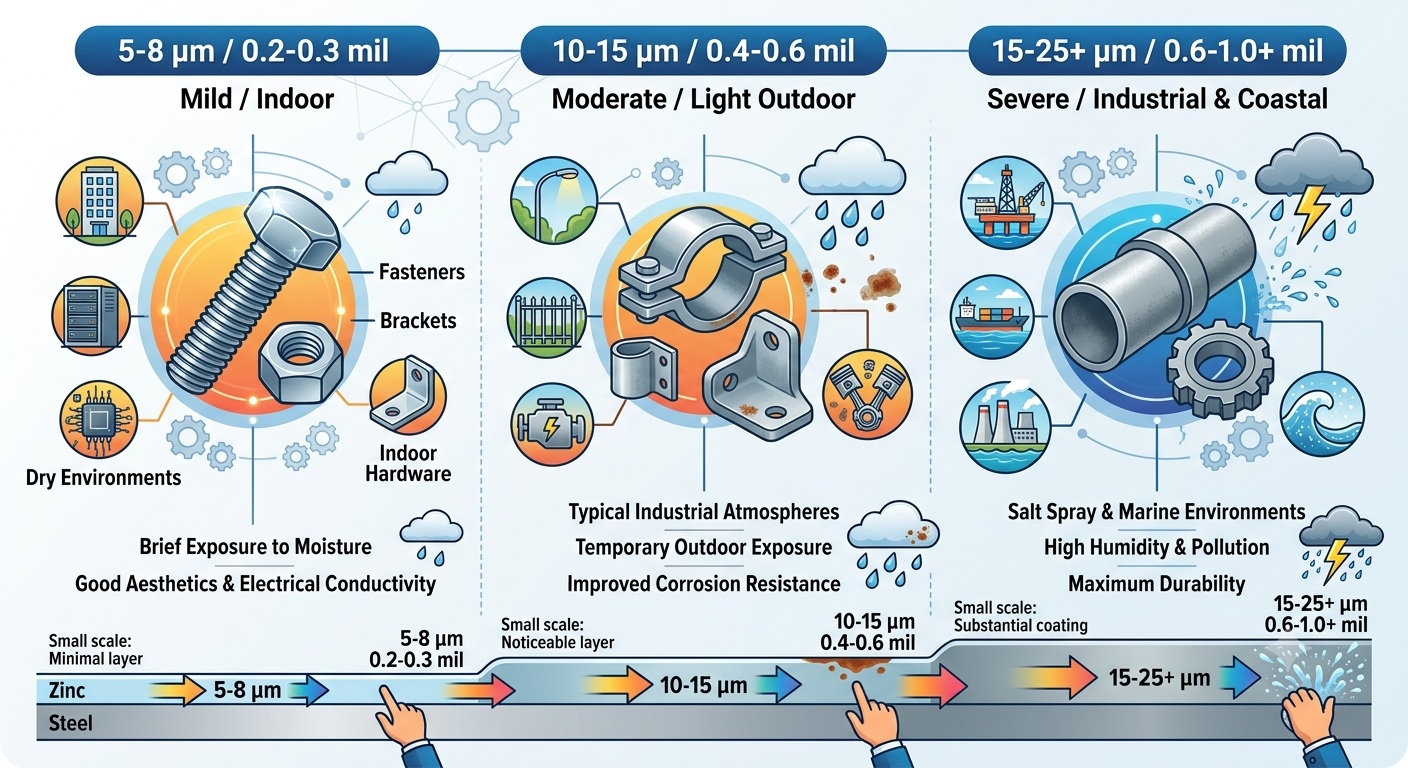
Specifying zinc plating thickness seems simple until you’re staring at a drawing that says “zinc plate per ASTM B633” and nothing else. Too little zinc and your parts fail before they reach your customer. Too much and you’re paying for protection you don’t need, risking dimensional issues on threaded components, and slowing down your supply chain. This guide gives you the precise answer: what the standard requires, how environment determines your real-world need, and how to specify it correctly the first time.
If you’ve ever written a purchase order that just says “zinc plate” and hoped for the best, you’re not alone. Zinc plating thickness is one of the most under-specified aspects of metal finishing and it’s the variable that determines whether a part lasts two years or twenty in the field.
At Plateco, we’ve been zinc plating parts since 1974. In that time, we’ve processed components for automotive OEMs, agricultural equipment manufacturers, construction hardware suppliers, and industrial fastener producers across Wisconsin and the Midwest. The single most common quality issue we see at the front end of a job is an under-specified thickness requirement or no thickness requirement at all.
This guide exists to close that gap. By the end, you’ll know exactly how much zinc you need, why the answer depends on where the part will live, and how to communicate that requirement to your plater so it’s met every time.
0.0002″Minimum SC1 zinc thickness (5µm)
SC1–SC4ASTM B633 service condition categories
1974Year Plateco began zinc plating
Why Zinc Plating Thickness Matters More Than Most People Realize
Zinc doesn’t protect steel through chemistry alone it protects through mass. The zinc coating on a plated part is the reservoir of sacrificial protection that stands between the base steel and corrosion. When that zinc is consumed oxidized into white zinc corrosion products whatever remains underneath it is unprotected steel that will begin to rust.
Thicker zinc deposits take longer to consume. That relationship is nearly linear: double the zinc thickness, and you roughly double the time before base metal corrosion begins, all other factors being equal. This is why getting thickness right isn’t a cosmetic choice it’s an engineering decision about the service life you’re designing for.
There’s a second reason thickness matters that’s less discussed: dimensional tolerances. Zinc plating adds material to every surface it covers. On non-critical surfaces, this is irrelevant. On threaded fasteners, precision fits, or assemblies with tight tolerances, it matters enormously. A coating that is too thick can cause threads to bind, interfere with assembly, or push a part outside its dimensional specification. Over-specifying is just as much a problem as under-specifying it simply causes different failures.
⚠ The Most Common MistakeWriting “zinc plate to ASTM B633” without specifying a service condition number leaves the thickness choice entirely up to the plater. Most will default to SC1 the minimum. If your parts operate outdoors, near moisture, or in harsh environments, this almost guarantees premature corrosion failure.
The right thickness is the minimum that reliably achieves your required service life in your specific operating environment. Anything less than that fails early. Anything significantly more than that costs money and may cause dimensional problems. Precision in specification pays dividends and it starts with understanding the standard that governs this decision.
ASTM B633: The Standard That Governs Zinc Plating Thickness
ASTM B633 is the primary American standard for electrodeposited coatings of zinc on iron and steel. It’s not the only specification in use OEM customers at companies like John Deere, Caterpillar, and Parker Hannifin have their own internal standards but ASTM B633 is the foundational document that most of those OEM specs reference and build upon.
The standard classifies zinc plating into four service condition (SC) categories, each with a corresponding minimum coating thickness measured in both micrometers (µm) and thousandths of an inch (mils). These categories are defined by the severity of the corrosive environment where the part will operate, not by the part itself.
The Four ASTM B633 Service Conditions Full Thickness Chart
ASTM B633 Zinc Plating Thickness Chart
| Service Condition | Min. Thickness (µm) | Min. Thickness (mils) | Thickness (visual) | Intended Environment | Typical Applications |
|---|---|---|---|---|---|
| SC 1 Mild |
5 µm | 0.2 mils | Dry indoor environments; minimal moisture exposure; no condensation | Interior fasteners, covered electrical enclosures, dry warehouse hardware | |
| SC 2 Moderate |
8 µm | 0.3 mils | Indoor with occasional condensation; some humidity; mild exposure risk | HVAC hardware, tools and zippers, general-purpose machine screws, light industrial | |
| SC 3 Severe |
12 µm | 0.5 mils | Outdoor exposure; subject to weather, temperature cycles, or atmospheric corrosion | Furniture hardware, automotive underbody parts, outdoor construction hardware, farm equipment chassis fasteners | |
| SC 4 Very Severe |
25 µm | 1.0 mil | Harsh outdoor environments; road salt, coastal air, industrial chemicals, agricultural chemicals, permanent outdoor exposure | Plumbing fixtures, marine hardware, road-facing automotive parts, agricultural attachments, construction anchors in concrete |
✓ How to Read This ChartThe µm values are minimum coating thicknesses not targets or averages. Your plater must achieve at least this thickness on the significant surfaces of the part (as defined by the drawing or default to the most exposed areas). On threaded parts, the coating must also not impair the function of the thread class specified.
What “Significant Surfaces” Means
ASTM B633 applies thickness requirements specifically to “significant surfaces” the surfaces of the part that are critical to function or corrosion protection, and that can be physically reached by a test probe or X-ray fluorescence (XRF) gauge. Recessed areas, blind holes, and internal features may receive a thinner deposit due to current distribution geometry, and this is considered acceptable under the standard as long as significant surface requirements are met.
This distinction matters when you specify a part with complex geometry. The accessible outer surfaces will meet the SC specification; interior surfaces will likely receive less. Your design must account for which surfaces need protection and whether those surfaces are reachable by the plating process.
Matching Thickness to Your Environment: A Practical Guide
The ASTM B633 service condition categories give you the framework but applying them to a real part in a real application still requires judgment. Here’s how to map your specific operating environment to the right service condition number.
The Four Environment Questions
Parts permanently housed indoors in a dry environment (no condensation, no humidity swings) are almost always SC1 or SC2 candidates. Parts with any outdoor exposure even partial or seasonal need at minimum SC3.
Salt is the fastest consumer of zinc. A part on the underside of a vehicle in a Wisconsin winter, or attached to farm equipment exposed to fertilizer, faces dramatically accelerated zinc consumption. These applications require SC4 — and in some cases, additional passivate treatment on top of maximum thickness.
If yes, there’s an upper bound on how much zinc you can apply before the coating impairs assembly. Class 1 fits can accommodate more zinc than Class 3 fits. In many threaded applications, SC1 (5µm) or SC2 (8µm) is the practical maximum before thread form is compromised, and you must verify dimensional compliance after plating.
If the part must last 5+ years in an outdoor environment without maintenance, SC3 at a minimum and likely SC4 with a yellow passivate or topcoat sealer. If it’s a consumable part replaced on an annual maintenance cycle, SC2 may be entirely adequate regardless of environment.
Zinc Plating Thickness by Industry: What Real Parts Actually Need
Typical spec: SC3 to SC4 (12–25µm)
Underbody fasteners, brake hardware, suspension clips, and wheel-related stampings face road salt and constant moisture. Most automotive OEM specs require a minimum of SC3 with trivalent yellow or clear passivate, and SC4 for any road-facing components. Many OEM specs (GM, Ford, Chrysler) exceed ASTM B633 requirements.
Typical spec: SC3 to SC4 (12–25µm)
Farm equipment faces soil abrasion, fertilizer chemicals, and constant outdoor exposure. John Deere JDM specifications which Plateco plates to regularly often require SC3 minimum with specific passivate systems and salt spray hour minimums. Seasonal storage means humidity cycling adds additional corrosion load.
Typical spec: SC3 (12µm) for general; SC4 (25µm) for embedded or permanent exposure
Anchor bolts, tie plates, structural connectors, and framing hardware need reliable outdoor protection. Parts embedded in concrete face alkaline environments that are actually somewhat protective of zinc but exposed fasteners and connectors need full SC3 or SC4.
Typical spec: SC1 to SC2 (5–8µm) for enclosed; SC3 (12µm) for process areas
Internal machine fasteners in dry enclosures can often use SC1. However, hardware in production areas exposed to coolants, washdown, or outdoor loading docks should be specified at SC2 or SC3. Always consider the actual use environment, not just the machine’s nominal operating environment.
A Word on OEM-Specific Specifications
If you supply parts to a major OEM John Deere, Caterpillar, Parker Hannifin, Case CNH their own specifications typically supersede ASTM B633 and may require specific salt spray hours, specific passivate systems, or documented traceability for every batch. These specs often require a minimum of SC3 and mandate trivalent (not hexavalent) chromate systems for RoHS compliance.
Plateco plates to all major OEM specifications and maintains the documentation and traceability these customers require. If you’re not sure which spec your customer requires, sending us their part print or purchase order specification is the fastest way to get it right on the first run.
How Passivate Treatment Multiplies Your Thickness Investment
Zinc coating thickness is only part of the corrosion resistance equation. The passivate or chromate conversion coating applied over the zinc after plating can dramatically extend the useful life of any service condition deposit. Understanding this multiplier effect helps you make smarter decisions about how to specify your parts.
What Passivate Actually Does
When zinc is freshly plated, its surface is chemically reactive and will begin forming white zinc oxide immediately when exposed to moisture. Passivation applies a thin chemical conversion layer over the zinc that seals this reactive surface, dramatically slowing the rate at which the zinc is consumed. The passivate doesn’t replace zinc it extends its effectiveness.
Passivate System Performance Comparison
| Passivate System | Color / Appearance | Hours to White Rust (approx.) | Hours to Red Rust (approx.) | RoHS Compliant | Best For |
|---|---|---|---|---|---|
| Trivalent Clear | Blue / clear | 24–48 hrs | 96–120 hrs | ✅ Yes | Indoor / mild exposure, decorative applications |
| Trivalent Yellow | Iridescent gold/yellow | 72–120 hrs | 200–240 hrs | ✅ Yes | General-purpose outdoor; most common OEM spec |
| Trivalent Black | Flat to satin black | 48–72 hrs | 120–168 hrs | ✅ Yes | Aesthetic applications needing dark appearance |
| Hexavalent Black | Glossy black | 72–96 hrs | 168–200 hrs | ❌ No (Cr VI) | Legacy specs; being phased out for RoHS markets |
| Olive Drab | Military green-brown | 96–120 hrs | 200–250 hrs | Depends on chemistry | Military / defense specifications |
| Trivalent Yellow + Topcoat Sealer | Yellow / sealed | 200+ hrs | 480+ hrs | ✅ Yes | Maximum protection, harsh outdoor environments |
✓ Practical Rule of ThumbFor outdoor or industrial applications, trivalent yellow passivate is almost always the right default. It’s RoHS compliant, widely accepted by OEM specs, provides meaningfully better corrosion resistance than clear, and costs only marginally more. If you’re currently specifying clear passivate on outdoor parts to save cost, you’re likely paying far more in warranty claims and returns.
How to Correctly Specify Zinc Plating Thickness on a Drawing
Understanding the right thickness is only half the problem. Communicating it correctly on a print or purchase order is where many manufacturers fall short. Here’s exactly what a complete zinc plating specification looks like.
The Complete Specification Format
A properly specified zinc plating callout on a drawing should include: the standard, the service condition, the passivate type, and any special requirements. A complete specification looks like this:
📋 Specification ExampleZinc electroplate per ASTM B633, SC3, Type II (trivalent yellow passivate).
Minimum thickness 12µm on significant surfaces.
Class 3A thread form to be maintained after plating.
Trivalent chromate per RoHS Directive 2011/65/EU.
Each element of that specification serves a specific purpose. The standard (ASTM B633) tells the plater which rulebook governs. The service condition (SC3) sets the minimum thickness. The type (Type II) specifies the passivate chemistry. The thread note sets a dimensional requirement. The RoHS note confirms chromate chemistry requirements for the customer’s compliance program.
What to Include and What to Never Leave Out
The two most commonly omitted elements are the service condition number and the passivate type. Leaving either of these off creates ambiguity that the plater resolves by making their best guess which may not align with what your application requires. At Plateco, when we receive a vague specification, we’ll contact the customer to clarify rather than default. But not all platers do this and vague specifications are a primary cause of parts that meet the print but still fail in service.
If you’re sourcing through a supply chain where your end customer specifies zinc plating requirements, always pass their complete specification through to your plater verbatim. Translating “plate per customer requirement” into a drawing note risks information loss that costs quality.
How Zinc Plating Thickness Is Measured and Verified
Specifying a thickness is only useful if it’s being measured and verified. There are two primary methods used in commercial zinc plating operations, and understanding both helps you ask the right questions when evaluating a plating partner.
X-Ray Fluorescence (XRF) The Industry Standard
XRF is the most common and accurate method for measuring zinc coating thickness in a production environment. A handheld or benchtop XRF instrument directs X-rays at the coated surface and measures the energy of the fluorescent X-rays emitted by the zinc layer. This gives a precise, non-destructive thickness measurement in micrometers within seconds.
XRF is well-suited for quality control on production lots because it’s fast, non-destructive, and can be used directly on the part without sample preparation. It’s accurate on flat, accessible surfaces which aligns exactly with ASTM B633’s concept of “significant surfaces.” Recesses, blind holes, and threads cannot be directly measured by XRF and are verified by inference from plating process control data.
Magnetic Induction (Eddy Current)
Magnetic induction gauges use a probe placed directly on the coated surface to measure thickness by detecting the magnetic response of the steel substrate beneath the zinc. These gauges are less expensive than XRF instruments and provide adequate accuracy for routine process checks. Their limitation is that they require the substrate to be magnetic (steel qualifies, aluminum does not), and they’re sensitive to surface roughness, part geometry, and operator technique.
What to Ask Your Plater
When evaluating a zinc plating supplier, ask specifically: “How do you measure and document coating thickness on our parts?” The answer should include a reference to XRF or magnetic induction, a description of how frequently measurements are taken per lot, and confirmation that results are recorded and available for customer review. At Plateco, thickness verification is integrated into the quality management system on every job, with documentation available for ISO 9001 and OEM audits.
Does Barrel vs. Rack Plating Affect Thickness Consistency?
The plating process barrel or rack has a meaningful effect on coating thickness distribution, and it’s a factor worth understanding when specifying your parts.
Barrel Plating Thickness Distribution
In barrel plating, parts tumble continuously through the electrolyte, receiving zinc deposition from constantly changing orientations. This tumbling motion is excellent for ensuring all surfaces including threads, holes, and complex features receive adequate coverage. However, because parts are in constant motion and current distribution is less controlled than in rack plating, there is a wider statistical distribution of thickness measurements across a plated lot. The average may be well above the SC minimum, but individual measurements on specific surfaces may show more variation.
For high-volume small parts where the priority is consistent corrosion protection and cost efficiency, barrel plating’s thickness distribution is entirely acceptable. Most SC1 through SC4 applications can be reliably met by barrel plating when the process is well-controlled.
Rack Plating Thickness Control
In rack plating, individual parts are hung on racks and held stationary in the bath. Current distribution can be more precisely controlled through rack design and anode positioning. This allows tighter thickness tolerances often ±0.0001 inch which is critical for large parts, decorative components, or applications where dimensional precision is paramount.
If your drawing specifies a tight thickness window (for example, 12–18µm with no more than ±3µm variation), rack plating is typically the better process. If your specification is a minimum with no upper bound and the part is small enough for barrel processing, barrel plating will achieve the SC requirement at lower cost per part.
“We treat zinc plating as an extremely complex process demanding state-of-the-art technology, painstaking planning, obsessive quality control, and a tremendous amount of talent. Because our customers don’t come to us for excuses they come to us for perfection. And we’ll do whatever it takes to give them nothing less.”
— Jim Schweich, Chief Executive Perfectionist, Plateco, Inc.
Frequently Asked Questions
What’s the difference between 5µm and 25µm zinc plating in real-world terms?
In a salt spray test environment, SC1 (5µm) zinc with clear passivate typically reaches white corrosion in 24–48 hours and red rust within 96–120 hours. SC4 (25µm) zinc with yellow passivate can reach several hundred hours before white corrosion and 480+ hours before red rust with a topcoat sealer. In real outdoor environments, this difference translates to years of additional service life. SC4 with proper passivate isn’t just “more protection” it’s often the difference between a part that lasts for a decade and one that shows visible rust within a single winter season.
Can I specify zinc plating thickness in mils instead of micrometers?
Yes both units are used in industry and ASTM B633 provides both. The conversions are: SC1 = 5µm = 0.2 mils; SC2 = 8µm = 0.3 mils; SC3 = 12µm = 0.5 mils; SC4 = 25µm = 1.0 mil. Micrometers are more commonly used in quality documentation because they’re the native unit of XRF measurement instruments, but either is acceptable on a drawing. What matters is that the value is clearly communicated.
Does more zinc plating thickness cause problems on threaded fasteners?
Yes, and this is a critical design consideration. Zinc plating adds material to every surface it covers, including thread flanks and crests. At SC3 (12µm) or SC4 (25µm), the accumulated coating on a threaded fastener can be enough to cause thread binding or to push the fastener outside its dimensional tolerance class. Standard practice is to use Class 1 external thread fits when specifying SC3 or SC4 to accommodate the coating, or to specify a post-plating thread inspection step. If tight dimensional tolerances are required, discuss with your plater before finalizing the specification.
What thickness does Plateco produce as a standard?
Plateco plates to SC1 through SC4 as directed by customer specifications. We don’t have a “default” thickness every job is run to the specification on the work order, which is derived from your print, purchase order, or the OEM spec you supply to us. If your print doesn’t specify a service condition, we’ll contact you to clarify before processing your parts. Getting the thickness right from the start is part of our commitment: on spec, on time, or it’s on us.
Does zinc plating thickness change the cost?
Yes, but less dramatically than most people expect. Heavier zinc deposits require longer time in the plating bath and more zinc material consumption, which adds some cost. Moving from SC1 to SC4 typically increases plating cost by 20–40% per part, depending on geometry and lot size. However, this cost increase is almost always small relative to the cost of warranty claims, product recalls, or customer returns caused by premature corrosion from under-specified plating. The right thickness for the application is the economically correct thickness.
My OEM customer specified “zinc plate” with no further detail. What should I do?
Go back to your customer and ask for a complete specification before running the parts. Ask specifically: which ASTM B633 service condition they require, which passivate system (clear, yellow, black), and whether there are any salt spray hour requirements or OEM-specific document references. Running parts to an under-specified “zinc plate” order means you’re carrying 100% of the quality risk. Getting the spec clarified protects both you and your customer, and any professional OEM will have the answer — this question should not surprise them.
Ready to Get It Right?
Tell Us About Your Parts
Plateco has been specifying and producing zinc plating to ASTM B633, John Deere JDM, Caterpillar CAT, Parker Hannifin, and dozens of other customer specifications since 1974. Not sure which service condition you need? Send us your print and we’ll tell you exactly what your application requires.