
A production manager at a Kenosha manufacturing operation is looking at two plating quotes side by side, and the geography makes the decision more interesting than it would be almost anywhere else in Wisconsin. One vendor sits comfortably within the state, a straightforward in-state relationship with no border considerations at all. The other is closer in raw miles, but sits across the state line in Illinois, which means a Kenosha manufacturer weighing that option isn’t just comparing quality and price, they’re implicitly weighing whether an out-of-state vendor relationship, even a genuinely close one, introduces friction that an in-state option doesn’t. This is a genuinely distinct situation compared to most of Wisconsin’s manufacturing base, and it’s worth addressing directly rather than pretending Kenosha’s location is identical to Green Bay’s or Madison’s.
This piece is written for manufacturers, fabricators, and purchasing teams across Kenosha, Pleasant Prairie, and the broader border region evaluating zinc plating vendors, with specific attention to what this particular geography means for that decision. We’ll cover what zinc plating involves, what makes Kenosha’s manufacturing base and location distinct, what to evaluate in a plating partner serving this specific region, and how Plateco fits into that picture for manufacturers near the Illinois border.
Why Kenosha’s Location Genuinely Changes the Vendor Conversation
Kenosha sits in a genuinely unusual position within Wisconsin’s manufacturing geography close enough to the Illinois border, and to the greater Chicago metropolitan area, that a Kenosha manufacturer’s realistic vendor search radius often includes both Wisconsin and northern Illinois options in a way that manufacturers based farther from the border simply don’t have to consider. That’s a real advantage in terms of raw option count, but it also introduces genuine practical considerations that don’t apply to a purely in-state comparison.
An out-of-state vendor relationship can mean different sales tax handling, different considerations if any state-specific compliance or reporting requirements come into play, and, for some manufacturers, a preference rooted in existing banking, accounting, or supply chain relationships that are already structured around in-state vendors. None of these factors are dealbreakers on their own, and plenty of Kenosha manufacturers work productively with Illinois-based suppliers across many categories. But it’s worth naming directly that a plating vendor evaluation for a Kenosha manufacturer legitimately includes a few more variables than the same evaluation would for a manufacturer based in, say, Eau Claire or Wausau, and treating the decision as a pure quality-and-price comparison without acknowledging those variables misses part of the real picture.
Kenosha’s manufacturing base itself reflects the area’s position within the broader Milwaukee-Chicago industrial corridor automotive and heavy equipment component manufacturing with genuine historical depth in this specific region, metal fabrication and stamping operations serving both Wisconsin and Illinois customers, and a meaningful base of logistics-adjacent manufacturing and assembly operations that benefit directly from the area’s position along major transportation corridors connecting two large metropolitan markets.
Since 1974
Plateco has served Wisconsin manufacturers with zinc plating services, including operations across Kenosha and the state’s southeastern border region
Multiple Alloys
Zinc plating capability across steel substrates, suited to automotive, heavy equipment, and general fabrication work common in the Kenosha area
0.1%
Current defect rate across Plateco’s production lines, the result of automated bath chemistry monitoring and in-process thickness verification
What Zinc Plating Actually Does, in Plain Terms
For teams newer to specifying plated finishes, it’s worth grounding this discussion in the fundamentals before getting into the specific evaluation considerations for Kenosha-area manufacturers.
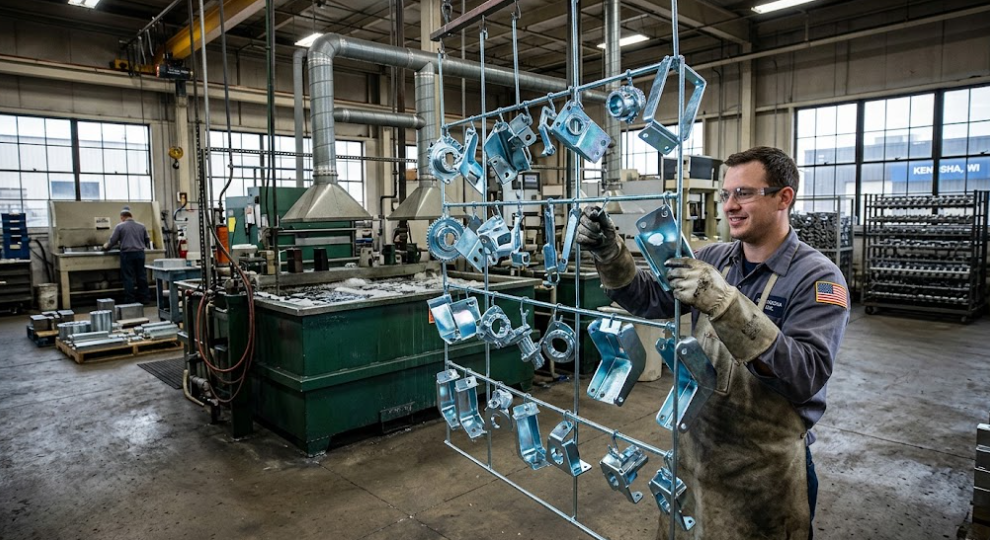
Zinc plating is an electrochemical process that deposits a controlled layer of zinc onto a steel or iron part, primarily to protect the base metal against corrosion. Zinc is more chemically reactive than the steel beneath it, so it corrodes sacrificially, protecting the underlying part even if the coating surface is scratched, until the zinc layer itself is eventually consumed. This sacrificial protection mechanism is why zinc plating remains one of the most widely specified corrosion protection methods across fasteners, brackets, structural components, and automotive hardware throughout industrial manufacturing.
The process involves several tightly controlled stages thorough cleaning to remove oils, scale, and surface contaminants that would otherwise prevent proper adhesion an electroplating bath, where controlled electrical current drives zinc ions onto the part’s surface at a rate and thickness determined by dwell time and current density rinsing and, frequently, a chromate conversion coating applied over the zinc layer, adding further corrosion resistance and available in different finishes, clear, yellow, black, or olive drab, depending on the application. Each stage demands precise control, because an inconsistency anywhere in that sequence, drifted bath chemistry, an under-timed dwell period, an improperly cleaned part, can produce a lot that looks acceptable at a glance but fails a genuine thickness or adhesion test.
Most Kenosha-area manufacturers specifying zinc plating are working against ASTM B633, the governing specification for electrodeposited zinc coatings on iron and steel, which defines coating thickness classes based on how demanding a part’s service environment will be. Given the area’s strong automotive and heavy equipment manufacturing presence, many Kenosha-area parts face genuinely demanding corrosion environments, road exposure, outdoor equipment use, which makes correct thickness classification a meaningful specification decision rather than a formality.
Have Questions About Your Parts? – (608) 524-8241
Working With an In-State Vendor: What It Actually Simplifies
For a Kenosha manufacturer weighing an in-state Wisconsin plating vendor against a nearby Illinois alternative, it’s worth being specific about what an in-state relationship genuinely simplifies, beyond a vague preference for staying within state lines.
Consistent regulatory and compliance framework. Working with a vendor operating entirely under Wisconsin’s regulatory and environmental compliance framework removes any need to track or reconcile differences between two states’ industrial and environmental regulations, which, while not usually a major practical burden either way, is one less variable for a purchasing or compliance team to manage.
Simpler logistics and accounting integration for Wisconsin-based manufacturers already structured around in-state vendor relationships. Many Wisconsin manufacturers, particularly smaller and mid-sized operations, have accounting, tax, and vendor management processes built primarily around in-state supplier relationships, and adding an out-of-state vendor, even a nearby one, can introduce administrative friction that a comparable in-state option avoids entirely.
A shared regulatory and business environment that can support more consistent long-term planning. For a manufacturer thinking about a plating vendor relationship over a multi-year horizon, an in-state Wisconsin vendor relationship sits within a single, stable regulatory environment for both parties, which can simplify long-term planning conversations around capacity, investment, and joint process improvement in a way that’s harder to coordinate cleanly across a state line.
None of this means an Illinois-based vendor should be automatically ruled out, particularly if that vendor offers genuinely superior quality, capacity, or specialization for a specific Kenosha manufacturer’s needs. It means the in-state option deserves real credit for the practical simplicity it offers, rather than being treated as functionally identical to a similarly-located out-of-state alternative.
A single, unified transportation and logistics environment for planning around Wisconsin’s own infrastructure and any state-specific trucking or delivery considerations. While interstate freight movement between Wisconsin and Illinois is routine and well-established for the vast majority of industrial shipping, a manufacturer coordinating tightly scheduled, high-frequency plating shipments may still find some marginal planning simplicity in working entirely within one state’s transportation and regulatory environment, particularly during periods of unusual weather, road conditions, or regional logistics disruption that can affect interstate corridors differently than purely in-state routes.
The Misconception We Hear Most Often From Kenosha-Area Manufacturers
That because Kenosha sits close to Illinois and the Chicago metro area, the smart sourcing move is always to cast the widest possible geographic net and let price and marketed capability be the only deciding factors, treating the Wisconsin-Illinois line as functionally irrelevant. In practice, the in-state simplicity discussed above is a genuine, quantifiable factor, not a sentimental one, and a Kenosha manufacturer weighing a close Illinois option against a comparable in-state Wisconsin vendor should weigh that simplicity explicitly in the decision, not treat it as a tiebreaker only when every other factor is dead even.
What Kenosha-Area Manufacturers Should Actually Evaluate in a Plating Vendor
Process control and documentation, confirmed directly. Ask specifically how bath chemistry is monitored, since continuous automated monitoring catches drift well before it produces a defective lot, while manual, periodic titration leaves real windows where inconsistency can develop undetected. Ask whether thickness verification happens in-process or only as an end-of-run sample check, and what documentation actually accompanies a shipment, since lot-specific, time-stamped process data tied to your purchase order is a meaningfully stronger signal of genuine process control than a general certificate of conformance.
Demonstrated experience with automotive and heavy equipment component work specifically. Given Kenosha’s manufacturing profile, it’s worth confirming directly that a prospective vendor has genuine, demonstrated experience with parts similar to yours, whether that’s automotive-grade documentation rigor or heavy equipment structural components facing demanding outdoor exposure, rather than a general capabilities claim that doesn’t speak to your specific application.
Turnaround reliability under real production pressure. Ask how a vendor’s production scheduling handles bath maintenance windows, seasonal volume spikes, and genuine rush orders, and whether committed delivery dates function as firm operational constraints rather than soft targets that slip during busy periods.
Capacity to serve your production volume without disruption. Confirm directly that a prospective vendor’s actual production capacity comfortably accommodates your volume, rather than assuming a vendor can seamlessly absorb a larger order without affecting either your schedule or their other customers’ commitments.
Environmental compliance and regulatory standing. Zinc plating involves regulated chemical processes, and a vendor’s environmental compliance track record is a legitimate diligence item, both as an indicator of overall operational discipline and because a vendor facing a regulatory disruption represents genuine supply chain risk for any manufacturer depending on them.
Industries Around Kenosha That Depend on Reliable Zinc Plating
Automotive component and Tier 2/3 suppliers. Kenosha’s genuine historical depth in automotive manufacturing means real ongoing demand for zinc-plated components meeting demanding documentation and consistency requirements, since a plating inconsistency traced back to a supplier’s parts can become a visible supply chain risk well beyond their own operation.
Heavy equipment and industrial machinery manufacturers. The area’s heavy equipment manufacturing presence regularly produces structural brackets, frame components, and mechanical hardware requiring reliable corrosion protection, often with thickness requirements driven by demanding outdoor or heavy-use operating environments.
Metal fabrication and stamping operations serving both Wisconsin and Illinois customers. Kenosha’s fabrication base often serves customers on both sides of the state line, which makes plating turnaround reliability particularly important given the tight production schedules involved in serving a broader, cross-border customer base.
Logistics-adjacent manufacturing and assembly operations. The area’s position along major transportation corridors connecting Milwaukee and Chicago supports a meaningful base of assembly and light manufacturing operations that depend on reliable, consistent finishing services to keep their own tight logistics and delivery schedules on track.
Plastics, packaging, and consumer goods manufacturers. Kenosha’s manufacturing base includes a meaningful presence of consumer goods and packaging-adjacent production, much of it depending on metal components and hardware, brackets, fasteners, structural supports, that require the same reliable corrosion protection as heavier industrial applications, even where the end product itself is a lighter consumer good.
What a Cross-Border Customer Base Means for Your Own Plating Vendor Decision
It’s worth extending the earlier discussion of in-state versus out-of-state vendor selection to a related, often overlooked point many Kenosha-area manufacturers aren’t simply deciding where to source their own plating, they’re also serving customers on both sides of the Wisconsin-Illinois line themselves, which adds its own layer of consideration to vendor selection.
A manufacturer shipping finished, plated components to customers in both states benefits from a plating vendor whose documentation and quality consistency can stand up to whatever mix of state-specific or customer-specific requirements exists across that broader customer base, rather than a vendor whose process was really built around a single state’s typical requirements. This is a subtle but genuine consideration for Kenosha’s cross-border manufacturing base specifically, and it’s worth raising directly with a prospective plating vendor ask not just whether they can meet your documentation needs, but whether they’ve demonstrated that consistency across a genuinely varied customer base similar to your own.
What Working With Plateco Looks Like for a Kenosha-Area Manufacturer
Plateco has served Wisconsin manufacturers, fabricators, and OEMs with zinc plating since 1974, including manufacturers based in Kenosha and the surrounding southeastern border region. For a manufacturer in this area evaluating Plateco, here’s what that relationship typically looks like in practice.
A genuinely in-state Wisconsin vendor relationship, offering the regulatory and administrative simplicity discussed earlier in this piece, without requiring a Kenosha manufacturer to weigh the added variables of an out-of-state vendor relationship against Plateco’s process quality and reliability.
A quoting process built around your actual prints and specs. Send your prints, specification requirements, and expected volume through Plateco’s RFQ process, and receive a quote built around your specific parts, alloy, geometry, and thickness classification.
Automated bath chemistry monitoring and in-process thickness verification on every run. The same process controls that drive Plateco’s current defect rate apply consistently, whether the order is automotive-grade component work or heavy equipment structural hardware.
Lot-specific process documentation with every shipment. Bath temperature, current density, and dwell time records tied to your specific lot number accompany your parts, giving your own quality team the documentation needed to reduce reliance on full incoming inspection over time.
“A Kenosha manufacturer shouldn’t have to choose between staying within Wisconsin and getting genuinely excellent process control. We built this business to make sure a manufacturer near the border never has to trade one for the other, whether that’s a fastener supplier feeding an automotive assembly line or a heavy equipment manufacturer shipping structural components across the region.”
Jim Schweich, Chief Executive Perfectionist, Plateco, Inc.
Questions to Ask Before Choosing a Zinc Plating Vendor Near Kenosha
If considering an out-of-state vendor, what does that relationship actually simplify or complicate for our specific operation? Weigh this honestly and specifically, rather than defaulting to either “buy local” sentiment or “closest wins” logic without examining your own operation’s actual administrative and compliance setup.
If our own customer base spans both Wisconsin and Illinois, has this vendor demonstrated consistent documentation across a genuinely varied customer base? As discussed above, this is a specific, worthwhile question for any Kenosha-area manufacturer whose own finished products ship across the state line, not just a general quality question.
Can you walk me through your experience with parts genuinely similar to ours, not just your general capability list? A vendor’s specific answer about comparable part geometry, documentation requirements, and volume tells you considerably more than a general description of their equipment and certifications.
How do you handle bath maintenance scheduling relative to committed delivery dates? This is a direct, practical question that reveals whether a vendor treats scheduling discipline as a genuine operational priority.
What does your documentation package actually include, and can I review a sample before committing volume? A vendor confident in their process control should have no hesitation providing an actual sample of their lot documentation for review.
What’s your environmental compliance history, and how do you manage wastewater treatment and regulatory reporting? This is a legitimate diligence question for any plating vendor, worth asking directly rather than assuming based on general reputation.
Frequently Asked Questions
Does Plateco serve manufacturers specifically located in Kenosha?
Yes. Plateco serves manufacturers, fabricators, and OEMs across Wisconsin, including operations in Kenosha and the broader southeastern border region, alongside customers across the state and in neighboring Illinois, Michigan, and Iowa.
Is there a genuine advantage to working with an in-state Wisconsin plating vendor versus a nearby Illinois vendor?
Yes, in terms of regulatory consistency and administrative simplicity, particularly for manufacturers whose accounting, tax, and vendor management processes are already structured around in-state relationships. This should be weighed alongside, not instead of, each vendor’s actual process quality and reliability.
What’s the typical turnaround time for a zinc plating order from a Kenosha-area manufacturer?
Turnaround depends on part volume, complexity, and current production scheduling, and is best confirmed directly through a quote request that accounts for your specific parts and required delivery timeline.
Can Plateco handle automotive-grade documentation requirements for Kenosha-area Tier 2 and Tier 3 suppliers?
Plateco’s lot-specific, time-stamped process documentation is built to support the kind of verifiable traceability automotive supply chains increasingly require, and the right approach for a specific customer’s documentation requirements is best confirmed directly through a conversation about your exact specification.
Does Kenosha’s border location affect delivery timelines for a Wisconsin-based plating vendor like Plateco?
Kenosha’s position within Wisconsin, even close to the state line, doesn’t meaningfully affect standard delivery logistics for an in-state vendor relationship, since the manufacturer and vendor remain within the same state’s transportation and regulatory framework throughout.
How does a Kenosha-area manufacturer get started with a quote from Plateco?
The process starts with sending prints, specifications, and expected volume through Plateco’s RFQ process, allowing a quote to be built around your actual parts and requirements.
Ready to Work With an In-State Plating Partner That Understands Kenosha’s Manufacturing Base?
Tell Us About Your Project
Plateco has been zinc plating for Wisconsin manufacturers, fabricators, and OEMs since 1974, including operations across Kenosha and the state’s southeastern border region. If you’re weighing an in-state vendor against a nearby out-of-state alternative, or if inconsistent quality and unreliable turnaround are costing your production schedule more than they should, send us your prints and specs and let’s talk through what a consistent Wisconsin-based partnership could look like.