

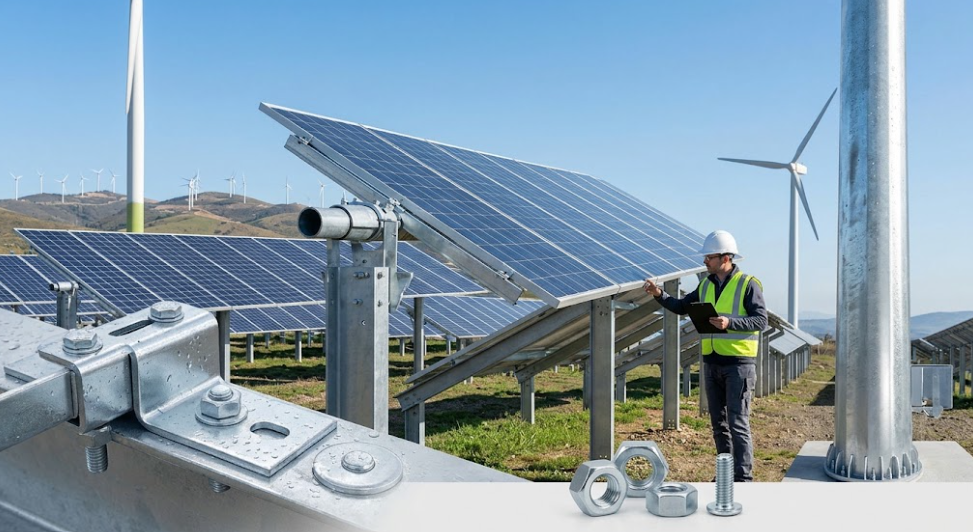
A solar farm developer specifies standard mounting hardware for a ground-mount array, the same racking clips, bolts and brackets that would go into a warehouse shelving system. Eighteen months later, red rust is bleeding through the coating on hardware sitting exposed to full sun, wind-driven rain and seasonal temperature swings across an open field, and a maintenance crew that was never budgeted for is now replacing fasteners on an installation that’s supposed to run maintenance-light for twenty-five years. Renewable energy hardware lives outdoors, under mechanical load, for decades, in environments that are often more corrosive than the industrial settings zinc plating was originally built to handle. Getting the coating specification right the first time isn’t a cost-saving nicety on these projects, it’s the difference between a component that performs for the life of the installation and one that becomes a recurring maintenance line item. This guide breaks down how zinc plating protects wind, solar and EV hardware, where the environmental and mechanical demands of renewable energy differ from general industrial applications, and how to specify a coating that actually matches the multi-decade service life these projects are built around.
Renewable energy infrastructure asks more of its hardware than most industrial applications ever have to consider. A solar racking system sits outdoors in direct weather exposure for its full service life. A wind turbine’s internal and tower-mounted hardware experiences constant vibration alongside altitude-driven temperature and humidity swings. An EV’s underbody and battery enclosure hardware faces road salt, moisture intrusion and vibration in a package that has to stay light enough to matter for range. In every one of these cases, the fastener or bracket holding the system together is rarely the part anyone thinks about first, and it’s exactly the part that determines whether the installation reaches its designed lifespan without unplanned maintenance.
At Plateco, we’ve supplied zinc plated components into industrial and construction supply chains since 1974, and the shift toward renewable energy work has meant applying that same process discipline to a category of hardware with genuinely different demands longer service life expectations, harsher continuous outdoor exposure, and in the case of wind and solar, installations where a maintenance visit isn’t a quick trip down the hall, it’s a bucket truck, a crane, or a technician climbing a tower. This guide covers where zinc plating fits across wind, solar and EV hardware, the environmental factors that should shape a coating specification for each, and how to think through service condition selection for hardware that’s expected to perform for twenty, twenty-five, or more years with minimal intervention.
25 Years
Typical design life expectation for solar racking and wind turbine structural hardware
SC3–SC4
The ASTM B633 service conditions most outdoor renewable energy hardware actually requires
1974
The year Plateco began supplying precision zinc plated components to regulated and demanding industrial supply chains
Why Renewable Energy Hardware Is a Different Corrosion Problem
It’s worth being specific about what makes wind, solar and EV component protection genuinely different from a general industrial or even a construction plating job, because the differences drive real specification decisions, not just marketing language.
Renewable energy hardware is overwhelmingly outdoor, continuously exposed hardware. A warehouse rack or a piece of indoor manufacturing equipment might see occasional condensation or an HVAC-controlled environment. A solar racking system or a wind turbine tower fastener sees full weather exposure, rain, humidity, UV, temperature cycling and, depending on location, salt air or industrial pollutants, for every day of a multi-decade service life with no climate control buffering any of it.
Service life expectations run considerably longer than most general industrial equipment. A piece of manufacturing equipment might be specified, replaced or refurbished on a ten-year cycle. Solar racking, wind turbine structural components and EV platforms are frequently designed around twenty to twenty-five year service life expectations, sometimes longer, which means the coating applied at installation needs to hold up for a genuinely long window without intermediate maintenance access in many cases.
Access for maintenance or replacement is often difficult and expensive by design. A corroded fastener on a warehouse shelf is a five-minute fix. A corroded fastener 260 feet up a wind turbine tower, or embedded in a ground-mount solar array spanning acres of a field, or inside a sealed EV battery enclosure, is a maintenance event that can cost far more than the part itself, in labor, equipment access and, in some cases, downtime for the entire system.
The Core Difference in One Sentence
General industrial plating specifications are often built around “corrosion resistance that’s good enough for the expected replacement cycle.” Renewable energy hardware specifications need to be built around “corrosion resistance that holds for the full design life of the installation,” because in most of these applications, there isn’t a convenient mid-life replacement cycle built into the maintenance plan.
Get Expert Help – (608) 524-8241
Solar Component Protection: Racking, Fasteners and Mounting Hardware
Solar installations, whether ground-mount utility-scale arrays, commercial rooftop systems or residential installations, depend on a large volume of structural and fastening hardware, and nearly all of it is exposed to continuous outdoor weather for the full life of the system.
Racking and Structural Framing
Solar racking systems, the structural framework that holds panels at their designed tilt angle and ties the array to its foundation, are typically galvanized or zinc plated steel, chosen specifically because the coating needs to protect structural steel through decades of outdoor exposure without repainting or refinishing being a realistic maintenance option across an installation that might span dozens or hundreds of acres.
Fasteners and Clips
The bolts, clips and connective hardware holding panels to racking, and racking to foundations, are individually small components, but there are thousands of them across a utility-scale installation, and a coating failure on even a small percentage of that hardware translates into a genuinely large maintenance and liability exposure across the full array. This is hardware where the cost of over-specifying the coating slightly is negligible against the cost of a maintenance crew accessing a field of racking to replace corroded fasteners.
Ground-Mount vs. Rooftop Exposure Differences
Ground-mount installations typically face more direct exposure to soil moisture, splash-back from rain and, depending on location, agricultural or coastal environmental factors. Rooftop installations face more direct UV and temperature cycling exposure with generally less splash and soil contact. Both environments justify a robust coating specification, but understanding which factors dominate for a specific project helps inform passivate selection and thickness decisions.
Tracking System Hardware
Single-axis and dual-axis solar tracking systems introduce moving mechanical components, motors, gearing and pivot hardware, into an outdoor exposure environment, which adds a wear and mechanical tolerance dimension to the corrosion protection question. Zinc plating on tracking system hardware needs to maintain both corrosion resistance and dimensional tolerance for moving parts that cycle daily across the system’s full service life.
Best For
Racking frames, mounting clips, structural fasteners, foundation hardware and tracking system components across utility-scale, commercial and residential solar installations.
Wind Turbine Component Protection: Tower, Nacelle and Foundation Hardware
Wind turbine hardware presents some of the most demanding corrosion protection requirements in renewable energy, combining extreme outdoor exposure with genuinely difficult maintenance access and, in many installations, added humidity and salt exposure from coastal or offshore siting.
Tower Structural Hardware
The bolts, flanges and connective hardware joining tower sections together carry both structural load and long-term corrosion exposure at heights where maintenance access requires specialized equipment. Coating failure on tower hardware isn’t just a corrosion cosmetic issue, it’s a structural integrity question over the multi-decade life of the turbine, which is why tower hardware specifications tend toward the higher end of available service condition categories.
Nacelle and Internal Components
Hardware inside the nacelle, the housing at the top of the tower containing the generator, gearbox and control systems, faces a somewhat different exposure profile than fully external tower hardware, generally more protected from direct weather but still subject to humidity, temperature cycling and, in many designs, condensation from temperature differentials between the nacelle interior and the outside air.
Foundation and Base Hardware
Foundation-level hardware sits closest to ground moisture, drainage patterns and, depending on the site, potential exposure to de-icing chemicals or agricultural runoff, factors that push foundation hardware specifications toward more aggressive service conditions even though this hardware is often more physically accessible than tower or nacelle components.
Offshore and Coastal Wind Considerations
Offshore and near-coastal wind installations introduce a materially harsher corrosion environment, sustained salt spray, higher humidity and, in many cases, more frequent temperature cycling, than inland installations face. Hardware specified for coastal or offshore wind projects generally needs to be evaluated against the most severe end of standard corrosion protection categories, and in some cases zinc plating alone may need to be supplemented with additional protective measures depending on the specific exposure severity and component criticality.
A Consideration Specific to Coastal and Offshore Installations
Salt spray exposure accelerates corrosion rates significantly compared to inland environments, and a coating specification that performs well for an inland wind farm may be genuinely insufficient for a coastal or offshore installation facing the same design life expectation. This is worth flagging explicitly to your plater at the specification stage rather than assuming a standard coating category will translate directly across different geographic exposure conditions.
Request a Quote For Your Project
EV Component Protection: Underbody, Battery Enclosure and Chassis Hardware
Electric vehicle hardware brings a different combination of demands to the corrosion protection question road exposure comparable to any automotive application, but layered with the added considerations of battery enclosure sealing, weight sensitivity and, increasingly, the higher voltage and current-carrying hardware unique to EV powertrains.
Underbody and Chassis Fasteners
Underbody hardware on any vehicle faces road salt, moisture, gravel impact and continuous vibration, an environment that’s driven decades of automotive corrosion protection standards generally. EV platforms don’t reduce this exposure at all, and in many cases the added weight of battery packs means underbody structural hardware is carrying more load than an equivalent internal combustion platform, making coating integrity and mechanical performance equally important.
Battery Enclosure Hardware
The fasteners and structural hardware sealing and supporting an EV battery enclosure carry a dual responsibility standard corrosion protection against road and weather exposure, and a role in maintaining the enclosure’s environmental seal integrity over the vehicle’s service life. Hardware that corrodes and loses dimensional tolerance at enclosure seal points isn’t just a cosmetic issue, it’s a pathway for moisture intrusion into a battery system where moisture intrusion is a genuine safety and performance concern.
Charging Port and Connector Hardware
Hardware around charging ports and electrical connectors faces frequent handling, exposure to outdoor weather during charging, and in some cases proximity to current-carrying components where material selection and coating choice need to account for both corrosion resistance and any relevant electrical conductivity considerations specific to the connector design.
Weight and Coating Thickness Tradeoffs
EV platforms are more weight-sensitive than most automotive applications, given the direct relationship between vehicle weight and range, which means coating thickness specifications sometimes involve a genuine conversation about the minimum thickness that satisfies the required service condition without adding unnecessary weight across a vehicle with potentially thousands of individual fasteners. This is a specification conversation worth having directly with your plater rather than defaulting to either the thinnest technically compliant coating or an oversized margin that adds weight without adding meaningful protection.
Best For
Underbody structural fasteners, battery enclosure hardware, chassis mounting components and connector hardware across EV platforms where corrosion resistance, weight and long-term seal integrity all factor into the specification.
ASTM B633 Service Conditions for Renewable Energy Applications
ASTM B633 governs required zinc coating thickness across four service condition categories, and renewable energy hardware, given its continuous outdoor exposure and long design life, generally clusters toward the more demanding end of this scale compared to general industrial applications.
ASTM B633 Thickness Requirements for Wind, Solar and EV Applications
| Service Condition | Min. Thickness (µm) | Exposure Environment | Typical Renewable Energy Application |
|---|---|---|---|
| SC 1 — Mild | 5 µm | Dry, indoor, minimal handling | Internal nacelle components with limited moisture exposure |
| SC 2 — Moderate | 8 µm | Indoor with occasional condensation | Internal EV battery enclosure hardware, controlled environments |
| SC 3 — Severe | 12 µm | Outdoor exposure, regular precipitation and humidity | Solar racking, inland wind tower hardware, EV underbody fasteners |
| SC 4 — Very Severe | 25 µm | Prolonged outdoor exposure, salt or chemical contact | Coastal and offshore wind hardware, ground-mount solar in humid or coastal regions, foundation-level hardware |
A Note on Design Life vs. Service Condition
A component rated for SC3 performance under standard testing conditions is being evaluated against a defined corrosion resistance benchmark, not against a specific number of years in the field, since actual field performance depends heavily on the specific site’s climate, exposure severity and maintenance practices. For a twenty-five year design life expectation in a genuinely harsh outdoor environment, it’s often worth discussing with your plater whether SC3 meets your actual project needs or whether SC4 is the more appropriate baseline, rather than assuming the minimum technically applicable category is automatically the right choice for a multi-decade installation.
Passivate Selection for Long-Term Outdoor Renewable Energy Hardware
The passivate layer applied over zinc plating plays a significant role in how long a coating maintains its corrosion protection before visible white corrosion products begin to appear, a factor that matters considerably more on hardware designed for decades of outdoor exposure than it does on shorter-life indoor components.
Trivalent yellow passivate is generally the standard recommendation for outdoor renewable energy hardware, offering meaningfully better corrosion resistance than a clear passivate at equivalent zinc thickness, along with straightforward RoHS compliance that matters increasingly across renewable energy supply chains with their own material disclosure requirements.
For hardware facing the most severe exposure categories, coastal and offshore wind components, ground-mount solar hardware in humid or salt-air regions, and foundation-level hardware generally, pairing a trivalent passivate with a topcoat sealer meaningfully extends the service window before white corrosion products appear, directly addressing the long design-life, difficult-maintenance-access reality that defines so much of renewable energy hardware.
Black passivate and black oxide finishes occasionally appear on visible hardware where aesthetic considerations matter alongside corrosion performance, though for structural and safety-critical hardware across wind, solar and EV applications, corrosion performance should generally drive the passivate decision ahead of appearance.
Writing a Zinc Plating Specification for Renewable Energy Hardware
A specification written for wind, solar or EV hardware needs to account for the multi-decade service life and often difficult maintenance access that define these applications, communicating not just a coating thickness but the actual environmental exposure the component will face over its full design life.
Specification Example — Ground-Mount Solar Racking Fastener
Zinc electroplate per ASTM B633, SC3, Type II (trivalent yellow passivate) with topcoat sealer. Minimum thickness 12µm on significant surfaces. Outdoor exposure, 25-year design life. RoHS Directive 2011/65/EU compliant. Certificate of conformance required with lot traceability.
Specification Example — Coastal Wind Tower Structural Bolt
Zinc electroplate per ASTM B633, SC4, Type II (trivalent yellow passivate) with topcoat sealer. Minimum thickness 25µm on significant surfaces. Coastal/high-humidity exposure. Material certification for zinc source and passivate chemistry required with shipment.
Specification Example — EV Battery Enclosure Fastener
Zinc electroplate per ASTM B633, SC2, Type II (trivalent yellow passivate). Minimum thickness 8µm on significant surfaces. Weight-optimized specification for sealed enclosure application. Certificate of conformance required.
The elements most often missing from renewable energy hardware specifications are an explicit statement of the actual site exposure conditions rather than a generic “outdoor” designation, a clear design life expectation that lets the plater and the engineering team evaluate whether the specified service condition genuinely matches project needs, and, for coastal or offshore applications specifically, a direct conversation about whether standard SC4 zinc plating meets project requirements or whether supplemental protective measures are warranted given the specific severity of the site.
A Note on Supplier Qualification for Renewable Energy Projects
Utility-scale solar and wind projects increasingly involve formal supplier qualification processes, particularly for projects backed by institutional financing where component reliability over the full design life is directly tied to project financial performance. A plating supplier who can document validated process parameters, provide material certifications and maintain lot-traceable records makes for a meaningfully easier qualification conversation than one who can only speak to coating appearance and general thickness claims.
Why Process Consistency Matters Across High-Volume Renewable Energy Orders
Utility-scale solar and wind projects order plated hardware in volumes that dwarf most general industrial orders, tens of thousands of fasteners for a single solar installation, thousands of structural bolts across a wind farm’s tower inventory, and consistency across that entire volume matters as much as the coating specification itself. A coating that performs to specification on a sample batch but drifts on lot forty of two hundred isn’t meeting the actual requirement, even if it technically passed initial qualification testing.
Working with a plating partner who maintains tight bath chemistry control, consistent current density and time parameters, and lot-by-lot thickness verification gives renewable energy project teams confidence that hardware installed in year one of a project performs identically to hardware installed in year three, a genuinely important consideration for installations where inconsistent early-life coating performance can translate directly into unplanned maintenance decades into a project’s operating life.
“We treat zinc plating as an extremely complex process demanding state-of-the-art technology, painstaking planning, obsessive quality control and a tremendous amount of talent. Because our customers don’t come to us for excuses, they come to us for perfection. And we’ll do whatever it takes to give them nothing less.”
— Jim Schweich, Chief Executive Perfectionist, Plateco, Inc.
Frequently Asked Questions
Is zinc plating suitable for offshore wind hardware, or does that environment require a different coating entirely?
Zinc plating, particularly at SC4 thickness with a trivalent passivate and topcoat sealer, can meet the corrosion protection needs of many offshore wind applications, but the most severe offshore exposure conditions sometimes call for supplemental protective measures beyond standard zinc plating alone. This is a conversation worth having directly with your plater based on the specific site’s exposure severity, salt spray frequency and the component’s criticality within the overall structure.
How does solar racking hardware corrosion protection differ between ground-mount and rooftop installations?
Ground-mount installations generally face more soil moisture, splash-back and, depending on location, agricultural or coastal exposure factors, while rooftop installations face more concentrated UV and temperature cycling exposure with generally less splash and soil contact. Both environments typically justify SC3 or higher zinc plating specifications, but understanding which exposure factors dominate for a specific project helps inform passivate and thickness decisions.
Why does EV hardware need a different approach to coating thickness than general automotive hardware?
EV platforms are more weight-sensitive than general automotive applications given the direct relationship between vehicle weight and range, which means coating thickness specifications sometimes involve a genuine tradeoff conversation between the minimum thickness that satisfies the required service condition and the cumulative weight impact across a vehicle with potentially thousands of individual fasteners. This tradeoff is less of a factor in general industrial or construction hardware specifications.
What service condition should I specify for solar racking hardware with a 25-year design life expectation?
Most solar racking and fastening hardware falls into SC3 territory for standard inland installations, though ground-mount hardware in humid, coastal or high-precipitation regions, and any hardware where maintenance access is particularly difficult, often warrants evaluating SC4 as the more appropriate baseline given the multi-decade design life and the real cost of unplanned maintenance across a large installation.
Does zinc plating on wind turbine hardware need to account for vibration in addition to corrosion resistance?
Yes, tower and nacelle hardware experiences continuous mechanical vibration throughout the turbine’s operating life, and while this is primarily a mechanical design and fastener selection question rather than a coating chemistry question, coating thickness and adhesion quality do need to hold up under that sustained mechanical stress without flaking, cracking or otherwise compromising the corrosion protection the coating is meant to provide.
Can Plateco support high-volume orders for utility-scale solar or wind projects?
Plateco maintains validated, documented zinc electroplating processes with lot-level traceability and consistent process control designed to support high-volume orders where coating consistency across thousands of components matters as much as the specification itself. If your project involves a large-volume order across an extended installation timeline, share your specification and volume expectations with us early so we can confirm capacity and timeline alongside the technical requirements.
What documentation should I expect for renewable energy hardware given the long design life these projects require?
At minimum, expect a certificate of conformance identifying the specification the parts were produced against and the measured results confirming compliance, with a lot or batch identifier tying that documentation to the specific production run. For projects with institutional financing or formal supplier qualification requirements, you should also request material certifications for the zinc and passivate chemistry used and confirmation of the specific service condition and passivate type applied, ideally as a standard part of your order rather than something requested after the fact.
Ready to Get Your Renewable Energy Component Specification Right?
Tell Us About Your Project
Plateco has been zinc plating precision components since 1974, with the process controls and documentation practices to support the long design life and high-volume demands of wind, solar and EV hardware. Send us your drawings and exposure conditions and we’ll confirm exactly what your components need before they go on the line.