

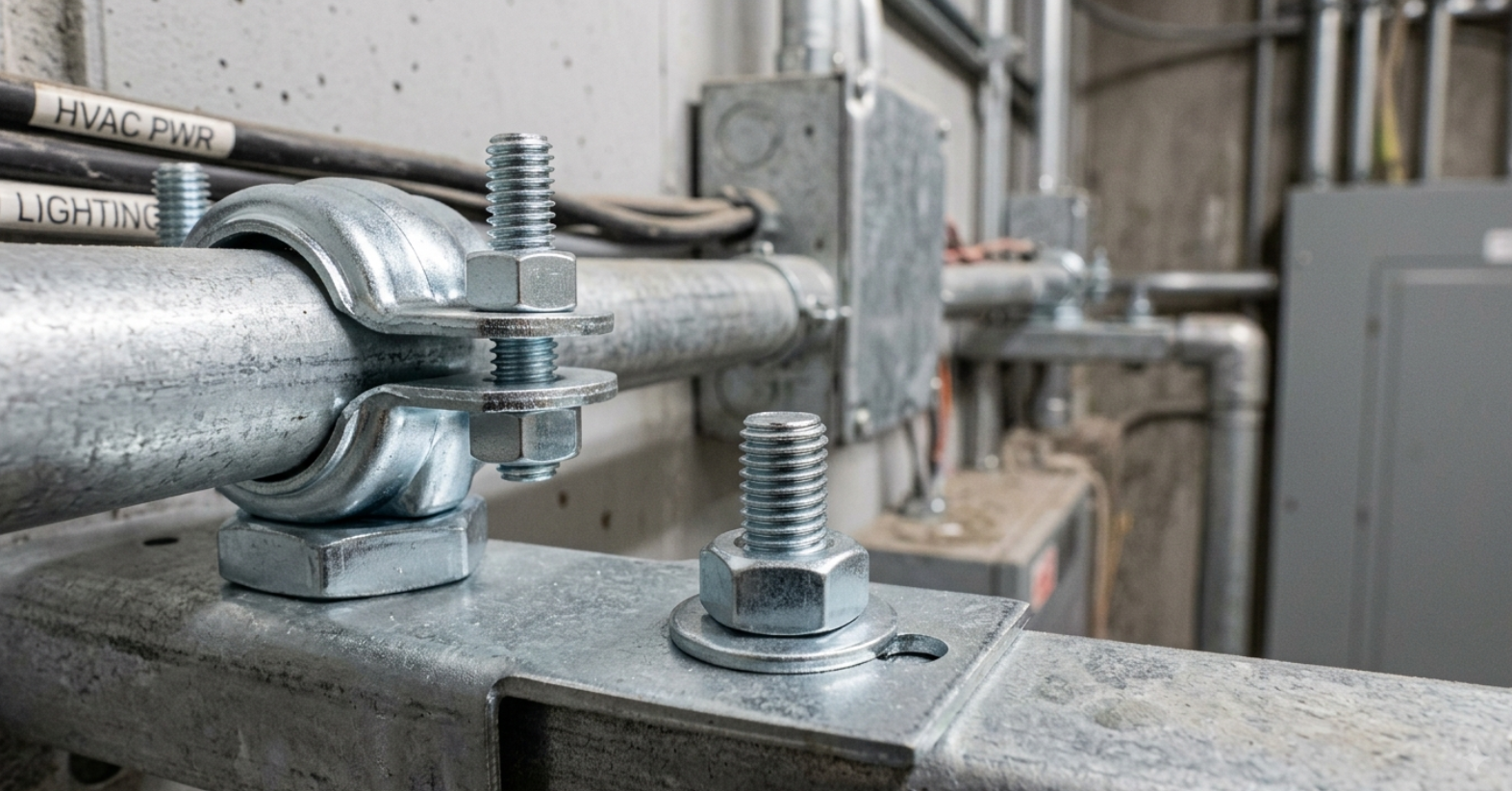
It’s a common and reasonable assumption if a part lives indoors, it doesn’t need much corrosion protection. Rain, snow, and road salt aren’t part of its world. For a lot of indoor hardware, that assumption holds up fine. For HVAC and electrical hardware specifically, it’s one of the more expensive assumptions a manufacturer or contractor can make, because “indoor” doesn’t mean “dry,” and HVAC and electrical equipment routinely sits in some of the most corrosive microenvironments a piece of hardware can occupy, condensation-soaked coil compartments, humid mechanical rooms, rooftop units exposed to weather despite technically being “indoor” equipment, and enclosures that trap moisture rather than shed it. This guide breaks down why indoor doesn’t mean low-risk for these two industries specifically, and what zinc plating specification actually needs to account for.
Plenty of indoor industrial hardware genuinely does face a mild, low-corrosion environment, a bracket inside a climate-controlled electronics enclosure, a fastener in a dry, conditioned office space. That’s exactly why ASTM B633 service condition system includes a mild category (SC1) in the first place not every indoor part needs heavy corrosion protection, and over-specifying every job to the highest available thickness wastes money without adding meaningful value.
HVAC and electrical hardware, though, routinely sits in a different category entirely, and the mistake we see most often in these two industries specifically is treating “indoor” as a synonym for “low corrosion risk” without actually examining the specific microenvironment a given component will occupy. A control panel bracket inside a rooftop HVAC unit isn’t living in the same environment as an office desk fastener, even though both would technically be described as indoor hardware on a generic purchase order. This guide is built to help HVAC and electrical manufacturers, contractors, and component suppliers specify zinc plating correctly for the environments their hardware actually faces, not the environment the word “indoor” might casually suggest.
95%+
Relative humidity commonly reached inside HVAC coil compartments during operation
SC2-SC3
Typical ASTM B633 service condition range for HVAC and electrical enclosure hardware
1974
Year Plateco began zinc plating for Wisconsin HVAC, electrical, and industrial manufacturers
Why “Indoor” Is a Misleading Category for Corrosion Risk
The core problem with treating indoor hardware as inherently low-risk is that indoor environments vary enormously in humidity, condensation exposure, and chemical contact, far more than the single word “indoor” suggests. A dry, climate-controlled server room and a humid, condensation-cycling HVAC coil compartment are both technically indoor, but they represent almost opposite ends of the corrosion risk spectrum.
Corrosion fundamentally requires moisture and, usually, oxygen in contact with an unprotected metal surface, along with time. It doesn’t require rain or direct weather exposure. A component sitting inside a sealed enclosure that regularly experiences condensation, temperature cycling, or contact with moisture-laden air can corrode just as reliably as an outdoor part, sometimes faster, because condensation cycling and trapped moisture in a confined space can actually be more persistently corrosive than open-air weather exposure that at least has a chance to dry out between rain events.
This is precisely the situation HVAC and electrical hardware frequently finds itself in. HVAC systems, by their fundamental function, move air across surfaces that experience significant temperature differentials, which is exactly the condition that produces condensation. Electrical enclosures, particularly those installed in mechanical rooms, basements, or near HVAC equipment, are frequently exposed to the same humidity and condensation cycling as the systems they’re mounted near, even when the enclosure itself is technically sealed.
The Core Misconception to Avoid
“Indoor” describes a location, not a corrosion environment. A component’s actual risk depends on the humidity, condensation exposure, and temperature cycling it experiences in that specific location, not simply whether it’s protected from direct rain. HVAC and electrical hardware frequently occupies indoor locations with genuinely outdoor-equivalent corrosion pressure, and specifying corrosion protection based on the word “indoor” alone, rather than the actual microenvironment, is one of the most common and costly specification gaps in these two industries.
The Specific Corrosive Conditions Inside HVAC Systems
HVAC equipment creates several distinct corrosive conditions that hardware manufacturers and contractors need to account for specifically, each with a different mechanism and a different practical implication for coating specification.
Condensation inside coil compartments and cabinets. Evaporator coils, by design, cool air below its dew point to remove humidity, which means the surfaces around and near the coil regularly experience direct condensation, sometimes at humidity levels exceeding 95 percent relative humidity within the immediate compartment. Any zinc plated hardware, brackets, fasteners, mounting rails, positioned in or near this environment needs to be specified for sustained, repeated condensation exposure, not the general indoor environment the rest of the equipment room might experience.
Rooftop units facing outdoor weather despite being classified as building equipment. Rooftop HVAC units are frequently categorized in project documentation as indoor or building-integrated equipment, but they sit fully exposed to actual weather, sun, rain, snow, and in many regions, road salt carried by wind, exactly like any outdoor structure. Hardware inside a rooftop unit’s cabinet needs corrosion protection matched to genuine outdoor exposure, regardless of how the unit is categorized on a project spec sheet.
Humid mechanical rooms and basement installations. Boiler rooms, mechanical equipment rooms, and basement HVAC installations frequently run at elevated ambient humidity, sometimes compounded by proximity to water heating equipment, humidifiers, or simply poor ventilation in a below-grade space. Hardware in these locations experiences meaningfully more corrosion pressure than a climate-controlled office or living space, even though both are unambiguously “indoor.”
Condensate drainage and standing moisture. Condensate lines, drain pans, and the hardware mounted near them face not just humidity but direct, repeated liquid water contact, sometimes combined with the mildly acidic pH condensate water can develop as it interacts with coil materials and airborne contaminants. Fasteners and brackets in direct proximity to condensate handling components warrant a genuinely conservative corrosion protection specification.
Chemical exposure from refrigerants and cleaning agents. HVAC service and maintenance routinely involves contact with refrigerants, coil cleaning chemicals, and other maintenance fluids, some of which can accelerate corrosion on unprotected or under-protected metal surfaces if contact is frequent or prolonged.
A Useful Reframe for Specifying HVAC Hardware
Instead of asking “is this part indoors,” ask “what’s the actual humidity, condensation, and moisture exposure this specific location experiences during normal equipment operation.” A coil compartment bracket and a control panel mounting screw in the same unit can face genuinely different corrosion environments despite both technically being inside the same “indoor” piece of equipment.
The Specific Corrosive Conditions in Electrical Hardware Applications
Electrical hardware carries its own set of indoor corrosion risks, often compounded by the fact that corrosion on electrical components isn’t just a structural or cosmetic concern, it can directly affect electrical conductivity, connection integrity, and equipment safety.
Enclosures in humid or condensation-prone locations. Electrical panels, junction boxes, and enclosures installed in mechanical rooms, near HVAC equipment, in basements, or in any location with elevated ambient humidity face condensation risk on internal hardware even when the enclosure itself carries a NEMA rating suggesting environmental protection. A NEMA rating protects against external ingress it doesn’t eliminate internal condensation risk from temperature cycling and ambient humidity that was already present inside the enclosure at the time it was sealed.
Hardware in food processing, agricultural, and washdown environments. Electrical hardware installed in food processing facilities, agricultural buildings, or any environment subject to regular washdown or high ambient moisture faces corrosion pressure that’s functionally similar to, and sometimes worse than, genuine outdoor exposure, despite being fully indoor installations.
Conduit and fastener hardware in below-grade or crawl space installations. Electrical conduit supports, fasteners, and mounting hardware installed below grade or in crawl spaces frequently experience elevated humidity and occasional direct moisture contact from groundwater seepage, soil moisture, or condensation on cool below-grade surfaces.
Corrosion’s direct impact on electrical performance, not just structural integrity. Unlike a structural bracket where corrosion primarily threatens mechanical strength, corrosion on electrical connection hardware, grounding lugs, terminal hardware, conduit fittings, can directly degrade electrical conductivity and connection integrity, creating resistance increases, heat buildup, and in some cases genuine safety hazards well before the hardware would fail structurally. This raises the practical stakes of under-specifying corrosion protection on electrical hardware above what the same coating gap might cause on a purely structural component.
A Risk That’s Easy to Underestimate
Corrosion on electrical connection hardware doesn’t need to progress nearly as far as it would on a structural bracket before it becomes a genuine problem, since even modest surface corrosion can increase electrical resistance at a connection point, generating heat and degrading performance well before any structural weakening would be visible. This is a meaningful reason to avoid defaulting to the thinnest available coating on electrical hardware simply because the application is indoors.
ASTM B633 Service Conditions for HVAC and Electrical Hardware
For zinc electroplated hardware in these applications, ASTM B633’s service condition categories provide the framework for matching coating thickness to actual exposure, and correctly identifying which category applies to a specific component is the central specification task.
ASTM B633 Service Conditions for Indoor HVAC and Electrical Applications
| Service Condition | Min. Thickness (µm) | Typical Environment | HVAC/Electrical Application Examples |
|---|---|---|---|
| SC 1 — Mild | 5 µm | Dry indoor, no condensation | Interior control panel hardware in climate-controlled spaces |
| SC 2 — Moderate | 8 µm | Indoor with occasional condensation | General electrical enclosure hardware, standard mechanical room fasteners |
| SC 3 — Severe | 12 µm | Outdoor or high-humidity/condensation-prone indoor exposure | Coil compartment brackets, rooftop unit hardware, basement/crawl space electrical fasteners |
| SC 4 — Very Severe | 25 µm | Harsh exposure, prolonged moisture, chemical contact | Rooftop units in coastal or heavy-salt regions, washdown-environment electrical hardware |
A useful pattern to recognize a significant share of HVAC and electrical hardware that would traditionally be specified at SC1 or SC2 based on a general “it’s indoors” assumption actually warrants SC3 based on its specific proximity to condensation, humidity, or moisture exposure once that microenvironment is actually examined. The cost difference between these service conditions is modest on a per-part basis the difference in actual field performance, particularly for hardware that’s difficult or expensive to access for replacement once installed, is not modest at all.
A Practical Default Worth Considering
For HVAC hardware positioned in or near coil compartments, condensate handling components, or rooftop unit cabinets, and for electrical hardware in mechanical rooms, below-grade installations, or any location with elevated ambient humidity, defaulting to SC3 rather than assuming SC1 or SC2 based purely on indoor classification is a reasonable, cost-effective baseline that accounts for the genuine microenvironment these components typically face.
Passivate Selection for HVAC and Electrical Hardware
Beyond the zinc coating thickness itself, the passivate finish applied over the zinc plays a meaningful role in corrosion resistance and, for electrical applications specifically, in maintaining reliable electrical contact performance over time.
Clear (blue) passivate offers the lowest additional corrosion protection among common options but provides a bright, low-resistance surface finish that’s frequently preferred for electrical connection hardware where maintaining predictable, low-resistance contact matters as much as corrosion resistance itself.
Yellow (trivalent) passivate provides meaningfully better corrosion resistance than clear passivate and is generally the right default for HVAC hardware facing SC3-level condensation and humidity exposure, where the additional protection outweighs the slight difference in surface conductivity characteristics that matters more for direct electrical contact applications.
Black passivate is sometimes specified for visible HVAC or electrical hardware where an aesthetic preference exists alongside functional requirements, offering corrosion resistance generally between clear and yellow options.
For hardware serving a direct electrical connection function, grounding hardware, terminal lugs, conduit bonding components, coordinating passivate selection with your electrical engineering requirements, not just general corrosion resistance guidance, ensures the finish supports both corrosion protection and the electrical performance characteristics the connection actually needs.
A Coordination Point Worth Raising Early
For hardware with a direct electrical function, ask your plating supplier specifically how a given passivate choice affects surface conductivity, not just corrosion resistance, since these two priorities can occasionally pull in different directions and the right answer depends on which one matters more for that specific connection point.
Common Specification Gaps We See in HVAC and Electrical Hardware Orders
A few specific patterns show up repeatedly in HVAC and electrical hardware purchase orders that create real downstream risk, worth flagging directly for any manufacturer or contractor reviewing their own specification practices.
Defaulting to a single service condition across an entire assembly regardless of component location. It’s common to see an entire HVAC unit or electrical panel assembly specified at a single, uniform service condition, when in reality, different components within the same assembly face meaningfully different exposure, a coil compartment bracket and an interior control board mounting screw don’t belong in the same category, even though they’re part of the same unit.
Treating rooftop equipment as indoor hardware for coating purposes. Because rooftop units are often categorized as building-integrated equipment in project documentation, their internal hardware sometimes gets specified using the same assumptions applied to genuinely interior, climate-controlled components, missing the fact that a rooftop unit’s cabinet experiences real outdoor weather regardless of its equipment classification.
Not accounting for regional climate in addition to microenvironment. A rooftop unit or basement mechanical room in a humid, freeze-thaw climate like Wisconsin’s faces meaningfully more corrosion pressure than the identical equipment installed in a consistently dry climate, and regional climate should factor into service condition selection alongside the specific microenvironment analysis covered above.
Leaving passivate type unspecified and letting a supplier default to whichever is cheapest or fastest to produce. As with coating thickness, an unspecified passivate requirement often results in a supplier defaulting to whatever’s most convenient for their production schedule, rather than the finish best matched to the component’s actual corrosion and, where relevant, electrical performance requirements.
A Specification Example Worth Following
Zinc electroplate per ASTM B633, SC3, Type II (trivalent yellow passivate). Applies to all hardware within coil compartment and condensate handling zones. Interior control panel hardware in climate-controlled cabinet sections may be specified separately at SC2. Confirm passivate selection with electrical engineering for any hardware serving a direct grounding or connection function.
Why Wisconsin’s Climate Adds an Extra Layer of Consideration
For HVAC and electrical hardware manufactured or installed in Wisconsin, or destined for installation in similar Upper Midwest climates, regional weather conditions compound the indoor microenvironment risks already covered in this guide, rather than replacing them.
Wisconsin’s humid summers push ambient moisture levels higher across the board, meaning even hardware in reasonably well-ventilated mechanical spaces experiences more baseline humidity exposure than the same equipment would in a drier climate. Winter freeze-thaw cycling affects rooftop and any partially exposed HVAC hardware directly, and road salt carried by wind or vehicle traffic near ground-level equipment adds a corrosion accelerant that a purely humidity-based analysis wouldn’t capture. Combined, these regional factors are a reasonable justification for erring toward the higher end of the applicable service condition range for Wisconsin-installed HVAC and electrical hardware, rather than assuming a national baseline specification is automatically sufficient.
Questions to Ask Before Finalizing Your Hardware Specification
What’s the actual humidity and condensation exposure at this specific hardware location, not just the general classification of the surrounding equipment or room?
This is the central question underlying everything in this guide, and answering it specifically for each hardware location within an assembly, rather than applying a single blanket assumption, is the most direct way to close the specification gaps covered above.
Does this hardware serve a direct electrical connection function that should factor into passivate selection?
If so, coordinate passivate choice with your electrical engineering requirements rather than defaulting purely on general corrosion resistance guidance.
Is this equipment actually installed outdoors or in an outdoor-adjacent location, regardless of how it’s categorized in project documentation?
Rooftop units and any HVAC or electrical equipment exposed to real weather should be specified according to that actual exposure, not the equipment category it falls under on a spec sheet.
Does the regional climate where this equipment will be installed warrant erring toward a higher service condition than a national baseline specification would suggest?
For installations in genuinely humid, freeze-thaw, or high-salt-exposure regions like Wisconsin, this is worth factoring in explicitly rather than assuming a generic specification transfers evenly across all installation climates.
Can your plating supplier confirm the specific service condition and passivate thickness they’re delivering, with documentation, rather than a general assurance that the hardware is “zinc plated”?
As with any critical coating specification, confirming actual delivered thickness and passivate type through documentation, rather than assuming a general zinc plating description guarantees a specific performance level, closes the loop between what was specified and what was actually received.
Getting the Environment Right, Not Just the Location
The single most useful shift a manufacturer, contractor, or component supplier can make when specifying zinc plating for HVAC and electrical hardware is moving away from “is this indoors” as the deciding question and toward “what moisture, condensation, and chemical exposure does this specific component actually experience.” That shift alone resolves most of the common specification gaps covered in this guide, and it costs nothing beyond the attention required to actually think through each component’s real operating environment rather than defaulting to a blanket assumption based on a building classification.
Plateco has plated hardware for Wisconsin HVAC, electrical, and industrial equipment manufacturers since 1974, with the process controls and service-condition expertise to help you match coating specification to actual exposure rather than a generic indoor assumption. If you’re reviewing your own hardware specifications, or sourcing plating for a new HVAC or electrical component line, we’re glad to walk through what your specific parts actually need.
Frequently Asked Questions
Does hardware inside a sealed electrical enclosure really need meaningful corrosion protection if outside air can’t get in?
Yes, in many cases. A sealed enclosure doesn’t eliminate internal corrosion risk if humidity was already present inside the enclosure at the time it was sealed, or if temperature cycling causes internal condensation to form and re-form repeatedly over the enclosure’s service life. Enclosures installed in humid mechanical rooms, near HVAC equipment, or in below-grade locations frequently experience meaningful internal condensation despite being technically sealed from outside weather, which is why internal hardware in these locations still warrants a service condition beyond the mildest SC1 category.
How do I know if a rooftop HVAC unit’s internal hardware should be specified as indoor or outdoor exposure?
Base the specification on the hardware’s actual physical exposure, not the equipment’s classification in project documentation. If the unit’s cabinet is exposed to direct weather, sun, rain, snow, or wind-carried salt, the internal hardware should generally be specified at SC3 or SC4 as appropriate, similar to genuinely outdoor structural hardware, regardless of whether the unit is categorized as building-integrated or indoor equipment on a spec sheet.
Is clear passivate ever the wrong choice for electrical connection hardware, even though it offers good conductivity?
It can be, if the hardware faces meaningful humidity or condensation exposure beyond a genuinely dry, low-risk indoor environment. In those cases, the corrosion protection gap between clear and yellow passivate can become a bigger practical concern than the modest conductivity difference, particularly since corrosion itself, not just the passivate type, ultimately degrades electrical connection performance if left unaddressed. Coordinating this choice with your electrical engineering team based on the hardware’s actual exposure is the right approach rather than defaulting to clear passivate purely for conductivity reasons in every case.
Does Wisconsin’s climate really make a meaningful difference for indoor HVAC and electrical hardware specifically?
Yes, indirectly but meaningfully. Wisconsin’s humid summers raise baseline ambient moisture levels in mechanical spaces broadly, and hardware in partially exposed locations, rooftop units, ground-level equipment near roadways, below-grade installations, faces additional regional factors like freeze-thaw cycling and road salt exposure that a purely generic, climate-neutral specification wouldn’t account for. This doesn’t mean every piece of indoor hardware in Wisconsin needs maximum protection, but it does support erring toward the higher end of the applicable service condition range rather than the minimum.
What’s the most cost-effective way to avoid over-specifying corrosion protection across an entire HVAC or electrical assembly?
Rather than applying a single blanket service condition to an entire assembly, break the specification down by actual component location and exposure, hardware near coil compartments or condensate handling gets a higher service condition, while genuinely dry, climate-controlled interior control hardware within the same overall unit can reasonably be specified lower. This location-specific approach avoids both the risk of under-protecting exposed components and the unnecessary cost of over-protecting genuinely low-risk ones.
Ready to Match Your Hardware Specification to Its Real Environment?
Tell Us About Your Project
Plateco has plated HVAC, electrical, and industrial hardware for Wisconsin manufacturers since 1974, with the process controls and service-condition expertise to help you specify corrosion protection based on actual exposure, not just a general indoor assumption. Send us your drawings and we’ll walk through exactly what each component needs.