

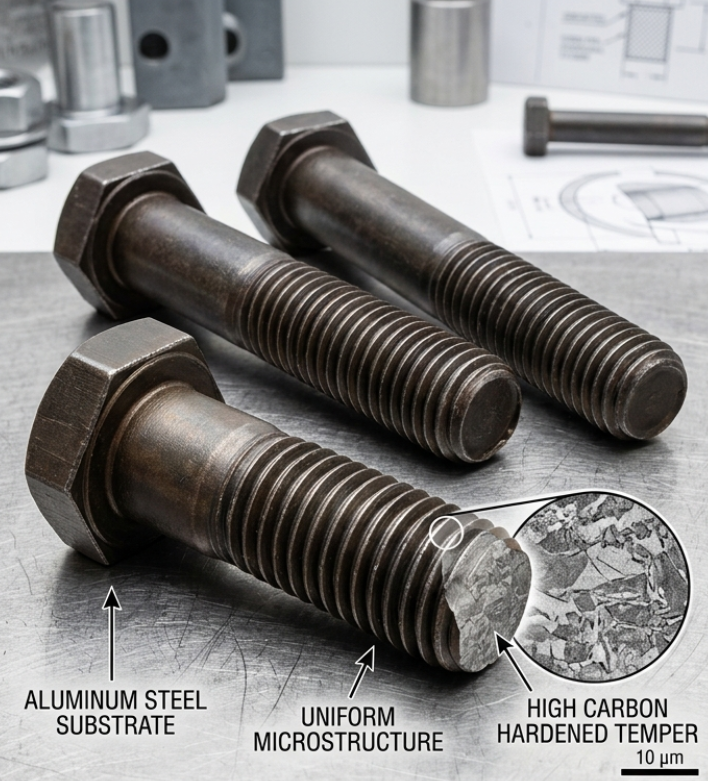
A high-strength bolt can pass every dimensional check, every visual inspection, and even an initial proof load test, and still fail catastrophically weeks or months later with no warning. That’s the specific, well-documented danger of hydrogen embrittlement, and it’s the reason aerospace and defense procurement specifications treat plating process control on high-strength fasteners with a level of rigor that can look excessive to anyone unfamiliar with the failure mode. It isn’t excessive. It’s calibrated to a genuine risk that has caused real structural failures in the past. This guide walks through what hydrogen embrittlement actually is, why high-strength steel is uniquely vulnerable to it, what ASTM F519 and AMS 2759/9 actually require, and what an aerospace or defense supplier should verify before trusting a plating partner with a high-strength fastener order.
Hydrogen embrittlement occupies a strange place in materials engineering it’s simultaneously well understood at the mechanistic level and genuinely difficult to detect after the fact without destructive testing. A bolt suffering from hydrogen embrittlement doesn’t look different, doesn’t weigh differently, and doesn’t fail a standard dimensional or visual inspection. It fails later, suddenly, often without the warning signs, yielding, visible cracking, gradual deformation, that engineers typically rely on to catch a developing structural problem before it becomes a failure.
For aerospace and defense supply chains, where a single fastener failure can mean loss of a critical system or, in the worst case, loss of life, this failure mode is treated as one of the most serious process control risks in the entire fastener supply chain. This guide is built for engineers, quality managers, and procurement teams working in or supplying into aerospace and defense programs who need to understand not just what hydrogen embrittlement is in the abstract, but what specific standards govern it, what documentation should accompany every high-strength plated fastener, and how to evaluate whether a plating supplier’s process actually controls for it.
260-280 ksi
The baseline ultimate tensile strength range used in ASTM F519 testing
200 Hours
Standard sustained load test duration under ASTM F519
190-220°C
Typical hydrogen embrittlement relief baking temperature range for steel fasteners
What Hydrogen Embrittlement Actually Is
Hydrogen embrittlement occurs when atomic hydrogen is absorbed into the crystal structure of a metal, most critically high-strength steel, during a process like acid pickling, cleaning, or electroplating. Once inside the metal, hydrogen atoms migrate toward regions of high stress concentration, thread roots, notches, fillets, and areas where microstructural defects already exist, and accumulate there. Under sustained tensile stress, this trapped hydrogen reduces the metal’s ductility at a microstructural level and can initiate cracking that propagates through the material, often with little to no plastic deformation beforehand, which is what makes the resulting failure so sudden and so difficult to predict from external inspection alone.
The critical variable that makes hydrogen embrittlement a fastener-specific concern is material strength. Lower-strength, more ductile steels can absorb meaningful amounts of hydrogen without significant embrittlement risk, because their microstructure can accommodate that hydrogen without a corresponding loss of fracture toughness. High-strength steels, generally those heat treated above roughly 150 ksi tensile strength, and increasingly critical as strength climbs toward the 200 ksi-plus range common in aerospace fastener applications, lose this tolerance almost entirely. The same hydrogen exposure that a mild steel bracket would shrug off can cause a high-strength aerospace bolt to fail under sustained load, sometimes days or weeks after the part was installed and appeared to be functioning correctly.
This delayed nature is what separates hydrogen embrittlement from most other coating or process defects a quality team is trained to catch. A porosity defect, an adhesion failure, an out-of-spec thickness, these are detectable, in principle, at the time of inspection. Hydrogen embrittlement is not. A part can pass every inspection performed at the time of manufacture and delivery and still fail in service, which is exactly why the industry has built such specific, process-focused standards around preventing it rather than relying primarily on after-the-fact detection.
Have Questions About Hydrogen Embrittlement? – (608) 524-8241
Why This Failure Mode Gets Treated Differently Than Others
Most coating defects reveal themselves, visually, dimensionally, or through short-term functional testing, close to the point of manufacture. Hydrogen embrittlement failures are specifically delayed, occurring under sustained load well after a part has passed every inspection available at time of shipment. This is why aerospace and defense specifications focus so heavily on process control and qualification testing rather than final-part inspection alone by the time a delayed failure would be detectable through simple observation, the part has often already been installed in service.
Why High-Strength Fasteners in Aerospace and Defense Face Elevated Risk
Aerospace and defense applications create a specific, compounding set of conditions that make hydrogen embrittlement a more acute concern than in most other industrial fastener applications.
Fastener strength requirements push well into the embrittlement-susceptible range. Structural fasteners in aircraft and defense systems are frequently specified at strength levels, often 180 ksi and above, and in some critical applications into the 260-280 ksi range that forms the baseline for ASTM F519 testing, where hydrogen embrittlement susceptibility is at its most severe. This isn’t a coincidence the same weight-to-strength performance that makes high-strength steel valuable in aerospace design is what makes it vulnerable to this specific failure mode.
Fasteners are frequently installed in genuinely inaccessible, safety-critical locations. Unlike many industrial applications where a fastener can be inspected or replaced during routine maintenance, aerospace fasteners are often installed in locations that are difficult or impossible to inspect without significant disassembly, and many are structural connections where a delayed failure has consequences far beyond the fastener itself.
Sustained and cyclic loading conditions are common in service. Aerospace and defense structures routinely experience sustained tensile loads, and often significant cyclic loading, both conditions that align directly with the mechanism through which hydrogen embrittlement causes delayed fracture. This is a meaningfully different loading profile than a fastener sitting in largely static compression in many general industrial applications.
Regulatory and program-level accountability is exceptionally high. A hydrogen embrittlement failure in an aerospace or defense application isn’t just a quality escape, it’s the kind of failure that triggers formal investigation, potential grounding of equipment, and program-level accountability that extends well beyond the individual supplier where the failure originated. This accountability structure is precisely why aerospace and defense procurement specifications are written with such specific process and testing requirements rather than general performance language.
Which Plating Processes Actually Carry Hydrogen Embrittlement Risk
Not every coating process poses meaningful hydrogen embrittlement risk, and understanding which ones do is essential for both specifying the right process and evaluating a plating supplier’s actual risk profile.
Cadmium plating (AMS-QQ-P-416). Cadmium plating has historically been one of the most common finishes for aerospace fasteners due to its excellent corrosion resistance and lubricity, but the electroplating process used to apply it generates significant hydrogen, making hydrogen embrittlement relief a mandatory, non-negotiable step for any high-strength fastener plated with cadmium. Cadmium is also increasingly restricted due to toxicity and environmental regulation, which has driven meaningful movement toward alternative coatings in many programs, though it remains specified in numerous legacy and current aerospace applications.
Zinc and zinc alloy electroplating. Standard zinc electroplating, and zinc-nickel alloy plating increasingly specified as a lower-toxicity alternative to cadmium, both carry hydrogen embrittlement risk through the same fundamental mechanism, hydrogen generated during the electrodeposition process. Low-hydrogen-embrittlement zinc-nickel processes have been developed specifically to reduce this risk relative to conventional plating baths, but “low embrittlement” formulations still require qualification testing and baking to confirm the risk has actually been controlled, not eliminated by process design alone.
Hard chrome plating. Hard chrome plating is particularly notorious for high hydrogen embrittlement risk because the process requires extremely high current densities that generate substantially more hydrogen than typical decorative or corrosion-resistant plating processes. Aerospace components requiring hard chrome, landing gear components being a common example, require especially rigorous embrittlement relief and testing given this elevated baseline risk.
Mechanical plating and zinc flake coatings. These non-electrolytic coating processes, applying zinc through mechanical tumbling or spray/cure application rather than an electric current, avoid the hydrogen generation mechanism entirely, which is precisely why they’re increasingly specified for high-strength fasteners where eliminating embrittlement risk at the process level is preferable to managing it through relief baking after the fact.
Chemical processes: pickling, cleaning, and etching. It’s worth noting that hydrogen embrittlement risk isn’t exclusive to electroplating. Acid pickling, certain cleaning processes, and chemical etching steps performed before plating can themselves introduce hydrogen into high-strength steel, which is why comprehensive specifications like ASTM B849 address pretreatment processes specifically, not just the plating step itself.
A Practical Distinction Worth Understanding
If eliminating hydrogen embrittlement risk at the process level, rather than managing it through post-plating relief, is a priority for a given application, mechanical plating or zinc flake coatings are worth evaluating specifically for that reason. If cadmium, hard chrome, or conventional electroplating is required by an existing specification or program legacy requirement, rigorous embrittlement relief and testing become non-negotiable rather than optional risk mitigation.
ASTM F519: The Standard Test Method for Hydrogen Embrittlement Evaluation
ASTM F519 is the standard aerospace and defense supply chains rely on to evaluate whether a plating or coating process introduces unacceptable hydrogen embrittlement risk, and understanding its structure is essential for any supplier or buyer working with high-strength fasteners.
The standard uses notched test specimens, typically manufactured from AISI 4340 steel heat treated to a baseline ultimate tensile strength of 260 to 280 ksi, reflecting decades of accumulated aerospace industry data on this specific alloy and strength combination’s response to hydrogen exposure. These notched specimens are plated or coated under actual production conditions, replicating the real process a supplier’s parts will undergo, then subjected to a sustained load test a fixed tensile load, commonly 75 percent of the specimen’s notched fracture strength, applied continuously for 200 hours. If a specimen survives the full 200-hour test period without fracturing, the plating or coating process is considered to have passed the embrittlement evaluation under those specific test conditions.
This methodology is deliberately conservative and process-focused rather than part-specific. ASTM F519 isn’t typically used to test every individual production lot, it’s used to qualify a supplier’s specific process, plating chemistry, pretreatment steps, and baking procedure combined, as capable of producing parts free from unacceptable embrittlement risk. Once a process is qualified through this testing, ongoing production relies on maintaining strict adherence to that qualified process, which is why process control documentation matters as much as the original qualification test itself.
ASTM F519 Testing at a Glance
Element Requirement Baseline material AISI 4340 steel per AMS-S-5000 Baseline strength 260-280 ksi ultimate tensile strength Test load Typically 75% of notched fracture strength Test duration 200 hours sustained load Pass criteria No fracture within the test period Primary use Process qualification, not routine lot testing
It’s worth noting explicitly that ASTM F519 evaluates the plating and coating process itself, not the relative hydrogen susceptibility of different base materials; separate standards, including ASTM F1624, address material-specific susceptibility testing when a component’s base material or heat treatment falls outside the standard baseline. For components with ultimate strength significantly above the 260-280 ksi baseline, the standard explicitly notes that the cognizant engineering authority should determine whether additional or component-specific testing is warranted, rather than assuming the baseline qualification automatically applies.
AMS 2759/9 and the Hydrogen Embrittlement Relief Process
Where ASTM F519 evaluates whether a process controls embrittlement risk, AMS 2759/9 governs the actual baking procedure used to relieve absorbed hydrogen from high-strength steel parts after plating, and it’s this standard that translates directly into a specific, verifiable step on the shop floor.
Hydrogen embrittlement relief works by heating plated parts to an elevated temperature, commonly in the range of 190 to 220 degrees Celsius (roughly 375 to 425 degrees Fahrenheit), for a specified duration, which allows absorbed hydrogen atoms enough thermal energy to diffuse back out of the steel before they can migrate to areas of stress concentration and initiate cracking. The exact time and temperature requirements under AMS 2759/9 vary based on factors including the part’s material, strength level, and the specific coating applied, which is why a supplier needs to reference the current, correct version of the specification for the specific part in question rather than applying a generalized baking cycle across all high-strength fasteners.
Critically, baking must begin within a specified, relatively short window after plating, since delayed baking allows hydrogen more time to migrate to critical stress locations before relief treatment begins. A supplier’s process documentation should reflect not just that baking occurred, but that it occurred within the required timeframe following plating, since a technically correct bake performed too late in the process timeline may not fully mitigate risk that’s already begun to concentrate in critical areas.
A Detail That Matters More Than It Might Seem
The requirement that baking begin promptly after plating, rather than simply “at some point before the part ships,” is a genuine process control point, not an administrative formality. A supplier’s documentation should reflect the actual elapsed time between plating and the start of baking, not just confirmation that baking eventually took place, since delayed baking meaningfully reduces the treatment’s effectiveness at mitigating risk that has already begun to concentrate at stress points within the part.
What Complete Documentation Should Actually Look Like
For an aerospace or defense procurement team receiving high-strength plated fasteners, documentation isn’t a bureaucratic add-on to the physical parts, it’s the primary evidence that hydrogen embrittlement risk was actually controlled, since the risk itself is undetectable through inspection of the finished part. Complete documentation for a high-strength fastener lot should include several specific elements.
Process qualification records. Evidence that the specific plating process used on the parts was originally qualified through ASTM F519 testing (or an equivalent, program-approved test method), including the specific coating chemistry and baking procedure that was qualified, not just a general reference to “F519 compliant” without supporting detail.
Lot-specific baking records. Documentation of the actual time and temperature the specific lot of parts was subjected to during hydrogen embrittlement relief, along with the elapsed time between plating and the start of baking for that lot, tied to a traceable lot or batch number.
Material and process traceability. Confirmation of the base material, heat treatment condition, and coating process applied, allowing any future investigation to trace a specific fastener lot back to the exact process conditions that produced it, which is essential if a field issue ever needs root-cause investigation.
Certificate of conformance referencing the specific governing specification. A clear statement of which specification, ASTM F519, AMS 2759/9, or a program-specific requirement, the parts were processed to, along with confirmation that current, correct revisions of those specifications were used rather than outdated versions.
A Direct Question Worth Asking Any Supplier
“Can you provide lot-specific documentation showing the elapsed time between plating and the start of hydrogen embrittlement relief baking for this specific order?” A supplier with genuinely mature process control will have this documentation readily available and will understand exactly why the question matters. A supplier who can only provide a general statement that “baking is performed per spec” without lot-specific, time-stamped detail may not be tracking this critical variable with the rigor the application requires.
Evaluating a Plating Supplier for Aerospace and Defense High-Strength Fastener Work
Given the stakes involved, supplier qualification for high-strength fastener plating deserves a more rigorous evaluation process than general commercial plating sourcing, and a few specific areas deserve direct attention.
Demonstrated ASTM F519 qualification history, not just familiarity with the standard. Ask specifically which processes a supplier has qualified through F519 testing, when that qualification was performed, and whether it remains current for the specific coating and base material combination your application requires.
A documented, time-controlled baking process tied to AMS 2759/9 or the applicable governing specification. Beyond simply confirming that baking occurs, verify that a supplier’s process explicitly controls and documents the elapsed time between plating and the start of baking, not just the baking parameters themselves.
Quality system certification appropriate to the application. ISO 9001 certification provides a meaningful baseline for documented process control, but many aerospace and defense programs require AS9100 certification specifically, given its additional aerospace-specific requirements around traceability, risk management, and configuration control. Confirm which certification level your specific program requires, and verify a prospective supplier’s current certification status directly rather than assuming general industrial plating experience transfers automatically to aerospace-grade process control.
A clear, specific answer about testing frequency and process monitoring. Ask how often a supplier re-qualifies or monitors their process against F519-type testing on an ongoing basis, not just at initial process qualification, since plating chemistry, equipment condition, and operator practices can all drift over time in ways that affect embrittlement risk even after an initial successful qualification.
Willingness to discuss a real corrective action example. As with any critical process, a mature supplier should be able to describe how they’ve handled a past deviation or nonconformance related to hydrogen embrittlement relief, what was found, how it was contained, and what changed as a result, rather than claiming the issue has simply never arisen.
A Genuine Red Flag
A supplier offering to plate high-strength fasteners for an aerospace or defense application without being able to discuss ASTM F519 qualification specifics, AMS 2759/9 process controls, or lot-specific baking documentation should be treated as a significant risk, regardless of price or turnaround time offered. This is not an area where general plating competence substitutes for demonstrated, documented, aerospace-specific process control.
Where General Industrial Plating Experience Fits, and Where It Doesn’t
It’s worth being direct about an important distinction: strong process discipline in general industrial and OEM zinc plating, the kind built around ISO 9001 certification, documented calibration, and rigorous nonconformance handling, is a genuinely relevant foundation for understanding why hydrogen embrittlement control matters and how mature quality systems are built. But it is not, by itself, equivalent to demonstrated AS9100 certification and specific ASTM F519 process qualification that primary aerospace structural fastener applications require.
For manufacturers working on defense-adjacent or aerospace-supporting equipment where high-strength fastener corrosion protection and embrittlement control matter, but the specific certification requirements of primary flight-critical structure don’t apply, a plating partner with strong general process discipline, documented hydrogen embrittlement relief practices, and transparent communication about what they can and cannot certify to is a legitimate and valuable resource. For primary aerospace structural applications with AS9100 or specific program certification requirements, verifying that exact certification directly, rather than assuming strong industrial credentials transfer automatically, is essential.
Plateco has built its zinc plating process around the same core discipline this guide has walked through, ISO 9001 certified process control, documented hydrogen embrittlement relief baking, and lot traceability, for Wisconsin and Midwest manufacturers since 1974, serving industrial, agricultural, and OEM supply chains with genuine process rigor around high-strength fastener plating. If your program’s certification requirements go beyond what we’re positioned to support, we’ll tell you that directly and help you understand exactly what to verify with a supplier who can.
Frequently Asked Questions
Does every high-strength bolt need to be individually tested under ASTM F519?
No. ASTM F519 is primarily used to qualify a plating or coating process, not to test every individual part or lot. Once a specific process, coating chemistry, pretreatment steps, and baking procedure combined, has been qualified through F519 testing, ongoing production relies on maintaining strict, documented adherence to that qualified process rather than repeating destructive F519 testing on every batch.
What strength level actually triggers hydrogen embrittlement concern for a fastener?
There’s no single universal threshold, but concern generally becomes significant above roughly 150 ksi ultimate tensile strength, and becomes acute in the 180 ksi and above range common in many aerospace structural fastener applications. The specific governing program specification for your application should define the exact strength threshold that triggers mandatory embrittlement relief and testing requirements, since this can vary by program and specification.
Is mechanical plating or zinc flake coating always a better choice than electroplating for high-strength aerospace fasteners?
Not universally, it depends on the specific program specification, required coating properties, and whether an existing application already specifies electroplated cadmium, zinc, or a specific alternative. Mechanical plating and zinc flake coatings do offer a genuine advantage in eliminating hydrogen generation at the process level, which is why they’re increasingly specified for new designs where this risk can be engineered out from the start, but many existing programs and legacy specifications still call for electroplated finishes with rigorous baking and testing as the qualified approach.
How long after plating does hydrogen embrittlement relief baking need to begin?
The specific required window varies by governing specification and should be confirmed against the current, applicable standard for your application, but it’s generally a relatively short timeframe, and beginning baking promptly after plating is a genuine process control requirement, not a flexible guideline. A supplier’s documentation should reflect the actual elapsed time for each specific lot, not just confirmation that baking eventually occurred.
Does AS9100 certification automatically mean a supplier has demonstrated ASTM F519 process qualification?
No, these are related but distinct things. AS9100 certifies a supplier’s broader aerospace quality management system, documentation control, traceability, risk management, while ASTM F519 qualification is a specific, process-level test confirming that a particular plating or coating process doesn’t introduce unacceptable hydrogen embrittlement risk. Confirm both separately AS9100 certification status, and specific, current F519 qualification for the exact process and material combination your application requires.
What should a procurement team do if a supplier can’t produce lot-specific hydrogen embrittlement relief documentation for an already-delivered order of high-strength fasteners?
This deserves immediate escalation rather than being treated as a paperwork gap, particularly for fasteners already installed in service. Request the documentation immediately, and if the supplier cannot produce it or confirms the process wasn’t consistently followed and documented, treat the affected parts as a genuine safety concern warranting internal escalation and, depending on the application and program requirements, a formal investigation into whether the parts remain fit for continued service.
Ready to Talk Through Your High-Strength Fastener Requirements?
Tell Us About Your Application
Plateco has built ISO 9001 certified process discipline around zinc plating and hydrogen embrittlement relief for Wisconsin and Midwest manufacturers since 1974. If your application involves high-strength fasteners, we’re glad to walk through exactly what our process can document, and be direct with you about where your program’s certification requirements might call for a different partner.