

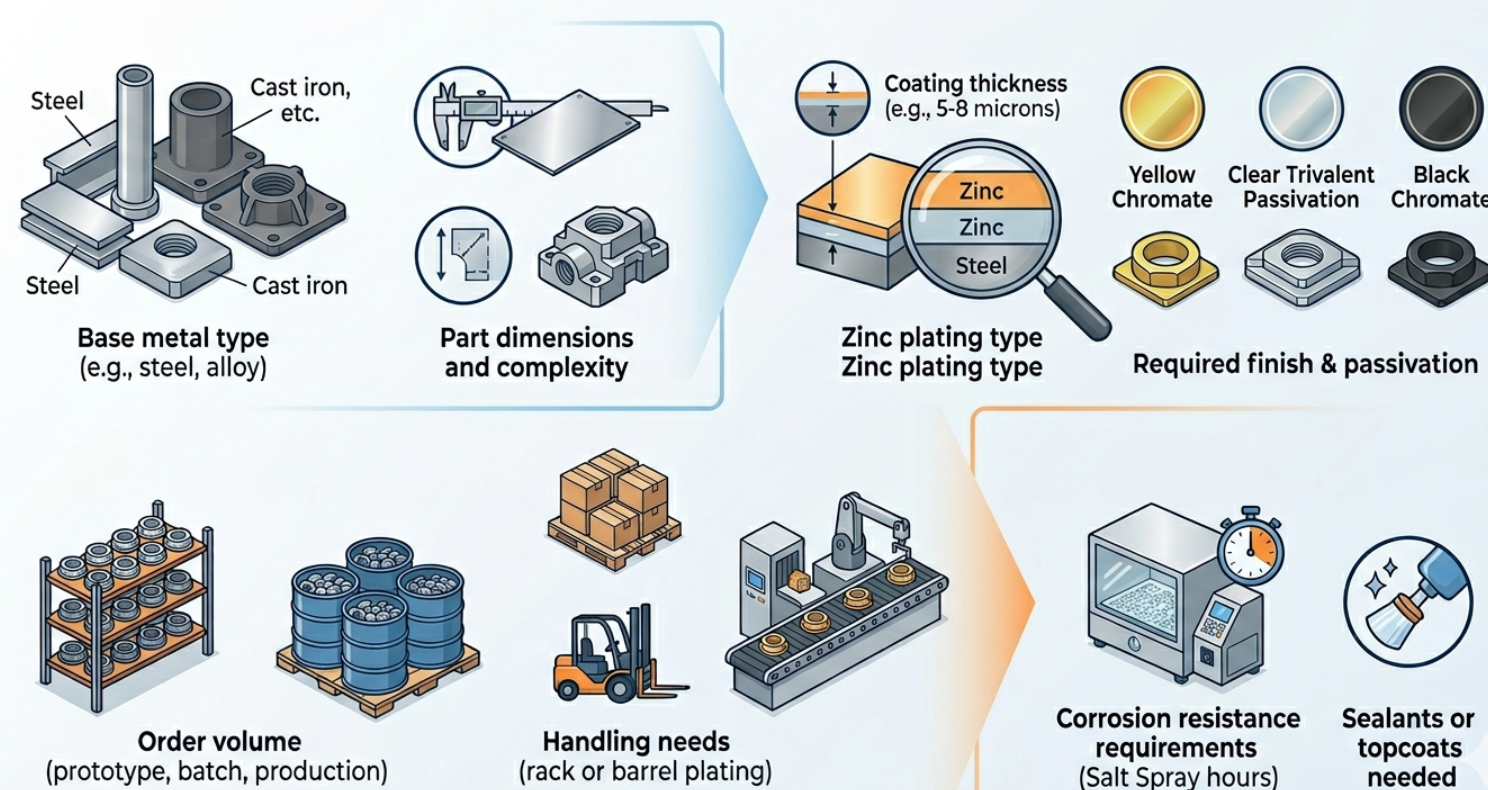
If you have ever sent an email that said ‘we need some parts zinc plated what’s the price?’ and received a slow response or a list of follow-up questions in return, this guide is for you.
Getting a fast, accurate zinc plating quote is not complicated but it does require the right information upfront. This post walks you through exactly what your plater needs to know, why each piece of information matters, and how providing it all at once saves you time, eliminates quoting delays, and gets your parts to production faster.
At Plateco, we have been zinc plating parts since 1974. We plate for automotive OEMs, agricultural equipment manufacturers, industrial hardware suppliers, and fastener producers across Wisconsin and the Midwest. Every week, our sales team fields quote requests and the fastest ones to turn around are always the ones where the buyer came prepared.
This guide exists to make you that buyer.
50M+
Parts Processed Per Year
since 1974
3
Plating Methods Available
barrel · rack · mechanical
Fast
Quote Turnaround
contact us today
Why a Vague Quote Request Costs You Time and Money
Zinc plating is not a one-size-fits-all service. The price, process, lead time, and even the physical outcome of the plating all depend on a specific set of variables tied to your part, your application, and your quality requirements.
When a plater receives a request with missing information, one of three things happens:
- They quote conservatively padding price and lead time to cover unknowns
- They ask you a list of clarifying questions adding days to the process
- They make assumptions which may or may not match what you actually need
None of these outcomes serves you well. Conservative quotes cost more. Clarifying questions slow you down. Wrong assumptions result in parts that fail, require re-work, or don’t meet your customer’s specification.
The solution is simple: know what information to bring before you reach out. A complete quote request takes less than five minutes to prepare, and it can cut your quote turnaround from days to hours.
The Complete Zinc Plating Quote Checklist
Here is every piece of information your plater needs and exactly why it matters.
| What Your Plater Needs | Why It Matters for Your Quote | |
| ✓ | Part Drawing or Dimensions | Determines if barrel or rack plating is required; flags thread or tolerance concerns |
| ✓ | Base Material | Affects pre-treatment process, chemistry compatibility, and adhesion |
| ✓ | Plating Specification / Standard | Defines thickness, passivate type, and test requirements |
| ✓ | Coating Thickness Required | Directly impacts cost, process time, and corrosion performance |
| ✓ | Passivate / Chromate Finish | Affects final appearance, corrosion hours, and RoHS compliance |
| ✓ | Part Quantity and Frequency | Drives pricing tier, scheduling priority, and lot setup costs |
| ✓ | Part Weight and Size | Determines barrel vs. rack eligibility and per-part handling cost |
| ✓ | Required Lead Time | Flags whether standard scheduling or rush processing applies |
| ✓ | Special Handling or Masking | Adds process steps, tooling, and cost must be quoted separately |
| ✓ | Significant or Critical Surfaces | Tells the plater where thickness must be guaranteed vs. secondary |
Information #1: Your Part Drawing or Dimensions
The single most useful document you can send a plater is a part drawing. If you have a drawing even a rough one send it. A drawing communicates in one page what would take paragraphs of text to describe.
Your plater looks at a drawing and instantly sees:
- The overall size and shape of the part
- Thread specifications and tolerance classes
- Any callouts for plating specification, thickness, or inspection
- Significant surfaces, masking zones, and datum references
- Any notes that affect how the part must be handled or racked
If you do not have a formal engineering drawing, dimensional information works too. Key measurements include the longest dimension, widest dimension, and overall weight of the part. These three figures alone tell the plater whether your part is a barrel candidate or a rack candidate which is one of the biggest cost drivers in zinc plating.
Barrel vs. Rack: Why It Matters for Your Quote
Barrel plating is the lower-cost, higher-volume method used for small parts typically fasteners, clips, stampings, and small hardware. Parts tumble together in a rotating barrel inside the plating tank.
Rack plating is used for larger, more complex, or more delicate parts that cannot tumble without damage. Parts are individually mounted on racks. Rack plating costs more per piece but provides better thickness distribution and surface quality.
Information #2: Base Material
What is the part made of? This seems like a simple question, but it has real process implications.
Zinc electroplating is designed primarily for iron and steel substrates. But there are important distinctions even within steel:
- Low carbon steel standard pre-treatment, no unusual concerns
- High carbon or hardened steel risk of hydrogen embrittlement; requires post-plate baking (per ASTM F519)
- Cast iron porous surface requires modified cleaning and activation steps
- Powder metallurgy (sintered) parts highly porous; may require special sealing pre-treatment
- Stainless steel generally not zinc plated; requires confirmation
If your part is heat-treated, case-hardened, or has a tensile strength above 150 ksi, tell your plater. These parts require hydrogen embrittlement relief baking after plating a required step under ASTM B633 and most OEM specifications. Missing this step can lead to delayed fracture failure in the field, which is a serious and costly quality issue.
Information #3: Plating Specification or Standard
What standard does the part need to meet? This is one of the most critical pieces of information in any zinc plating quote and one of the most frequently missing.
The most common zinc plating specification is ASTM B633, the standard for electrodeposited coatings of zinc on iron and steel. ASTM B633 defines four service condition categories, each corresponding to a minimum coating thickness:
| Service Condition | Min. Thickness | Environment | Typical Use |
| SC1 — Mild | 5 µm (0.2 mils) | Dry indoor only | Interior fasteners, enclosures |
| SC2 — Moderate | 8 µm (0.3 mils) | Some humidity | HVAC hardware, light industrial |
| SC3 — Severe | 12 µm (0.5 mils) | Outdoor exposure | Automotive, construction hardware |
| SC4 — Very Severe | 25 µm (1.0 mil) | Salt, chemicals, harsh outdoor | Marine, road-facing, agricultural |
If you supply to a major OEM John Deere, Caterpillar, Parker Hannifin, Case CNH, General Motors their internal specifications typically reference ASTM B633 but add additional requirements such as minimum salt spray hours, specific passivate systems, and documented process traceability. Tell your plater the OEM specification number if one applies. “John Deere JDM F13” means something very specific to an experienced plater far more than “zinc plate for John Deere” does.
Important: Always State a Service Condition Number
Writing “zinc plate to ASTM B633” without a service condition number leaves thickness undefined. Most platers will default to SC1 the minimum. If your parts operate outdoors or near moisture, this is almost certain to result in premature corrosion failure. Always specify SC1, SC2, SC3, or SC4.
Information #4: Passivate or Chromate Finish
Zinc plating alone gives you a dull gray, minimally corrosion-resistant surface. The passivate (also called chromate conversion coating) applied over the zinc is what gives plated parts their characteristic color, shine, and enhanced corrosion resistance.
Your quote needs to specify which passivate you need. The main options are:
| Passivate Type | Appearance | Salt Spray Hours (typical) | Notes |
| Clear / Bright | Silver-white sheen | 72–120 hours | Most common; RoHS-compliant (trivalent) |
| Yellow / Gold | Yellow-gold iridescent | 120–200 hours | Enhanced protection; RoHS-compliant (trivalent) |
| Black | Matte to semi-gloss black | 72–120 hours | Aesthetic; may require topcoat sealer |
| Olive Drab | Military green-brown | 200+ hours | Military/defense applications |
If your parts need to comply with RoHS (the European Restriction of Hazardous Substances directive) which is required for most automotive, electronics, and export applications make sure you specify trivalent passivate. Hexavalent chromate provides superior corrosion resistance but is prohibited in RoHS applications. If you are unsure which applies, your plater can advise, but you need to raise the question.
Information #5: Quantity and Order Frequency
How many parts do you need plated and how often? This information is critical to how your plater structures your quote, schedules your work, and determines per-piece pricing.
Quantity Drives Per-Piece Price
Zinc plating has significant setup cost. Pre-treating, loading the barrel or rack, processing, rinsing, and passivating each lot takes time regardless of whether the lot is 100 pieces or 10,000. That fixed cost is spread across all the parts in the lot which means higher quantities almost always result in lower per-piece pricing.
When you request a quote, provide:
- The initial order quantity
- Expected order frequency (weekly, monthly, quarterly)
- Annual volume if you have it
If you are a first-time buyer testing a new part, say so. A plater may quote a small initial run differently than a steady-state production quantity. Being transparent about your volume expectations lets the plater give you a realistic long-term price not just a one-time number.
Frequency Affects Scheduling and Priority
A buyer who runs 50,000 pieces per month is a different customer than one who calls once a year with 500 pieces. Knowing your frequency helps the plater slot you into their production schedule appropriately and helps you understand whether standard lead time or a blanket order arrangement makes more sense for your supply chain.
Information #6: Part Weight and Piece Size
The physical size and weight of your parts directly determine which plating method is available to you and that choice has a major impact on price.
As a general guide:
| Part Characteristic | Typical Method | Cost Implication |
| Small, < 3″ longest dimension, < 0.5 lb | Barrel plating | Lowest per-piece cost; high-volume efficient |
| Medium, 3″–12″, or delicate/complex shape | Rack plating | Higher per-piece; better finish control |
| Large, > 12″ or heavy castings | Rack plating (heavy) | Higher setup; may require custom fixturing |
| Small, hardened or powdered metal | Mechanical galvanizing | No hydrogen embrittlement risk; specialty process |
Weight also matters for mechanical galvanizing Plateco’s dry plating method that uses impact energy rather than electrical current. Mechanical galvanizing is ideal for high-strength fasteners and parts where hydrogen embrittlement is a concern. It works best on parts under about 1.5 pounds.
Information #7: Required Lead Time
How quickly do you need the parts back? Lead time affects scheduling, overtime, and the plater’s ability to fit your job into the current production queue.
For most standard zinc plating jobs, a competent plater can turn work around within a few business days. But “standard” depends on:
- Current production load at the shop
- Whether your parts require any special pre-treatment or post-bake
- Volume small lots can often move faster than large ones
- Complexity rack jobs with custom fixturing take longer to set up
If you have a hard delivery date, say so upfront. Most platers can accommodate rush jobs but rush processing comes with a price premium, and it needs to be factored into the quote from the start. Telling your plater “I need these in two days” after you have already agreed on a price creates friction, delays, and sometimes disappointment.
If you have a flexible timeline, say that too. Platers can sometimes offer better pricing when your job can be scheduled into available capacity rather than requiring priority placement.
Information #8: Special Handling, Masking, or Surface Requirements
Does any portion of the part need to be kept free of zinc? Are there threads that need to be protected? Surfaces that need to remain bare for welding, press-fit, or electrical contact?
Masking is the process of protecting specific surfaces from the plating bath during processing. It adds cost both in materials and in labor and must be planned for before the quote is finalized.
Common masking needs include:
- Threaded holes that must remain to tolerance for assembly
- Internal bores or bearing surfaces with tight dimensional requirements
- Surfaces designated for welding after plating
- Electrical contact areas that require bare metal conductivity
- Branding or label areas where paint or adhesive adhesion is required
Even if you only think masking might be needed, raise it early. The discussion of significant surfaces which areas of the part must meet the full thickness specification vs. which areas are secondary also matters here. Your drawing should ideally identify significant surfaces. If it does not, your plater will need to determine this with you before quoting.
Putting It All Together: What a Complete Quote Request Looks Like
Here is what a well-prepared zinc plating quote request looks like in practice. This takes less than five minutes to write, and it gives the plater everything they need to respond with a firm, accurate price on the first pass:
Sample Quote Request — Complete
Part: 3/8″-16 hex head bolt, SAE Grade 8, hardened steel, approximately 2″ long.
Quantity: 25,000 pieces initial order; monthly runs of 10,000–15,000 expected.
Specification: ASTM B633, SC3, trivalent yellow passivate. Must comply with RoHS.
Additional requirements: Hydrogen embrittlement bake required (Grade 8 steel). Threads must be functional after plating class 2A fit. No masking required.
Lead time: Standard turnaround preferred; first order needed within 10 business days.
Drawing attached: Yes (PDF attached).
Notice what this request does: it names the part and material, states a quantity and frequency, provides an exact specification with service condition and passivate type, flags a process requirement (hydrogen embrittlement bake), addresses threads and dimensional requirements, and gives a lead time. This is a request that can be quoted in minutes.
Compare that to: “Need some 3/8 bolts zinc plated what’s the price?” That message kicks off a round of questions before any number can be given.
Common Mistakes That Delay Your Zinc Plating Quote
Even experienced procurement professionals make these errors. Here are the most common ones and how to avoid them:
Mistake #1: No Specification Just ‘Zinc Plate It’
Without a specification, the plater cannot quote to a standard. They will either ask you for one or quote to the minimum possible thickness. Neither outcome is ideal. Always specify a standard and a service condition.
Mistake #2: Sending Samples Without Dimensions or Drawings
Physical samples are helpful, but they do not communicate what the part is made of, what tolerance it needs to meet, or what specification it must comply with. Always accompany a sample with documentation.
Mistake #3: Not Mentioning High-Strength Steel
If your parts are hardened or have a tensile strength over 150 ksi, they require post-plate hydrogen embrittlement relief baking. Leaving this out of the quote means the baking step may not be priced and then either gets done unpaid or, worse, gets skipped entirely.
Mistake #4: Quoting One Quantity, Ordering Another
Quoting 1,000 pieces and then ordering 50,000 or vice versa changes the per-piece price significantly. If your volume is uncertain, ask for tiered pricing at multiple quantities so you have the right number when your order comes in.
Mistake #5: Not Mentioning OEM Specifications
If your customer requires a John Deere JDM, GM, or Ford specification, that must be in the quote request. These specs add process requirements, documentation, and traceability that affect price. Finding out after the quote is agreed upon that an OEM spec applies creates problems for everyone.
Ready to Get Your Zinc Plating Quote? Here Is How Plateco Makes It Easy
Plateco has been plating parts since 1974. We are ISO 9001:2015 certified. We plate to ASTM B633, and to dozens of OEM-specific specifications including John Deere JDM, military MIL-SPEC, and automotive OEM standards. We offer barrel electroplating, rack electroplating, and zinc mechanical galvanizing from our Wisconsin facility.
Here is how our quoting process works:
- Submit your quote request at plateco.net/rfq/ include your drawing, material, quantity, specification, and lead time
- Our Sales Perfectionist reviews your request and follows up with any clarifying questions usually within one business day
- You receive a firm, accurate quote no vague estimates, no hidden assumptions
- Once approved, your parts enter our production schedule and we manage the process from pre-treatment through final inspection
We built our reputation on getting it right the first time. When you come to us with complete information, that is exactly what we deliver
Get Your Zinc Plating Quote Today
Have your drawing, material, quantity, specification, and lead time ready. Submit at plateco.net/rfq/ or call us directly at (608) 524-8241. Our team will respond within one business day.
plateco.net/rfq/ | (608) 524-8241
Final Thoughts
Getting a fast, accurate zinc plating quote is not complicated but it does require preparation. The eight pieces of information covered in this guide are not arbitrary. Each one directly affects how the plater will process your parts, what they will charge, and how confident they can be that the outcome meets your requirements.
The buyers who get the best pricing and the fastest turnarounds are the ones who come prepared. They know their material, their specification, their quantity, and their lead time. They send drawings. They flag process requirements like hydrogen embrittlement bake upfront.
If you are ready to be that buyer and to work with a plater that has been earning that efficiency for over fifty years Plateco is here.