

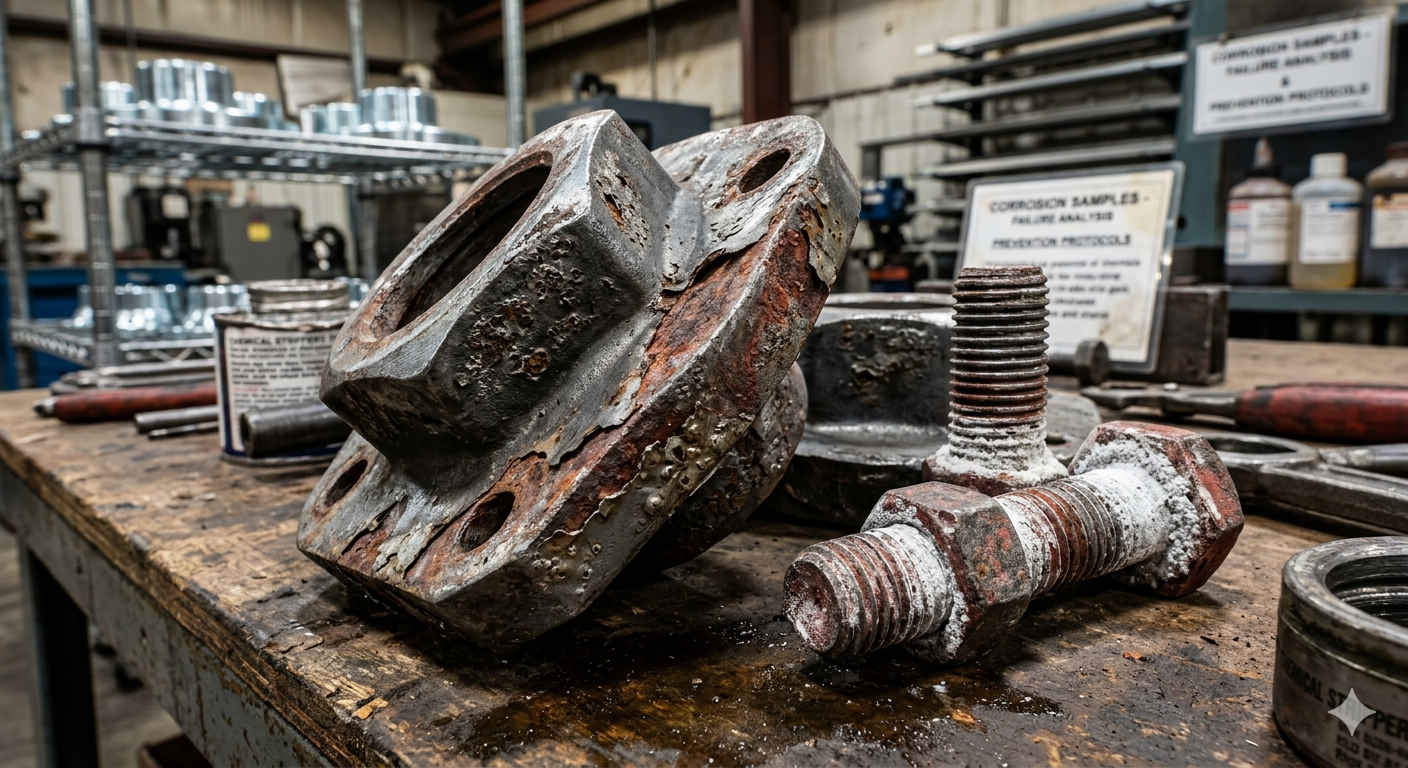
Zinc plating is one of the most reliable corrosion protection systems in industrial manufacturing — when it’s done right. When it fails, the consequences range from cosmetic rejection to structural part failure in the field. This guide covers every major defect mode, what causes each one, and exactly what a precision zinc plating operation does to prevent them.
For quality engineers, procurement managers, and manufacturing professionals who specify zinc-plated components, plating failure is not an abstraction. It is a warranty return, a field incident, an assembly-line stoppage, or — in the worst case — a structural failure that puts equipment or people at risk. Understanding what zinc plating failure actually looks like, what drives each defect mode, and what separates a precision plating operation from a commodity shop is the difference between confident specification and blind hope.
Zinc plating, executed correctly, delivers decades of reliable corrosion protection. The operative phrase is “executed correctly.” A zinc deposit is only as good as the substrate preparation behind it, the bath chemistry controlling it, the passivation protecting it, and the quality system auditing every step. When any of those links fail, the consequences appear on your parts — sometimes immediately, sometimes months later in the field.
This guide walks through every major category of zinc plating defect: what it looks like, what causes it, what happens when it reaches the field, and how a disciplined plating operation prevents it.
You may want to know more about – Zinc Plating
Why Zinc Plating Fails: The Root Cause Framework
Before cataloguing individual defect types, it is useful to understand the framework within which zinc plating defects arise. Virtually every plating defect traces back to one of four root cause categories: inadequate substrate preparation, bath chemistry deviation, process control breakdown, or post-plate handling and passivation failure. A facility that has robust controls on all four categories will produce consistently high-quality zinc deposits. A facility with gaps in any one of them will produce defects — reliably, reproducibly, and at a rate that scales directly with the severity of the gap.
Key InsightThe zinc plating industry is not uniform. At one end of the spectrum are commodity operations running informal chemistry management, minimal process documentation, and no formal quality system. At the other are precision finishing operations — ISO 9001-certified, OEM-approved, with documented bath chemistry control, real-time quality monitoring, and customer return rates below 0.25%. The price difference is marginal. The performance difference is not.
The four root cause domains interact. Substrate contamination, for instance, can compromise bath chemistry over time as organic contaminants accumulate. Bath chemistry deviation can make even well-prepared substrates impossible to plate correctly. Understanding the interdependencies is why serious plating operations treat process control as a system, not a checklist.
The Eight Major Zinc Plating Defect Types
The following defect types represent the most common failure modes encountered in electrodeposited zinc plating. Each has a distinct appearance, a distinct set of root causes, and a distinct consequence if it reaches field service.
1. Blistering & Peeling
High Risk
Zinc deposit separates from the substrate surface, forming blisters or peeling away entirely. Often not visible until post-assembly stress or temperature cycling.
2. White Rust (Wet Storage Stain)
Moderate Risk
White, chalky zinc oxide/hydroxide deposits that form when moisture is trapped between freshly plated parts before passivation or during storage.
3. Hydrogen Embrittlement
High Risk
Hydrogen absorbed during electroplating reduces ductility in high-strength steels. Parts may fail catastrophically under stress — sometimes days after installation.
4. Pitting & Roughness
Moderate Risk
Pinholes or rough, nodular surfaces on the zinc deposit. Accelerates localized corrosion and can cause dimensional out-of-tolerance on close-fit components.
5. Insufficient Thickness
High Risk
Deposit below the specified ASTM B633 service condition minimum. Directly reduces the corrosion life of the coating proportionally to the thickness shortfall.
6. Passivation Failure
High Risk
Incomplete or degraded chromate/trivalent conversion coating. Bare zinc without passivation loses corrosion resistance within hours of moisture exposure.
7. Burn & Nodulation
Moderate Risk
Dark, rough, or nodular deposits at high-current-density areas — edges, corners, threads. Indicates excessive current or low bath zinc metal concentration.
8. Staining & Discoloration
Moderate Risk
Iridescent, streaked, or inconsistent coloration across the passivated surface. May indicate bath contamination, rinsing failure, or passivate chemistry drift.
Defect Deep Dive: Blistering and Adhesion Failure
Blistering is among the most serious zinc plating defects because it is often invisible at time of delivery. Parts pass incoming inspection, proceed through assembly, and fail in the field — typically when subjected to thermal cycling, mechanical stress, or prolonged humidity exposure. At that point, the coating lifts away from the substrate in domed blisters or peels entirely, exposing bare steel to corrosion at exactly the moment corrosion protection matters most.
The root cause of blistering is adhesion failure at the zinc-to-steel interface — and adhesion failure is almost invariably a substrate preparation problem. Zinc electrodeposition requires atomically clean steel to achieve the metallurgical bond that holds the deposit in place. Any contamination — oil, oxide scale, rust, mill scale, residual metalworking fluids, or passivation chemistries from prior processing — interposes a weak boundary layer between the steel and the growing zinc deposit. The deposit looks complete and well-formed on the surface. The boundary layer beneath it is defective. The failure waits.
What Causes It
The most common contamination sources that produce blistering are: inadequate degreasing that leaves hydrocarbon films on steel surfaces; acid pickling sequences that are too short to remove all mill scale; rinsing failures that allow cleaning chemistry residues to remain on the part surface; and overlong delays between cleaning and plating that allow re-oxidation of the cleaned steel surface. In barrel plating, mechanical agitation can complicate this if parts arrive with deep recesses that the cleaning chemistry cannot penetrate effectively.
🔧 Prevention StandardA precision plating operation uses a multi-stage cleaning sequence: alkaline soak cleaning, electrolytic cleaning (anodic or cathodic), and controlled acid activation — each stage with dedicated rinse steps. Bath concentration, temperature, and immersion time at each stage are documented in formal process specifications, measured on a defined frequency, and adjusted when out of range. The cleaning sequence is not “good enough when the parts look clean.” It is defined, controlled, and verified.
Defect Deep Dive: White Rust and Wet Storage Stain
White rust — the white, powdery corrosion product that appears on zinc surfaces — is one of the most frequently misunderstood zinc plating defects. It often alarms buyers who interpret it as a sign of fundamental plating failure. The reality is more nuanced. White rust is zinc oxide and zinc hydroxide forming on the zinc surface in response to moisture. It is not red rust — it is not iron corrosion. But it is a legitimate quality failure when it appears shortly after delivery, and its presence reveals specific process breakdowns.
The most common cause is wet storage stain: condensation or moisture trapped between parts during transit or storage before passivation chemistry has fully cured. Fresh zinc without mature passivation is highly reactive. A stack of freshly plated, improperly dried parts in a humid shipping container can develop heavy white staining within 24 hours. The passivate is there, but it hasn’t fully cross-linked and sealed the zinc surface yet.
Field Consequences
When white rust is superficial — present only on the passivation layer without underlying zinc loss — it can be removed without structural compromise to the coating. When it is advanced, it indicates that the zinc deposit itself is actively corroding, which reduces the sacrificial zinc reserve available to protect the steel substrate. In parts specified for severe service conditions, advanced white rust staining at the time of installation is a meaningful reduction in expected coating life.
⚠ Specification NoteASTM B633 provides guidance on the acceptable extent of white rust in delivered parts — superficial staining that does not compromise the zinc deposit is typically acceptable under the standard. However, many OEM specifications impose stricter limits, and parts that arrive at assembly with significant white rust staining will typically be rejected regardless of ASTM compliance. Specifying passivate type and minimum cure time before shipment explicitly in the purchase specification prevents ambiguity.
Defect Deep Dive: Hydrogen Embrittlement
Hydrogen embrittlement is the zinc plating defect with the highest potential for catastrophic consequence, and it deserves proportionately detailed treatment. In electroplating, hydrogen is generated at the cathode surface as a byproduct of the electrochemical reduction reaction. Under normal plating conditions, most of this hydrogen escapes as gas. A fraction, however, diffuses into the steel substrate as atomic hydrogen. In low-strength steels, this absorbed hydrogen is relatively harmless — it diffuses back out over time without causing structural damage. In high-strength steels, particularly those with core hardness above Rockwell C34, the absorbed hydrogen can reduce ductility and fracture toughness dramatically.
The failure mechanism is delayed: a hydrogen-embrittled fastener may appear perfectly normal immediately after plating and installation. Under sustained tensile stress — which is exactly the loading condition a properly installed fastener experiences — the weakened steel can crack along grain boundaries at stress levels well below its rated tensile strength. These failures occur hours, days, or even weeks after installation, with no warning.
Hydrogen embrittlement is not a zinc problem — it is an electroplating problem. It affects cadmium plating equally. The mechanism is the same: both processes generate hydrogen at the cathode. The perception that it is a zinc-specific risk is a historical artifact of zinc replacing cadmium in high-strength fastener applications. The mitigation is the same for both: post-plate embrittlement relief baking. The prevention is the same for both: mechanical galvanizing when embrittlement risk is unacceptable.
— Plateco Engineering Reference Archive
ASTM Requirements for High-Strength Parts
ASTM B633 and ASTM F519 establish the requirements for post-plate hydrogen embrittlement relief baking of high-strength steel parts. The governing requirement is: parts with core hardness at or above Rockwell C34 must be baked at 375°F (190°C) for a minimum of 3 hours, initiated within 4 hours of electroplating. The baking cycle allows absorbed hydrogen to diffuse out of the steel lattice before stress-induced cracking can initiate.
For applications where even residual embrittlement risk is unacceptable — Grade 8 fasteners, high-strength structural bolts, safety-critical fasteners — zinc mechanical galvanizing is the correct specification. Mechanical galvanizing deposits zinc through mechanical impaction, generating no electrochemical current and introducing no hydrogen into the substrate. The embrittlement risk is eliminated, not mitigated.
- All parts with hardness ≥ RC34 must be baked within 4 hours of plating
- Baking at 375°F for minimum 3 hours per ASTM B633/F519
- Grade 8 and higher fasteners: consider mechanical galvanizing specification
- Baking records must be traceable to individual production lots
- Re-embrittlement testing per ASTM F519 for critical structural applications
Defect Deep Dive: Insufficient Coating Thickness
Coating thickness is the single most directly quantifiable determinant of zinc plating corrosion performance. The sacrificial protection mechanism of zinc plating works by consuming the zinc deposit over time as it preferentially corrodes in place of the steel substrate. A thicker deposit means more zinc to consume — a longer corrosion life before the steel is exposed. A deposit below minimum thickness means less zinc reserve, shorter service life, and potentially premature corrosion in conditions where the specified service class should have provided adequate protection.
ASTM B633 establishes minimum zinc thickness requirements by service condition classification. These are minimum requirements, not targets — and they apply at the point of measurement on a finished, delivered part. They are not average requirements, not nominal deposit requirements. Every measured point on every specified part must meet the minimum.
| ASTM B633 Class | Minimum Thickness | Typical Application | Salt Spray Target |
|---|---|---|---|
| SC 1 — Mild | 5 µm (0.0002″) | Indoor, dry environments; light-duty hardware | ~24 hrs to white rust |
| SC 2 — Moderate | 8 µm (0.0003″) | Sheltered outdoor; industrial interiors | ~72 hrs to white rust |
| SC 3 — Severe | 12 µm (0.0005″) | Outdoor weather; agricultural equipment | ~120 hrs to white rust |
| SC 4 — Very Severe | 25 µm (0.001″) | Coastal/marine; chemical environments | 500+ hrs with |
The Under-Specification Trap
The most costly and common specification error buyers make with zinc plating is selecting a service condition classification below what the actual operating environment demands — in order to reduce unit cost. The incremental cost savings of specifying SC 2 versus SC 4 on a component that will see genuine SC 4 conditions is real but modest — typically a few cents per part. The cost of the resulting field failures — warranty returns, equipment downtime, potential liability — invariably dwarfs the savings. Correct service class specification is free corrosion protection.
🔧 Engineering GuidanceWhen specifying service condition, consider the worst-case environment the component will actually experience, not its nominal operating environment. Agricultural equipment may operate in moderate climates, but will it ever see fertilizer exposure, irrigation spray, or coastal transport? A fastener specified for SC 2 that experiences a single season of fertilizer contact may fail years ahead of its design life.
Defect Deep Dive: Passivation Failure and Degraded Conversion Coating
The passivation step — the application of a chromate or trivalent conversion coating over the zinc deposit immediately after plating — is the most important factor separating a zinc-plated part that will perform well in service from one that will corrode prematurely. Bare zinc, unpassivated, develops white corrosion products within hours in humid ambient conditions. The passivate is not cosmetic — it is a chemically active conversion layer that substantially extends the zinc deposit’s useful corrosion life.
Passivation failure manifests in several ways. Incomplete passivation — from under-immersion time, insufficient passivate concentration, or parts that drain poorly and create passivate-starved areas — leaves bare zinc zones that begin corroding immediately. Degraded passivation — from improper rinsing, inadequate drying, or damage during handling — compromises the sealed surface even where the passivate is present. Incompatible passivate types — applying a thin clear passivate where a thick trivalent yellow was specified — delivers the appearance of compliance with a fraction of the performance.
The Trivalent Passivate Standard
The industry’s shift from hexavalent chromate passivation to trivalent chromate systems — driven by RoHS compliance requirements — was initially resisted by quality engineers who worried, legitimately, that trivalent systems could not match hexavalent performance. That concern has been resolved. Modern trivalent yellow passivate systems, combined with optimized organic sealers, routinely achieve 500 or more hours of neutral salt spray resistance on properly plated zinc. This represents the current state of the art for standard zinc electroplate passivation.
⚠ Critical Specification PointA purchase specification that says only “zinc plated per ASTM B633 SC 3” leaves passivate type entirely undefined. The difference between a clear trivalent passivate and a trivalent yellow with sealer can be 400+ hours of salt spray performance on the same zinc deposit. For any application with meaningful corrosion exposure, passivate type must be explicitly specified — not left to the plater’s discretion.
The Prevention Framework: What a Precision Plating Operation Does Differently
Every defect described above has a corresponding prevention — a specific process control, quality system element, or engineering practice that, if properly implemented and consistently executed, eliminates or drastically reduces that defect mode. The following framework describes what separates a precision zinc plating operation from a commodity shop.
Documented, Multi-Stage Cleaning Sequences Alkaline soak cleaning, electrolytic cleaning, and acid activation — each with dedicated rinse steps. Bath concentration, temperature, and immersion time are formally specified, measured on a defined frequency, and trended over time. Contamination limits trigger bath dump-and-replace, not informal adjustment.
Continuous Bath Chemistry Monitoring Zinc metal concentration, brightener levels, pH, and conductivity are measured on a defined schedule. Automated or semi-automated replenishment maintains chemistry within specified control limits. Formal bath records are maintained and traceable to specific production runs.
Calibrated Thickness Measurement — Every Lot X-ray fluorescence (XRF) or magnetic thickness gauges — calibrated to traceable standards — are used to measure deposit thickness on every production lot. Measurements are taken at defined locations on representative parts. Results are recorded, trended, and trigger corrective action when out of specification.
Hydrogen Embrittlement Relief Baking Protocol Parts with core hardness ≥ RC34 are identified at order entry, segregated in the production schedule, and baked within 4 hours of plating. Bake oven temperature is verified with calibrated thermocouples. Bake time and temperature are recorded per lot and included in the quality documentation package.
Passivation Chemistry Control and Sealer Application Passivate bath concentration, pH, temperature, and immersion time are specified and monitored. Sealer application equipment is maintained to ensure consistent coverage. Salt spray panels are run from each production shift to verify passivate performance. Results are reviewed against specification before lots are released.
Handling and Packaging Protocols to Prevent Post-Plate Damage Parts are dried completely before packaging. Packaging materials are specified to prevent moisture entrapment. Parts are not stacked in conditions that allow condensation to form between passivated surfaces. Storage time between plating and shipment is minimized for parts with reactive passivates.
ISO 9001:2015 Quality Management System The above controls are not informal — they are documented in a quality management system that is externally audited and certified. Corrective action processes ensure that defects, when they do occur, are investigated, root-caused, and permanently resolved rather than informally managed.
What Zinc Plating Failure Costs in the Field
It is worth being specific about what zinc plating defects cost when they reach field service, because the economics clarify why precision plating operations — which may charge modestly more than commodity shops — are the correct economic choice for any component with real corrosion exposure.
A corrosion failure on a zinc-plated fastener in an agricultural implement does not cost the price of a fastener. It costs the labor and downtime to diagnose the problem, the cost of replacement hardware, potential crop loss if the equipment fails during a critical season window, and the warranty cost if the equipment is within warranty period. A hydrogen embrittlement failure on a high-strength structural fastener in a construction application carries all of those costs — plus potential liability exposure if the failure causes injury.
The economics are asymmetric. The savings available from under-specifying zinc plating — choosing a cheaper service class, accepting a lower-quality supplier — are measured in cents per part. The costs of field failures attributable to plating defects are measured in multiples of the cost of the entire plated assembly. The rational specification decision — corrosion protection appropriate to the actual operating environment, from a supplier with demonstrated process discipline — is not a premium. It is the only cost-effective approach when failure consequences are real.
✓ Plateco Quality BenchmarkPlateco’s current customer return rate is 0.1% for Q1 2026 — a figure that reflects two fully automated production lines, continuous bath chemistry monitoring, 100% lot-level thickness verification, and an ISO 9001:2015 quality management system. For context: industry average defect return rates in commodity zinc plating frequently run 1–3%. The difference between 0.1% and 2% defect rates, at scale, represents tens of thousands of non-defective parts delivered per million — parts that stay in service instead of generating warranty returns.
Questions to Ask Your Zinc Plating Supplier
For procurement engineers and quality managers evaluating zinc plating suppliers, the following questions separate process-controlled operations from commodity shops. A qualified supplier should be able to answer all of them with specificity.
| Question | What a Good Answer Looks Like | What a Poor Answer Looks Like |
|---|---|---|
| What is your documented customer return rate? | A specific number, tracked by lot and trended monthly. Below 0.5% indicates a controlled process. | “Very low.” “We rarely get returns.” No specific figure. |
| Are you ISO 9001:2015 certified? | Yes, with a current certificate and named registrar available on request. | “We follow ISO principles.” “We’re working toward certification.” |
| How do you control and document bath chemistry? | Defined measurement frequency, formal bath records, automated or documented replenishment protocols, dump-and-replace criteria. | “We check it regularly.” “Our operators manage the bath.” |
| How do you measure and verify deposit thickness? | XRF or calibrated magnetic gauge, every lot, at defined locations, with recorded results traceable to production run. | “We test periodically.” “We rely on process parameters.” |
| How do you handle high-strength parts for embrittlement? | Formal identification at order entry, baking within 4 hours, calibrated oven, lot-level records. | “We bake when customers ask.” “Our process doesn’t cause embrittlement.” |
| Which OEM specifications are you approved under? | Specific OEM names with current approval documentation available. | “We can meet most specs.” No specific OEM approvals. |
The Standard That Prevents Failure
Zinc plating failure is not random. It is the predictable result of process breakdown — in cleaning, in bath chemistry, in thickness control, in passivation, in handling, or in the quality system that is supposed to catch and correct all of those breakdowns before they reach your parts. Facilities that treat zinc plating as a complex, precision process — and build quality systems accordingly — produce defect rates that are an order of magnitude lower than facilities that treat it as a commodity service.
For buyers, the implications are straightforward. Specify the correct service condition for the actual operating environment. Specify passivate type explicitly. Identify high-strength components and require documented embrittlement relief baking. And select suppliers who can demonstrate — not just claim — the process discipline to deliver on those specifications consistently.
Zinc plating, correctly specified and correctly executed, is one of the most cost-effective corrosion protection systems available to industrial manufacturing. When it fails, the reason is almost always that one of those conditions was not met. Knowing where failures originate is the first step to ensuring they don’t reach your assembly line — or your customers’ equipment.
We treat zinc plating as an extremely complex process demanding state-of-the-art technology, painstaking planning, obsessive quality control, and a tremendous amount of talent. Because our customers don’t come to us for excuses — they come to us for perfection. And we’ll do whatever it takes to give them nothing less.
— Jim Schweich, Chief Executive Perfectionist, Plateco, Inc.
Don’t Accept Defective Zinc Plating
Plateco’s 0.1% return rate and ISO 9001:2015 certification mean your parts arrive on spec, on time — or it’s on us. Talk to our engineering team about your corrosion protection requirements.