

The Corrosion Problem in Construction
Steel is the material that holds the built world together. From the anchor bolts embedded in concrete foundations to the structural screws fastening shear walls, from the heavy-duty hardware connecting timber frames to the high-strength fasteners securing steel moment connections — steel hardware is everywhere in construction, and it is under constant attack from corrosion.
Corrosion is not merely a cosmetic issue for construction hardware. When anchor bolts lose tensile strength, when connection plates crack from rust-induced stress, when structural fasteners seize or fracture after years of corrosive degradation, the consequences range from expensive structural repairs to genuine safety risks. The American Society of Civil Engineers has estimated that corrosion-related costs in U.S. infrastructure and construction run into hundreds of billions of dollars annually.
For construction engineers, hardware manufacturers, and project specifiers, the question is never simply whether to protect steel hardware from corrosion — it is always which protection method is technically appropriate and economically justified for the specific application and environment.
Mechanical galvanizing has emerged as one of the most important answers to that question for a specific and important class of construction hardware: medium to large fasteners, anchor hardware, and structural connectors that need heavy zinc protection without the thermal distortion risks of hot-dip galvanizing or the thickness limitations of electroplating. This guide explains exactly what mechanical galvanizing is, what it does well for construction applications, where it has genuine limitations, and how to evaluate it against alternatives.
What Is Mechanical Galvanizing?
Mechanical galvanizing is a cold-process zinc coating method in which zinc powder is mechanically bonded to steel surfaces through a combination of tumbling action, compressive force, and controlled chemistry — without the use of electrical current or high heat.
The term “mechanical” distinguishes this process from the two other primary zinc coating methods: electroplating (which uses electrical current to deposit zinc from a solution) and hot-dip galvanizing (which immerses steel in molten zinc at temperatures around 840°F). Mechanical galvanizing occupies a technically distinct middle ground between these two methods, combining elements of both without the limitations of either.
The fundamental mechanism of mechanical galvanizing is cold welding. When zinc powder particles are tumbled against steel surfaces under controlled conditions, kinetic energy from the impacts plastically deforms the zinc particles and bonds them to the steel substrate. The result is a dense, tightly adherent zinc coating that is metallurgically bonded to the steel without heat and without electrical current.
The zinc layer produced by mechanical galvanizing is characteristically thicker than electroplated zinc and more dimensionally consistent than hot-dip galvanized coatings. It preserves thread geometry — a critical requirement for threaded fasteners — while achieving coating thicknesses that can match or approach hot-dip galvanizing performance levels.
Mechanically galvanized parts are governed primarily by ASTM B695 — Standard Specification for Coatings of Zinc Mechanically Deposited on Iron and Steel — which defines coating classes based on minimum zinc thickness requirements.
How the Mechanical Galvanizing Process Works
Understanding the process mechanics is important for evaluating whether mechanical galvanizing is suitable for a specific part or application. Here is a step-by-step overview of what happens during mechanical galvanizing:
1. Surface Cleaning and Preparation
Parts are cleaned through degreasing, acid pickling, and rinsing to remove all surface contamination — oils, oxides, mill scale, and machining residues. Surface cleanliness is critical because the mechanical bonding process depends on direct metal-to-metal contact between zinc particles and the steel substrate. Any contamination layer between the two will result in poor adhesion and premature coating failure.
2. Copper Flash Pre-Treatment
Before zinc application, parts typically receive a thin copper flash coating through a chemical displacement reaction. This copper layer serves a critical function: it provides a consistent, reactive surface that promotes adhesion of the subsequent zinc deposit. Without this pre-treatment, zinc bonding to bare steel can be inconsistent.
3. Loading into the Drum
Prepared parts are loaded into a rotating drum along with zinc powder, glass bead impact media, water, and chemical promoters. The glass beads serve as the mechanical energy transfer medium — their mass and hardness allow them to drive zinc particles into the steel surface through repeated impacts as the drum rotates. The chemical promoters condition the surface chemistry to facilitate zinc bonding.
4. Tumbling and Zinc Deposition
As the drum rotates, parts, glass beads, and zinc powder tumble together continuously. Each impact between a glass bead and a part surface drives zinc particles into the steel substrate through cold welding. The tumbling action ensures that all surfaces — threads, recesses, blind holes, undercuts — receive repeated impacts and build up a consistent zinc layer. Additional zinc powder is added incrementally to build up the coating to the target thickness.
5. Post-Treatment and Passivation
After the zinc layer reaches the specified thickness, parts are removed, separated from the glass bead media, rinsed, and treated with a chromate or other passivation system to enhance corrosion resistance and achieve the required finish appearance. Post-treatment chemistry can be tailored to meet specific salt spray performance targets or appearance requirements.
6. Inspection and Quality Verification
Finished parts undergo coating thickness measurement, visual inspection, and corrosion resistance testing as required by the applicable specification. For construction hardware produced to ASTM B695 or customer-specific requirements, documentation of thickness measurements and process parameters supports traceability and quality audit requirements.
ASTM B695Primary specification standard for mechanical galvanizing
25–100 µmTypical zinc coating thickness range achievable
ZeroRisk of hydrogen embrittlement vs. electroplating
No meltApplied cold — no thermal distortion of steel parts
Why Construction Materials Need Heavy-Duty Zinc Protection
Construction hardware operates in environments that test zinc coatings more severely than almost any other industrial application. Understanding the specific corrosion mechanisms at work in construction settings explains why coating thickness and adhesion quality — the two defining characteristics of mechanical galvanizing — matter so much for this industry.
Freeze-Thaw Cycling
In northern climates, construction hardware embedded in or attached to concrete foundations, masonry walls, and exposed structural connections endures hundreds of freeze-thaw cycles over a structure’s service life. Water infiltrates the interface between hardware and structure, freezes and expands, then thaws — a process that physically stresses coatings, promotes micro-cracking, and creates pathways for continued moisture infiltration. Thick, well-bonded zinc coatings tolerate this mechanical cycling far better than thin electroplated coatings.
Road Salt and Deicing Chemical Exposure
Infrastructure construction — bridges, highway sound walls, retaining structures, parking decks — exposes steel hardware to chloride-laden deicing chemicals every winter. Chloride ions are among the most aggressive accelerators of steel corrosion known, breaking down passive oxide layers and dramatically accelerating the electrochemical corrosion reaction. Foundation hardware near roadways, anchor bolts in bridge abutments, and connection hardware on parking structures all face this environment. Mechanical galvanizing’s thick zinc layer provides a substantial reservoir of sacrificial zinc to consume before any chloride attack reaches the base steel.
Ground Contact and Below-Grade Environments
Anchor hardware, foundation bolts, soil nails, and ground anchor systems in direct contact with soil face continuous moisture exposure, variable soil chemistry, and occasional stray electrical current — a combination that can destroy inadequate coatings within years. Below-grade construction hardware must be specified with sufficient zinc mass to provide decades of sacrificial protection without access for inspection or maintenance.
Pressure-Treated Lumber Interface
Modern ACQ (alkaline copper quaternary) and CA (copper azole) pressure-treated lumber preservatives are significantly corrosive to zinc coatings. The copper compounds in these preservatives create an aggressive galvanic environment at the wood-metal interface. While no zinc coating provides unlimited resistance to ACQ lumber chemistry, thicker zinc deposits from mechanical galvanizing provide substantially longer service life than standard electroplated coatings in this environment.
Key Benefits of Mechanical Galvanizing for Construction
1. Thick Zinc Coatings Without Thread Damage
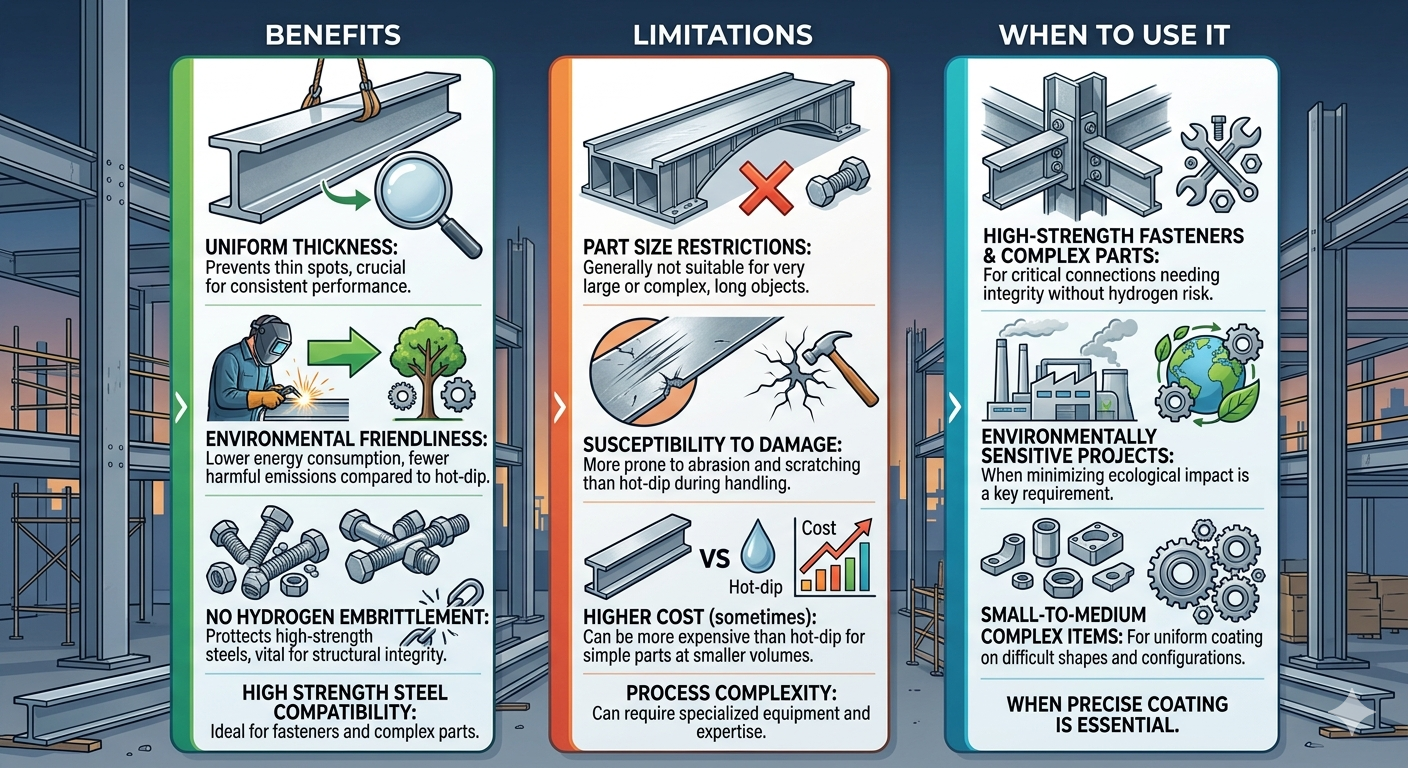
This is perhaps the single most important advantage of mechanical galvanizing for threaded construction hardware. Hot-dip galvanizing applies zinc at 840°F as a liquid, producing coatings so thick on threaded surfaces that the threads are frequently unusable without re-tapping — adding cost and potentially weakening the thread engagement. Mechanical galvanizing builds up thick coatings at room temperature through incremental particle deposition, allowing precise thickness control that preserves thread geometry and dimensional tolerances even at coating thicknesses of 50 to 100 micrometers. For large-diameter anchor bolts, heavy hex bolts, and threaded rod, this is a decisive technical advantage.
2. Zero Hydrogen Embrittlement Risk
High-strength fasteners — Grade 8 bolts, high-tension structural bolts, pretensioned anchor hardware — are vulnerable to hydrogen embrittlement: the absorption of hydrogen atoms into the steel lattice during certain electroplating processes, which can cause sudden brittle fracture under tensile load. Because mechanical galvanizing uses no electrical current and no acid at the zinc deposition stage, it introduces no hydrogen into the steel. For high-strength construction hardware where hydrogen embrittlement risk is a specification concern, mechanical galvanizing is often the technically mandated choice over electroplating.
3. No Thermal Distortion of Parts
Hot-dip galvanizing exposes steel to temperatures around 840°F. For most structural steel members this is acceptable, but for precision fasteners, springs, thin stampings, and heat-treated hardware, these temperatures can cause dimensional distortion, loss of temper, and changes to mechanical properties. Mechanical galvanizing operates at ambient temperature throughout, making it safe for heat-sensitive components and thermally processed hardware that must maintain their precise mechanical properties after coating.
4. Excellent Coating Uniformity on Complex Geometry
Construction hardware includes geometrically complex parts: hex bolts with recessed drive features, anchor hardware with complex head geometry, stamped connectors with formed flanges and punched holes. The tumbling action of mechanical galvanizing exposes all surfaces — including internal threads, recesses, and undercuts — to the zinc particle stream repeatedly, producing uniform coating thickness across the entire part. This uniformity is critical for corrosion resistance: any uncoated or thin-coated area becomes the preferential site for corrosion initiation regardless of how well the rest of the part is coated.
5. Superior Performance vs. Electroplating in Harsh Environments
Standard zinc electroplating for construction hardware typically deposits 5 to 25 micrometers of zinc. Mechanical galvanizing routinely achieves 25 to 100 micrometers. Because the zinc acts as a sacrificial anode — consuming itself to protect the underlying steel — thicker zinc deposits directly translate to longer service life in corrosive environments. For construction hardware in severe outdoor, underground, or coastal exposure, mechanical galvanizing’s heavier zinc mass provides substantially greater longevity than electroplated alternatives.
6. Compatibility with ASTM B695 and Construction Specifications
Many commercial construction specifications, structural engineering standards, and infrastructure project specifications reference ASTM B695 for mechanically galvanized hardware. This well-established standard defines Class designations (Class 25, 50, 65, 75, and higher) based on minimum zinc coating thickness in micrometers. Specifying to ASTM B695 gives engineers and construction managers a verifiable, testable performance target and supports quality documentation requirements for commercial and public construction projects.
Honest Limitations of Mechanical Galvanizing
A technically accurate evaluation of mechanical galvanizing must also address its limitations. Understanding where this process falls short is as important as understanding where it excels — particularly for construction specifiers making coating decisions that will last the lifetime of a structure.
1. Not Suitable for Very Small Parts
Mechanical galvanizing requires that parts be large enough to withstand the tumbling and impact energy of the process without being damaged. Very small fasteners — screws under about 1/4 inch diameter, fine stampings, delicate clips — can be physically deformed or tangled during tumbling. For these small parts, zinc barrel electroplating is a better-suited process that achieves consistent coverage without part damage.
2. Higher Per-Part Cost Than Electroplating
Mechanical galvanizing is a more materials-intensive process than zinc electroplating. The zinc powder, glass bead media, chemical promoters, and longer processing cycles required to build up thick coatings make it inherently more expensive on a per-part basis than standard barrel electroplating. For budget-constrained projects where the corrosion environment does not justify heavy zinc protection, electroplating delivers adequate performance at lower cost.
3. Not Appropriate for Very Large Structural Members
Mechanical galvanizing is a batch drum process suited to discrete hardware components — fasteners, anchors, connectors, and similar parts that fit into a rotating drum. Large structural steel members such as beams, columns, girders, angles, and grating cannot be processed by mechanical galvanizing. For these large structural elements, hot-dip galvanizing remains the industry standard corrosion protection method.
4. Surface Appearance Is Matte, Not Bright
Mechanically galvanized coatings have a characteristic matte gray appearance rather than the bright metallic finish of electroplated zinc or the spangled appearance of freshly hot-dip galvanized steel. For applications where coating appearance is a specification requirement — exposed architectural hardware, decorative connectors, visible fasteners in finished interiors — the matte gray finish of mechanical galvanizing may not meet aesthetic requirements without additional finishing.
5. Requires Skilled Process Control for Consistency
Achieving consistent zinc thickness across a production batch in mechanical galvanizing requires careful control of drum loading, rotation speed, zinc powder addition rate, glass bead media condition, and process chemistry. Poorly controlled mechanical galvanizing can produce significant variation in coating thickness across a batch. This is why working with a plating provider that operates certified quality management systems and documented process controls is critical — inconsistent coating is a worse outcome than a thin-but-uniform coating, because it creates unpredictable corrosion performance in the field.
6. Not Suitable for ACQ Pressure-Treated Lumber in All Cases
While mechanical galvanizing outperforms electroplated zinc when used with pressure-treated lumber, neither process provides unlimited resistance to the aggressive chemistry of modern ACQ or CA treated lumber. Many building code requirements and fastener manufacturers specify hot-dip galvanized or stainless steel hardware for structural connections to ACQ-treated lumber in outdoor applications. Always verify the applicable building code and fastener specification requirements for pressure-treated lumber connections before specifying mechanically galvanized hardware.
Construction Use Cases — Where Mechanical Galvanizing Excels
⚓ Heavy Anchor Bolts and Foundation Hardware
Large-diameter J-bolts, L-bolts, and headed anchor rods embedded in concrete foundations are ideal candidates for mechanical galvanizing. Their size excludes them from standard barrel electroplating, their thread geometry excludes hot-dip galvanizing, and their below-grade exposure demands heavy zinc protection.
🔩 High-Strength Structural Bolts
ASTM F3125 Grade A325 and A490 structural bolts used in steel moment connections, column base plates, and beam-to-column connections are high-strength fasteners where hydrogen embrittlement risk from electroplating is a real concern. Mechanical galvanizing provides the required corrosion protection without introducing hydrogen into the steel microstructure.
🌉 Bridge and Infrastructure Hardware
Expansion joint hardware, bearing assembly fasteners, railing connection bolts, and drainage hardware on bridges face severe chloride exposure from deicing salts. The Class 50 or Class 65 mechanical galvanizing specifications commonly required for infrastructure hardware provide the thick zinc deposit needed for multi-decade service life in these aggressive environments.
🏗️ Heavy-Duty Framing Connectors
Large post bases, column caps, beam seat connectors, and heavy timber hardware used in exposed outdoor structures — pergolas, bridges, agricultural buildings, and heavy commercial timber framing — benefit from mechanical galvanizing’s thick coating where standard electroplating would be insufficient for the long-term outdoor exposure.
🌱 Soil and Ground Anchor Systems
Rock bolts, soil nails, helical anchors, and tie-back systems used in retaining wall construction, slope stabilization, and foundation underpinning are installed in direct ground contact where access for inspection or re-coating is impossible. Mechanical galvanizing to Class 75 or higher provides the zinc mass needed for long-term below-grade sacrificial protection.
🔧 Heavy Hex Nuts, Washers, and Threaded Rod
Large-diameter threaded rod, heavy hex nuts, and bearing washers used in structural bolted connections throughout commercial and industrial construction are well-suited to mechanical galvanizing — large enough to process without damage, threaded geometries preserved by the cold-application process, and exposed environments justifying heavier zinc deposits.
Mechanical Galvanizing vs. Other Zinc Coating Methods
| Feature | Mechanical Galvanizing | Zinc Barrel Electroplating | Hot-Dip Galvanizing |
|---|---|---|---|
| Process Temperature | Ambient (cold process) | Ambient (cold process) | ~840°F (molten zinc) |
| Typical Zinc Thickness | 25–100+ µm | 5–25 µm | 45–150+ µm |
| Thread Preservation | ✔ Excellent | ✔ Excellent | ✘ Often damages threads |
| Hydrogen Embrittlement Risk | ✔ None | ✘ Possible with acid pickling | ✔ None |
| Thermal Distortion Risk | ✔ None | ✔ None | ✘ Yes for heat-sensitive parts |
| Part Size Suitability | Medium to large parts | Small to medium parts | All sizes including large structural members |
| Per-Part Cost | Moderate | Low | Low for large parts, high for small fasteners |
| Key Standard | ASTM B695 | ASTM B633 | ASTM A123 / A153 |
| Best Construction Use | Large fasteners, anchor bolts, high-strength hardware | Small fasteners, screws, clips, light connectors | Structural steel members, grating, large fabrications |
No single zinc coating method is universally best for all construction hardware. The right choice depends on part size, strength level, thread geometry requirements, corrosion environment severity, and production volume. Many construction projects use all three methods simultaneously — hot-dip galvanized structural steel, mechanically galvanized anchor bolts, and electroplated small fasteners — each optimized for its specific role.
Specifications and Standards
For construction specifiers, engineers, and procurement teams, understanding the applicable standards for mechanically galvanized hardware is essential for writing specifications that will be interpreted consistently and verified reliably.
ASTM B695 defines mechanical galvanizing coating classes by minimum zinc thickness. The most commonly specified classes for construction applications are as follows:
| ASTM B695 Class | Min. Zinc Thickness | Typical Construction Application |
|---|---|---|
| Class 25 | 25 µm (0.001 in) | Moderate outdoor exposure, non-critical structural hardware |
| Class 50 | 50 µm (0.002 in) | Severe outdoor exposure, infrastructure hardware, bridge fasteners |
| Class 65 | 65 µm (0.0026 in) | Very severe exposure, coastal environments, chemical plant construction |
| Class 75 | 75 µm (0.003 in) | Below-grade hardware, soil anchors, ground contact applications |
For construction projects requiring documentation of material compliance, a qualified mechanical galvanizing provider should be able to supply coating thickness measurement records, process certification to ASTM B695, and traceability documentation linking specific production batches to specific part numbers and coating classes. ISO 9001 certified quality management systems provide the framework for this documentation.
How to Decide: Is Mechanical Galvanizing Right for Your Application?
Use the following decision framework to evaluate whether mechanical galvanizing is the appropriate specification for a specific construction hardware application:
✔ Choose Mechanical Galvanizing When:
- Parts are medium to large diameter threaded fasteners or anchors
- Hardware is high-strength (Grade 8, A325, A490) and hydrogen embrittlement risk is a concern
- Application requires heavier zinc than electroplating provides (outdoor, underground, coastal)
- Thread geometry must be preserved — hot-dip galvanizing would plug threads
- Parts are heat-sensitive and cannot withstand hot-dip galvanizing temperatures
- Specification references ASTM B695 or requires Class 25 or above
✘ Consider Alternatives When:
- Parts are very small — under ~1/4 inch — and may be damaged by tumbling (use barrel electroplating)
- Budget is the primary driver and environment is mild indoor exposure (use electroplating)
- Parts are large structural members that cannot fit in a drum (use hot-dip galvanizing)
- Bright cosmetic finish is required (use electroplating with clear chromate)
- Application is structural connection to ACQ pressure-treated lumber — verify code requirements first
Frequently Asked Questions
What is the difference between mechanical galvanizing and hot-dip galvanizing?
Hot-dip galvanizing immerses steel in molten zinc at approximately 840°F, producing a thick zinc-iron alloy coating through a metallurgical reaction. Mechanical galvanizing applies zinc powder at room temperature through tumbling and impact energy, cold-welding zinc particles to the steel surface. The key practical differences for construction hardware are that mechanical galvanizing preserves thread geometry (hot-dip often plugs threads), avoids thermal distortion (hot-dip temperatures can distort heat-sensitive parts), and eliminates the re-tapping cost often required after hot-dip galvanizing of threaded parts.
Can mechanically galvanized bolts be used in slip-critical structural connections?
Slip-critical structural connections require that the bolt clamping force be maintained to prevent relative movement of the connected elements. The coefficient of friction (slip coefficient) of the faying surfaces is critical to this performance. Mechanically galvanized bolts can be used in Class A slip-critical connections, but the connection design must use the appropriate slip coefficient for the coating type. Consult the applicable structural engineering standards and the bolt manufacturer’s data for specific guidance on slip-critical connection design with mechanically galvanized fasteners.
How long will mechanical galvanizing last in outdoor construction applications?
Service life depends on the coating class (zinc thickness), the specific environment, and the presence of any post-treatment passivation. As a general guide, Class 50 mechanical galvanizing provides substantially longer outdoor service life than standard electroplated zinc in comparable environments — often 20 to 40 years in typical North American climates before zinc depletion allows rust initiation on the base steel. In coastal or chloride-rich environments, Class 65 or 75 is typically specified to achieve comparable longevity.
Is mechanically galvanized hardware compatible with galvanized steel plates and members?
Yes. Both mechanically galvanized fasteners and hot-dip galvanized structural members are zinc-coated steel. When they are in contact, both are essentially the same electrochemical material — no galvanic couple is established between the zinc of one and the zinc of the other. This makes mechanically galvanized bolts and nuts fully compatible with hot-dip galvanized structural members in bolted connections.
What part sizes can be processed by mechanical galvanizing?
Mechanical galvanizing is well-suited for fasteners and hardware components ranging from approximately 1/4 inch diameter up to large anchor bolts several inches in diameter and rod sections several feet in length, depending on the drum capacity of the processing facility. Parts that are too small may be damaged by tumbling action; parts that are too large may not fit within the drum. Consulting with a mechanical galvanizing specialist about specific part dimensions and geometry is the best way to confirm process suitability.
Further Reading from the Plateco Blog
If this guide gave you a clearer picture of zinc coating specifications, these related articles from the Plateco blog go deeper on the processes and topics referenced throughout:
| Blog Title | Description | Link |
|---|---|---|
| Understanding Zinc Plating | ||
| What Is Zinc Plating? Process, Types & Applications | A foundational overview of zinc plating and where it’s used across industries. | Read → |
| Complete Industrial Zinc Plating Process Explained | Step-by-step breakdown of what happens inside a zinc plating facility. | Read → |
| Zinc Electroplating: A Complete Beginner’s Guide | Process, benefits, and industrial applications — written for engineers. | Read → |
| Choosing the Right Plating Method | ||
| Rack Plating vs. Barrel Plating: The Definitive Guide | How to choose based on part geometry, volume, and tolerance requirements. | Read → |
| What Is Zinc Rack Electroplating? | A dedicated look at rack plating for larger or cosmetically sensitive parts. | Read → |
| What Is Zinc Barrel Electroplating? | The case for barrel plating for high-volume fasteners and small parts. | Read → |
| What Is Mechanical Galvanizing? | The cold-process alternative achieving thicker coatings without embrittlement. | Read → |
| Passivation & Corrosion Resistance | ||
| Why Zinc Passivation Matters | How chromate and trivalent conversion coatings affect salt spray performance. | Read → |
| Corrosion-Resistant Zinc Plating Guide | How zinc protects steel through sacrificial and barrier mechanisms. | Read → |
| Quality & Material Considerations | ||
| Case Study: Hydrogen Embrittlement Relief | Real test data on corrosion resistance with and without passivate reapplication. | Read → |
| More Lead, More Problems | Why leaded steel creates adhesion challenges for your part design. | Read → |