

Corrosion costs U.S. industry an estimated $270 billion annually. For manufacturers producing large steel components — hydraulic cylinders, structural brackets, agricultural equipment frames, heavy machinery housings — uncontrolled rust is not just an aesthetic problem. It is a structural failure waiting to happen. Zinc rack electroplating is one of the most proven, cost-effective, and technically precise methods for stopping corrosion before it starts.
What Actually Happens When Industrial Steel Corrodes
Before understanding how zinc rack plating prevents corrosion, it helps to understand exactly what corrosion is doing to your steel at the molecular level — because the chemistry of zinc protection is directly tied to the chemistry of rust formation.
When bare steel is exposed to oxygen and moisture, iron atoms on the surface give up electrons in an electrochemical reaction. Those electrons are picked up by oxygen and water, forming iron oxide — the red, flaking material we recognize as rust. This process is called oxidation, and it is relentless. Once it begins, it accelerates: rust is porous and absorbs more moisture, pulling the corrosion front deeper into the metal over time.
For large industrial components — parts that may weigh hundreds of pounds and measure several feet in length — surface corrosion is not a slow, manageable degradation. It is a ticking clock. A structural bracket that develops rust at a weld seam will fail under load. A hydraulic cylinder rod that oxidizes at the surface will score its own seals. A mounting frame that corrodes at its bolt holes will lose its clamping force.
The Three Conditions Required for Steel Corrosion
- An anode: The iron in steel, which gives up electrons
- A cathode: Another material or area that accepts electrons
- An electrolyte: Moisture that allows the exchange to occur
Remove any one of these three, and the corrosion reaction stops. Zinc rack plating eliminates the anode — replacing exposed iron with zinc, which corrodes preferentially before the steel ever can.
Why Zinc Is the Ideal Sacrificial Coating
Not all protective coatings work the same way. Paint, for example, creates a purely physical barrier. If the paint film is scratched or chipped, bare steel is immediately exposed to the environment — and corrosion begins at that exposed point. Zinc works on a fundamentally different principle: it provides sacrificial (galvanic) protection.
Zinc is electronegatively positioned below iron on the galvanic series. This means that when both zinc and iron are present and exposed to an electrolyte, zinc preferentially acts as the anode — it gives up its electrons first, corroding before the iron does. The iron acts as the cathode and is protected.
This electrochemical protection mechanism has a profound practical implication: even if the zinc coating is scratched, nicked, or damaged during handling, shipping, or assembly, the underlying steel remains protected. The zinc surrounding the damage continues to corrode sacrificially, extending the protective barrier to the exposed steel area without any intervention required.
When you witness white corrosion forming on a zinc-plated part, the zinc is sacrificing itself to protect your steel. That is the process working exactly as designed — the steel beneath remains intact and rust-free.
— Plateco Engineering Team
This is why zinc-plated parts can withstand hundreds of hours in standardized salt spray testing — far beyond what a painted or untreated steel part could survive. The zinc is not just blocking corrosion. It is actively defending against it through electrochemistry.
14.5 ft
Maximum part length processable at Plateco’s rack plating facility
0.22%
Plateco’s industry-leading customer return rate
What Is Zinc Rack Electroplating — And How Is It Different?
Zinc electroplating is available in several process configurations. The two primary methods used for steel industrial components are barrel plating and rack plating. Understanding the difference between them is essential for any engineer or procurement professional specifying a finish for large or complex parts.
In barrel plating, parts are tumbled together inside a rotating perforated drum submerged in a zinc plating bath. The constant tumbling facilitates part-on-part contact, which transfers electrical current and allows zinc to deposit across all surfaces. Barrel plating is efficient, economical, and excellent for high volumes of small, durable parts — fasteners, stampings, nuts and bolts.
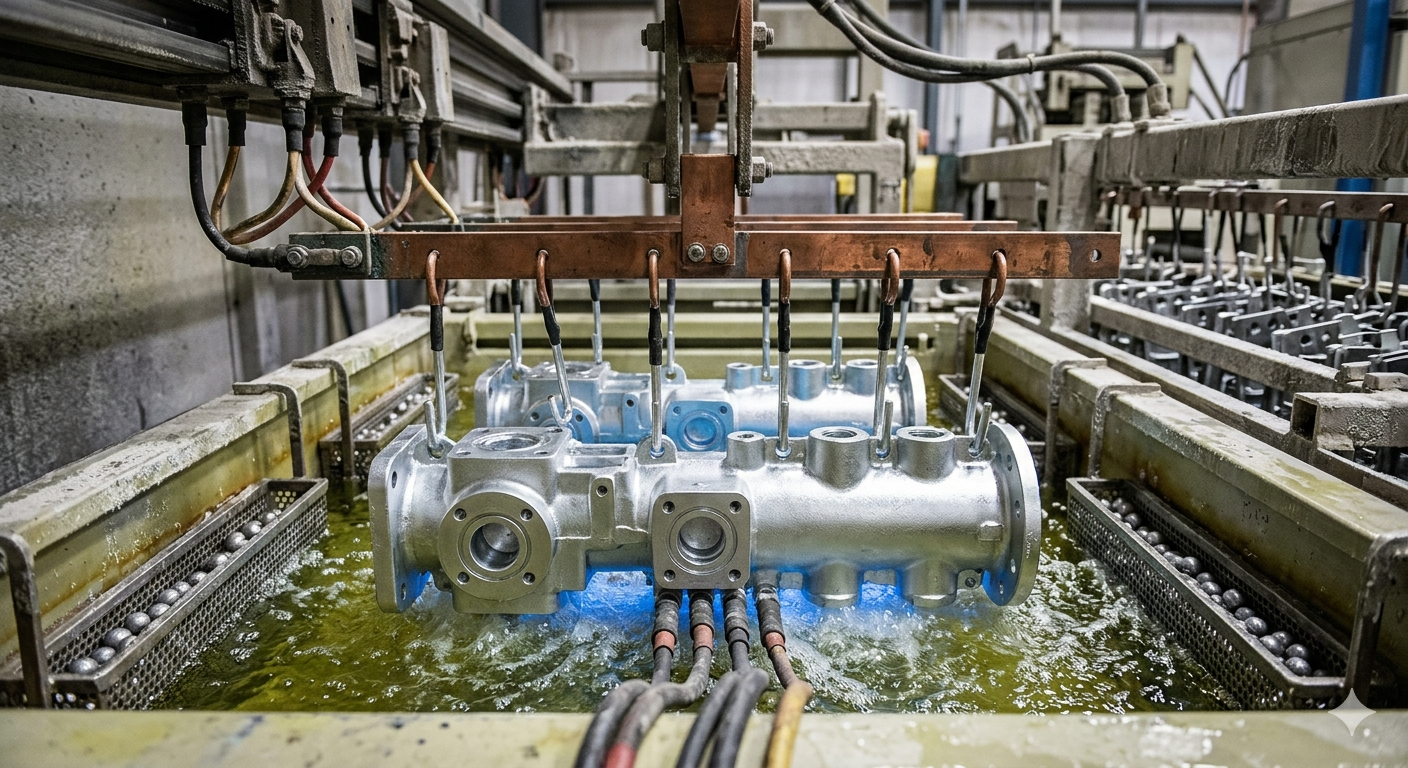
Zinc rack electroplating takes an entirely different approach. Parts are individually fixtured — mounted, hung, or clamped — onto metal racks using specialized tooling. These loaded racks are then submerged into the zinc plating bath, and electrical current is applied. Because each part is held individually and stationary throughout the process, rack plating offers capabilities that barrel plating fundamentally cannot provide.
Why Rack Plating Is the Only Option for Large Industrial Parts
- Parts too large or heavy for barrel tumbling are plated individually on racks
- Fragile or geometrically complex parts avoid mechanical damage from barrel contact
- Precise coating thickness control is achievable across entire part surfaces
- Deep recesses and complex internal geometries can be oriented for optimal plating access
- Parts with tight dimensional tolerances remain within specification throughout the process
How Zinc Rack Plating Specifically Prevents Corrosion on Large Parts
The corrosion protection delivered by zinc rack plating is not a single mechanism — it is a layered system of protection that begins with individual fixturing and extends through final passivation coating. Each stage of the process contributes to the finished part’s corrosion resistance.
1. Superior Surface Preparation Enables Full Zinc Adhesion
Corrosion protection begins before a single atom of zinc is deposited. The most critical variable in any electroplating process — and the one most responsible for coating failures in the field — is surface cleanliness. Zinc can only bond to the iron in the steel substrate. Any surface contamination that covers that iron — oil, weld flux, heat treat scale, mill scale, rust — will prevent proper zinc adhesion at that point.
At Plateco, parts pass through seven distinct cleaning stages before entering the plating bath, including heated soaps, acid pickling stages, and proprietary cleaning processes developed over decades. This level of cleaning is what transforms a potentially porous, poorly adhering zinc coat into a dense, continuous protective film with no gaps or weak points for corrosion to exploit.
The Key Insight: A zinc coating is only as effective as its adhesion to the substrate. A part with 0.0005″ of zinc that is 100% adhered will outperform a part with 0.001″ of zinc that has adhesion voids — because corrosion attacks voids first and uses them as pathways beneath the coating. Surface preparation is where corrosion protection is won or lost.
2. Precise Thickness Control Across the Entire Part Surface
In barrel plating, electrical current flows through a mass of tumbling parts from a central dangler to the outer edges of the barrel. This inherently creates variation in current density — parts at the outer tumble receive more zinc than those buried in the center. While rotation averages this out, a statistical “bell curve” of thickness variation is inevitable.
In rack plating, because each part is individually positioned and the current paths are engineered for that specific part, plating shops can exercise precise control over where electricity — and therefore zinc — goes. Plateco’s engineers use shields to block excess current from high-density areas like sharp corners (preventing over-plating), and auxiliary anodes to push current into deep recesses that would otherwise receive insufficient zinc coverage.
For large industrial parts with complex geometries — hydraulic cylinder bodies, valve housings, structural castings — this precision is what ensures that the entire surface receives protective zinc coverage, including the internal features, deep recesses, and threaded bores that are most vulnerable to corrosion in service.
Engineering & Work Order Creation
Plateco’s engineers analyze each new part — geometry, material, specification, and tolerances — and create a detailed work order specifying exact rack positioning, tooling selection, current parameters, and plating targets before a single part enters production.
Parts pass through heated soaps, acid pickling, and proprietary cleaning stages to remove all oil, scale, flux, and contaminants, leaving a pure iron surface ready for complete zinc adhesion with no weak points.
Each part is mounted to the rack using one of Plateco’s 80+ tooling types — many custom-designed — ensuring optimal positioning for current distribution, solution access to all surfaces, and zero mechanical contact damage.
Parts are submerged in either a chloride bath (superior throwing power for deep recesses and cosmetic finish) or alkaline bath (superior covering power for large surface areas with consistent thickness). Electrical current drives zinc deposition across all surfaces simultaneously.
A post-plate chromate conversion coating — trivalent clear, yellow, black, or olive drab — chemically bonds to the zinc surface, forming a secondary protective film that dramatically extends corrosion resistance before the zinc itself begins to sacrifice.
Each batch undergoes visual inspection, XRF coating thickness measurement, adhesion testing, and salt spray testing per ASTM B117. Parts are tested “as processed” at the Plateco facility — before material handling can degrade the coating — ensuring the most accurate corrosion resistance data available.
3. The Passivate Layer — A Second Line of Defense
Raw zinc, on its own, will begin to form white corrosion products (zinc oxides and carbonates) relatively quickly when exposed to moisture. This does not mean the steel is in danger — the zinc is simply doing its job and sacrificing. But for industrial components with cosmetic requirements or extended service life specifications, white corrosion appearing prematurely is a problem.
Chromate conversion coatings — also called passivates — solve this by creating a protective film over the zinc surface that significantly slows the formation of white corrosion, extending the period before the zinc begins sacrificing and therefore extending overall part life. Different passivate types provide different levels of protection and appearance:
- Trivalent Clear: A silver-toned finish offering standard corrosion protection; RoHS and REACH compliant
- Trivalent Yellow: Enhanced protection with a gold-yellow appearance; widely used in heavy industrial hardware
- Trivalent Black: Dark aesthetic finish for visible components; equivalent corrosion protection to yellow
- Hexavalent Black & Olive Drab: Available for applications where these legacy finishes are still specified
The combination of a well-adhered zinc coating at proper thickness, plus the right passivate for the application, is what allows zinc rack-plated parts to achieve 240, 500, or even 1,000+ hours of salt spray resistance per ASTM B117 testing.
Chloride vs. Alkaline Bath: Which Provides Better Corrosion Protection?
Plateco operates two distinct rack plating lines — one using a chloride zinc bath and one using an alkaline zinc bath. This is not redundancy; it is engineering precision. Each bath chemistry has different characteristics that make it superior for specific part geometries and corrosion protection requirements.
| Characteristic | Chloride Bath | Alkaline Bath |
|---|---|---|
| Best For | Deep recesses, complex geometry, cosmetic finish | Large surface area, long parts, uniform coverage |
| Throwing Power | ✔ Superior — penetrates deep into recesses | Good — suitable for open geometries |
| Covering Power | Good — some buildup at edges | ✔ Superior — consistent across large surfaces |
| Finish Appearance | Bright, brilliant, highly cosmetic | Matte to semi-bright |
| Edge Build-Up | More pronounced at sharp edges | ✔ Minimal — no zinc buildup on ends |
| Ideal Part Type | Complex castings, deep-recessed housings | Long shafts, flat plates, large structural parts |
For large industrial parts specifically, the alkaline bath often provides the more consistent overall corrosion protection — because covering power ensures that even the far ends and flat faces of a long, heavy part receive the same zinc thickness as the center sections, eliminating thin-spot vulnerabilities that could otherwise become corrosion initiation points.
Industries That Depend on Zinc Rack Plating for Large Part Corrosion Protection
Zinc rack electroplating is specified by major OEMs and manufacturers across virtually every heavy industrial sector. The common thread is always the same: large, heavy, or complex steel parts that must resist corrosion across demanding service environments.
🚜 Agricultural Equipment
Structural frames, hydraulic brackets, PTO housings, and implement mounting components from John Deere (JDM), Case CNH, and AGCO face constant soil, moisture, fertilizer, and weather exposure. Zinc rack plating to OEM specifications is mandatory.
🏗️ Heavy Construction
Caterpillar (CAT), Komatsu, and Volvo CE equipment contains large steel structural members, boom components, and hydraulic cylinder assemblies that require corrosion protection capable of surviving construction site mud, water, and road salt environments.
⚙️ Industrial Fluid Power
Parker Hannifin and other hydraulic and pneumatic system manufacturers specify zinc rack plating for cylinder bodies, manifold blocks, valve housings, and actuator components where corrosion at sealing surfaces directly causes system failure.
🚗 Heavy Truck & Automotive
Frame rails, suspension components, steering arms, and drivetrain brackets on commercial trucks and specialty vehicles require rack plating capable of handling large, heavy structural parts while meeting demanding corrosion resistance specifications.
⚡ Energy & Power Generation
Structural supports, mounting hardware, and enclosure components for wind turbines, electrical distribution infrastructure, and power generation equipment face outdoor exposure and require long-service-life corrosion protection.
🛡️ Defense & Government
Military vehicles, weapon system components, and government infrastructure hardware require zinc rack plating meeting MIL-SPEC and ASTM B633 standards, with olive drab and black passivate finishes for tactical applications.
OEM Specifications and Industry Standards
One of the most important practical aspects of zinc rack plating for large industrial parts is the ability to plate to exact OEM and industry specifications. These specifications define not just the zinc thickness, but the passivate type, corrosion hours required in salt spray testing, hydrogen embrittlement relief requirements, and dimensional tolerance impacts.
Plateco plates to a wide range of OEM and industry specifications, including:
- ASTM B633 — The foundational standard for electrodeposited zinc coatings on iron and steel; defines coating thickness classes (Fe/Zn 5, 8, 12, 25) and service condition classes
- John Deere JDM Standards — Specific zinc coating and passivate requirements for agricultural equipment components
- Case CNH Standards — Construction and agricultural equipment specifications
- Caterpillar (CAT) Standards — Heavy construction and mining equipment specifications
- Parker Hannifin Standards — Fluid power system component specifications
- MIL-SPEC and Government Standards — Defense and military application requirements
Meeting these specifications is not simply about applying the right thickness of zinc. It requires documented process controls, in-process quality monitoring, and post-process testing data that proves the coating performed to specification. This is why selecting a zinc rack plating partner with an ISO 9001:2015-certified quality system is critical for large industrial parts destined for OEM-specified applications.
Hydrogen Embrittlement: The Risk Unique to Rack Plated High-Strength Parts
There is one critical technical consideration for large industrial parts that are made from high-strength or hardened steel: hydrogen embrittlement. During the electroplating process, hydrogen ions generated in the plating bath can diffuse into micro-cracks and grain boundaries in the steel substrate. If these hydrogen atoms are not removed, they can cause the steel to become brittle and susceptible to sudden fracture under tensile load — a failure mode that does not reveal itself during manufacturing or quality inspection, but can be catastrophic in service.
Any steel component with a hardness of 40 HRC or greater — hardened fasteners, high-tensile bolts, spring steel components, case-hardened parts — requires hydrogen embrittlement relief baking after zinc electroplating, as specified in ASTM B633.
Plateco’s Approach to Hydrogen Embrittlement Relief: Rather than a standard industrial oven with doors, Plateco uses a proprietary conveyor belt oven over 90 feet in length. This system ensures all parts reach and hold the required temperature for the full required duration, with proper airflow throughout — something door ovens cannot guarantee. After baking, parts return to the production line for passivate re-application, since the baking process dehydrates the passivate coating.
How to Choose the Right Zinc Rack Plating Partner for Large Industrial Parts
Not all zinc plating facilities are capable of handling large industrial parts. The equipment requirements, tooling investment, engineering expertise, and quality systems needed to process parts weighing hundreds of pounds and measuring feet in length are substantial. When evaluating zinc rack plating partners for large component corrosion protection, the following factors matter most:
- Part size capability: Can the facility process your largest parts? Plateco handles parts up to 14.5 feet in length and 1,000 pounds
- Tooling library: More tooling options means better fixturing solutions for complex geometries. Plateco maintains 80+ tooling types, many custom-designed
- Dual bath chemistry: Both chloride and alkaline bath capabilities allow the best chemistry to be selected for each part type
- Engineering planning: A dedicated engineering team that creates detailed work orders for every new part ensures consistent results across production runs
- Quality systems: ISO 9001:2015 certification, in-process monitoring, and post-process salt spray testing with “as processed” data
- OEM specification experience: Documented capability to plate to your specific OEM or ASTM standard
- On-time delivery: A plating partner with 95%+ on-time delivery ensures your production schedule is not disrupted
The Bottom Line on Zinc Rack Plating and Corrosion Prevention
Corrosion is not a problem that resolves itself. For large industrial steel components, unprotected or inadequately protected surfaces degrade predictably — and the cost of that degradation compounds over the component’s service life in warranty claims, field failures, replacement costs, and reputational damage.
Zinc rack electroplating addresses the corrosion problem at the fundamental electrochemical level — replacing exposed iron with a sacrificial zinc layer that corrodes preferentially, protecting steel even through surface damage that would defeat any purely physical barrier coating. When properly applied through a precisely engineered process, with the right passivate for the application and the right testing to prove compliance, zinc rack-plated parts can achieve corrosion resistance measured in hundreds of hours of salt spray exposure — performance that translates directly into years of service life in real-world conditions.
For large industrial parts specifically, the individual fixturing that defines rack plating is not just a process detail — it is what makes complete, uniform, specification-compliant zinc coverage physically achievable on parts that barrel plating could never touch.
Ready to Protect Your Large Industrial Parts?
Plateco has been the zinc rack plating partner of choice for heavy industrial manufacturers since 1974. Tell us about your parts — size, material, specification, and volume — and our engineering team will determine the exact process to deliver the corrosion protection your components require.
Frequently Asked Questions
How thick is the zinc coating applied in rack plating, and how does thickness affect corrosion resistance?
Zinc coating thickness in rack electroplating is specified per ASTM B633 service condition classes: Class Fe/Zn 5 (0.0002″ minimum), Fe/Zn 8 (0.0003″), Fe/Zn 12 (0.0005″), and Fe/Zn 25 (0.001″). Thicker coatings provide longer protection before zinc sacrifice exposes the steel, but coating thickness alone does not determine corrosion performance — passivate type, surface preparation quality, and coating uniformity are equally important variables. Plateco verifies coating thickness using XRF fluorescence gauging on every batch.
Can zinc rack plating be applied to parts with complex internal cavities or threaded features?
Yes — rack plating’s individual fixturing allows parts to be oriented so that internal cavities are accessible to plating solution flow and air bubbles can escape. Plateco’s engineers use auxiliary anodes to drive current into deep recesses that would otherwise receive insufficient coverage. Threaded features require careful specification of the coating thickness to maintain thread fit — zinc deposition adds material to thread flanks, and overplating can cause fit issues. Plateco’s work order system specifies exact parameters for threaded features on every part.
What is the difference between trivalent and hexavalent chromate passivates for corrosion protection?
Both provide corrosion protection by forming a protective conversion film over the zinc. Hexavalent chromate (Cr6+) historically provided superior corrosion protection, particularly in yellow and olive drab finishes. However, hexavalent chromium is a regulated substance restricted under RoHS and REACH environmental compliance frameworks. Trivalent chromate (Cr3+) is the compliant alternative — Plateco’s trivalent passivate system delivers equivalent or superior corrosion protection to older hexavalent systems, and all trivalent coatings at Plateco are RoHS and REACH compliant, making plated parts suitable for any regulated market globally.
How does salt spray testing validate the corrosion resistance of zinc rack-plated parts?
Salt spray testing per ASTM B117 exposes plated parts to a continuous mist of 5% sodium chloride solution at 95°F in a controlled chamber. Results are measured in hours to first white corrosion (zinc oxide formation) and hours to first red corrosion (base steel rust). Plateco tests parts “as processed” at its own facility — before parts are shipped and subjected to handling degradation — providing the most accurate and reliable corrosion data available. Common specifications require 96, 240, or 1,000+ hours to first red corrosion depending on the application and service condition class.