

For anyone tasked with protecting steel components from the relentless creep of rust and corrosion, the “zinc family” of coatings is the first line of defense. Zinc is the ultimate sacrificial metal it is chemically more active than steel, meaning it will corrode first, effectively “taking the hit” to keep the underlying structure sound.
However, once you decide on zinc, you face a critical fork in the road: Zinc Plating (Electroplating) or Mechanical Galvanizing?
While both finishes use the same raw material, the way that zinc is applied to the steel changes everything from the part’s fatigue life and structural integrity to how well it fits into an assembly. At Plateco, we see firsthand how choosing the wrong process can lead to catastrophic part failure or unnecessary costs.
This guide will break down the fundamental differences between these two processes, helping you make an informed engineering decision for your next project.
1. The Fundamental Difference: How the Bond is Formed
The primary distinction between zinc plating and mechanical galvanizing lies in the “physics” of the application.
Zinc Plating: The Electrolytic Bond
Zinc plating is an electrochemical process. The steel parts are submerged in a chemical bath (the electrolyte) containing dissolved zinc. A direct electrical current (DC) is passed through the bath. The steel parts act as the cathode (negative charge), while zinc anodes (positive charge) dissolve into the solution.
The electricity drives the zinc ions out of the solution and onto the surface of the steel, forming a thin, molecularly bonded layer. This results in a smooth, shiny, and aesthetically pleasing finish.
Mechanical Galvanizing: The Kinetic “Cold-Weld”
Mechanical galvanizing uses zero electricity. Instead, it relies on kinetic energy. Parts are placed in a rotating drum with water, glass impact beads, and zinc powder.
As the drum tumbles, the glass beads act as millions of tiny hammers. When a bead strikes a zinc particle against the steel surface, it flattens it and “cold-welds” it to the part. This is a mechanical bond, built up layer by layer through physical force rather than chemical attraction.
Call (608) 524-8241 for expert guidance
2. Hydrogen Embrittlement: The Silent Killer of High-Strength Steel
If you are working with high-strength fasteners (Grade 8, 10.9, or higher), this section is the most important part of the article.
The Risk in Zinc Plating
During the electroplating process, water molecules in the chemical bath break down, releasing hydrogen atoms. These tiny atoms can migrate into the crystalline structure of high-strength steel. Once trapped inside, they create internal pressure that makes the metal brittle.
Under load, a hydrogen embrittled bolt can snap like glass often hours or days after installation without any visible warning. To mitigate this, electroplated parts must undergo a “bake cycle” (usually 4 to 24 hours at 400°F) immediately after plating to drive the hydrogen out. This adds significant cost and time, and even then, the risk is never truly zero.
The Solution in Mechanical Galvanizing
Because mechanical galvanizing does not involve an electrical current or the same acid-immersion chemistry, hydrogen is not generated during the process. There is no risk of hydrogen embrittlement. For engineers designing critical structural components or automotive suspension parts, mechanical galvanizing is the “safe” choice that eliminates the need for expensive post-plate baking.
3. Coating Thickness and Corrosion Resistance
In the world of corrosion protection, thickness is directly proportional to the “service life” of the part.
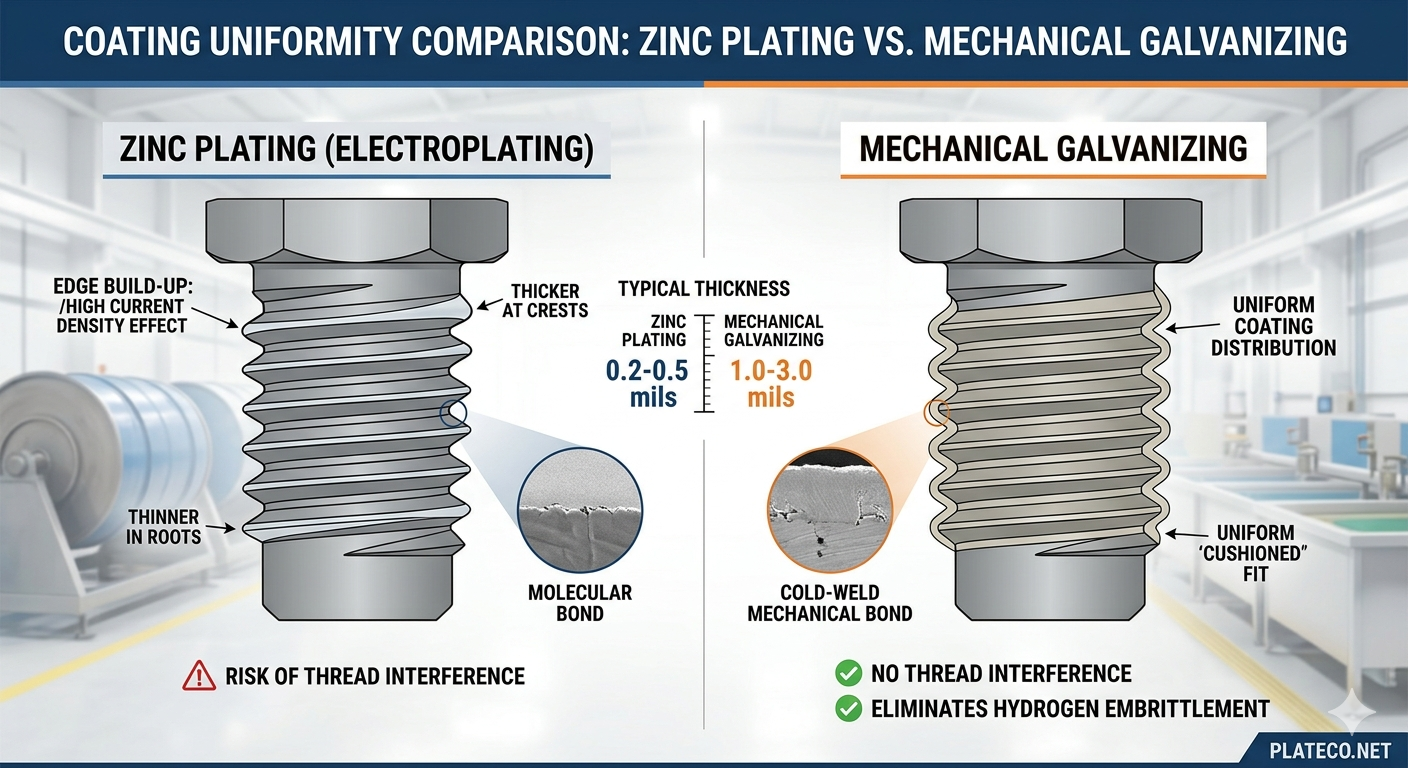
- Zinc Plating is typically a thin-film coating. Standard thicknesses range from 0.0002” to 0.0005” (5 to 12 microns). While this is enough for indoor electronics or office furniture, it will struggle in the rain, snow, or salt of an outdoor environment.
- Mechanical Galvanizing excels at heavy-duty protection. It can easily achieve thicknesses of 0.001” to 0.003” (25 to 75 microns) or more.
If your part needs to survive 500 to 1,000+ hours in a salt spray test, mechanical galvanizing is the superior option. It provides the heavy-duty protection of hot-dip galvanizing but without the messy “icicles” or heat-related issues.
4. Dimensional Accuracy and Thread Fit
When you apply a coating to a threaded bolt, you are adding “mass” to the peaks and valleys of the threads. This is where the two processes behave very differently.
The “High-Current” Problem of Plating
In electroplating, electricity naturally gravitates toward the “sharpest” points of a part the peaks of the screw threads and the corners of the hex head. Consequently, the zinc builds up more heavily on the peaks than in the valleys. This can cause “thread interference,” making it difficult or impossible to thread a nut onto the bolt without stripping the coating.
The Uniformity of Mechanical Application
In mechanical galvanizing, the glass beads can only hit what they can touch. Because the beads are physical objects, they cannot “over-apply” zinc to the peaks of the threads. In fact, the rolling action of the beads tends to keep the coating remarkably uniform across the entire geometry of the part. This ensures that even with a heavy 2.0 mil coating, your fasteners will still fit perfectly into their mating parts.
5. Aesthetics: Bright Blue vs. Matte Grey
For some industries, looks matter.
- Zinc Plating is the winner for aesthetics. It can be clear (blue-bright), yellow (iridescent), or even black. It has a metallic luster that is perfect for consumer goods, hand tools, and engine bays where the “wow factor” is important.
- Mechanical Galvanizing produces a functional, industrial finish. It is typically a matte, “pebble-grey” color. While it can be sealed with clear or yellow passivates to add some color, it will never have the mirror-like shine of an electroplated part.
Rule of thumb: If the part is visible to a customer on a luxury item, plate it. If the part is buried in a bridge, a tractor, or an industrial machine, mechanically galvanize it.
6. Temperature and Heat Distortion
Some parts are sensitive to heat. While neither of these processes reaches the 840°F temperatures of Hot-Dip Galvanizing, there are still differences to consider.
Zinc plating is an ambient-temperature process, but as mentioned, high-strength parts require a 400°F bake cycle. For some specialized spring steels or temper-sensitive alloys, even 400°F can be risky.
Mechanical galvanizing is a “true” room-temperature process. There is no molten metal and no post-plate baking. The physical properties of the steel you send to the shop are exactly the same as the properties of the steel that returns.
7. Environmental Impact
As manufacturers move toward “Green” initiatives, the environmental footprint of finishing is under the microscope.
- Zinc Plating requires large volumes of water and complex chemical baths that must be strictly monitored and treated. The use of cyanide (though decreasing) and hexavalent chromium in some legacy plating lines presents significant waste-management challenges.
- Mechanical Galvanizing is widely considered the “greener” alternative. It uses less energy (no massive rectifiers or heaters), fewer hazardous chemicals, and produces significantly less wastewater. At Plateco, we prioritize efficiency and environmental stewardship, making our mechanical lines some of the most sustainable in the industry.
8. Summary Comparison Table
| Feature | Zinc Plating (Electro) | Mechanical Galvanizing |
| Bond Type | Electrochemical | Kinetic (Cold-Weld) |
| Typical Thickness | 0.2 – 0.5 mils | 1.0 – 3.0+ mils |
| Hydrogen Embrittlement | High Risk (Requires Baking) | Zero Risk |
| Aesthetic | Bright, Shiny, Metallic | Matte Grey, Industrial |
| Thread Fit | Risk of build-up on peaks | Highly Uniform |
| Corrosion Resistance | Low to Moderate | High to Extreme |
| Heat Exposure | 400°F (If baking) | Ambient (No Heat) |
Which Process is Right for Your Project?
Choosing between these two isn’t about which is “better” it’s about which is right for the application.
Choose Zinc Plating if:
- The part is for indoor use with low moisture exposure.
- The aesthetic appearance is a primary requirement.
- The part is made of low-carbon steel (Grade 2 or 5) where embrittlement isn’t a factor.
- You are working with extremely tight tolerances where even 1.0 mil of coating is too much.
Choose Mechanical Galvanizing if:
- The part is for outdoor use, agriculture, or heavy infrastructure.
- The part is High-Strength (Grade 8 / 10.9 / 12.9) and failure is not an option.
- You need the corrosion protection of Hot-Dip but have precision threads that must fit.
- You want a more environmentally friendly finishing process.
- You want to eliminate the cost and lead-time of hydrogen relief baking.
Partnering with Plateco for Your Finishing Needs
At Plateco, we don’t believe in a one-size-fits-all approach. We specialize in both high-volume zinc plating and precision mechanical galvanizing because we know that every project has a unique set of stresses, environments, and requirements.
Based in Wisconsin, we have built our reputation on helping manufacturers solve their most difficult corrosion and embrittlement problems. Our team of experts is ready to review your blueprints and help you select the finish that balances cost-effectiveness with long-term performance.
Don’t leave your part’s integrity to chance. Whether you need the bright finish of electro-zinc or the rugged reliability of mechanical galvanizing, Plateco has the capacity and the expertise to deliver.